


An invitation letter for tourist visa template is a host-side letter that identifies the visitor, explains the purpose and dates of the trip, confirms where the visitor will stay, states who will pay for what, and points to the evidence behind those claims. It helps most in Canada, the UK, Australia, and many Schengen family-visit files. But it does not work the same way everywhere. According to IRCC, a letter of invitation can help, but it does not guarantee that Canada will issue the visa. UKVI says sponsor evidence should show what support is being provided, how, the relationship, the sponsor's funds, and lawful status in the UK. Australia's subclass 600 checklist asks for relationship proof, a host letter, host ID, and host funds if the host is paying. The U.S. State Department is the big exception: a letter of invitation or Affidavit of Support is not needed for a B-1/B-2 visitor visa.
That difference is why generic template pages cause so much confusion. Most search results give you one bland sample and pretend it fits every embassy. It does not. This guide gives you a clean base template, then shows how to adapt it for Canada, the UK, Australia, Schengen, and the United States so the letter matches the route you are actually filing. If you want the rest of the file checked after the host letter is drafted, Vidicy's How It Works page shows how the checklist, evaluation, and Atlas workflow fit together before you submit.
| Destination | Official stance | Current official facts | What your template should emphasise |
|---|---|---|---|
| Canada | A letter of invitation can help, but does not guarantee approval | Visitor visa starts at CAN$100; biometrics cost CAN$85 for one person or CAN$170 for a family applying together | Identity of both parties, relationship, stay address, payment split, and exit date |
| United Kingdom | Sponsor evidence must show what support is provided, how, the relationship, sponsor funds, and legal UK status | Standard Visitor visa is GBP 135 from 8 April 2026, allows up to 6 months, can be filed 3 months early, and usually takes 3 weeks | Exact support promised, realistic dates, sponsor status, and proof the visitor still leaves |
| Australia | Tourist-stream host letters matter when visiting friends or family; Sponsored Family cases may require Form 1149 | Form 1149 sponsors must be 18+, settled in Australia, and a bond is generally AUD 5,000 to AUD 15,000 per person if requested | Relationship proof, host ID, host funds, and whether the case is Tourist stream or Sponsored Family |
| United States | Visitor visa applicants qualify on their own ties abroad, not on host assurances | B visitor visa application fee is $185 | Keep the host note secondary; your own funds, purpose, and return ties matter more |
| Schengen | The EU requires proof of purpose, accommodation, and means; host-letter formats still vary by mission | Adult short-stay fee is EUR 90; apply no earlier than 6 months and at least 15 days before travel | Match the letter to the exact consulate checklist instead of using a generic embassy-neutral version |
At a glance
- Use this page for a base tourist-visa host-letter template before you customize it for the actual country and support pattern.
- The template should identify the host, visitor, trip dates, stay address, payment split, and exit plan in plain language.
- It works best for Canada, the UK, Australia, and many Schengen host-based trips, but the U.S. does not treat it as required visitor-visa evidence.
- If the file also needs funding or work-ties proof, keep those in separate sponsor, bank, and employment documents instead of overloading the host letter.
Table of Contents
- What an invitation letter for tourist visa applications actually does
- Invitation letter for tourist visa template
- What the host should attach with the template
- How to adapt the template for each destination
- Common mistakes that weaken tourist visa invitation letters
- Official sources
- FAQ
- Conclusion
What an invitation letter for tourist visa applications actually does
The fastest way to use an invitation letter for tourist visa template correctly is to separate it from the other letters people confuse with it.
| Document | Who writes it | What it proves | When to use it |
|---|---|---|---|
| Invitation letter for tourist visa | The host in the destination country | Who is inviting the visitor, where they will stay, why the visit makes sense, and what support is offered | Family visit, friend visit, or host-backed holiday |
| Sponsor letter | The person paying or supporting the trip | What financial or practical support the sponsor will provide | When the host is paying for housing, meals, or part of the trip |
| Cover letter / explanation letter | The applicant | How the whole application fits together | When the applicant needs to explain itinerary, funds, prior refusals, or unusual facts |
| Employment letter | The employer | Current work, salary, leave approval, and return-to-work expectation | When work ties help prove the visitor will leave after the trip |
In practice, the invitation letter often overlaps with sponsor evidence. The difference is not the title. The difference is the job the document is doing.
- If the host is mainly proving relationship and accommodation, the letter behaves like an invitation letter.
- If the host is mainly proving financial support, it behaves like sponsor evidence.
- If the applicant still needs to explain why the trip makes sense overall, that belongs in the applicant's own cover letter.
That is why the strongest host letters are short, factual, and easy to verify. They should tell the officer:
- who the host is
- who the visitor is
- what the relationship is
- what dates the visit covers
- where the visitor will stay
- what the host will pay for
- which documents prove those claims
If the host is paying but the applicant's own finances or return-home story are weak, fix those separately with the Bank Statement for Visa: What Officers Check guide and the Employment Letter for Visa: Sample + Checklist guide. A host letter should support the file, not carry the whole file by itself.
Invitation letter for tourist visa template
There is no one universal government form for every tourist invitation letter. The safest version is a short signed letter that mirrors the destination country's own evidence rules.
Use this base template, then adjust the highlighted parts in the country section below:
[Host full name]
[Full address]
[Phone number]
[Email address]
[Date]

To Whom It May Concern,

I am writing to invite [visitor full name], passport number [passport number], born on [date of birth], who is my [relationship], to visit me from [arrival date] to [departure date].

The purpose of the trip is [tourism / family visit / short holiday / event / graduation]. During this visit, [visitor name] will stay with me at [full address].

I am currently [citizen / permanent resident / legal resident / visa holder] of [country] and I live at the address above. I work as [job title] at [employer], if applicable.

During this visit, I will provide [accommodation only / accommodation and meals / accommodation and local transport / partial financial support / full financial support]. [Visitor name] will pay for [flights / personal expenses / insurance / other items].

We plan for [visitor name] to leave on or before [departure date] and return to [home country], where [he/she/they] currently [works/studies/lives].

Attached are copies of my [passport or residence proof], [address proof], [financial evidence if I am paying], and [relationship documents if relevant].

I confirm that the information in this letter is true and that the support described above is genuine.

Sincerely,

[Host name]
[Signature]
How to adapt the sample without weakening it
- If the host is not paying for flights, say that clearly instead of making the support sound broader than it is.
- If the visitor is staying with you but paying their own daily costs, make the split explicit.
- If several relatives are travelling, list each visitor separately.
- If the route is U.S. B-1/B-2, treat the host letter as optional background evidence, not the centre of the case.
- If the route is Canada, the UK, or Australia, match the letter to the exact official checklist rather than copying a U.S. sample.
If you already know the country, use the dedicated route guides instead of forcing a generic letter into the wrong legal frame:
- Invitation Letter for Visitor Visa Canada
- Invitation Letter for UK Visa
- Invitation Letter for Australian Tourist Visa
- How to Write an Invitation Letter for US Visa
What the host should attach with the template
The letter matters less than the proof behind it. Across the official pages reviewed for this article, the same evidence groups repeat.
| Attachment | Why it matters | Common failure |
|---|---|---|
| Host passport or residence proof | Shows the host is real and, where relevant, legally in the destination country | Letter names a host but gives no status proof |
| Proof of address | Confirms where the visitor will stay | The letter mentions accommodation but does not back up the address |
| Host financial evidence | Supports any promise to pay for lodging, meals, or local costs | Letter says "I will pay" but no bank or income evidence follows |
| Relationship evidence | Shows the host and visitor really know each other | Relationship is mentioned but never proved |
| Applicant itinerary | Helps the stay dates match the rest of the file | Letter says 10 days, form or bookings say 21 |
| Applicant return-home evidence | Shows the visit is temporary | Host letter tries to replace the visitor's own work or family ties |
For most tourist routes, the safest supporting pack is:
- host ID or residence proof
- recent bank evidence if the host is paying
- relationship proof if it is a family or close-friend visit
- address proof if the visitor will stay with the host
- the applicant's own passport, itinerary, bank statements, and return-tie documents
That last bullet matters most. A host letter does not solve a weak applicant story by itself. If the whole package still feels fragile, compare it against the route checklist first: Canada visa requirements, UK visa requirements, Australia visa requirements, US visa requirements, and Schengen visa requirements.
How to adapt the template for each destination
This is where most template pages become inaccurate. The same search term hides different official rules.
Canada: include both parties, the payment plan, and the exit date
Canada's rules are the clearest. IRCC says that if your friend or family member needs a visitor visa, you may provide a letter of invitation, and the letter can help, but it does not guarantee that the visitor will get a visa. The dedicated IRCC invitation-letter page then lists what the host should include about the visitor: full name, date of birth, address and telephone number, relationship, purpose of trip, length of stay, where the visitor will stay, how they will pay for things, and when they plan to leave Canada. It also lists what the host should include about themselves, including status in Canada and proof of that status.
The current Canada visitor visa page also says the visa fee starts at CAN$100, and IRCC's biometrics page says biometrics cost CAN$85 for an individual or CAN$170 for a family applying together. Those are not template details, but they shape the broader timing and evidence plan because the file usually moves through both steps together.
For Canada, your template should do four things clearly:
- identify the visitor and the host in full
- explain the stay address and trip dates
- explain the payment split honestly
- give a believable exit plan
That is why the Canadian version should rarely be a one-line "I invite my cousin to visit" note. IRCC wants enough detail that the invitation letter matches the rest of the application.
Canada.ca links this official application-completeness video from its own video page:
If your case is Canada-specific, use the dedicated Invitation Letter for Visitor Visa Canada guide after you finish this generic template.
United Kingdom: write the letter like sponsor evidence, not a promise of approval
The UK is stricter than most template pages admit. The updated UKVI guide says that if someone else is providing your travel, maintenance or accommodation, you should provide evidence showing:
- what support is being provided
- how the support is being provided
- that the sponsor has enough funds to support themselves and their dependants
- the relationship between visitor and sponsor
- that the sponsor is legally in the UK, where relevant
The live Standard Visitor application page gives the timing and fee context: the earliest you can apply is 3 months before travel, the fee is GBP 135 as of 8 April 2026, the maximum stay is 6 months, and you will usually get a decision within 3 weeks once you have applied, proved your identity, and provided documents.
That means a UK invitation letter should be narrow, factual, and document-led. It should not try to "guarantee" that the visitor will leave. It should show exactly what support the host will provide and which evidence proves it.
GOV.UK also links an official Applying for a UK visitor visa video from its support-video page if you want a process refresher after drafting the letter.
If your route is the UK, the dedicated Invitation Letter for UK Visa article goes deeper into sponsor evidence and UKVI's "less useful documents" list.
Australia: decide first whether this is Tourist stream or Sponsored Family stream
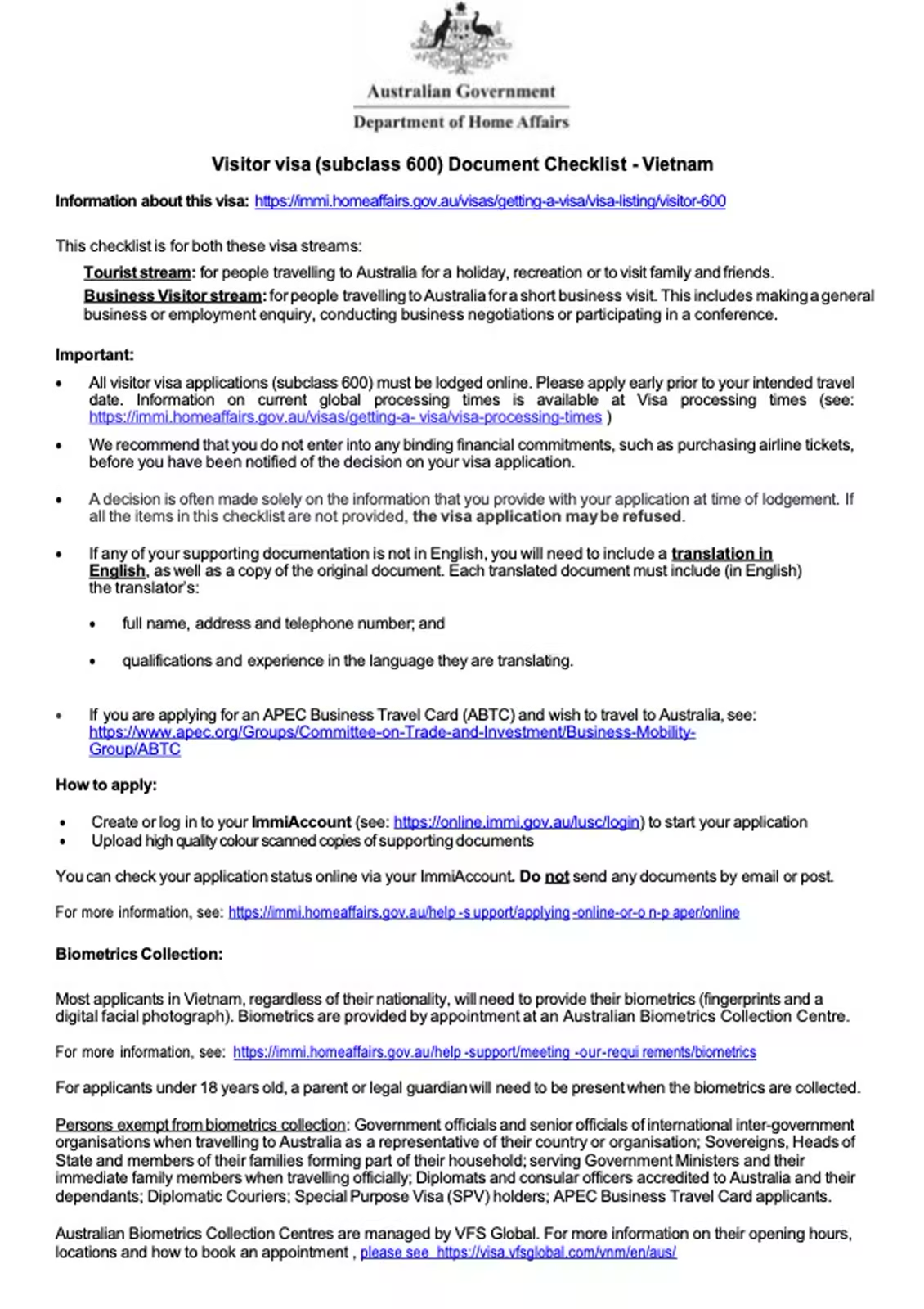
Australia is where many generic templates fail hardest. The Ho Chi Minh City subclass 600 visitor checklist says that if a Tourist stream applicant intends to visit a relative, partner or friend in Australia, they should provide:
- evidence of the relationship
- a letter of invitation from the person they intend to visit
- evidence of the host's personal funds and income if the host is paying
- a copy of the host's passport identity page or other identification, such as a driver's licence
The same checklist also says all subclass 600 applications must be lodged online, that a decision is often made only on the material provided at lodgement, and that missing checklist items can lead to refusal.
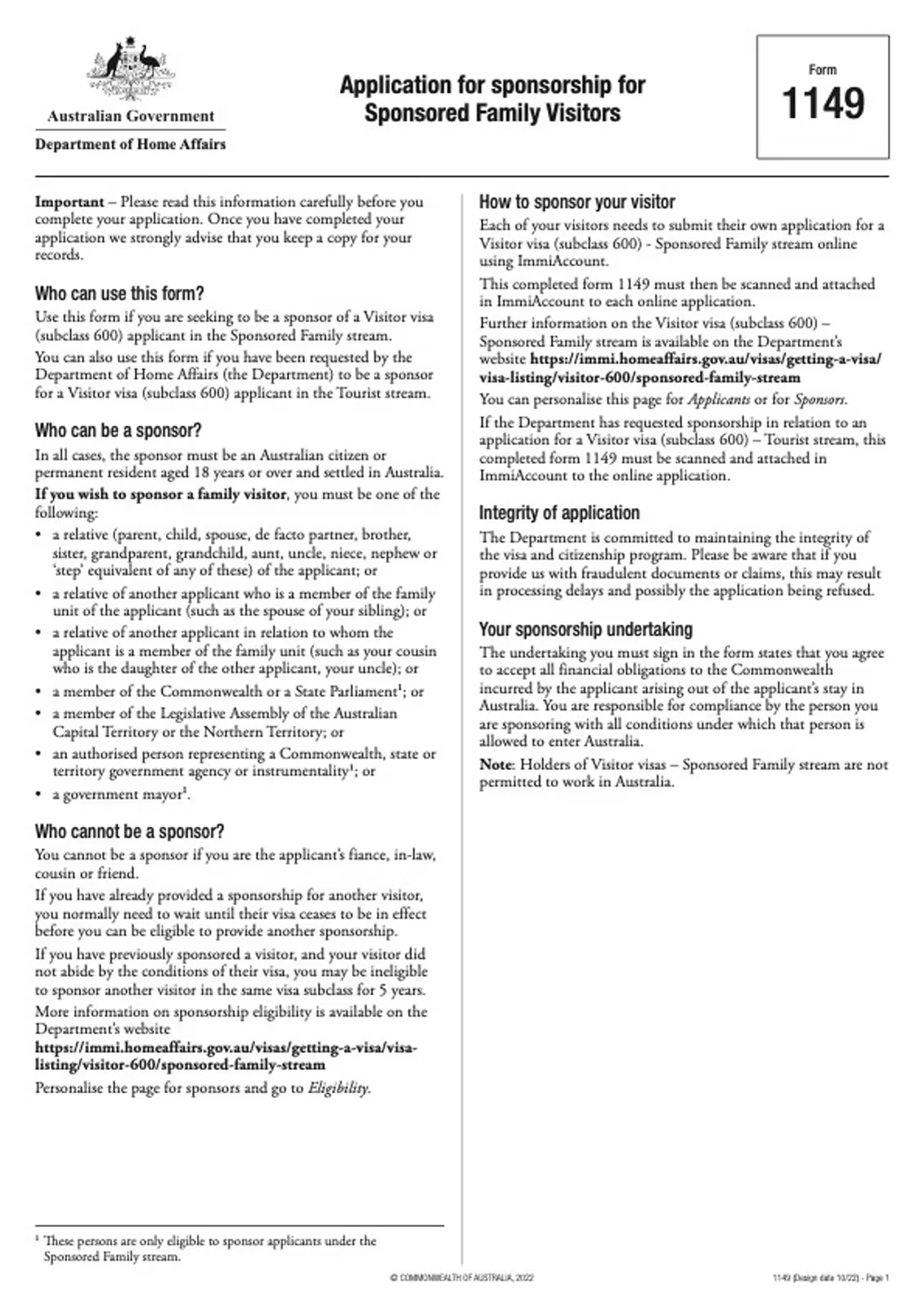
But Australia has a second layer that generic articles often miss: Form 1149. The Home Affairs sponsorship form says that in all cases the sponsor must be an Australian citizen or permanent resident aged 18 years or over and settled in Australia. It also says that a fiance, in-law, cousin, or friend cannot be a sponsor under the Sponsored Family stream, and that a requested security bond is generally between AUD5,000 and AUD15,000 per person. The same form warns that sponsorship does not guarantee the grant of the visa.
So the Australia rule is:
- use a normal host invitation letter for ordinary Tourist stream family-or-friend visits
- use Form 1149 only when the case is actually Sponsored Family stream or Home Affairs specifically asks for sponsorship in a Tourist stream file
For processing context, the Home Affairs visitor visa program report for the quarter ending 30 June 2025 shows 12 calendar days at the median and 18 calendar days at the 75th percentile for Tourist Visitor grants overall. That is not a promise, but it is a good reminder that a thin host letter can waste time you do not really have.
If the case is Australia-specific, use the dedicated Invitation Letter for Australian Tourist Visa guide after this base template.
United States: the host letter is optional, and your own ties matter more
The U.S. rule is different enough that many non-lawyer template sites get it wrong. The State Department's visitor visa page says applicants may be asked for additional evidence of the purpose of the trip, intent to depart, and ability to pay trip costs. But it also says that applicants must qualify based on their ties abroad, not on assurances from U.S. family or friends, and that a letter of invitation or Affidavit of Support is not needed to apply for a visitor visa. The same page lists the current visitor visa application fee at $185.
For a U.S. B-1/B-2 file, that means the invitation letter is optional context at most. It can support the story if you are visiting relatives, but it is not the centre of the case. Your DS-160 answers, funds, itinerary, prior travel, interview answers, and home-country ties matter more.
If you are on the U.S. route, switch to the route-specific How to Write an Invitation Letter for US Visa guide once you have the base structure in place.
Schengen: use the template only as a base, then check the exact mission checklist
For Schengen files, the European Commission's application page gives the framework: you must apply at least 15 days before travel, no earlier than 6 months before travel, and pay EUR 90 as an adult short-stay applicant. The same EU-level process also requires supporting documents for the purpose of the trip, accommodation, and sufficient means of subsistence. But host-letter formats and notarisation rules still vary by mission, member state, and visa centre.
That is why a Schengen host letter should start from the generic template above, then be checked against the exact consulate checklist for the country you are applying to. In practice, that means you should confirm whether the mission wants only a simple host letter, a municipal invitation form, proof of accommodation, or additional sponsorship evidence.
If the destination is Schengen, the safer next step is the route-level Schengen visa requirements guide plus the checklist on Schengen visa document requirements, not a country-neutral template copied word for word.
Common mistakes that weaken tourist visa invitation letters
The common failure pattern is not "forgot the letter." It is "the letter says one thing and the rest of the evidence says something else."
| Mistake | Why it hurts | Better move |
|---|---|---|
| Vague wording such as "I will support them" | Officers want to know what support is being provided and how | State exactly what the host pays for and what the visitor pays for |
| No host status evidence | Canada, UK, and Australia all expect some proof behind the host identity | Attach passport, residence proof, or official ID |
| Dates do not match the form | Officers compare the letter with the online application, itinerary, and leave letter | Keep one exact set of travel dates everywhere |
| Copying the wrong country format | U.S., UK, Canada, and Australia treat host letters differently | Start with the base template, then adapt by route |
| Trying to use the host letter to replace return-home evidence | Visitor visas still rely on the applicant's own ties | Add work, study, family, or property evidence in the applicant's name |
| Overpromising | A host cannot guarantee approval or future compliance | Keep the language factual and limited |
If you are trying to fix a weak overall pack, not just the invitation letter, the better follow-up reads are how to prepare visa application documents and why visa applications get rejected because of document mistakes.
Related guides
If you're building the rest of the application pack, these companion guides help:
- Invitation Letter for Visa: Country Rules + Sample
- Invitation Letter for Visa Canada: Rules + Samples
- Sponsor Letter for Tourist Visa: Sample + Guide
- Visa Cover Letter Format: Tourist Sample + Official Tips
- Employment Letter for Visa: Sample + Checklist
Official sources
- IRCC Help Centre: How do I help a family member or friend apply to visit Canada?
- Canada.ca: Letter of invitation for visitors to Canada
- Canada.ca: Visitor visa (temporary resident visa)
- Canada.ca: Biometrics - how to give your fingerprints and photo
- Canada.ca video page: Save Time - Send a Complete Application
- GOV.UK: Visiting the UK - guide to supporting documents
- GOV.UK: Apply for a Standard Visitor visa
- GOV.UK: Home Office immigration and nationality fees, 8 April 2026
- GOV.UK support video page: Applying for a UK visitor visa
- U.S. Department of State: Visitor Visa
- Department of Home Affairs: Form 1149 - Application for sponsorship for Sponsored Family Visitors
- Australian Consulate-General Ho Chi Minh City: Visitor visa (subclass 600) Document Checklist - Vietnam
- Department of Home Affairs: Visitor visa program report 30 June 2025
- European Commission: Applying for a Schengen visa
FAQ
Is an invitation letter required for every tourist visa application?
No. It depends on the country and the case. Canada, the UK, Australia, and many Schengen family-visit files often benefit from one, but the U.S. State Department says a letter of invitation is not needed for a B visitor visa. Always check the route-specific official checklist before you rely on one.
What should an invitation letter for tourist visa applications include?
At minimum, include the host's identity and address, the visitor's identity, the relationship between both parties, the purpose of the trip, arrival and departure dates, where the visitor will stay, who will pay for which costs, and a short list of the documents that back up those claims.
Does the host need to notarize the letter?
Not usually as a universal rule. Some destinations or specific visa offices may ask for extra formality, but Canada and the UK do not publish a blanket tourist-visa notarisation rule for normal hosted visits. For Schengen and special Australia or business cases, check the exact mission or stream requirements instead of assuming.
Can a tourist visa invitation letter replace the applicant's bank statements?
No. A host letter can support the accommodation or payment story, but it does not replace the visitor's own financial evidence, work ties, travel history, or return-home evidence. Officers still assess whether the whole file makes sense, not whether one person promised to help.
Does the United States use the same invitation-letter logic as Canada or the UK?
No. The U.S. State Department says visitor visa applicants qualify on their own ties abroad, not on assurances from U.S. family and friends, and that a letter of invitation or Affidavit of Support is not needed to apply. Canada and the UK treat host letters more seriously as supporting evidence.
What is the biggest mistake people make with tourist visa invitation letters?
The biggest mistake is treating the host letter like a magic document. Weak letters are usually vague, unsupported, or inconsistent with the form, itinerary, bank statements, and employment proof. The strongest letters are short, factual, and fully aligned with the rest of the file.
Conclusion
An invitation letter for tourist visa template only works when it matches the destination country's rules and the rest of the evidence pack. The safe pattern is simple: identify both parties clearly, explain the purpose and dates, state the accommodation and payment split honestly, and attach proof that backs every important claim.
If you are ready to stress-test the full application, not only the host letter, start with Vidicy's How It Works page and then create your account so you can review the checklist, supporting documents, and weak spots together before the embassy sees them.