


If you need an invitation letter for UK visa purposes, the shortest accurate answer is this: for most Standard Visitor cases, the letter is supporting evidence, not a magic standalone form. According to the UKVI guide to supporting documents updated on 25 February 2026, sponsor evidence should show five things: what support is being provided, how it will be provided, that the sponsor has enough funds, the relationship between visitor and sponsor, and that the sponsor is legally in the UK. The Home Office fees table effective 8 April 2026 lists the Standard Visitor visa fee at GBP 135. The GOV.UK visitor route pages still say the route allows stays of up to 6 months, can be filed up to 3 months before travel, and usually takes 3 weeks for a standard decision outside the UK.
That framing matters because many ranking templates tell readers to "just attach an invitation letter." UKVI's live guidance is stricter than that. A strong letter only works when it matches the rest of the file: passport details, address, travel dates, trip cost, host status, and home-country ties. If you want the route-level version first, use Vidicy's UK visa document checklist or the fuller UK visa checklist for 2026. If you are comparing UK host-letter rules with Canada, Australia, Germany, or the U.S. for a family visit, use the cross-country family invitation letter for visa guide after this route-specific version. If the missing piece is the applicant's explanation rather than the host's, use this companion guide instead: Cover Letter for UK Visa: Sample + What UKVI Checks. If the host's main job is proving who pays and how, not just who is inviting the visitor, use the dedicated sponsor letter for visitor visa UK guide. If you want the broader cross-country version of that same problem, Sponsor Letter for Visa: Sample + Country Rules compares the UK approach with Canada, Australia, and the U.S.
| Item | Current UKVI position | What it means for your letter |
|---|---|---|
| Standard Visitor fee | GBP 135 | State clearly who is paying the fee and trip costs. |
| Standard stay length | Up to 6 months | Keep the travel window realistic and specific. |
| Earliest application point | 3 months before travel | Date the letter close to the real trip, not a year early. |
| Standard processing time | 3 weeks | Avoid treating flight reservations as a guaranteed schedule. |
| Sponsor evidence test | 5 proof points in UKVI guidance | Your letter should cover each point, then back them with documents. |
Table of Contents
- Is an invitation letter required for a UK visa?
- What a UK visa invitation letter should include
- Invitation letter for UK visa sample
- Supporting documents to send with the letter
- Mistakes that weaken a UK invitation letter
- How to apply after the letter is ready
- Official sources
- FAQ
- Conclusion
Is an invitation letter required for a UK visa?
For a normal visit to see friends or family, UKVI does not publish a separate mandatory invitation-letter form that every applicant must upload. Instead, the official supporting-documents guide says that if someone else is providing your travel, maintenance or accommodation, you should provide evidence covering the sponsor points listed above.
Inference from UKVI guidance: for most family and friend visits, an invitation letter is usually helpful sponsor evidence, not a substitute for the rest of the application.
That distinction matters because UKVI separately describes cases where an invitation letter is more explicit. If you are attending a business event or conference, the organiser should provide a letter of invitation. If you are coming for a permitted paid engagement, UKVI says you need an invitation letter showing why you are carrying out the engagement and how long it will be for. If you are actually travelling to marry or register a civil partnership, you should stop and check the Marriage Visitor route instead of using a normal Standard Visitor template.
In practice, that creates four common scenarios:
- Family or friend visit: the letter explains accommodation, relationship, and sponsor support.
- Business visitor trip: the organiser's letter explains the event, meetings, or conference.
- Permitted paid engagement: the invitation letter is closer to a formal requirement.
- Wrong route risk: the letter will not fix an application filed under the wrong visa category.

What a UK visa invitation letter should include
UKVI gives you the raw evidence rules on two different pages. The sponsor guide explains the five sponsor proof points, and the online Standard Visitor application page asks for practical trip details such as where you will stay, how much the visit will cost, your annual income, and in some cases your travel history for the last 10 years. Turn those rules into one clean letter.
Use this checklist before you draft
| Section | What to include | Why UKVI cares |
|---|---|---|
| Date of letter | The date you signed the letter | A current letter is more credible than an old recycled template. |
| Host identity | Host full name, UK address, phone, email, and immigration status | UKVI wants to know the sponsor is real and legally in the UK. |
| Visitor identity | Visitor full name, date of birth, passport number, and home address | This lets the caseworker match the letter to the application. |
| Relationship | How you know each other and how long you have known each other | UKVI asks for evidence of the relationship. |
| Travel window | Planned arrival and departure dates | Dates must match the online form, leave letter, and itinerary. |
| Accommodation | Exact address where the visitor will stay | This shows how the visit will be maintained in practice. |
| Financial support | What the host will pay for and an estimated amount | UKVI wants to know what support is provided and how. |
| Return context | A short sentence about the visitor's work, studies, family, or property back home | This supports the genuine-visitor test. |
| Attachments | List of sponsor ID, address proof, bank evidence, and relationship proof | The letter works best when its claims are backed by evidence. |
Keep the promise of the letter narrow
According to the official sponsor guide, the point is not to promise that the visitor "will definitely return." The point is to explain the visit honestly and show how it will be supported. A good letter is specific, calm, and boring in the best possible way.
That usually means:
- one clear purpose of visit
- one realistic stay address
- one consistent payment story
- one set of dates that matches every other document
If your visitor also needs strong work-tie evidence, pair the invitation letter with a proper Employment Letter for UK Visa: Sample + UKVI Checks. If you are still assembling the full pack, how to prepare visa application documents is the better companion before you upload anything.
Invitation letter for UK visa sample
The safest template is one that mirrors the UKVI evidence rules instead of copying a random blog paragraph. Use this as a starting point, then replace every placeholder with real facts that match the rest of the file.
[Host full name]
[Full UK address]
[Phone number]
[Email address]
[Date]

To UK Visas and Immigration,

I am writing to invite [visitor full name], passport number [passport number], who is my [relationship], to visit me in [city], United Kingdom, from [arrival date] to [departure date].

I am a [British citizen / settled resident / visa holder] living at [full address]. During this visit, [visitor name] will stay with me at the address above.

The purpose of the visit is [family visit / tourism / event / graduation / short holiday]. During the trip, we plan to [brief itinerary or event details].

I will provide [accommodation only / accommodation and meals / accommodation and local transport / full financial support]. The estimated cost I will cover is [amount and currency]. This support does not affect my ability to maintain myself or my dependants.

[Visitor name] will return to [home country] on or before [date]. [He/She/They] currently [works/studies/lives] at [brief home-country tie].

Attached are copies of my [passport or residence document], proof of address, and supporting financial evidence. I confirm that the information in this letter is true.

Sincerely,

[Host name]
[Signature]
How to adapt the sample
- If the host is not paying for flights or daily expenses, say that clearly.
- If the visitor is attending a conference or business meeting, name the event and add the organiser's invitation.
- If several relatives are applying, list each person separately instead of writing one vague group sentence.
- If any document is not in English or Welsh, UKVI says the translation should include the translator's full name, signature, contact details, and the date.
UKVI also publishes its own short visitor-visa walkthrough on GOV.UK. The video below comes from the official "Applying for a UK visitor visa" page and is useful once the letter is ready:
Supporting documents to send with the letter
The letter matters, but UKVI decides the case on the full file. The sponsor guide is blunt about what is useful and what is not.
Stronger supporting documents
For most family or friend visits, the host should send:
- a copy of the host's British passport or UK residence document
- recent financial evidence showing the host can support the visit if they say they will pay
- relationship evidence such as birth certificates, marriage certificates, or other records that explain how the parties are connected
- address evidence that is more meaningful than a single utility bill, such as a tenancy agreement or ownership record where available
The visitor should usually upload:
- passport and previous travel evidence
- bank statements and other financial records
- employer or school evidence
- trip plan details that match the stated purpose
UKVI's online application page also asks who you are staying with, what you will pay, and may ask for travel history covering the last 10 years. That is why the invitation letter and the application form have to tell the same story. If the host letter is ready but the financial proof still feels weak, use this UK visitor visa bank statement requirement guide before you upload the sponsor statements and applicant bank history.
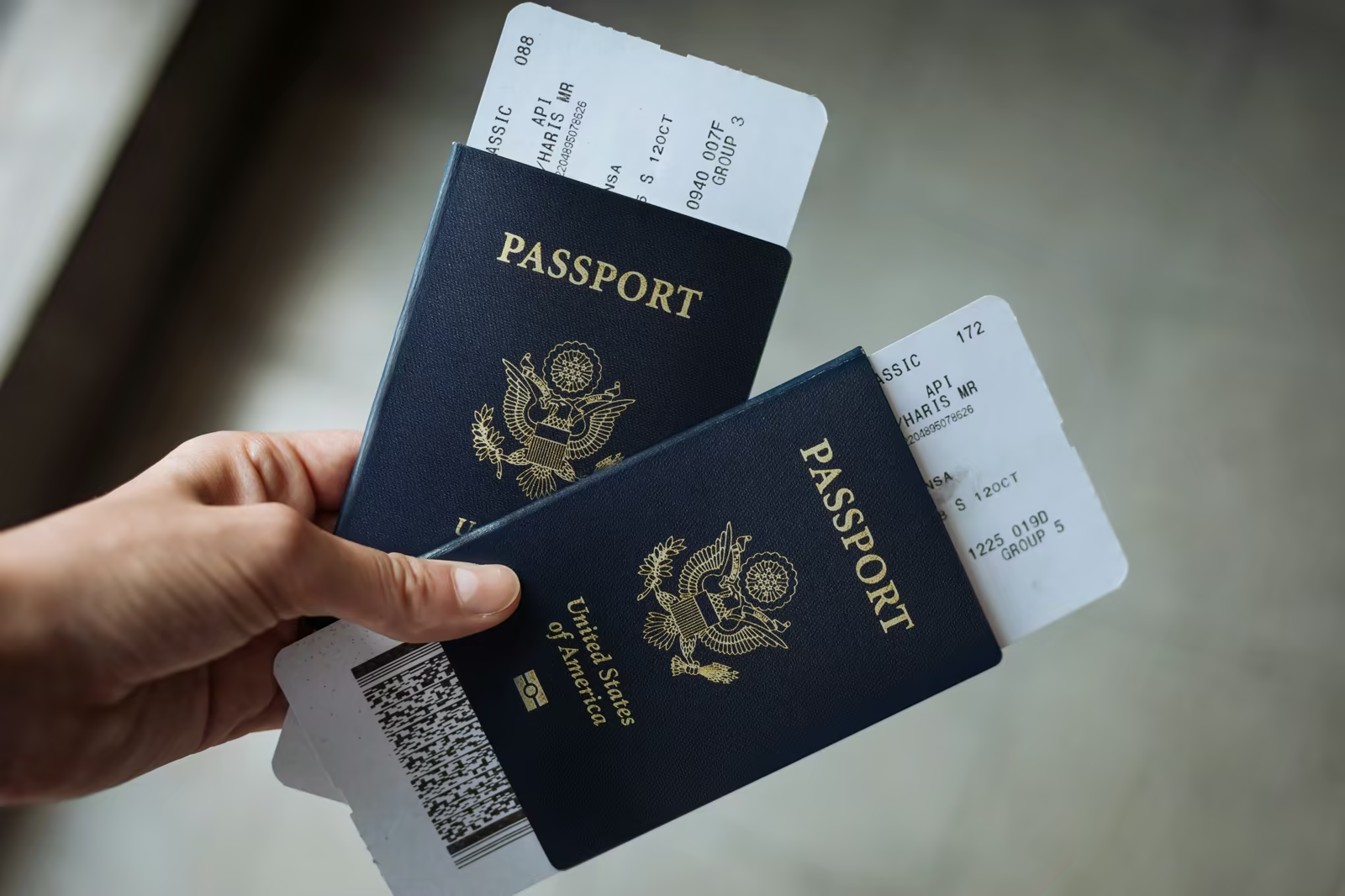
Documents UKVI says are less useful
One of the biggest gaps in competing articles is that they skip the official "less useful evidence" list. UKVI specifically says these documents often carry less weight:
- hotel bookings
- flight bookings
- bank statements or letters that are more than 1 year old
- sponsor utility bills
- council tax bills
- driving licences
- notarial certificates
- photographs
That does not mean you can never include a hotel reservation or a photo. It means you should not rely on them as the core proof that the visit is genuine or financially supported. If your whole file leans on weak evidence, the invitation letter will not rescue it.
If your route is actually an employer-backed case rather than a host visit, use the separate visa sponsorship letter guide instead of recycling a visitor template.
Mistakes that weaken a UK invitation letter
The common failure pattern is not "forgot the letter." It is "the letter says one thing and the rest of the evidence says something else."
| Mistake | Why it hurts | Better move |
|---|---|---|
| Vague wording such as "I will support them" | UKVI wants to know what support is being provided and how | State exactly what the host pays for and what the visitor pays for |
| No host status evidence | The sponsor guide asks for proof the sponsor is legally in the UK | Attach a passport or residence document copy |
| Dates that do not match the form | Caseworkers compare the letter with the online application | Keep one exact set of travel dates everywhere |
| Relying on hotel or flight bookings alone | UKVI lists them as less useful evidence | Use stronger finance, relationship, and status evidence |
| Confusing a visitor invitation with a sponsorship or marriage route | Wrong route problems cannot be solved by better wording | Check the visa category before drafting the letter |
| No home-country ties for the visitor | The genuine-visitor test still applies | Add work, study, family, or property evidence that supports return |
Another mistake is overexplaining. Most successful letters do not read like legal submissions. They read like a factual note backed by documents. Keep paragraphs short. Avoid emotional appeals. Do not promise approval. Do not claim the host can "guarantee" the visitor will leave.
For a final pre-submit review across the full file, not just the letter, Vidicy's workflow overview explains how a structured document check can catch mismatched names, dates, and payment claims before you apply.
How to apply after the letter is ready
Once the letter and attachments are done, the remaining process is straightforward:
- Apply online for the Standard Visitor route.
- Submit the application no earlier than 3 months before travel.
- Pay the current GBP 135 fee for each applicant.
- Book and attend the visa application centre appointment.
- Track the case against the published 3-week standard processing time for UK visit visas.
Two details are easy to miss:
- UKVI says each family member must make their own application and pay the fee.
- If you rely on translated documents, each translation must carry the translator's details and signature.
This official UKVI processing-times explainer is worth watching after submission:
If you want the photo and upload step from UKVI itself, this short official video is the right companion: UKVI Guidance: Taking a photo.
If you are ready to turn the letter and the rest of the file into a submission-ready pack, create a Vidicy account and run the case through a structured check before you upload.
Related guides
If you're building the rest of the application pack, these companion guides help:
- Invitation Letter for Visa: Country Rules + Sample
- Documents Required for UK Visitor Visa (2026 Checklist)
- Documents Required for UK Visitor Visa (2026 Checklist)
- Cover Letter for UK Visa: Sample + What UKVI Checks
Official sources
- Standard Visitor visa overview
- Apply for a Standard Visitor visa
- Guide to supporting documents for visiting the UK
- UK visa processing times
- Applying for a UK visitor visa - official GOV.UK video page
- Taking a photo for a visa application or permission - official GOV.UK video page
- Understanding UK visa processing times - official GOV.UK video page
Illustration credits: the images above are bundled with Vidicy for performance and reliability.
FAQ
Is an invitation letter mandatory for a UK tourist visa?
Not as a universal standalone form. UKVI's live guidance focuses on sponsor evidence rather than a compulsory invitation-letter template for every visitor. In practice, the letter is usually supporting evidence for family or friend visits, and it works best when it matches the sponsor's ID, finances, address, and the visitor's own documents.
Who should write the invitation letter for a UK visa?
The host in the UK should write it. That is usually the family member, partner, or friend the visitor will stay with. If the trip is for a conference or business activity, the organiser should provide the invitation. The key is that the writer must be able to prove the facts stated in the letter.
What documents should a UK host attach to the invitation letter?
At minimum, attach evidence of the host's legal status in the UK and any financial evidence the host is relying on to prove support. For family visits, add relationship proof as well. Avoid relying on weak items alone, because UKVI says hotel bookings, flight bookings, sponsor utility bills, and photos are often less useful evidence.
Can a friend sponsor my UK visit?
Yes, a friend can host or financially support a visit, but the application still has to satisfy the genuine-visitor rules. UKVI wants to understand what support is being provided, how it will be provided, the relationship between both people, and whether the sponsor is legally in the UK and can afford the support being offered.
Does a UK visa invitation letter need notarisation?
UKVI's current visitor guidance does not say that a normal invitation letter must be notarised. A notarised paper is not a substitute for stronger evidence. In fact, the UK sponsor guide lists notarial certificates among the items that are often less useful evidence, so focus on accurate facts and better supporting documents instead.
How recent should financial evidence be for a UK visit application?
Use current evidence. UKVI's sponsor guide specifically says bank statements or bank letters that are more than 1 year old are less useful evidence. Even when a document is technically still true, recent records usually do a better job of proving the current financial picture that supports the visit.
Before sending your host letter, verify the full evidence pack with documents required for UK visitor visa so invitation details match finances, identity, and trip intent.
Conclusion
The best invitation letter for UK visa purposes is short, specific, and backed by real evidence. It should explain who is visiting, where they will stay, who pays for what, how the host is legally in the UK, and why the travel dates make sense. Then it should stop. The rest of the case has to do its job too.
If you want the safest workflow, start with the UK checklist, fix the supporting documents that carry the most weight, and only then upload the final pack. That is the difference between having a letter and having a file that actually holds together.