


A family invitation letter for visa applications is a host-written document that explains who is inviting whom, why the family visit is happening, where the visitor will stay, how long the stay will last, and who will pay. According to IRCC, the letter should include the visitor's name, relationship, trip purpose, stay length, address, payment plan, and departure date. UKVI says sponsor evidence should show what support is being provided, how it is being provided, and the relationship to the sponsor. Australia says visitor files should include a letter sent from your family or friends inviting you to visit if that is the purpose of the trip. Germany says an invitation for a family visit needs no special formalities unless the host will cover the costs through a formal declaration of commitment. The U.S. State Department is the main exception: a family invitation letter is not needed for a B visitor visa.
That is the real rule behind this keyword. A family invitation letter helps prove the purpose of the visit, but it usually does not carry the application by itself. Officers still compare it against the passport, itinerary, funds, host status, and the visitor's evidence of returning home after the trip. If you want the country-specific checklist before you draft the letter, start with Vidicy's Canada visa checklist, UK visa checklist, Australia visa checklist, or Schengen visa checklist.
| Route | What the official source says | What the family invitation letter must prove | Current official numbers |
|---|---|---|---|
| Canada visitor visa | IRCC lists the visitor's identity, relationship, trip purpose, stay length, address, payment plan, and departure date | relationship, stay address, support, and when the visitor will leave | Visitor visa may be valid for up to 10 years; most visitors can stay up to 6 months |
| UK Standard Visitor | UKVI says sponsor evidence should show what support is provided, how, and the relationship | host identity, support type, family relationship, and legal status in the UK where relevant | Earliest application is 3 months before travel; Standard Visitor fee is GBP 135 |
| Australia visitor visa | Home Affairs says to include a letter sent from your family or friends inviting you to visit | family host details, visit purpose, and how the trip fits the wider visitor file | Sponsored Family sponsors must be 18 years or over and settled in Australia; bond is generally AUD5,000 to AUD15,000 per person if requested |
| Germany / Schengen family visit | Germany says no special formalities are required for an invitation unless the host covers costs through a Verpflichtungserklaerung (declaration of commitment) | reason for the family visit, accommodation, and whether the host is taking formal cost responsibility | Schengen short stays are up to 90 days in any 180-day period; apply at least 15 days before travel and no earlier than 6 months |
| U.S. B visitor | State says a family invitation letter is not needed and is not one of the factors used to issue or deny the visa | at most, trip context and where the visitor will stay | B visitor application fee is $185 |
Key takeaways
Use this guide to verify the route, evidence, and next action before you finalize the file. A family invitation letter should prove who invites whom, the relationship, stay address, visit dates, support offered, and documents attached.
Table of Contents
- What a family invitation letter for visa applications must prove
- Country rules: Canada, UK, Australia, Germany, and the U.S.
- Family invitation letter for visa sample
- What the host should attach with the letter
- When a simple family invitation letter is not enough
- Official sources
- FAQ
- Conclusion
What a family invitation letter for visa applications must prove
The clearest way to think about a family invitation letter for visa files is this: it is host-side evidence, not the whole case. Its job is to help the officer understand the family relationship and the visit plan quickly.
In practice, a strong letter answers seven questions:
- Who is the host?
- Who is the visitor?
- What is the family relationship?
- Why is the visit happening now?
- Where will the visitor stay?
- Who pays for flights, accommodation, and daily costs?
- When will the visitor leave?
If one of those answers is vague, the letter becomes weak. A sentence like "my cousin is visiting me for some time" does not help much. A sentence that names the visitor, the relationship, the address, the dates, and the support arrangement gives the rest of the file something concrete to support.
This is also where people confuse three different documents:
| Document | Who writes it | Main job | Use it when |
|---|---|---|---|
| Family invitation letter | The host or close relative in the destination country | Explains the family visit and where the visitor will stay | Parent, child, sibling, spouse, or other family visit |
| Sponsor letter | The host or financial supporter | Explains what costs the host will cover | The host is paying for some or all of the trip |
| Cover letter / letter of explanation | The applicant | Explains how the whole file fits together | The applicant needs to explain dates, funds, or prior refusals |
That distinction matters. If your aunt in Canada writes the invitation letter, that still does not replace the visitor's own cover letter if the funding story needs explanation. If the host is paying for the whole stay, the invitation letter may also need sponsor-style evidence. If you need the broader host-support version, the separate sponsor letter for visa guide is the better companion post.

Country rules: Canada, UK, Australia, Germany, and the U.S.
The reason generic template posts underperform on this keyword is simple: a family invitation letter for visa applications does not carry the same legal weight everywhere.
Canada: IRCC publishes the clearest field list
Canada gives hosts the most explicit checklist. On the official IRCC page, the invitation letter should include the invited person's complete name, date of birth, address and telephone number, your relationship to the person, the purpose of the trip, how long the person plans to stay, where the person will stay and how they will pay for things, and when the person plans to leave Canada. IRCC also asks the host to include their own name, date of birth, address in Canada, job title, status in Canada, status proof, and some family details.
Two official limitations matter just as much:
- IRCC says a letter of invitation doesn't guarantee visa issuance.
- Canada says a visitor visa may be valid for up to 10 years, but most visitors can stay up to 6 months at a time.
That means the letter should be specific without pretending it is the approval document. If the host is paying for housing only, say that. If the visitor pays flights and daily costs, say that too. If the route is Canada-specific, use the more detailed Invitation Letter for Visitor Visa Canada guide after you finish this generic version.
Canada.ca also links this official IRCC video about avoiding incomplete applications, which is especially relevant when a family host letter is only one part of the file:
UK: family relationship plus sponsor support evidence
The UK guidance is more document-led than template-led. UKVI's supporting-documents guide says that if someone else is providing your travel, maintenance or accommodation, you should provide evidence showing:
- what support is being provided
- how this support is being provided
- that the sponsor has enough funds
- the relationship between you and the sponsor
- that the supporting person is legally in the UK where relevant
That is why a UK family invitation letter is rarely just a note saying "please visit me." It works best when it is paired with the host's passport or residence evidence, address details, and proof of funds if the host is covering meaningful costs.
Current UK route facts also shape how family cases are prepared:
- the earliest you can apply is 3 months before travel
- the Standard Visitor fee is GBP 135
- if you apply with relatives, each person must have their own application and pay the fee
If the visit is specifically UK-focused, the next read should be Invitation Letter for UK Visa rather than a generic template.
Australia: a normal family invitation can escalate into Form 1149
Australia is where applicants most often confuse an ordinary family invitation letter with a formal sponsored-family process.
The Department of Home Affairs says visitor applicants should include:
- a current payslip
- a letter from your employer granting you leave from work
- a letter sent from your family or friends inviting you to visit, if that is the purpose of the trip
That tells you the invitation letter is only one part of the visitor story. Home Affairs is still checking whether the trip makes sense as a temporary visit.
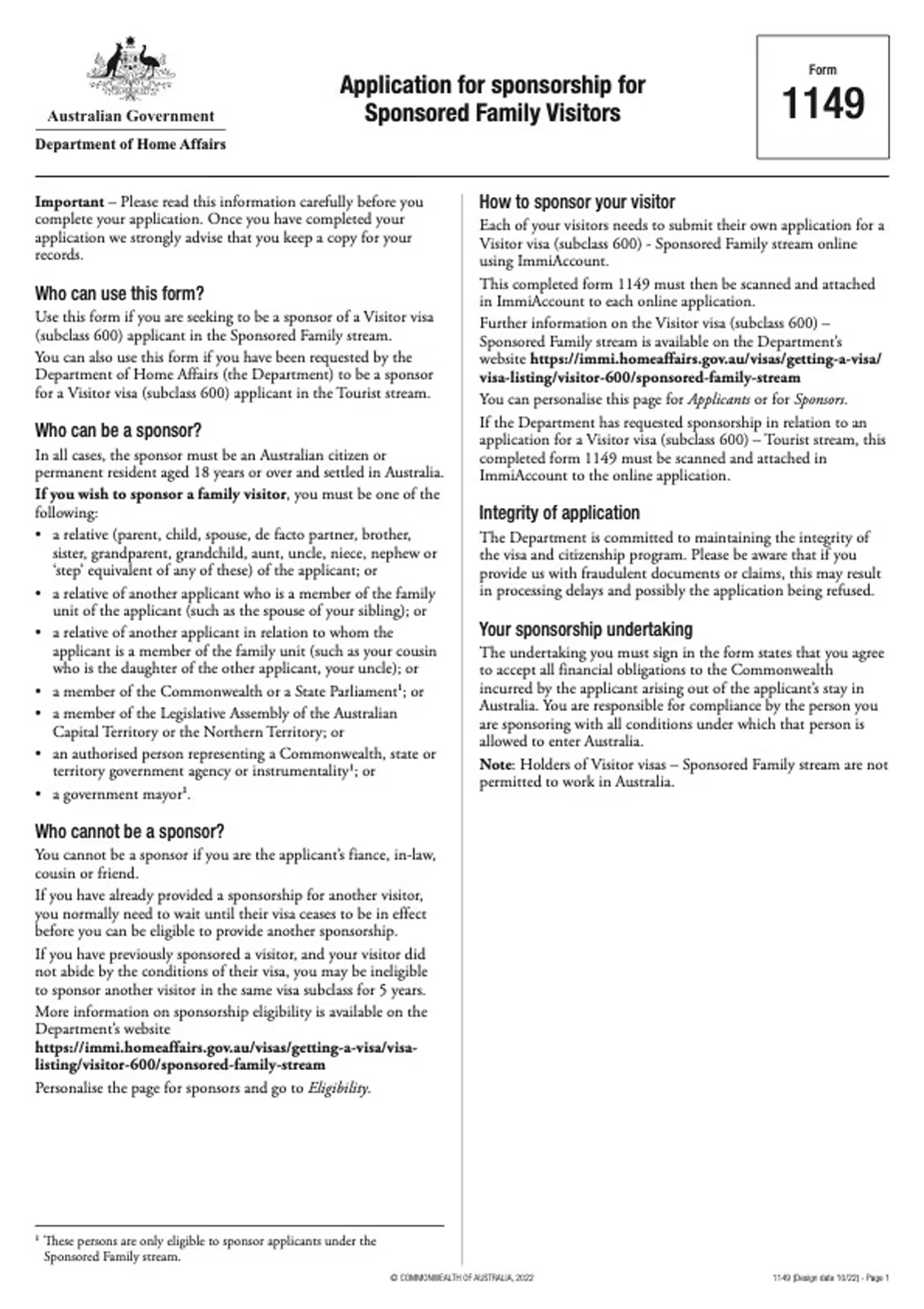
Then Form 1149 changes the stakes. The official PDF says a sponsor under the Sponsored Family stream must be an Australian citizen or permanent resident aged 18 years or over and settled in Australia. The same form says a security bond may be requested and is generally between AUD5,000 and AUD15,000 per person. It also says sponsorship and any bond do not guarantee visa grant.
In other words, a normal family invitation letter may be enough for some visitor files, but family-based subclass 600 cases can move into a stricter sponsorship lane very quickly.
Germany and Schengen: purpose first, formal cost undertaking only if needed
Germany's Federal Foreign Office gives one of the cleanest answers on this topic. It says that, in the first place, an invitation proves the purpose of the intended journey, so no special formalities are required. But if the host intends to cover the costs of the trip, a formal declaration of commitment must be presented with the visa application.
That distinction is useful because many family visitors mix up:
- a simple invitation proving the family visit is real
- a formal Verpflichtungserklaerung, which is Germany's declaration of commitment for trip costs
The wider Schengen rules still apply around that family letter. The European Commission says a Schengen visa is for a short visit of up to 90 days in any 180-day period. You must apply at least 15 days before the journey and no earlier than 6 months beforehand. The Commission also says you need supporting documents for the purpose of stay, financial means, accommodation, and intention to return. So even a good family invitation letter remains one piece of a bigger file.
If your trip is Schengen-first, compare the letter against the route-level Schengen visa requirements guide before you submit.
U.S.: the family invitation letter is optional, not decisive
The U.S. State Department is unusually direct. It says B-2 visitor activities include a visit with friends or relatives, but it also says a letter of invitation or Affidavit of Support is not needed to apply for a visitor visa and is not one of the factors used to decide whether to issue or deny the visa.
The same page adds a more important rule: if the applicant cannot cover all trip costs, they may show evidence that another person will cover some or all costs. That means a family letter can still help explain accommodation or partial support, but it does not replace proof of the trip purpose, ties abroad, or the applicant's overall credibility.
The current State Department fee page lists the B visitor visa application fee at $185. So if the letter mentions who is paying, the financial story should also account for the application cost and the rest of the travel budget realistically.
Family invitation letter for visa sample
Use this as a structure, not as a script to copy blindly.
[Host full name]
[Full address]
[Phone number]
[Email address]
[Date]

To the Visa Officer,

I am writing to invite [visitor full name], passport number [passport number], to visit me in [country] from [arrival date] to [departure date].

[Visitor name] is my [relationship], and the purpose of the visit is [family visit / holiday with family / attending a family event / supporting a relative].

During the visit, [visitor name] will stay with me at [full address]. [He / She / They] will stay for [number of days or weeks] and plans to leave on [departure date].

I will provide [accommodation only / accommodation and meals / accommodation and local transport / partial financial support / full financial support]. [If relevant: The visitor will pay for flights and personal expenses.]

I am currently [citizen / permanent resident / visa holder] of [country], and I am employed as [job title] at [employer].

Attached are copies of my [passport or residence proof], [address proof], [financial evidence if relevant], and [relationship proof if relevant].

I confirm that the information in this letter is true and that the visit described above is genuine.

Sincerely,

[Host name]
[Signature]
How to adapt the sample
- Canada: add every visitor and host field IRCC lists, including when the visitor plans to leave and how they will pay.
- UK: make the support arrangement explicit instead of vague.
- Australia: say whether this is only a family visit letter or a Sponsored Family stream case.
- Germany: do not imply a formal cost undertaking unless the host is actually filing a declaration of commitment.
- U.S.: keep the wording factual and modest because the invitation letter is not the deciding document.
If the applicant also needs to explain the whole file, pair the host letter with a route-appropriate cover letter such as cover letter for UK visa or cover letter for Canada visitor visa.
What the host should attach with the letter
The letter matters less than the proof behind it. A stronger family-visit file usually pairs the invitation letter with:
- host identity proof: passport, PR card, residence permit, or other legal-status document
- host address proof: where the visitor will stay
- relationship proof: birth certificate, marriage certificate, family register, or another credible document
- financial proof if the host is paying for any material part of the trip
- trip timing proof if the visit is tied to a family event, medical support, or caregiving situation
The safest rule is simple: if the letter promises something, the file should prove it.
Common examples:
| Promise in the letter | Best supporting evidence |
|---|---|
| "She will stay with me" | host address proof and enough space or a plausible living arrangement |
| "I will pay for accommodation" | host bank evidence and status proof |
| "He is my brother" | birth-certificate chain, family register, or another accepted civil record |
| "The visit is for our daughter's graduation" | event invitation, school notice, or family-event evidence |
| "The visitor leaves on 20 August" | itinerary or return-plan evidence that matches the same date |
If the whole file still feels fragile, the better next step is not another template. It is a full consistency check through How It Works and then sign up when the draft application is ready.
When a simple family invitation letter is not enough
This is where most refusals or delays start.
A normal family invitation letter is usually not enough when:
- the host is formally taking financial responsibility
- the route uses a separate sponsorship form
- the visitor's own funds and return-home evidence are weak
- the family relationship is not easy to prove from names alone
The official sources make those limits clear:
- Canada says the letter does not guarantee visa issuance.
- Australia says sponsorship and any security bond do not guarantee a visa.
- Germany says the invitation itself can be informal, but formal cost responsibility changes the paperwork.
- The U.S. says the invitation letter is not one of the deciding factors.
That is why the best family invitation letter for visa applications stays factual. It proves the family visit. It does not try to sound like a legal argument or a guarantee.
Related guides
If you're building the rest of the application pack, these companion guides help:
- Invitation Letter for Visa: Country Rules + Sample
- Invitation Letter for Spouse Visa: What to Include
- Invitation Letter for Visa Canada: 2026 Guide
- Documents Required for Tourist Visa (2026 Guide)
- Bank Statement for Visa: What Officers Check
- Travel Visa Checker: What to Verify Before You Submit
Official sources
- Canada.ca, Letter of invitation for visitors to Canada: https://www.canada.ca/en/immigration-refugees-citizenship/services/visit-canada/letter-invitation.html
- Canada.ca, Visitor visa: about the document: https://www.canada.ca/en/immigration-refugees-citizenship/services/visit-canada/about-visitor-visa.html
- GOV.UK, Visiting the UK: guide to supporting documents: https://www.gov.uk/government/publications/visitor-visa-guide-to-supporting-documents/guide-to-supporting-documents-visiting-the-uk
- GOV.UK, Apply for a Standard Visitor visa: https://www.gov.uk/standard-visitor/apply-standard-visitor-visa
- Australian Department of Home Affairs, Applying for a visitor visa: https://immi.homeaffairs.gov.au/check-twice-submit-once/visitor-visa
- Australian Department of Home Affairs, Form 1149 PDF: https://immi.homeaffairs.gov.au/form-listing/forms/1149.pdf
- Federal Foreign Office, invitation from a relative or acquaintance in Germany: https://www.auswaertiges-amt.de/en/visa-service/buergerservice/faq/12-einladung/606720
- European Commission, Applying for a Schengen visa: https://home-affairs.ec.europa.eu/policies/schengen/visa-policy/applying-schengen-visa_en
- U.S. Department of State, Visitor Visa: https://travel.state.gov/content/travel/en/us-visas/tourism-visit/visitor.html
- U.S. Department of State, Fees for Visa Services: https://travel.state.gov/content/travel/en/us-visas/visa-information-resources/fees/fees-visa-services.html
- Canada.ca, Save Time: Send a Complete Application: https://www.canada.ca/en/immigration-refugees-citizenship/news/video/save-time-send-complete-application.html
FAQ
Does a family invitation letter guarantee a visa?
No. Canada says the letter does not guarantee a visa, Australia says sponsorship and any security bond do not guarantee grant, and the U.S. says invitation letters are not deciding factors. Treat the letter as supporting evidence that proves the family visit, not as the approval case by itself.
What should a family invitation letter for visa applications always include?
At minimum, include the host's identity, the visitor's identity, the family relationship, the reason for the visit, where the visitor will stay, who pays, and when the visitor plans to leave. Then make sure those details match the itinerary, address proof, and funds evidence exactly.
Does the host need to show bank statements?
Only if the host is promising to cover meaningful costs. If the letter says the host will provide accommodation, meals, or wider support, that promise should be backed by financial evidence where the route expects it. If the visitor is self-funding, the letter should not exaggerate the host's role.
Is notarization required for a family invitation letter?
Usually not unless the country, consulate, or a local sponsorship process says otherwise. Germany's official guidance says no special formalities are required for the invitation itself unless the host is formally covering costs. What matters most is whether the facts are specific and supported by documents.
When does a family invitation letter turn into a sponsorship case?
That happens when the host is taking formal financial responsibility or when the route has a separate sponsorship process. Australia's Form 1149 is the clearest example. Germany's declaration of commitment is another. In those cases, a simple invitation letter may still help, but it is no longer the only host-side document that matters.
Can one family member apply on behalf of everyone?
Not automatically. The UK says each family member must have their own application and pay the fee even when applying together. Other routes also assess each traveller individually. A shared invitation letter can support several relatives, but each applicant still needs a complete, internally consistent file.
Conclusion
The best family invitation letter for visa applications is short, specific, and route-aware. It proves the family relationship, the purpose of the visit, where the visitor will stay, who pays, and when the visitor will leave. What changes is the legal weight around it: Canada gives hosts a field list, the UK treats it as sponsor evidence, Australia can escalate it into Form 1149, Germany separates invitation from formal cost responsibility, and the U.S. keeps it optional.
If you want a second set of eyes before submission, start your Vidicy review and check the invitation letter against the full document pack, not in isolation.