

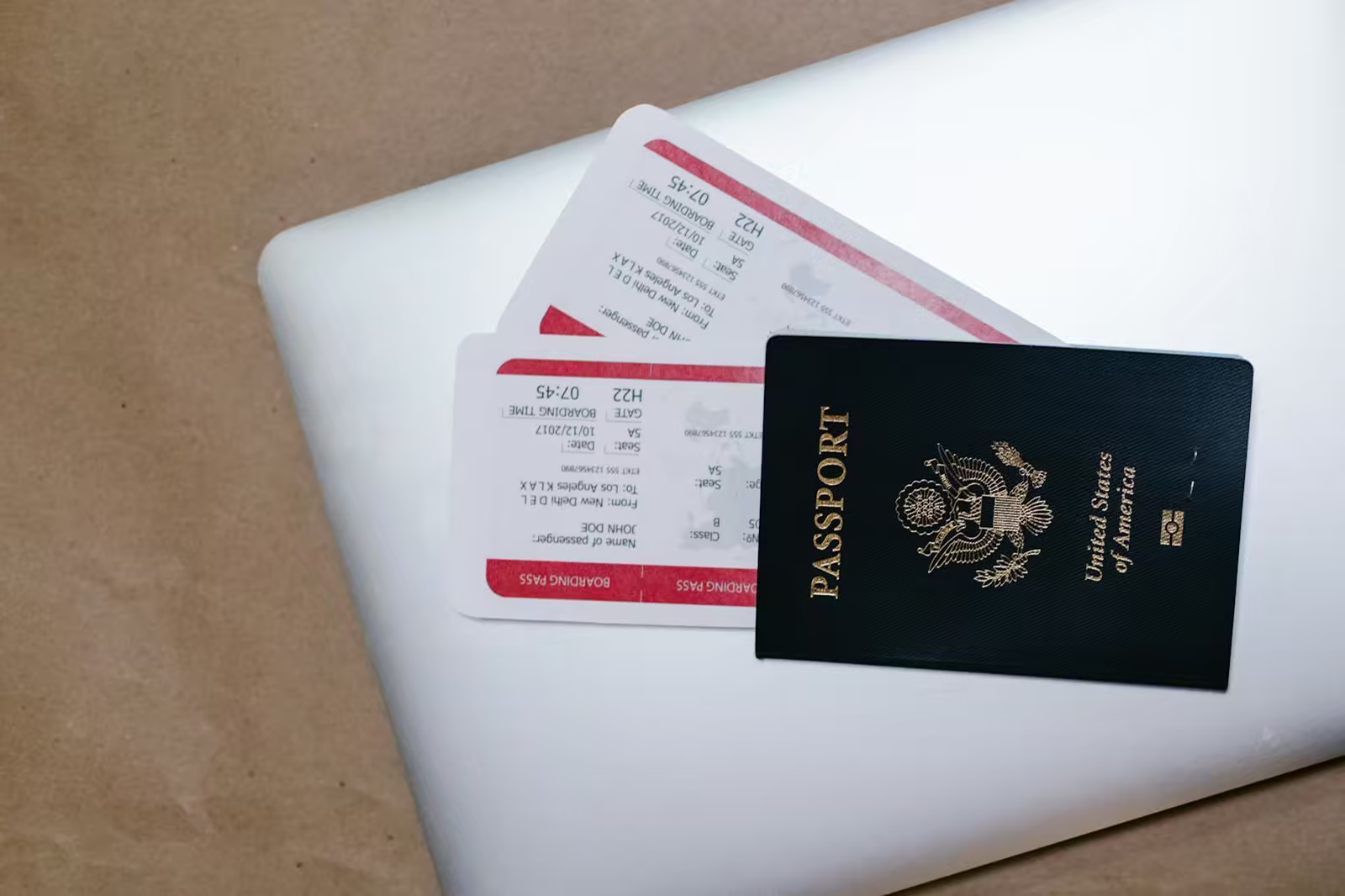

A travel visa checker is a pre-submission review that checks whether your passport details, itinerary, funds, sponsor evidence, photos, and route-specific documents match what the official visa pages ask for. The best travel visa checkers do more than answer "Do I need a visa?" They test whether the file you plan to submit is internally consistent and strong enough to survive an embassy or visa-centre review.
That distinction matters because the live search results for this keyword are dominated by destination eligibility tools. Those tools help with passport-based entry rules, but they do not catch the document mismatches that still delay or weaken applications. According to current official pages from GOV.UK, Canada.ca, Australia's Department of Home Affairs, the European Commission, and the U.S. Department of State, officers still want to see a file that proves purpose of travel, financial capacity, and intent to return. A travel visa checker is useful only if it tests those document signals before you submit.
If you want the product workflow version, Vidicy's How It Works page shows how the checklist, evaluation, and Atlas review steps fit together. If you are ready to run a live case, go straight to sign up.
At a glance
| Route | What the official source says to verify | Key official numbers |
|---|---|---|
| UK Standard Visitor | Show you are a genuine visitor, can support yourself, and can pay onward or return costs; sponsor evidence must explain what support is provided and how | GBP 135 in the Home Office fee table effective 8 April 2026, usually up to 6 months, apply 3 months before travel, usually 3 weeks for a decision |
| Canada visitor visa | The document list changes by travel reason; only submit recommended proof, and IRCC may still ask for more information | CAN$100 fee, CAN$85 biometrics, visa may be valid up to 10 years, most visitors can stay up to 6 months |
| Australia Visitor visa | Decision-ready files should match passport details exactly, explain the itinerary, show return-home reasons, include host letters where relevant, and include English translations | Home Affairs says complete applications get a faster outcome, but route facts still depend on the visitor stream |
| Schengen short-stay visa | Show the purpose of stay, financial means, accommodation, and intention to return; fingerprints are normally collected | EUR 90 adult fee, apply at least 15 days before travel and no earlier than 6 months, normal processing 15 days |
| U.S. B-1/B-2 visitor visa | Additional documents may be requested to prove trip purpose, intent to depart, and ability to pay; invitation letters are not required | Local embassy instructions control the final document set; if photo upload fails, bring one printed photo in the required format |
Table of Contents
- What a real travel visa checker should actually check
- Why visa requirement tools miss document-level risk
- Route-specific checks from current official sources
- Manual review vs an AI travel visa checker
- A 7-point workflow before you submit
- Official video walkthroughs worth watching
- Official sources
- FAQ
- Conclusion
What a real travel visa checker should actually check
The fastest way to separate a real checker from a marketing widget is to ask one question:
Does it check the document pack, or only the destination rule?
A useful travel visa checker should validate at least four groups of signals:
- Identity signals
- passport validity
- exact passport spelling
- prior names or name changes where the route asks for them
- photo compliance and form consistency
- Travel-plan signals
- trip purpose
- intended dates
- accommodation plan
- how the itinerary lines up with leave letters, bookings, or event evidence
- Financial signals
- whether the statements cover the right period
- whether balances and deposits look believable over time
- whether sponsor claims are actually supported by sponsor evidence
- Route-rule signals
- what the specific country asks for
- whether sponsor, translation, biometrics, insurance, or fingerprint rules apply
- whether the file matches the route you selected
That last point is where many applications go wrong. The file looks complete because every document exists. It still fails because the route logic is wrong.
If you want the broader document-by-document version of this same process, use How to Prepare Visa Application Documents before you upload anything.
Why visa requirement tools miss document-level risk
Most search results for travel visa checker are really visa requirement checkers. They answer questions like:
- Do I need a visa for this destination?
- Can I use an e-visa or visa on arrival?
- How long can I stay with this passport?
Those are useful questions, but they sit above the document layer.
Embassies and visa centres still review the evidence pack itself. A route can be technically correct and still produce problems if:
- the bank trail does not support the stated trip cost
- the leave dates do not match the booking window
- the sponsor letter says one thing and the applicant form says another
- the photo or translation misses a technical rule
- the passport spelling does not match older supporting records
That is why a real travel visa checker should behave more like a consistency check than a geography lookup.
The practical rule is simple:
- use a visa requirement checker to confirm whether the route exists
- use a travel visa checker to pressure-test whether the document pack is ready
If you are already worried about hidden mismatches, the next companion read is How to Catch the Hidden Document Errors That Reject Visa Applications.
Route-specific checks from current official sources
The most reliable way to design a checker is to start from live official guidance instead of copy-pasted checklist blogs.
UK: support yourself, prove the trip, and do not lean on weak evidence
The current GOV.UK guidance still frames the problem as genuine-visitor proof.
The safer current fee reference is the Home Office immigration and nationality fees table effective 8 April 2026, which lists a Standard Visitor visa fee of GBP 135. The live visitor pages still say the route allows stays of up to 6 months, the apply page says the earliest you can apply is 3 months before travel, and once you have applied online, proved your identity, and provided your documents, you will usually get a decision within 3 weeks. Because GOV.UK's visitor pages are not fully aligned right now, check the live fee table before payment.
The stronger checker logic comes from the current supporting documents guide. It says you should show that:
- you are coming for a permitted purpose
- you will leave the UK at the end of the visit
- you can support yourself and any dependants during the trip
- you can pay for the return or onward journey
It also says that if somebody else is paying for your travel, maintenance, or accommodation, the file should show:
- what support is being provided
- how it is being provided
- the relationship between applicant and sponsor
- that the sponsor is legally in the UK, where relevant
One of the most useful signals for a checker is the same guide's list of weak evidence. It says documents like hotel bookings, flight bookings unless you are transiting, personal photographs, sponsor utility bills, and sponsor council tax bills are less useful as evidence. In other words, the checker should not just look for uploaded files. It should help you distinguish strong proof from comfort files.
If your case is UK-specific, validate the route pack against the documents required for UK visitor visa before you submit.
Canada: the document list changes by travel reason
Canada's current visitor-visa flow is unusually clear that the checklist is not one-size-fits-all.
The current visitor visa apply page says the reason you are travelling determines how you apply and which documents you need to submit. It also says:
- not all listed documents are required
- the list is not exhaustive
- you should submit only the recommended documents that prove eligibility
- IRCC may request more information
- even a fully listed package is not a guarantee of approval
The current visitor visa overview page says a visitor visa may allow multiple entries for up to a maximum of 10 years, and that most visitors can stay for up to 6 months at a time.
IRCC's current application flow also says the visitor visa fee starts at CAN$100, while the biometrics guidance says the biometrics fee is CAN$85 for one person and CAN$170 for a family applying at the same time. The biometrics page also says you must pay that fee when you submit the application or you may experience delays.
For a checker, that means Canada logic should test:
- whether the file matches the travel reason selected in the application flow
- whether the bank evidence actually covers the requested period
- whether invitation or family-visit proof appears when the travel reason requires it
- whether biometrics, photos, and uploaded forms are in the right state for first-time applicants
If you are building that pack now, pair this guide with the Canada visitor visa checklist.
Australia: decision-ready means exact names, return-home proof, and complete translations
Australia's current Applying for a visitor visa page is one of the best official sources for what a checker should test before submission.
Home Affairs says that if your application has all the information and documents they need, you will get a faster outcome. The same page tells applicants to:
- include a clear copy of the personal-details page of the passport
- make sure the spelling matches the passport exactly
- provide all previous or current names
- outline the reason for travelling and include itinerary details
- show you intend to return home, using evidence like current payslips, an employer leave letter, enrolment proof, or children's birth certificates
- include a host letter if you are visiting family or friends
- include documents that prove you have enough money, such as recent bank statements
- submit English translations of documents that are in other languages
That is strong checker logic because it combines identity, purpose, funding, return-home evidence, and translation compliance in one official checklist.
If Australia is your route, compare the file against the Australia visitor visa checklist after the technical review. If you are still choosing between visitor, student, and partner routes, start with the broader visa documents required for Australia guide before you build the upload pack.
Schengen: match purpose, funds, accommodation, and return-home proof
The European Commission's current Applying for a Schengen visa page is still the cleanest baseline for a short-stay checker.
It says applicants should provide:
- supporting documents relating to the purpose of the stay
- evidence of financial means
- evidence of accommodation
- evidence of the intention to return to the home country after the stay
The same page says that fingerprints are normally collected at submission. It also sets the calendar and fee expectations a checker should surface:
- apply at least 15 days before the intended journey
- apply no earlier than 6 months before travel
- the visa costs EUR 90 for adults
- the normal processing time is 15 days, extendable to 45 days
That means a Schengen-ready checker should flag mismatches between itinerary, hotel plan, proof of funds, and return-home evidence long before appointment day.
If you need the route-specific pack next, use the Schengen visa checklist. If your destination is New Zealand, use the New Zealand tourist visa checklist to separate Visitor Visa, NZeTA, funding, translation, and arrival-declaration checks before you apply.
United States: prove purpose, intent to depart, and ability to pay
The current U.S. visitor visa page is blunt about what consular officers may ask for. It says additional documentation may be requested to establish:
- the purpose of the trip
- the applicant's intent to depart the United States after the trip
- the applicant's ability to pay all trip costs
The same page also says a letter of invitation or Affidavit of Support is not needed to apply for a visitor visa and is not one of the factors used to determine whether to issue or deny the visa. It also notes that if the photo upload fails, you must bring one printed photo in the required format.
For a travel visa checker, that means U.S. review should focus less on template invitation letters and more on whether the file proves:
- why the trip is happening
- who is paying
- what ties pull the applicant back home
- whether the applicant's interview story matches the documents
If that is your route, the next stop is the US visa checklist.
Manual review vs an AI travel visa checker
Manual review still matters. But manual review alone is where applicants miss small contradictions because they already know what the documents were supposed to say.
| Review method | Strength | Blind spot |
|---|---|---|
| Destination visa checker | Fast answer to "Do I need a visa?" | Does not test whether your documents support the case |
| Manual checklist review | Good for spotting missing files | Easy to miss cross-document mismatches |
| AI travel visa checker | Fast at comparing names, dates, funds, sponsor proof, and route rules together | Cannot guarantee approval or replace official embassy instructions |
The right mental model is not "human versus AI." It is:
- official source first
- checker second
- manual judgment last
That sequence is what reduces avoidable mistakes without pretending the checker is the embassy.
A 7-point workflow before you submit
If you want a practical workflow rather than theory, use this order:
- Lock the route first. Confirm the actual visa route and the country page you are filing under.
- Upload the core documents first. Start with passport, form, itinerary, bank statements, and employment or sponsor proof.
- Check the identity layer. Names, dates of birth, passport numbers, and addresses should match exactly.
- Check the travel layer. Dates in the form, leave letter, bookings, and insurance should tell the same story.
- Check the finance layer. The trip cost, sponsor claims, and bank activity should be believable together.
- Check the route-specific layer. Photo rules, translations, biometrics, fingerprints, or sponsor rules should match the country guidance.
- Re-check after every fix. One corrected date can create a new mismatch somewhere else.
This is also the point where a tool should be honest about limitations. A travel visa checker can surface document-level risk. It cannot promise approval, override local embassy discretion, or replace a live rule change on the official site.
If you want the full Vidicy workflow after the pre-check, see How It Works, then move to a live case through sign up.
Official video walkthroughs worth watching
Two official videos are worth including because they explain the parts applicants usually rush:
The first is Canada.ca's Save Time: Send a Complete Application, which IRCC hosts on its own video page and links out to YouTube. It is useful because it focuses on incomplete forms, wrong photo specs, missing supporting documents, and avoidable return-without-processing mistakes.
The second is GOV.UK's Applying for a UK visitor visa video, published by UK Visas and Immigration. It is the cleanest official walkthrough for the visitor-visa application flow itself.
If your main concern is decision timing rather than the form flow, GOV.UK also publishes Understanding visa processing times from the same official video collection.
Related guides
If you want to catch the most common mistakes before you file, these companion guides help:
- Schengen Visa Checker: What to Verify Before You Apply
- Why Visa Applications Get Rejected: 7 Document Mistakes
- Why visa applications get rejected: 7 document mistakes
- If My Visa Is Rejected, Can I Apply Again? (2026)
- Visa Rejected? What to Do Next After Refusal
Official sources
- U.S. Department of State, Visitor Visa: https://travel.state.gov/content/travel/en/us-visas/tourism-visit/visitor.html
- GOV.UK, Check if you need a UK visa: https://www.gov.uk/check-uk-visa?step-by-step-nav=e8254fb0-f2d9-45b1-bdc4-d17cbba11bef
- GOV.UK, Apply for a Standard Visitor visa: https://www.gov.uk/standard-visitor/apply-standard-visitor-visa
- GOV.UK, Visiting the UK: guide to supporting documents: https://www.gov.uk/government/publications/visitor-visa-guide-to-supporting-documents/guide-to-supporting-documents-visiting-the-uk
- GOV.UK, Apply for a UK visitor visa: video: https://www.gov.uk/government/publications/how-to-apply-for-a-uk-visitor-visa-video/how-to-apply-for-a-uk-visitor-visa-video
- Canada.ca, About the visitor visa: https://www.canada.ca/en/immigration-refugees-citizenship/services/visit-canada/about-visitor-visa.html
- Canada.ca, How to apply for a visitor visa: https://www.canada.ca/en/immigration-refugees-citizenship/services/visit-canada/apply-visitor-visa.html
- Canada.ca, How to give your fingerprints and photo: https://www.canada.ca/en/immigration-refugees-citizenship/campaigns/biometrics/how-to-give-biometrics.html/1000?wbdisable=false
- Canada.ca, Save Time: Send a Complete Application: https://www.canada.ca/en/immigration-refugees-citizenship/news/video/save-time-send-complete-application.html
- Australian Department of Home Affairs, Applying for a visitor visa: https://immi.homeaffairs.gov.au/check-twice-submit-once/visitor-visa
- European Commission, Applying for a Schengen visa: https://home-affairs.ec.europa.eu/policies/schengen/visa-policy/applying-schengen-visa_en
FAQ
Is a travel visa checker the same as a visa requirement checker?
No. A visa requirement checker usually tells you whether your passport needs a visa, e-visa, ETA, or visa-on-arrival option. A travel visa checker should go one step further and test whether the documents you plan to submit are complete, consistent, and aligned to the route's live rules.
Can a travel visa checker replace the official embassy website?
No. The checker should sit after the official source, not instead of it. Requirements change, and local consulates or visa centres can ask for route-specific documents that a generic tool does not know unless it is updated from those official pages.
Which documents should I check first?
Start with the passport, the application form, the itinerary, the bank statements, and any employment or sponsor proof. Those files usually carry the identity, funding, and trip-purpose signals that create most cross-document mismatches.
Can a travel visa checker guarantee approval?
No. It can reduce document-level risk, but it cannot control interviews, undisclosed history, discretionary judgments, or route changes after you check the file. The honest value is error reduction, not a promise.
When should I run the checker?
Run it before you book non-refundable travel and again after you fix any flagged mismatch. A checker is most useful when the file is mostly assembled but still editable.
Conclusion
A strong travel visa checker does not just answer whether you need a visa. It checks whether your passport details, itinerary, finances, sponsor evidence, and route rules all point in the same direction before you submit.
That is the standard that matters because current official sources still ask officers to evaluate trip purpose, financial credibility, supporting evidence, and intent to return. If your document pack cannot survive that review, a passport-based checker alone will not save it.
If you want the route-aware review workflow behind that logic, start with How It Works. If your file is ready for a live pre-submit check, move to sign up and run the application through a full review before submission day.