

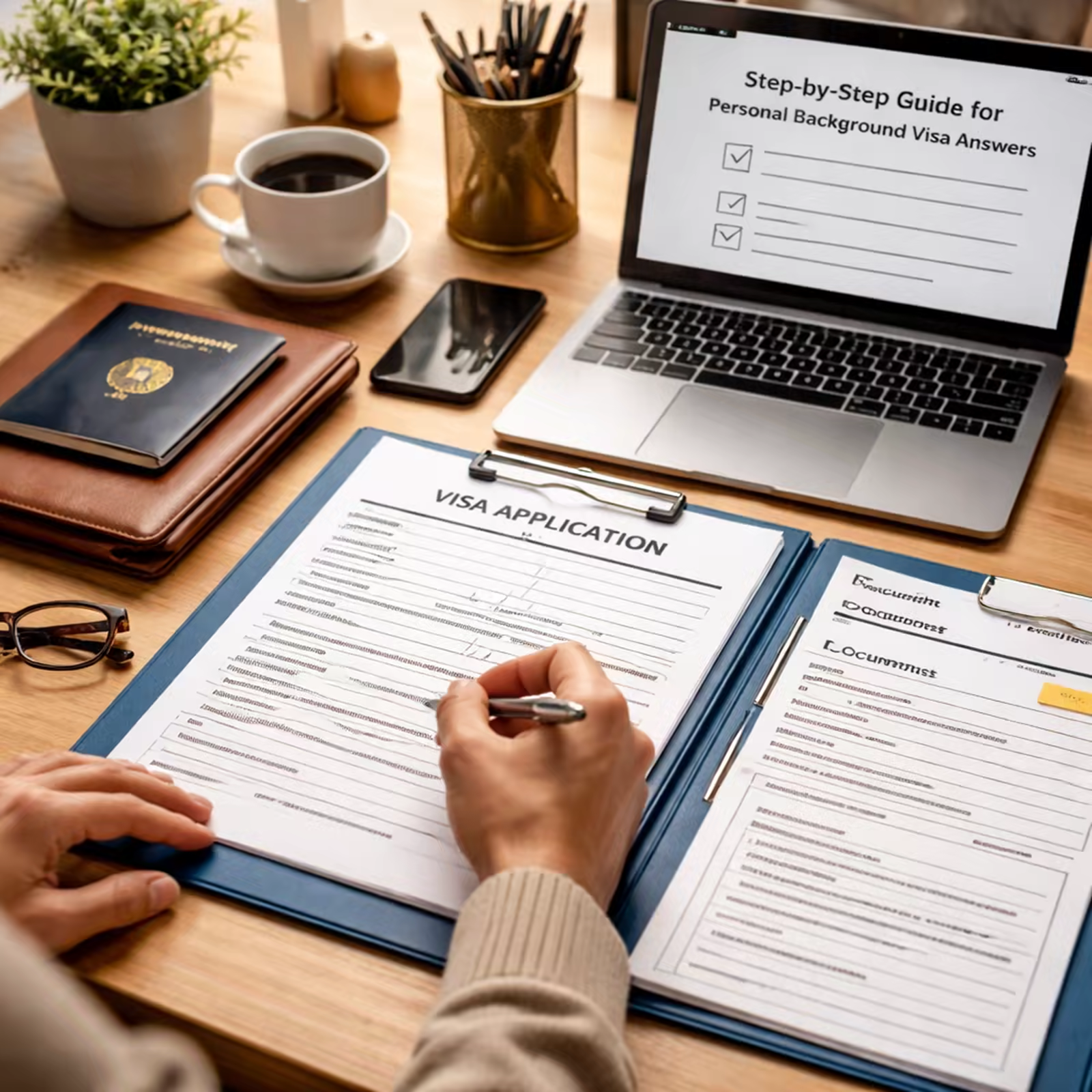

If you are searching for a US visa checklist, start with this direct answer: for a standard B1/B2 case, your non-negotiables are a passport that is generally valid for at least 6 months beyond your U.S. stay, a DS-160 confirmation page, the $185 nonimmigrant visa fee, and a compliant photo if your upload fails or your post asks for a printed backup. Then you need supporting evidence that proves trip purpose, funds, and ties abroad. As of December 12, 2025, the Department of State also says nonimmigrant applicants should schedule visa interviews in their country of nationality or residence.
This checklist is for first-time and repeat visitor-visa applicants who want the route-level version before they touch DS-160 or book the interview. If you want the product-led starting point first, open Vidicy's US visa document checklist, then use this guide to pressure-test what has to be in the file and what is merely helpful.
| Checklist area | Official benchmark | What to prepare |
|---|---|---|
| Passport | Valid at least 6 months beyond stay unless exempt | Current passport plus older passports if they help show travel history |
| DS-160 | Bring the confirmation page; full application printout not needed | Saved application ID, barcode page, clean answers that match your documents |
| Fee | B visitor visas are $185.00 | Correct fee payment path for your embassy or consulate |
| Photo | Printed photo only if upload fails; printed size 2 x 2 inches | Backup print plus compliant digital upload |
| Supporting evidence | Officers may ask for purpose, intent to depart, and ability to pay | Itinerary, job or school proof, funds, and sponsor evidence if relevant |
| Interview location | Since December 12, 2025, schedule in country of nationality or residence | Confirm where you should book before paying or joining a queue |
| Wait times | Posted times are generally maximums and new slots are added | Check the live page and your post-specific instructions |
Table of Contents
- US visa checklist: required items vs supporting proof
- The required items every B1/B2 applicant should check first
- Supporting documents that make a US visa checklist stronger
- The 2026 booking rule and wait-time reality
- DS-160 and photo checks that cause avoidable rework
- Official sources
- FAQ
- Conclusion
US visa checklist: required items vs supporting proof
A US visa checklist is not just a packing list. It is the shortest set of items that lets you (1) book correctly, (2) clear interview-day document checks, and (3) answer the officer's core questions without contradictions.
The first distinction that matters is required items versus supporting proof.
- Required items are the basics on the State Department's visitor-visa page: passport, Form DS-160 confirmation page, fee receipt if your post requires prepayment, and a compliant photo if your upload fails.
- Supporting proof is the second layer: evidence of your trip purpose, your intent to depart the United States after the trip, and your ability to pay the costs.
That distinction matters because a lot of internet checklists turn everything into a “required document.” The State Department does not do that. It says additional evidence may be requested and gives those three screening themes as the reason.
There is one more definition worth keeping straight: a U.S. visa lets you travel to a port of entry and request admission; it does not guarantee entry. That is why your checklist should be built for the full process, not just the sticker.
If you already know the file is tourism-heavy and want the B2-specific packing version, read Documents Required for US Tourist Visa (B2). For the interview-day version that maps B1/B2 evidence to officer questions, use the documents required for US travel visa interview guide. If your weak point is the form itself, use How to Fill DS-160 alongside this checklist.
The required items every B1/B2 applicant should check first
For a normal B1/B2 case, the short official checklist is more stable than most people think. The details below are the ones worth checking before you book anything non-refundable.
1. Passport validity
The visitor-visa page says your passport must generally be valid for at least six months beyond your period of stay in the United States, unless a country-specific exemption applies. That is a simple rule, but it still causes avoidable rescheduling when applicants wait too long to renew.
Use this practical test:
- Check your intended U.S. trip end date.
- Add 6 months.
- Make sure the passport expiry date is later than that threshold, unless you know your nationality is exempt under the State Department's linked CBP agreement list.
If you have older passports with previous visas or clean travel history, keep them in your file. They are not the same thing as the current passport requirement, but they can support the broader story that you travel and return as claimed.
2. DS-160 confirmation page
The State Department's DS-160 instructions tell applicants to print and keep the DS-160 barcode page and clarify that you do not need to print the full application. For checklist purposes, that means your real deliverable is not “finish the form someday.” It is “finish the form accurately and preserve the barcode page you will actually use later.”
That is why the best DS-160 checklist is not just technical. It is consistency-based:
- Passport spelling must match exactly.
- Travel purpose must match the route you will discuss at interview.
- Employer, school, and address history should match the documents you may later show.
- U.S. contact and stay details should fit the trip you are describing.
For a visual walkthrough, this verified YouTube result from the U.S. Embassy Bangkok official channel walks through part of the DS-160 flow. The appointment and fee steps are Bangkok-specific, but the screen logic is still useful:
3. Fee payment
As of April 16, 2026, the State Department fee table lists $185.00 as the non-refundable nonimmigrant visa application processing fee for Visitor Visas - Business, Tourism, Medical treatment (B).
Two nuances matter here:
- The fee is non-refundable.
- Your embassy or consulate instructions control how and when you pay in practice.
That is why a strong US visa checklist includes not only “pay the fee” but also “verify the payment workflow for the exact post where you will apply.”
4. Photo backup
The visitor-visa page says you will upload your photo while completing Form DS-160. If the upload fails, you must bring one printed photo that meets the photograph requirements.
The current State Department photo rules say visa photos must be:
- taken within the last 6 months
- in front of a plain white or off-white background
- 2 x 2 inches (51 x 51 mm) for printed format
- framed so the head is 1 to 1 3/8 inches tall, or 50% to 69% of image height
- taken with both eyes open and a neutral expression
- taken without eyeglasses, except rare medical exceptions
If you want the photo-only breakdown, use our US visa photo requirements guide before interview week.
Supporting documents that make a US visa checklist stronger
This is where the article becomes more useful than a generic embassy checklist. The State Department says additional evidence may be requested to establish:
- the purpose of the trip
- your intent to depart the United States after the trip
- your ability to pay all trip costs
That means your supporting pack should answer those exact three questions.
Evidence of trip purpose
A clean purpose pack is usually small. For most B1/B2 applicants, it includes:
- a simple itinerary with dates and cities
- hotel or accommodation details, if already arranged
- conference, meeting, medical, or event records, if those are the reason for travel
- host details if you are staying with family or friends
Keep it specific. “Tourism in the U.S.” is not as strong as “10 days in New York and Washington, staying at these addresses, with these dates.”
Evidence you will depart after the trip
On the visa-denials page, the State Department explains that officers look at each application individually and consider the applicant's circumstances, travel plans, financial resources, and ties outside of the United States that will ensure departure after a temporary visit.
Strong tie evidence is usually some combination of:
- employment letter with role, pay, and approved leave
- business ownership documents or recurring business obligations
- school enrollment records
- lease, property, or other long-running home-country commitments
- family obligations that are real and documentable
If your employer letter is the weak point, use the employment letter guide before you submit. If the officer is likely to compare trip costs to your income, pair that with the proof of funds guide.
Evidence you can pay
The official visitor-visa page does not publish a universal required bank balance. That is a clue: the right question is not “What is the magic number?” but “Does my money story fit the trip?”
A convincing funds pack usually shows:
- recent bank statements
- income evidence that matches your employment story
- an explanation for large recent deposits if they exist
- sponsor evidence if someone else is paying
If a U.S. host or family member is contributing to the trip, keep one important rule in mind: the State Department says a letter of invitation or Affidavit of Support is not needed to apply for a visitor visa, and it is not one of the factors used to determine whether to issue or deny the visa. That does not mean host-side evidence is useless. It means it should support your story, not replace your own proof of purpose, funds, or ties.
The 2026 booking rule and wait-time reality
This is the section most generic US visa checklist posts skip.
On December 12, 2025, the Department of State updated its instructions for all nonimmigrant visa applicants scheduling interviews. The rule now says applicants should schedule their interview at a U.S. Embassy or Consulate in their country of nationality or residence.
That matters because it changes the checklist before the checklist. Before you pay the fee or chase appointment availability, confirm whether you are booking in the right country.
The same update adds three practical warnings:
- if your application is based on residency, you must be able to demonstrate residence in that country
- applying outside your country of nationality or residence may make it more difficult to qualify
- fees paid for those out-of-country nonimmigrant interviews will not be refunded and cannot be transferred
The State Department also says appointment wait times vary by location and that applicants going outside their country of nationality or residence should expect to wait significantly longer.
On the separate wait-times page, the Department adds another useful detail: published wait times are generally maximums, and new appointments are continuously being added. In practice, that means a scary number on the public table is not the only number that matters. The right move is to monitor the live page and your post-specific website instead of assuming today's figure is fixed forever.
If you want a product-led check before interview week, the most practical next step is to run your pack through Vidicy's US visa photo checker if the photo or digital upload is your weak point.
DS-160 and photo checks that cause avoidable rework
Most real checklist failures are not dramatic. They are boring mismatches.
The recurring high-friction points are:
- passport spelling that does not match DS-160
- trip dates that conflict with leave letters or itinerary
- a missing DS-160 confirmation page
- a photo upload that fails because the image does not meet digital rules
- a printed backup photo that does not meet the U.S. 2 x 2 inch format
The State Department's digital image requirements are specific:
- minimum 600 x 600 pixels
- maximum 1200 x 1200 pixels
- JPEG format
- file size less than or equal to 240 kB
- compression ratio less than or equal to 20:1
That is why a real US visa checklist is partly technical. If your photo fails before the interview, or your barcode page is missing, the rest of your evidence may not even get a fair chance to matter.
Related guides
If you're building the rest of the application pack, these companion guides help:
- US Visa Checklist for 2026
- Bank Statement for Visa: What Officers Check
- Flight Itinerary for Visa Applications: What to Submit and What to Avoid
- Travel Visa Checker: What to Verify Before You Submit
Official sources
These are the primary official pages used for the facts above:
- U.S. Department of State: Visitor Visa
- U.S. Department of State: DS-160 Online Nonimmigrant Visa Application
- U.S. Department of State: Fees for Visa Services
- U.S. Department of State: Photo Requirements
- U.S. Department of State: Digital Image Requirements
- U.S. Department of State: Visa Denials
- U.S. Department of State: Visa Appointment Wait Times
- U.S. Department of State: Adjudicating Nonimmigrant Visa Applicants in Their Country of Residence
- U.S. Embassy Bangkok official YouTube walkthrough: DS-160 Presentation - Part 2
FAQ
What belongs on a US visa checklist for a B1/B2 applicant?
The short official list is passport, DS-160 confirmation page, fee receipt if your post requires prepayment, and a printed photo if the DS-160 upload fails. The second layer is supporting evidence for trip purpose, ability to pay, and ties outside the United States.
Do I need an invitation letter for a US visa?
Not as a core requirement. The State Department says a letter of invitation or Affidavit of Support is not needed to apply for a visitor visa and is not one of the factors used to decide issuance or refusal. Use it only as supporting context, not as a substitute for your own evidence.
Is the US visitor-visa fee still $185 in 2026?
As of April 16, 2026, yes. The State Department fee schedule lists $185.00 for Visitor Visas - Business, Tourism, Medical treatment (B). Because government fees can change, always confirm the live fee page before payment.
Do I print the whole DS-160?
No. The DS-160 instructions say to print and keep the barcode confirmation page. They also say you do not need to print the full application. What matters is that the barcode page is preserved and the answers match the documents you may later show.
Can I apply for a US visa outside my home country?
Sometimes, but the current rule is stricter. Since December 12, 2025, the Department of State says nonimmigrant applicants should schedule interviews in their country of nationality or residence. Applicants outside those countries may face longer waits, harder qualification, and non-transferable fees.
What photo should I bring if the DS-160 upload fails?
Bring one printed photo that meets the U.S. photograph rules: 2 x 2 inches (51 x 51 mm), taken within the last 6 months, plain white or off-white background, neutral expression, and no eyeglasses except rare medical exceptions.
Conclusion
A strong US visa checklist is short at the front and disciplined at the back. The front layer is clear: passport, DS-160 confirmation page, $185 fee, and a compliant photo backup if needed. The back layer is what usually decides how credible the case feels: evidence of purpose, funds, and ties abroad, plus the current rule on where you should book the interview.
If you want to move from a generic checklist to a case-aware review, start with Vidicy's US visa document checklist and pressure-test the file before interview day.