


If you need a bank statement for visa applications, the short answer is this: the statement has to prove that the money is yours, available, stable over time, and consistent with the trip you say you are taking. According to UKVI’s supporting-documents guide updated on 25 February 2026, bank statements should detail the origin of the funds held. Canada.ca’s current visitor-visa application page says bank account statements should include at least 6 months of account details, including balances. NetherlandsWorldwide says Schengen tourism applicants who pay their own costs should bring bank statements from the previous 3 months and, if employed, 3 recent payslips. Australia’s current Ho Chi Minh City visitor-visa checklist asks for recent bank statements and recent credit card statements showing available balance. The U.S. Department of State says officers may ask for evidence of your ability to pay all costs of the trip.
That matters because a bank statement for visa application review is not a screenshot contest. Officers are not trying to admire one closing balance. They are checking whether the statement matches your job, your sponsor story, your trip budget, and your reason to return home after travel. If you want the route-level document stack first, start with Vidicy’s UK visa checklist, Canada visa checklist, or Schengen visa checklist before you upload the financial proof.
If your route is specifically a UK Standard Visitor case, use the more focused UK visitor visa bank statement requirement guide after this article. It stays with the live UKVI wording on sponsor evidence, weak documents, priority timelines, and the lack of a published fixed minimum balance.
| Route | What the official source says | What your bank statement should prove |
|---|---|---|
| UK Standard Visitor | UKVI says financial documents must clearly show you have access to the funds, and bank statements should detail the origin of the funds held | your money trail is real, current, and consistent with the trip |
| Canada visitor visa | Canada.ca says bank account statements should include at least 6 months of account details, including balances | six months of genuine cash flow, clear account ownership, and a believable income story |
| Schengen tourism (Netherlands example) | NetherlandsWorldwide asks self-funded applicants for bank statements from the previous 3 months and, if employed, 3 recent payslips | you can pay for the trip yourself and still show social or economic ties at home |
| Australia Visitor visa (subclass 600) | The official Ho Chi Minh City checklist asks for recent bank statements and recent credit card statements showing available balance | your funds are accessible now and the upload is strong enough to decide the case from the lodgement pack |
| U.S. B-1/B-2 | The State Department says additional requested documents may include evidence of your ability to pay all costs of the trip | the statement supports affordability, but it does not replace your ties abroad |
At a glance
- Use this page as the cross-route finance hub before you switch to the country-specific bank-statement rule.
- A strong statement proves ownership, availability, stability over time, and a believable match to the trip budget.
- Different routes want different statement windows, but all of them care about traceability and consistency.
- Big unexplained deposits, weak sponsor proof, and mismatched work or itinerary evidence are the fastest ways to make funds look staged.
Table of Contents
- What a bank statement for visa applications must prove
- What official sources say in 2026
- How many months of bank statements should you show
- Red flags that make a bank statement look staged
- How to present bank statements clearly
- Official sources
- FAQ
- Conclusion
What a bank statement for visa applications must prove
A good bank statement for visa cases usually does four jobs at once.
- It proves the account really belongs to you or to the sponsor you named.
- It proves the money did not appear overnight for filing week.
- It proves your income pattern fits the work, business, or sponsor story in the rest of the file.
- It proves the trip cost is plausible against the funds you can actually use.
That is why a neat ending balance is not enough by itself. A statement with a big recent lump-sum deposit but no explanation can be weaker than a lower balance with six months of normal salary inflows. A sponsor’s account can help, but only if the sponsor’s identity, relationship, and willingness to pay are documented clearly. A screenshot can still fail if it hides the account holder name or the statement period.
Use this quick test before you upload:
- Is the account holder name visible?
- Is the statement period long enough for the route you are using?
- Do the deposits make sense against your payslips, employer letter, or business records?
- Does the trip budget match what the statement shows?
- If someone else pays, did you attach the sponsor letter, sponsor ID, and the sponsor’s own financial proof?
If the statement cannot answer those questions cleanly, it is usually not ready. Before you submit, compare it against the route-specific finance guides, starting with Bank Statement for Canada Visa: Visitor vs Study or Proof of Funds for Schengen Visa: 2026 Amounts, and the broader document mismatch guide.
What official sources say in 2026
There is no one global bank-statement rule. The official pages split in an important way: some routes publish a fixed statement window, while others care more about whether the money story is credible and traceable.
UK: traceability matters more than a magic month count
UKVI does not publish one universal “show exactly X months” rule on the supporting-documents page. What it does say is more important: financial documents must clearly show you have access to the funds, and bank statements should detail the origin of the funds held.
That means the UK question is not just “How much money is in the account?” It is:
- where did the money come from?
- does it fit your declared income?
- does it fit any family support you claimed?
- does it fit the cost of the trip?
If your route is the UK Student visa rather than a Standard Visitor case, use the dedicated proof of funds for UK student visa guide instead of forcing visitor-route finance logic onto the wrong application type.
If you need the UK-only version of this banking analysis, use the dedicated UK visitor visa bank statement requirement guide. It focuses only on Standard Visitor evidence, sponsor support, and the UKVI documents that are actually worth uploading.
As of 16 April 2026, the current UK visitor pages still say the route allows visits of up to 6 months and the earliest application point is 3 months before travel. For fees, the safer current reference is the Home Office fee table effective 8 April 2026, which lists the short visit visa at £135. That timing matters because old statements may still be true, but current statements do a better job of showing what your financial position looks like now.
Canada: the clearest official six-month example
Canada’s rules are easier to explain because the current Canada.ca visitor-visa application page gives a clear bank-statement standard. For tourist applications, it says bank account statements should include:
- at least 6 months of account details, including balances
- the bank name and contact information
- proof the account is yours, such as your name and address on the statement
The same page also recommends an employer letter that confirms you have a stable job and will return to it, which is why the strongest Canada files pair the statement with employment evidence instead of treating the balance page as a standalone answer.
This is a route where the phrase 6 months bank statement for visa has real official backing. It is also why Canada files often go weak when applicants upload only one recent summary page. Six months is enough time for officers to see whether the account behaves like a real everyday account or a temporary parking place for application money.
Schengen: member-state examples matter
At the EU level, the Schengen rules are broad: a short-stay visa covers up to 90 days in any 180-day period, the standard adult fee is €90, and the normal processing time is 15 days unless further examination is needed. But the bank-statement detail often shows up on the member-state checklist, not only on the EU overview page.
The Netherlands’ official tourism checklist gives a strong live example. If you pay your own costs, you must provide:
- your bank statements for the previous 3 months
- if you are employed, 3 recent payslips
That is a useful Schengen benchmark because it shows two things at once: the account history matters, and the statement is usually strongest when it is paired with proof of how the money is earned.
Australia: recent funds plus a documents-only decision model
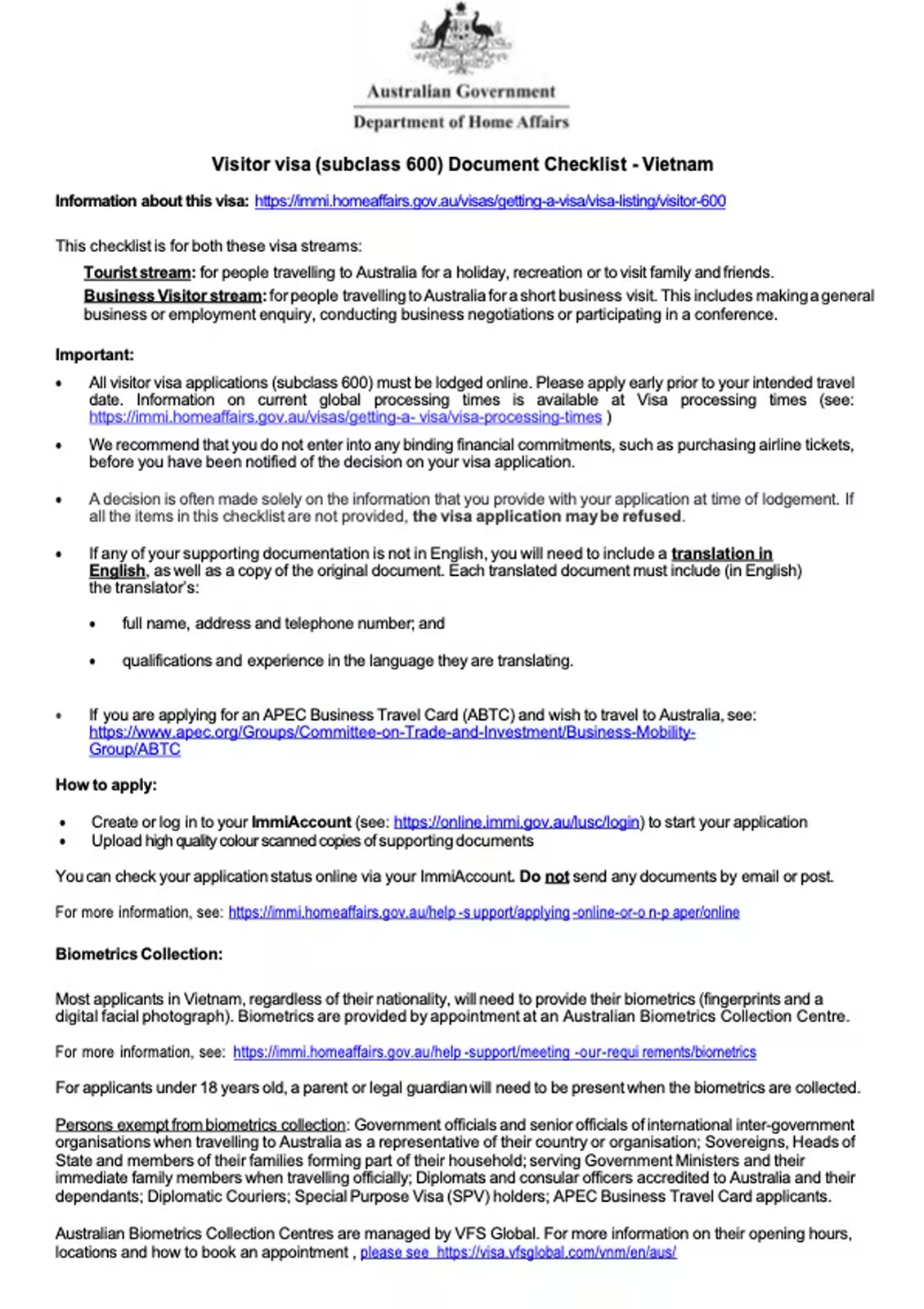
Australia’s current Ho Chi Minh City visitor-visa checklist asks for:
- recent bank statements
- recent credit card statements showing available balance
- employer details and a leave letter if you are employed
It also warns that a decision is often made solely on the information you provide at the time of lodgement and tells applicants to upload high-quality colour scanned copies. That combination matters for bank statements because it means a fuzzy upload or a half-explained account can become the problem immediately.
The official Visitor Visa Program Report dated 30 June 2025 adds two useful context points: applicants must genuinely intend to stay temporarily, and study or training may be permitted for up to 3 months on a visitor visa. In other words, the statement is always being read alongside the wider temporary-visitor story.
United States: no standard month count, but affordability still matters
The U.S. Department of State does not publish a fixed “bring 3 months” or “bring 6 months” rule on the visitor-visa overview page. Instead, it says additional requested documents may include evidence of:
- the purpose of your trip
- your intent to depart the United States after your trip
- your ability to pay all costs of the trip
It also says evidence of your employment and/or family ties may be sufficient to show the purpose of your trip and your intent to return. That tells you how to use the bank statement in a U.S. case: as one part of a larger home-ties and affordability story, not as a magic approval document.
How many months of bank statements should you show
This is the question almost everyone asks, and the truthful answer is: follow the official checklist for your route first.
| Route | Official statement window | What to do in practice |
|---|---|---|
| Canada visitor visa | At least 6 months of account details, including balances on Canada.ca | Use a full six-month set and make sure the income story stays consistent across all pages |
| Netherlands tourism / Schengen example | Previous 3 months plus 3 recent payslips if employed | Do not rely on one current balance; show the recent pattern |
| UK Standard Visitor | No single universal month count on the supporting-documents guide | Submit current statements that make the origin of funds easy to understand |
| Australia Visitor visa | “Recent” bank statements and credit-card statements | Use current, readable records that match your employer letter or sponsor story |
| U.S. visitor visa | No fixed public month count on the main visitor page | Bring statements only if they help explain how the trip is funded |
The most important distinction is this:
- Fixed-window routes like Canada and the Dutch Schengen tourism checklist care about a published period.
- Credibility routes like the UK and the U.S. care more about whether the money story is understandable.
That is why copying a “sample bank statement for visa application” checklist from one country into another country can backfire. The document may look complete, but it may still answer the wrong question.
Red flags that make a bank statement look staged
Most weak bank statement for visa application files fail for pattern reasons, not because the PDF is missing.
1. A large unexplained deposit appears right before filing
If the balance jumps sharply a few days before the application, officers will often want to know why. Was it a salary payment, a property sale, a business transfer, a family gift, or borrowed money? If the statement does not explain that on its own, attach the proof that does.
2. The statement and the employment proof do not match
If your payslips show one salary figure and the deposits show another, the account immediately becomes harder to trust. The same problem happens when the employer name on the salary letter does not match the narration on the deposits.
3. The account looks inactive until visa week
An account that sits near zero or shows little real activity for months, then suddenly fills up, can look staged. Stable, ordinary use over time is more persuasive than one dramatic top-up.
4. Screenshots hide the details officers need
A cropped app screenshot may hide the account holder name, statement dates, or transaction history. That turns a real bank balance into weak evidence. Whenever possible, use the bank-issued statement format rather than a partial mobile screenshot.
5. Sponsor money is present, but sponsor proof is missing
If a third party is paying, the sponsor’s bank statement does not work alone. You usually need:
- the sponsor letter
- the sponsor’s identity document
- proof of the relationship, where relevant
- proof of the sponsor’s own income or account history
6. The scan quality is poor
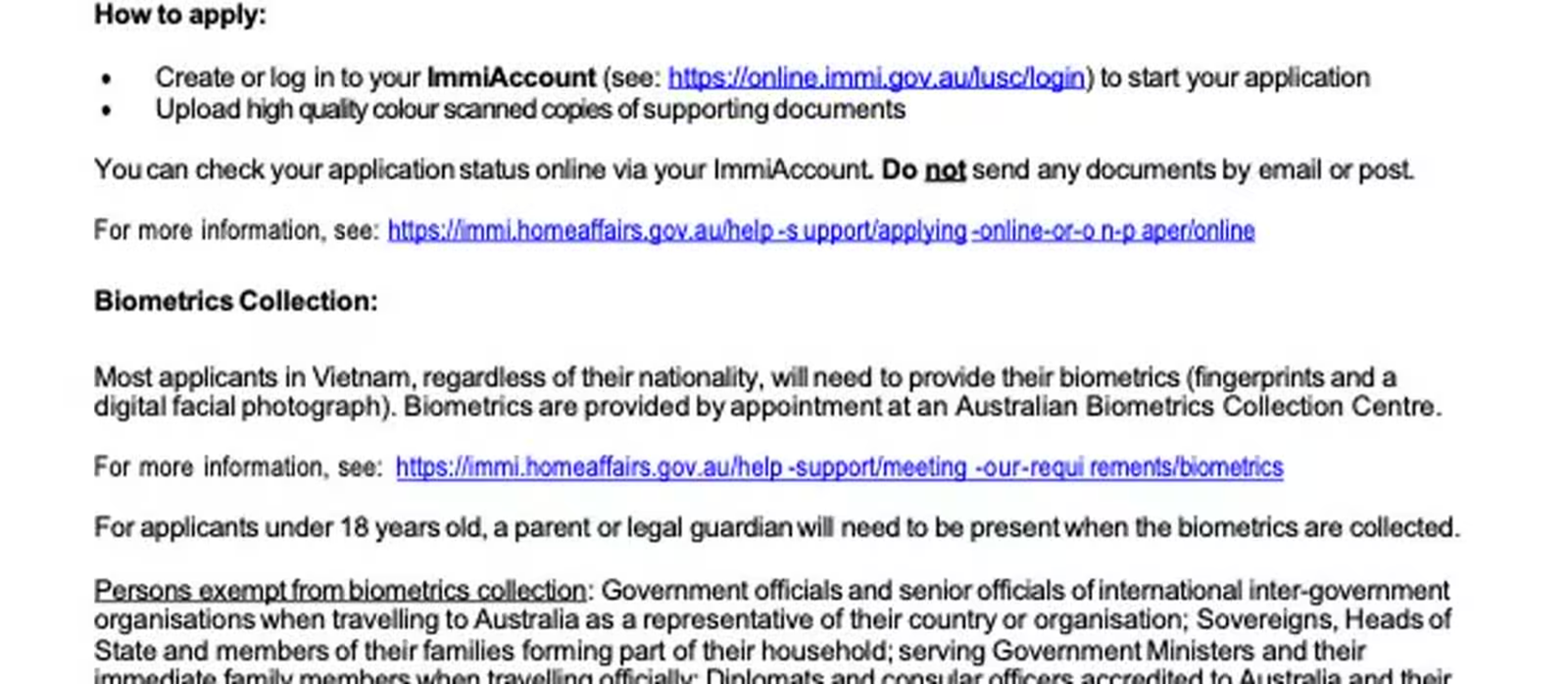
This sounds technical, but it matters. Australia’s official checklist says to upload high-quality colour scanned copies and warns that the decision may be made only from the documents provided at lodgement. A blurry bank statement is not just ugly. It makes the financial evidence harder to verify.
If your bigger problem is not the statement itself but the way it clashes with the rest of the file, read How to prepare visa application documents before you upload.
How to present bank statements clearly
The safest approach is to make the officer’s job easy.
- Use the full statement period the route expects, not a single summary page.
- Keep the pages in chronological order.
- Pair the statement with the document that explains the money source: payslips, employer letter, tax records, or sponsor proof.
- Add a short applicant explanation only when the statement really needs one, such as a recent transfer or mixed funding.
- Keep the trip budget realistic. A short holiday should not require a funding story that only works on paper.
One official reminder worth watching is IRCC’s “Save Time: Send a Complete Application” video. It specifically warns applicants that incomplete files cause delays and calls out financial statements as supporting documents that need to be included and readable.
If your route is UK-specific, GOV.UK also links an official visitor-visa walkthrough here: Applying for a UK visitor visa. Use it after the statement set is ready, not before.
For a final route-specific check, compare the finished evidence pack against Vidicy’s how it works page and then start your application review before you submit.
Related guides
If you're building the rest of the application pack, these companion guides help:
- Bank Statement for Canada Visa: Visitor vs Study
- Proof of Funds Canada Visitor Visa: What to Show
- Proof of Funds for Schengen Visa: 2026 Amounts
- Proof of Funding for Visa Applications: 2026 Guide
- Schengen Visa Bank Statement Requirement (2026)
- UK Visitor Visa Bank Statement Requirement (2026)
Official sources
- UKVI: Visiting the UK guide to supporting documents
- GOV.UK: Standard Visitor overview
- Canada.ca: How to apply for a visitor visa
- Canada.ca: Save Time: Send a Complete Application
- NetherlandsWorldwide: Schengen tourism checklist
- European Commission: Applying for a Schengen visa
- Australian Consulate-General Ho Chi Minh City: Visitor visa (subclass 600) document checklist
- Department of Home Affairs: Visitor Visa Program Report 30 June 2025
- U.S. Department of State: Visitor Visa
- GOV.UK: How to apply for a UK visitor visa video page
FAQ
How many months of bank statements do I need for a visa?
It depends on the route. Canada.ca asks for at least 6 months of account details, including balances. NetherlandsWorldwide asks Schengen tourism applicants for the previous 3 months plus payslips if employed. UK and U.S. visitor guidance focus more on whether the money story is credible and traceable than on one fixed month count.
Can I use my sponsor’s bank statement instead of my own?
Sometimes, but not by itself. If a sponsor is paying, most routes still expect the sponsor letter, sponsor ID, and supporting proof showing the sponsor can really cover the costs. The U.S. visitor page also warns that approval is based on the applicant’s ties abroad, not on invitation letters alone.
Are sudden deposits a problem for visa applications?
They can be. A recent lump-sum deposit is not automatically fatal, but it needs to make sense. If the money came from a sale, a gift, or a business transfer, add the document that proves it. A balance that appears suddenly without context can make the account look staged for the application.
Do screenshots count as bank statements?
Only if they still show the details officers need. The safer choice is always the bank-issued statement format with the account holder name, statement period, and transaction history visible. Australia’s official checklist also stresses high-quality colour scans, which is another reason partial mobile screenshots are weaker.
Can a bank statement replace an employment letter?
Usually no. A bank statement shows whether the money trail is real and current. An employment letter explains the job, salary, and leave dates behind that money trail. Strong files often use both, especially when the officer needs to connect your salary pattern to approved leave and return-to-work evidence.
What should a bank statement sample for visa applications include?
At minimum, it should show the account holder name, statement dates, transaction history, and enough recent activity to explain where the money came from. If the route expects a sponsor, the sample should also be paired with the sponsor’s letter and identity proof so the statement does not float by itself.
Conclusion
A strong bank statement for visa applications is not the one with the highest last-page balance. It is the one that makes the money story easy to verify. Canada’s official example asks for 6 months. The Netherlands’ tourism checklist asks for 3 months. The UK asks for the origin of funds. Australia wants recent statements uploaded clearly enough to decide from the lodgement pack. The U.S. uses the statement to test whether the trip is affordable, not whether the statement looks impressive.
If you want to catch the quiet mismatches before an officer does, review Vidicy’s workflow and run the full case through a final consistency check so the statement, itinerary, sponsor proof, and return-ties documents all tell the same story.