

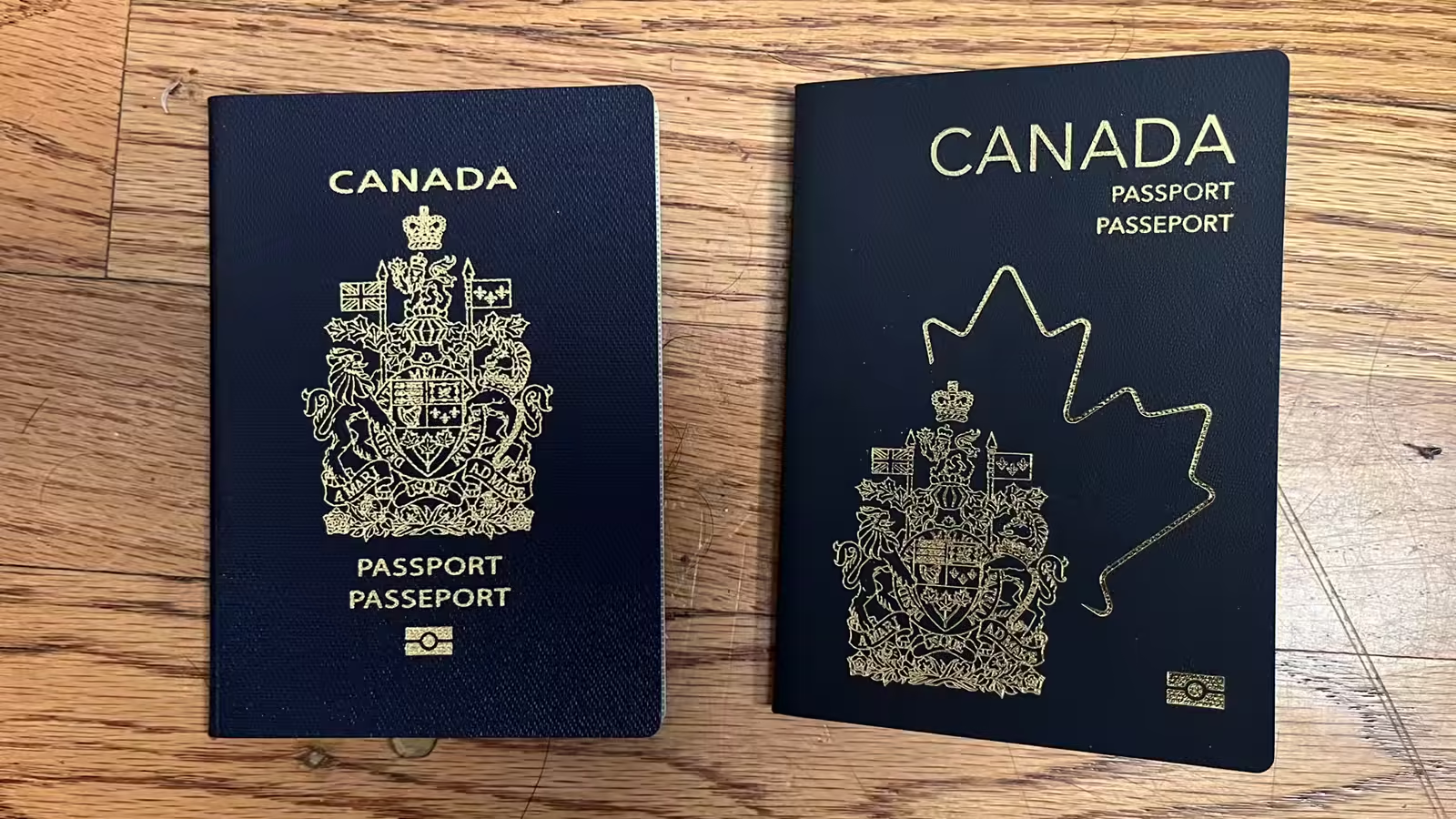

If you are searching for proof of funds Canada visitor visa rules, start with the direct answer: IRCC does not publish one fixed dollar minimum for a regular visitor visa. Instead, Immigration, Refugees and Citizenship Canada says you must have enough money for your stay, and that the amount depends on how long you will stay, whether you will stay in a hotel, and whether you will stay with friends or relatives. On the official visitor-visa apply page, IRCC also says your bank account statement should include the bank name and contact, proof the account is yours through your name and address, and at least 6 months of account details, including balances.
That distinction matters because many top-ranking pages still guess at a magic balance number. The live Canada.ca sources do not. They point officers toward a fuller story: your bank history, your job or income, who is paying, where you will stay, and why you are likely to leave Canada at the end of the visit. If you want the route-level prep first, start with Vidicy's Canada visa checklist.
| Checkpoint | Current official signal | Why it matters |
|---|---|---|
| Base visitor visa fee | CAN$100 starting fee on the visitor visa page | Your trip budget should account for application costs before flights and hotels. |
| Biometrics fee | CAN$85 individual or CAN$170 family max | Many applicants must budget for fingerprints and a photo too. |
| Bank statement depth | At least 6 months of account details | IRCC wants to understand your financial pattern, not just one closing balance. |
| Visitor stay length | Most visitors can stay up to 6 months | Trip cost planning has to match the length of the proposed stay. |
| Visa validity ceiling | A visa may be valid up to 10 years or until passport/biometrics expiry | Validity and allowed stay are different concepts. |
| Biometrics age range | Temporary-residence biometrics usually apply to applicants 14 to 79 | Family budgets and timelines change when multiple applicants need biometrics. |
At a glance
- Use this page when you want the actual IRCC logic for visitor funds instead of a guessed “minimum balance” number.
- Canada does not publish one fixed regular visitor-visa amount; enough money depends on stay length, hotel costs, and host support.
- IRCC still wants at least 6 months of bank-statement history for the visitor route.
- Funds matter, but they only help when the stay plan, job story, host support, and return-home logic all line up.
Table of Contents
- Proof of funds Canada visitor visa: the real IRCC rule
- What bank statements should show
- How much money is enough for a Canada visitor visa
- When sponsor or host money helps
- Funds alone do not win approval
- Fees, biometrics, and stay limits that affect your budget
- Common proof-of-funds mistakes IRCC will notice
- Official sources
- FAQ
- Conclusion
Proof of funds Canada visitor visa: the real IRCC rule
According to IRCC's live visitor visa eligibility page, you must show that you have enough money for your stay in Canada. The same page explains that the amount depends on:
- how long you will stay
- whether you will stay in a hotel
- whether you will stay with friends or relatives
That means there is no single official Canada visitor visa bank balance number that works for every traveler. A two-week family visit where accommodation is free is not assessed the same way as a six-month self-funded tourism plan with hotels across multiple cities.
This is the gap in the current SERP. Many ranking pages and videos try to turn proof of funds into a fixed number. The official sources do not. They focus on whether the money story is believable for your trip.
The official visitor visa overview also says most visitors can stay up to 6 months, while a visa itself may be valid for up to 10 years or until your passport or biometrics expire, whichever comes first. Those are different concepts:
- Visa validity tells you how long the document can be used to travel.
- Length of stay tells the officer how long your visit inside Canada is supposed to last.
If you confuse those two ideas, your funds plan can become unrealistic very quickly.
What bank statements should show
The clearest operational guidance is on IRCC's current apply page for a visitor visa. In the bank account statement section, IRCC says the document should help officers understand whether you have enough money to support yourself during your stay in Canada.
Specifically, IRCC says the statement should show:
- the bank name and contact
- proof that it is your account through your name and address
- at least 6 months of account details, including balances
That last point is more important than it looks. IRCC is not only checking whether you can produce money on one day. Officers are trying to understand your broader financial situation.
A stronger bank-statement package usually shows:
- stable incoming funds that make sense for your job or business
- normal account activity rather than a single last-minute transfer
- a balance that fits the length and style of the trip
- enough buffer to cover flights, accommodation, food, local transport, and the visa process itself
If your salary letters or HR papers are weak, tighten them before you rely on the bank balance alone. The work-and-income side of the file should match the statement pattern cleanly.
How much money is enough for a Canada visitor visa
The safest answer is not a number. It is a comparison:
| Trip pattern | What IRCC will likely compare | Stronger evidence set |
|---|---|---|
| Short hotel stay | hotel cost, flights, daily spending, bank history | recent itinerary, hotel bookings, 6 months of statements, salary or business proof |
| Staying with family or friends | lower accommodation cost, host letter, your own funds, return plan | invitation letter, host address, your own statements, relationship proof |
| Longer visit close to 6 months | bigger living-cost burden and stronger need to prove return ties | deeper bank history, employment or business proof, clear reason to return home |
| Family application | combined budget, biometrics fees, who pays for whom | coordinated statements, cover note, sponsor or lead applicant explanation |
The practical question is: does the money story match the itinerary story?
For example:
- A 10-day visit with free accommodation from close family may not need the same balance as a hotel-based trip.
- A planned 6-month stay with no strong host support will attract more scrutiny if the account balance looks thin or erratic.
- A family file gets harder to believe if one applicant has no visible income and the lead applicant's statements do not clearly support everyone.
If you want the broad version of this analysis first, use the route-neutral Bank Statement for Visa: What Officers Check. If you are building the full Canada package at the same time, pair this article with the Canada visitor visa checklist. If your real question is whether Canada visitor and study routes use the same bank-statement rules, use the dedicated Bank Statement for Canada Visa: Visitor vs Study guide next.
When sponsor or host money helps
Proof of funds is not always only your money. But sponsor-backed visitor files still need to make sense.
IRCC's official letter of invitation for visitors to Canada page says the host letter should include:
- the visitor's complete name, date of birth, address, and telephone number
- your relationship to the visitor
- the purpose of the trip
- how long the visitor plans to stay
- where the visitor will stay, and how the visitor will pay for things
- when the visitor plans to leave Canada
That payment detail is the key proof-of-funds link. If a host says they will cover accommodation or other costs, the rest of the file should support that claim with:
- the host's Canadian status document where relevant
- evidence of the host's address
- the host's financial capacity if they are paying for a meaningful part of the stay
- relationship proof so the officer understands why this support is credible
If you are building that letter now, use the Canada-specific invitation letter for visitor visa Canada guide. A host letter can strengthen the application, but it does not replace your own need to show a credible trip and credible ties to home.
Funds alone do not win approval
A high account balance by itself does not guarantee approval. IRCC's own rules say officers assess the whole story, including whether you will leave Canada at the end of the visit.
The easiest way to think about it is this:
- funds show whether the trip is affordable
- itinerary shows whether the trip is real
- employment, family, or business ties show why you are likely to return
Travel history can support that overall credibility too. This passport-stamp image is a useful reminder that previous compliant travel can help, but it still needs to fit the rest of the file:
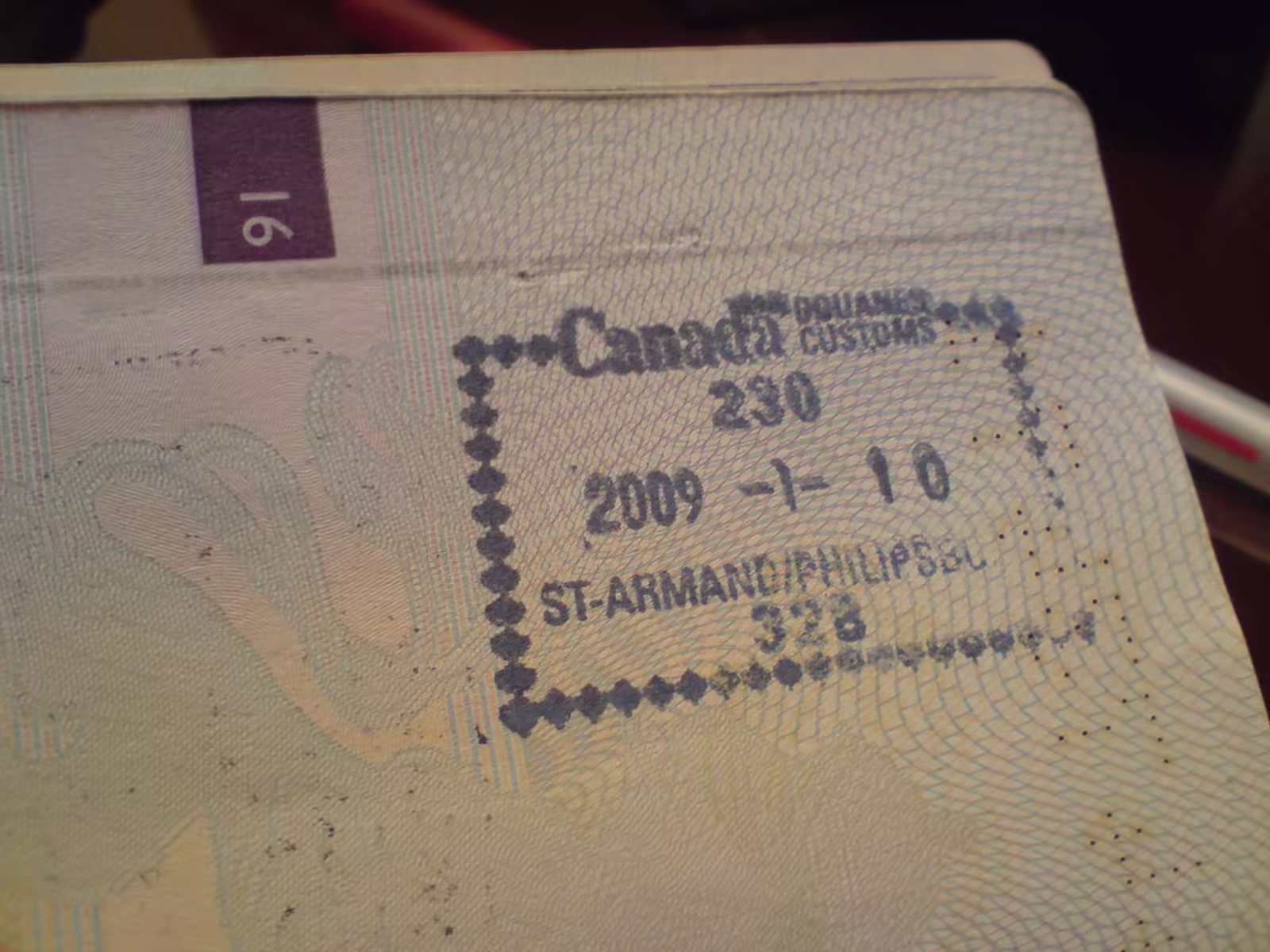
If the pattern across your documents is weak, officers will notice gaps quickly. Common examples include:
- a large unexplained deposit right before application
- employer letters that do not match salary credits
- a host letter promising accommodation while the itinerary shows hotel bookings
- a long stay plan with very limited visible funds
For the broader document-consistency side of the problem, review your itinerary, host letter, and return-ties evidence side by side before you submit.
This official IRCC video is not proof-of-funds-specific, but it is directly relevant because it explains how incomplete or inconsistent supporting documents create delays:
The video above is linked from an official Canada.ca page, so it is useful as a workflow companion while the written IRCC pages remain the final authority for numbers and document rules.
Fees, biometrics, and stay limits that affect your budget
Proof of funds is not only about daily spending money. You also need to budget for the application itself.
The official visitor visa overview currently lists the fee as starting from CAN$100. On IRCC's biometrics eligibility and instruction page, the biometrics fee is CAN$85 for one person or CAN$170 as the maximum for a family applying at the same time.
IRCC's biometrics guidance also says:
- temporary-residence biometrics generally apply to applicants aged 14 to 79
- if you already gave biometrics for temporary residence, they are generally valid for 10 years
- you can only give biometrics after IRCC sends the instruction letter
That matters because money planning is really timeline planning too. If your file is thin and IRCC asks follow-up questions, costs can expand beyond the base application fee.
This official IRCC biometrics infographic is useful because it shows the application and identity-check flow that sits around your proof-of-funds documents:

And this official video, linked from Canada.ca, explains the biometrics side in more detail:
If you want the whole trip budget and document sequence reviewed in one place instead of checking every file manually, the next practical step is how Vidicy works and then sign up when your draft application is ready.
Common proof-of-funds mistakes IRCC will notice
Most weak Canada visitor visa files fail on consistency, not on arithmetic alone.
| Mistake | Why it hurts | Better move |
|---|---|---|
| Treating proof of funds as a fixed magic number | IRCC does not publish one universal minimum for regular visitor visas | Match the money story to stay length, accommodation, and who pays |
| Uploading only one recent statement | IRCC says to show at least 6 months of account details | Provide a multi-month history with readable balances |
| Hiding sponsor dependence until the invitation letter | Officers need to understand who pays and how | Explain host support clearly and back it with documents |
| Showing a sudden large deposit with no context | It can look borrowed or temporary | Add a clear paper trail or do not rely on that deposit |
| Ignoring return ties because the bank balance looks high | Funds do not replace the need to show you will leave Canada | Add employment, business, study, or family-tie evidence |
| Planning a long stay with a thin hotel budget | Officers compare trip cost against visible resources | Shorten the plan or show stronger funding support |
The clearest pre-submit habit is simple: compare your bank statements, invitation letter, itinerary, and employment proof side by side. If they do not tell the same story, fix that before you upload anything.
Related guides
If you're building the rest of the application pack, these companion guides help:
- Bank Statement for Canada Visa: Visitor vs Study
- Bank Statement for Visa: What Officers Check
- UK Visitor Visa Bank Statement Requirement (2026)
- Canada Visitor Visa Checklist for 2026
- Invitation Letter for Visitor Visa Canada: Checklist
Official sources
- IRCC visitor visa eligibility: enough money for your stay
- IRCC apply page: bank account statement details and recommended documents
- IRCC visitor visa overview: processing-times note, CAN$100 starting fee, and stay/validity basics
- IRCC visitor visa: about the document, including up to 10-year validity and most visitors staying up to 6 months
- IRCC invitation-letter guidance for visitors to Canada
- IRCC biometrics eligibility and instruction page
- Official Canada.ca source page for “Save Time: Send a Complete Application”
- Official Canada.ca source page for “A step-by-step look at biometrics”
FAQ
Is there a fixed proof of funds amount for a Canada visitor visa?
No official fixed amount is published for a regular Canada visitor visa. IRCC says you must have enough money for your stay, and that the amount depends on the length of your visit and whether you will stay in a hotel or with friends or relatives.
How many months of bank statements should I show for a Canada visitor visa?
IRCC's current apply page says a bank account statement should include at least 6 months of account details, including balances. That is one of the clearest official numbers in the entire proof-of-funds process, so do not rely on a shorter statement set unless IRCC specifically asks for something different.
Can an invitation letter replace proof of funds?
No. An invitation letter can strengthen the file, especially when a host is paying for accommodation or some trip costs, but it does not replace the need for a believable financial story. Officers still assess whether the visitor's plan, host support, and overall circumstances make sense together.
Does a high bank balance guarantee a Canada visitor visa approval?
No. A large balance can help, but it does not guarantee approval. Officers still look at return ties, trip purpose, travel history, host support, and the consistency of the overall file. A strong account balance with a weak or contradictory story can still fail.
What extra costs should I include in my proof-of-funds planning?
At minimum, include the CAN$100 visitor visa fee and, if biometrics apply, CAN$85 per person or CAN$170 for a family applying together. You should also budget honestly for flights, accommodation, food, local transport, insurance, and any document or translation costs tied to the application.
Conclusion
The most accurate way to think about proof of funds Canada visitor visa rules is this: IRCC is not asking for a magic number. It is asking for a believable money story that fits your trip, your host arrangement, your job or income, and your return plan.
If you want that story reviewed as a full application instead of as isolated files, use the Canada visitor visa checklist as your final route-level companion before you submit.