

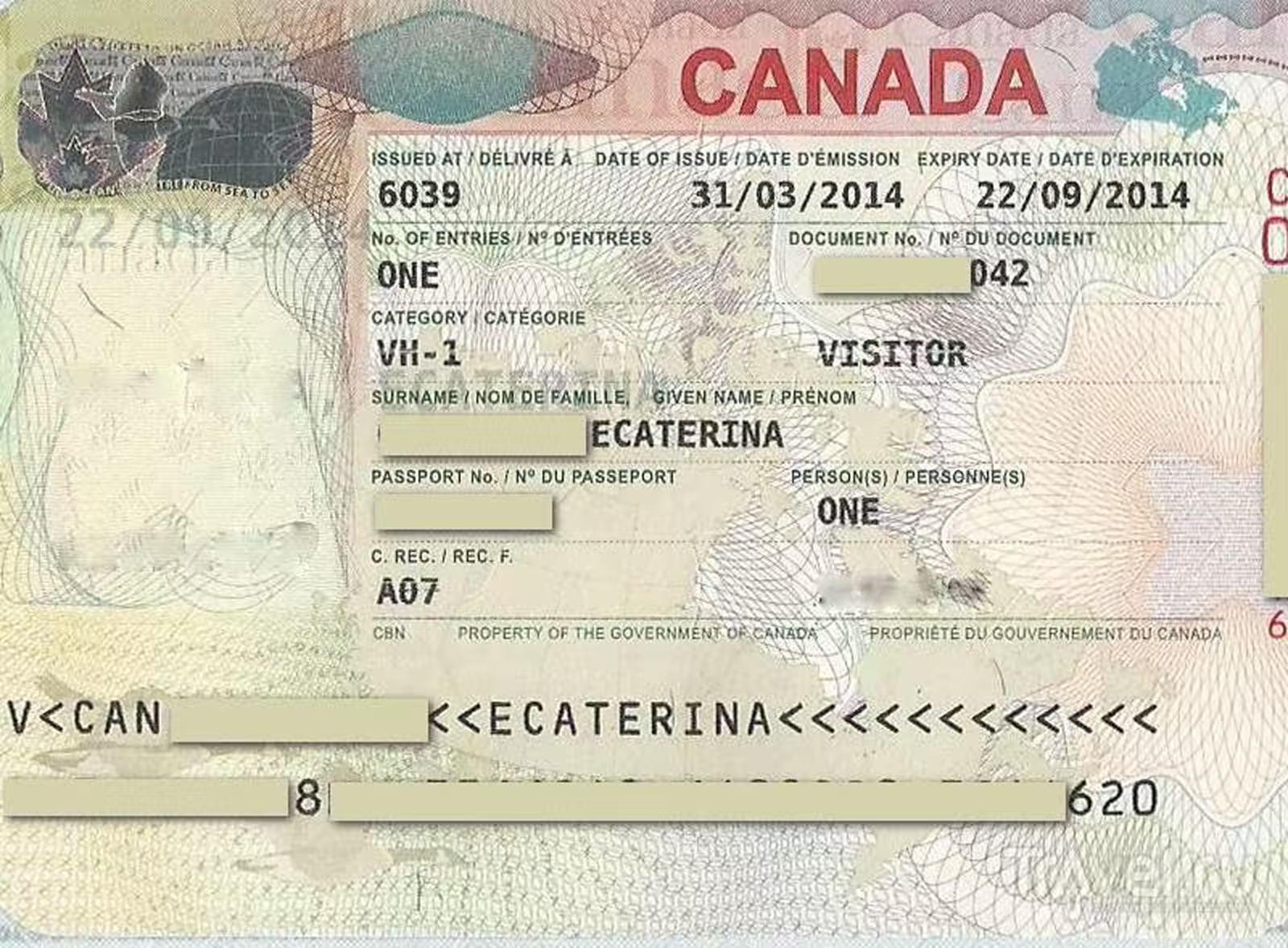

If you are searching for a Canada visitor visa checklist, start with this direct answer: most applicants need a clear colour copy of the passport page, an itinerary, bank statements, travel history, and often an employment letter. If you are 18 or older, IRCC also asks many applicants to complete Family Information (IMM 5645), and if you are visiting relatives, you should add an invitation letter and proof of relationship. As of March 5, 2026, the official IRCC visitor visa page lists the application fee as starting from CAN$100, and IRCC’s biometrics page lists CAN$85 for one person or CAN$170 for a family applying together.
If your purpose is specifically tourism (not a family visit or business travel), start with the scannable companion checklist: Canada Visitor Visa Checklist for 2026. For the deeper “what each document proves” breakdown, use: Canada Visitor Visa Checklist (2026). If the traveller is a parent or grandparent planning a longer family stay, switch to the dedicated Super Visa Checklist Canada instead of forcing a regular visitor checklist onto the wrong IRCC route.
That is the short version. The more useful version is that Canada does not publish one universal “upload these 10 files and you are done” rule. On the official IRCC apply page, the documents change based on whether you are applying as a tourist, for a family visit, or as a business visitor. IRCC also says some items are recommended, not mandatory, and that submitting every listed document still does not guarantee approval. If you want the document-by-document version of that question before you start checking files off, use Canada Visitor Visa Checklist (2026).
This guide turns those official rules into a practical 2026 checklist you can actually use before you upload anything. If you want the route-level version first, start with Vidicy’s Canada visa checklist. If you are still deciding whether the real Canada route is visitor, study, or spouse sponsorship, compare this article with Canada Visa Document Checklist for 2026 before you assemble the evidence pack. If your case is actually a college or university program, switch to Documents Required for Canada Student Visa (2026) because the study-permit pack adds an LOA, PAL/TAL rules, and a different proof-of-funds test. If IRCC has already refused the case and you are deciding whether to rebuild or reapply, use Canada Visa Refused: What to Fix Before Reapplying as the refusal-specific companion guide.
| Item | What IRCC expects | Why it matters |
|---|---|---|
| Visitor visa fee | Starting from CAN$100 | Your application is not complete without the correct fee. |
| Biometrics fee | CAN$85 individual, CAN$170 family max | Many applicants need fingerprints and a photo after applying. |
| Bank statements | At least 6 months of account details | IRCC uses this to understand whether you can support yourself. |
| Employer letter | Dated no earlier than 3 months before you apply | Shows stable work, leave approval, and a reason to return home. |
| Super Visa distinction | Up to 5 years at a time, multiple entries up to 10 years | Useful if you are actually visiting children or grandchildren long-term. |
Table of Contents
- Canada visitor visa checklist: what IRCC actually asks for
- Required and recommended documents for most applicants
- How to prove funds, travel purpose, and ties to home
- Fees, biometrics, forms, and processing times
- Common mistakes that weaken a Canada visitor visa file
- FAQ
- Conclusion
Canada visitor visa checklist: what IRCC actually asks for
The most important detail in the official rules is that your reason for travel controls the checklist. On IRCC’s live visitor visa application page, the government separates the workflow into tourist, business visitor, family visit, and a few other special cases. That means there is no single static Canada visitor visa checklist PDF that perfectly covers every case.
There is an official IMM 5484 document checklist, and it is still useful as a prep sheet. But the current IRCC apply page is the stronger source because it breaks the documents down by trip type and says clearly that:
- not every listed document is required in every case
- the list is not exhaustive
- IRCC may ask for more information
- even a complete file is not a promise of approval
That is why the safest approach is to treat your checklist in two layers:
- Core file: passport, finances, itinerary, travel history, and identity forms.
- Purpose-specific proof: invitation letter, proof of relationship, event registration, or employer support depending on why you are traveling.
If you are still organizing the full package, how to prepare visa application documents is the best companion read before you upload.
Required and recommended documents for most applicants
Below is the most practical Canada visitor visa checklist for a normal tourist or family-visit case in 2026, based on the current IRCC apply flow plus the official checklist PDF.
1. Passport or travel document copy
IRCC asks for a clear colour copy of the valid passport or travel document you will use to travel to Canada. If you have a passport, the current apply page says you should include:
- the page showing your birth date and country of origin
- any pages with stamps, visas, or markings
This is one of the simplest files to submit, but applicants still get it wrong by uploading only the bio page and ignoring travel stamps that support their history.
2. Family Information form
For many tourist and family-visit applications, IRCC says each applicant 18 years or older must complete Family Information (IMM 5645). That matters because the form gives IRCC a faster way to compare the application story with the rest of your file.
3. Travel history
IRCC recommends copies of previous visas, entry and exit stamps, old passports, or study and work permits that show you have traveled outside your home country in the last 10 years. Travel history is not a guarantee of approval, but it can help prove that you have complied with previous visas.
4. Itinerary
IRCC says your itinerary can include copies of:
- flight details
- proof of accommodation
- event registration
This is where many “tourist” files become weak. The booking dates, hotel dates, and leave dates all need to tell the same story. If they do not, the problem is not just “missing paperwork.” It becomes a credibility problem.
5. Bank account statements
On the official apply page, IRCC says bank statements should show:
- the bank name and contact
- proof the account is yours through your name and address
- at least 6 months of account details, including balances
That six-month detail is important because it shows IRCC is not just looking for one high closing balance. Officers want to understand the pattern behind your money.
If funds are the part you are least confident about, use the dedicated proof of funds guide before you submit. If you want the Canada-specific version of that question, read Proof of Funds Canada Visitor Visa: What to Show before you upload your bank history.
6. Employer letter
IRCC’s business and family-visit sections both explain what a good employer letter should contain. The letter should be on official letterhead and dated no earlier than 3 months before you apply. It should include:
- confirmation that you have a job
- your full name and date of birth
- the date you started work
- a short job description
- current salary
- manager contact information
- employer name and address
- signature from your manager or HR contact
This is one of the cleanest ways to prove ties to home. If you need a template or a checklist for HR, use the employment letter guide.
7. Invitation letter and proof of relationship
For a family visit, IRCC says you should include a copy of the letter from the family member inviting you to Canada. The same section also points to relationship evidence such as:
- marriage certificate
- birth certificate
- official document naming you as a parent
Do not treat the invitation letter as magic. It helps prove the purpose of the visit, but it does not replace finances, employment evidence, or return-tie documents. If your whole trip is built around visiting relatives, use the dedicated Canada family visitor visa documents checklist before you upload the family evidence. If you need the Canada-wide version of that question before you draft the host note, use Invitation Letter for Visa Canada. It separates regular visitor letters from business invitations and super visa support letters. If you need the host-letter structure itself, use this invitation letter for visitor visa Canada guide before you draft it. If the applicant also needs one short document that ties the whole file together, use this cover letter for Canada visitor visa guide after the checklist is assembled.
8. Minor child documents
If a child under 18 travels with only one parent, with a friend or relative, or alone, IRCC says you may need:
- a travel authorization letter
- custody documents
- adoption papers, where relevant
This is exactly the kind of document family applications forget until the last minute.

How to prove funds, travel purpose, and ties to home
A strong Canada visitor visa checklist is not only a list of documents. It is a list of documents that support the same explanation.
There is no single official money threshold
On the visitor visa eligibility page, IRCC says you must have enough money for your stay, but it also says the amount depends on:
- how long you will stay
- whether you are staying in a hotel
- whether you are staying with friends or relatives
That means Canada does not publish one universal tourist-visa bank balance number that works for everyone. A believable financial story matters more than chasing a random figure from forums or YouTube comments.
What a believable financial story looks like
For most visitor visa cases, your finances should show:
- consistent income or a clear source of funds
- enough balance to cover flights, accommodation, and daily costs
- no suspicious last-minute deposits that you cannot explain
- a stable pattern over time, not a one-day spike
If you are staying with relatives, your invitation letter and accommodation details should match the financial explanation. If you say you will stay with family for free, but your file still shows hotel bookings in another city, you create unnecessary questions.
Ties to home country still matter
IRCC’s eligibility page says you must convince an officer that you:
- will leave Canada at the end of your visit
- have ties such as a job, home, financial assets, or family that will take you back
That is why a good checklist often includes more than the bare minimum. Even if a lease, property record, or family dependency document is not listed as “required,” it can still strengthen the story.
For a practical list of what goes wrong when those details do not line up, read why visa applications get rejected because of document mistakes.
Walkthroughs can help you see what a complete upload package looks like in practice:
The video above is useful for package structure, but use IRCC’s live pages for the final rule check.
Fees, biometrics, forms, and processing times
Visitor visa fee
The official IRCC visitor visa overview currently lists the fee as starting from CAN$100. That is the base number most travelers search for, but you should budget for biometrics too if IRCC requires them in your case.
Biometrics fee
IRCC’s biometrics instructions list these current fees:
- CAN$85 for an individual applicant
- CAN$170 maximum for a family applying at the same time
The same page also says you should pay the biometrics fee when you apply or you may face delays.
Photos and biometrics
The official IMM 5484 checklist says to include two photos that meet visa photograph specifications, but it also says that if you must provide biometric fingerprints and a biometric photo, you do not need to include paper photos with the application.
That single note saves applicants from uploading or mailing unnecessary files.
If the photograph itself is the part you want to isolate first, use the dedicated Canada visa photo requirements guide. It separates the visitor-visa photo spec from passport photos and biometrics, which is where many Canada applications get mixed up.
Processing times
IRCC does not publish one fixed global processing time for every visitor visa case. On the official visitor visa page, it says processing times vary based on factors like:
- the type of application submitted
- whether the application is complete
- how easily IRCC can verify your information
- how quickly you respond to follow-up requests
Use the live IRCC processing times tool instead of relying on old blog posts or “my cousin got approved in 12 days” anecdotes.
Super Visa is a different route
If you are visiting children or grandchildren for a longer stay, do not confuse a normal visitor visa with a Super Visa. IRCC says a Super Visa allows visits of 5 years at a time and can provide multiple entries for up to 10 years. That is a separate workflow with its own requirements. Use the dedicated Super Visa checklist for parents and grandparents when the case needs host-income proof, 1-year insurance, and the super-visa medical-exam flow rather than a normal short-stay visitor file.
If you are unsure which route fits your case, start with how Vidicy works and then move into a case-specific checklist before you upload.
For a form-specific walkthrough, this IMM 5257 tutorial is useful as a visual companion:
If you want a second video focused on the form itself rather than the upload flow, this IMM 5257 walkthrough is worth a quick pass.
Common mistakes that weaken a Canada visitor visa file
The most common Canada visitor visa checklist mistakes are not dramatic. They are small inconsistencies that make the file feel unreliable.
| Mistake | Why it hurts | Better move |
|---|---|---|
| Uploading only the passport bio page | You lose the travel-history evidence shown by stamps and visas | Include the bio page plus stamped or marked pages |
| Showing only one recent bank statement | IRCC asks for at least 6 months of account details on the apply page | Upload a clean multi-month statement set |
| Using an old employer letter | IRCC wants a letter dated no earlier than 3 months before you apply | Request a new HR letter right before submission |
| Treating the invitation letter as enough by itself | An invitation does not replace funds, ties, or travel logic | Pair it with finances, employment, and relationship proof |
| Using conflicting dates across flight, hotel, and leave documents | Officers compare the package as one story | Cross-check every date before upload |
| Guessing at processing times from forums | Timelines vary and old anecdotes go stale quickly | Check the live IRCC tool instead |
The second-level mistake is assuming “recommended” means “irrelevant.” In visitor visa files, recommended documents often become the evidence that makes your story believable.
Illustration credits: the stamp spread image is adapted from Wikimedia Commons, Passport stamps 18-19 by Jon Rawlinson (CC BY 2.0).

If you want a final pre-submit sweep after you assemble the documents, create a Vidicy account and run the file through a structured review before you send it to IRCC.
Related guides
If you're building the rest of the application pack, these companion guides help:
- Canada Visitor Visa Checklist for 2026
- Canada Visitor Visa Checklist for 2026
- Invitation Letter for Visitor Visa Canada: Checklist
Official sources
- IRCC apply page
- IMM 5484 document checklist
- visitor visa eligibility page
- IRCC visitor visa overview
- biometrics instructions
- IRCC processing times tool
FAQ
What is the official Canada visitor visa checklist PDF?
The closest official printable checklist is IMM 5484, but the current IRCC apply page is more useful because it builds the document list around your travel purpose. Use the checklist as a prep sheet, then confirm everything against the live IRCC workflow.
How much bank balance is required for a Canada visitor visa?
IRCC does not publish one fixed balance for every traveler. The official eligibility page says the amount depends on the length of stay and whether you are staying in a hotel or with friends or relatives. What matters is a believable financial story supported by at least 6 months of account history.
Is an invitation letter mandatory for a Canada visitor visa?
Not for every case. It becomes relevant when you are visiting family or a business contact in Canada. The invitation letter helps confirm the purpose of the visit, but it does not replace proof of funds, travel plans, or ties to your home country.
Do I need biometrics for a Canada visitor visa?
Many applicants do, but it depends on nationality and application history. If biometrics are required, IRCC’s current fee is CAN$85 for one person or CAN$170 for a family applying together, and IRCC says you should pay that fee when you apply to avoid delays.
How recent should my employer letter be?
IRCC’s current visitor visa guidance says the letter should be dated no earlier than 3 months before you apply. Older letters can make your work, leave dates, or salary details look stale.
How long does a Canada visitor visa take in 2026?
There is no single fixed 2026 processing time for every case. IRCC says timelines vary based on completeness, verification needs, and follow-up requests, so the safest answer is to check the live processing-times tool right before you apply.
Conclusion
The best Canada visitor visa checklist for 2026 is not a generic forum list. It is a case-specific package built from IRCC’s current apply flow: passport copy, family information where required, travel history, itinerary, bank statements, employer support, and invitation or relationship evidence when your trip involves family or business contacts.
The highest-signal numbers to remember are straightforward: CAN$100 starting fee, CAN$85 biometrics for one person, CAN$170 biometrics for a family, 6 months of bank-history detail, and an employer letter dated within the last 3 months. Get those basics right, then make sure every date and document supports the same story.
If you want a checklist that adapts to your case before you submit, open Vidicy’s Canada visa checklist. If you want the full workflow that checks the whole file for quiet mismatches, start with how Vidicy works.