


A super visa checklist is the document stack parents and grandparents need before they apply for Canada's long-stay family-visit route. The shortest accurate answer is this: IRCC expects a signed invitation letter from the child or grandchild in Canada, proof the host meets the minimum necessary income, proof of relationship, proof of health insurance with at least $100,000 in emergency coverage for 1 year, proof of a medical exam, and any local visa office instructions that apply where the parent or grandparent is filing. According to IRCC, a super visa can allow multiple entries for up to 10 years, and applicants who apply on or after June 22, 2023 are eligible to stay for 5 years at a time.
That matters because a super visa is not just a regular Canada visitor visa with a longer invitation letter. It is a separate checklist with extra host-income and insurance rules. If you want the route-level filing workflow first, start with Vidicy's Canada visa checklist. If you are still comparing the normal short-stay route against the longer family-visit route, use the companion Canada visitor visa checklist before you upload anything.
| Route point | Super visa rule | Normal visitor visa rule |
|---|---|---|
| Who it is for | Parents and grandparents of people in Canada | Tourists, family visitors, and business visitors |
| Stay per entry | 5 years at a time for current applications | Usually up to 6 months |
| Visa validity | Multiple entries for up to 10 years | May also be issued as single or multiple entry, depending on the case |
| Insurance | Mandatory, minimum $100,000, valid 1 year from entry | Not a standard mandatory visitor-visa document |
| Host income rule | Mandatory minimum necessary income | No super-visa income table |
| Base visa fee | CAN$100 | CAN$100 |
Table of Contents
- What goes on a super visa checklist
- Host income rules and the current minimum income table
- Insurance, medical exam, and stay-length rules
- How to apply without weakening the file
- Official sources
- FAQ
- Conclusion
What goes on a super visa checklist
The current IRCC forms-and-documents page is the best place to start because it breaks the route into the exact proof buckets officers review first.
Use this super visa checklist before you submit:
- Signed invitation letter from the child or grandchild in Canada
- Proof the host meets the minimum necessary income
- Proof of the host's status in Canada
- Proof you are the parent or grandparent of the host
- Proof of health insurance that matches IRCC's coverage rules
- Proof of a completed immigration medical exam
- Any extra local visa office instructions for the country of application
IRCC is unusually specific about what the host letter has to say. The letter must include:
- proof that the host meets or exceeds the income threshold
- the list and number of people included in the family-size count
- the name and date of birth of each person counted
The host can also use a co-signer, but not just anyone. IRCC says only the host child's or grandchild's spouse or common-law partner can co-sign, and that person also needs qualifying status in Canada. Siblings and other relatives cannot co-sign.
For relationship proof, IRCC says it accepts a copy of the host's birth certificate, baptismal certificate, or another official document naming you as the parent or grandparent. That is a simple rule, but it is one of the easiest parts of the file to weaken if names do not match the passport or if a translation is missing.
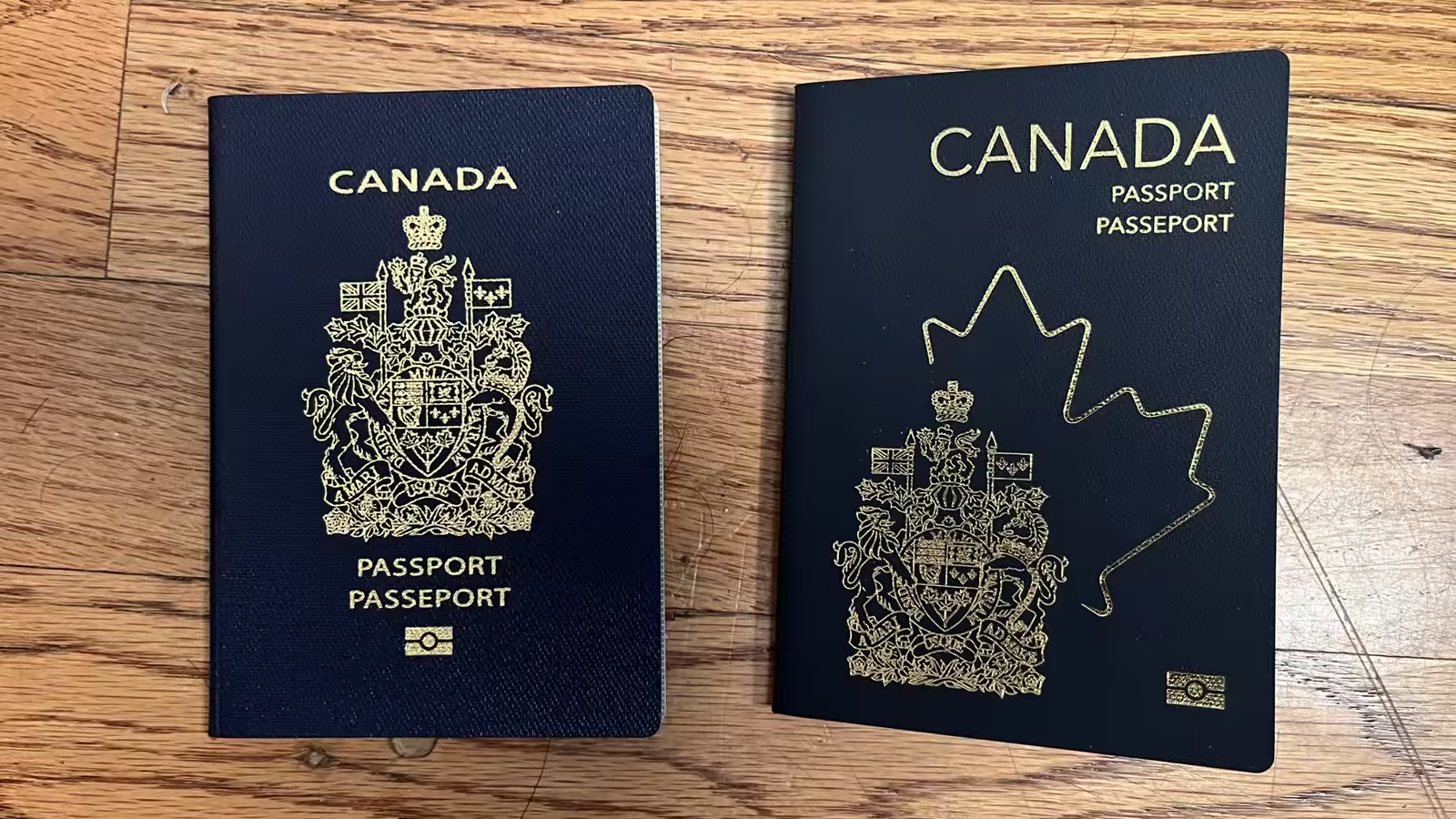
Image source: Family Airport Travel, Wikimedia Commons, CC BY-SA 3.0.

If the invitation-letter wording is the part you want to fix first, use the route-specific invitation letter for visitor visa Canada guide. If the bigger problem is making the entire pack consistent, Vidicy's How It Works page is the better starting point because it lets you review the host letter, funds, and identity documents together instead of one by one.
Host income rules and the current minimum income table
The host-income step is what separates a super visa checklist from a normal Canada visitor visa checklist.
IRCC says the host's invitation letter must include proof that the host can financially support the parent or grandparent during the stay. The government also explains how to calculate the correct family size. The count includes:
- the invited parent or grandparent and any other super visa applicants being supported
- the host child or grandchild in Canada
- the host's spouse or common-law partner
- dependent children of the host or spouse or common-law partner
- previously approved super visa applicants still covered by another active invitation
- previously sponsored people whose sponsorship undertaking is still in effect
That last point trips people up. A host can look financially strong, but still fail the checklist if they calculate family size too narrowly.
Here is the current IRCC table for the minimum income your host needs, in Canadian dollars:
| Family size | Minimum income |
|---|---|
| 1 | $30,526 |
| 2 | $38,002 |
| 3 | $46,720 |
| 4 | $56,724 |
| 5 | $64,336 |
| 6 | $72,560 |
| 7 | $80,784 |
| Each additional family member over 7 | Add $8,224 |
Two parts of the income rule matter:
Option 1: The standard proof path
IRCC says the host can prove income by showing their total income, including a co-signer's income if one is allowed, meets or exceeds the minimum amount in either of the 2 tax years before the application is submitted. The preferred document is the Canada Revenue Agency notice of assessment.
Option 2: The partial-year flexibility rule
IRCC now also says the host can qualify if their total income in the year before the application is submitted was at least 75% of the minimum required amount, as long as the applicant's own income covers the rest and the combined amount still meets the threshold.
That is useful, but it does not mean the supporting documents can be vague. IRCC lists the acceptable proof categories clearly:
- notice of assessment from the CRA
- T4 or T1 for the last tax year
- pay stubs for the most recent 12-month period available
- an original employer letter stating job title, job description, and salary
- bank statements showing regular employment, pension, or investment income
- proof of other income such as pension statements or rental income
If the parent or grandparent is adding their own income to reach the threshold, IRCC says the documents must also prove that the applicant will continue to earn income while in Canada and must show the currency they are paid in.
This is why the cleanest super visa checklist is not just "host income" and "applicant income" as separate folders. It is a story about whether the combined household support is real, documented, and stable. If you need help checking how those numbers interact with the rest of the file, compare your pack against the proof of funds guide before you submit.
Insurance, medical exam, and stay-length rules
Insurance is where many weak super visa files quietly fail.
IRCC says you must have proof of a health insurance policy on each entry to Canada. The policy must:
- be issued by a Canadian insurance company or by an eligible foreign insurer that is authorized by OSFI and doing insurance business in Canada
- be valid for a minimum of 1 year from the date of entry
- be paid in full or in instalments with a deposit
- cover health care, hospitalization, and repatriation
- provide a minimum emergency coverage of $100,000
- be valid for each entry to Canada
IRCC also says quotes are not accepted. That is one of the most useful checklist details on the page because many applicants still attach a quote or broker summary instead of an actual paid policy.
Image source: Passport documents desk (Unsplash), Wikimedia Commons, CC0 1.0.
.jpg)
The medical-exam rule is simpler: IRCC says you must provide proof that you had a medical exam with an approved panel physician.
Then there is the stay-length rule, which many search results still describe incorrectly. IRCC's current length-of-stay page says:
- if you applied on or after June 22, 2023, you are eligible to stay for 5 years at a time
- super visas can allow multiple entries for up to 10 years
- if you need even more time after a current authorized stay, you may be able to apply to extend your stay
That is why a super visa is not interchangeable with a standard hosted visitor visa. A normal hosted visit can still be the right route if the stay is short and the trip is ordinary. But if the real travel plan is a longer parent-or-grandparent visit, the super visa checklist is the safer route to follow.
How to apply without weakening the file
The fastest way to improve a super visa checklist is to make every document answer one of the same four questions:
- Are you really the parent or grandparent of the host?
- Can the host and applicant really support the stay?
- Does the insurance and medical evidence match IRCC's actual rule set?
- Is the application complete for the local visa office and biometrics process?
Use this practical filing order:
1. Lock the route first
Make sure the parent or grandparent is not accidentally building a standard visitor-visa file. If you are still comparing routes, read the Canada visitor visa checklist first and decide there, because the two routes overlap in some documents but not in the income and insurance rules.
2. Build the host letter around the family-size count
Do not write the invitation letter first and calculate the family size later. IRCC requires the letter to include the people counted and their names and dates of birth, so the math and the letter have to be drafted together.
3. Match the income proof to the route you are using
If the host qualifies under the 2-tax-year rule, use the notice of assessment path cleanly. If you need the 75% rule plus the applicant's own income, say that plainly and document both sides. Do not mix the two approaches halfway through the file.
4. Treat insurance like a checklist item, not a shopping screenshot
IRCC wants a paid policy with the insurer name, coverage, and validity. A quote, a half-finished application, or a vague broker email is not the same thing.
5. Do not forget the standard visitor-visa mechanics
Even though the route is a super visa, the base visitor-visa mechanics still show up in the file. Canada's official visitor-visa page currently lists the fee as starting from CAN$100. IRCC's biometrics guidance lists CAN$85 for one person and CAN$170 as the family maximum when eligible people apply together at the same time. The visitor-visa page also says processing times vary by country.
IRCC's Canada.ca video page links this official reminder about avoiding incomplete applications:
6. Check the local visa office instructions last, not first
IRCC's forms-and-documents page says your visa office may require additional documents. That means the local instruction sheet is the final route-specific layer, not a substitute for the core IRCC checklist above.
The most common super visa checklist mistakes are predictable:
- the host miscounts family size
- the invitation letter leaves out names or dates of birth for counted household members
- the insurance document is only a quote
- the income proof shows one story, but the employer letter or bank deposits show another
- the applicant uses a normal visitor-visa template for a parent-or-grandparent long stay
If you want a second set of eyes before you submit, Vidicy can help you compare the income proof, invitation letter, and identity documents in one pass. Start with How It Works or go straight to sign up.
Related guides
If you're building the rest of the application pack, these companion guides help:
- Canada Visitor Visa Checklist for 2026
- Canada Visitor Visa Checklist for 2026
- Invitation Letter for Visitor Visa Canada: Checklist
- Proof of Funds Canada Visitor Visa: What to Show
Official sources
- Super visa for parents and grandparents
- Super visa forms and documents
- Proof of financial support for a super visa
- How long you can stay in Canada on a super visa
- Visitor visa (temporary resident visa)
- Application for a Visitor Visa (Temporary Resident Visa - TRV)
- Canada.ca video page: Save Time: Send a Complete Application
FAQ
Is a super visa the same as a normal Canada visitor visa?
No. A super visa is the parent-and-grandparent family-visit route. It adds extra host-income, insurance, and medical-exam rules that do not apply the same way in a normal hosted visitor-visa file. The biggest practical difference is that current super visa holders can stay 5 years at a time instead of the usual up to 6 months.
How much income does the host need for a super visa?
It depends on the full family-size count, not just the invited parent or grandparent. IRCC's current table starts at $30,526 for a family size of 1, $38,002 for 2, and $80,784 for 7, with $8,224 added for each extra person above 7.
Can the host use a co-signer on the invitation letter?
Yes, but only in a narrow way. IRCC says the host child's or grandchild's spouse or common-law partner can co-sign and provide income proof if that person has qualifying status in Canada. Other relatives, including siblings, cannot co-sign the super visa invitation letter.
Does super visa insurance have to come from a Canadian company?
Not always. IRCC says the policy can come from a Canadian insurance company or from an eligible foreign insurer that is authorized by OSFI and doing insurance business in Canada. The policy still needs at least $100,000 in emergency coverage and must be valid for 1 year from entry.
How long can parents or grandparents stay on a super visa now?
For applications made on or after June 22, 2023, IRCC says eligible travellers can stay for 5 years at a time. The visa itself may allow multiple entries for up to 10 years. Those are different numbers, so do not confuse visa validity with the maximum stay on one entry.
What is the current government fee for a super visa application?
The base visitor-visa filing fee currently starts at CAN$100. If biometrics are required, IRCC currently lists CAN$85 for one person and CAN$170 as the family maximum for eligible people applying together. Insurance and the medical exam are separate costs on top of the filing fee.
Conclusion
The best super visa checklist is not just a folder of PDFs. It is a clean match between the host letter, the family-size calculation, the income proof, the insurance policy, the medical exam, and the parent-or-grandparent relationship evidence. If one of those parts drifts, the whole application feels weaker than it should.
If you want a case-aware review before the file reaches IRCC, start with Vidicy's Canada visa checklist, then move into the full document review workflow or create a workspace.