



If you need a study visa checklist Canada applicants can actually use in 2026, start with the official IRCC baseline: most outside-Canada applicants need a valid passport or travel document, a letter of acceptance (LOA), a provincial or territorial attestation letter (PAL/TAL) in most cases, proof of funds for tuition + living expenses + return transportation, and any extra documents triggered by biometrics, medical, police, or local visa-office rules. As of April 18, 2026, the official study permit fee is CAN$150, the biometrics fee is CAN$85 for one person, and a single applicant outside Quebec filing on or after September 1, 2025 must show CAN$22,895 in living funds, excluding tuition and transportation.
This article is for students applying from outside Canada for studies longer than 6 months. It is built as a practical checklist, not a recycled SDS-era study-abroad post. If you want the route-level workflow first, start with Vidicy’s Canada visa checklist. If you are still sorting whether your Canada file belongs under a visitor, study, or spouse-sponsorship route, use Canada Visa Document Checklist for 2026 before you drill into the study-permit details. If you already know Canada is the route and want the document order that keeps weak study-permit files from being returned, this is the faster read.
| Checklist item | Current official rule | Why people still miss it |
|---|---|---|
| LOA | Always required; post-secondary LOAs are validated by the school | Applicants upload the PDF but never confirm school-side validation |
| PAL/TAL | Needed in most cases and must be filed with the application | Older guides still act as if the 2024 cap changes never happened |
| Passport + photos | Passport copy plus 2 recent passport-size photos with name and date of birth on the back | Applicants assume the bio page alone is enough |
| Proof of funds | Must cover tuition, living costs, and return transportation; bank statements can cover the past 4 months | Search results keep flattening visitor and study rules into one fake checklist |
| Letter of explanation | Recommended by IRCC | Many applicants skip the one document that connects the whole file |
| Biometrics | Usually required for ages 14 to 79; give them within 30 days of the instruction letter | People pay late or treat biometrics like an optional follow-up |
At a glance
- Use this page when you want a Canada student visa checklist that matches live IRCC rules rather than old SDS advice.
- The core pack is: passport, LOA, PAL/TAL in most cases, funds proof, letter of explanation, and any conditional medical, police, custodian, or country-specific documents.
- Canada calls this route a study permit, not a student visa, even though searchers use “study visa” as shorthand.
- The newest rule many guides still miss: from January 1, 2026, many public master’s and doctoral students no longer need a PAL/TAL.
Table of Contents
- Study visa checklist Canada: what the route actually is
- The always-required documents IRCC checks first
- Money checklist: what proof of funds must cover
- PAL, TAL, Quebec CAQ, and the 2026 graduate exception
- Apply online, pay the right fees, and finish biometrics on time
- Common missing items that still get study-permit files returned
- Official sources
- FAQ
- Conclusion
Study visa checklist Canada: what the route actually is
A lot of searchers say Canada study visa, but IRCC’s official term is study permit. That matters because the permit and the entry document are not the same thing.
IRCC’s study-permit tool says that if your program lasts more than 6 months, you need a study permit before you travel. IRCC also says the permit itself is not a visa. If your application is approved, Canada automatically issues either a visitor visa (TRV) or an eTA, depending on the passport or travel document you hold.
That distinction matters for checklist logic:
- the study permit is the authorization to study
- the TRV or eTA is what lets you travel to Canada
- the document pack has to support both the academic plan and the travel identity check
If your goal is a broader route comparison before you pay any fee, use Documents Required for Student Visa in 2026. If you already know Canada is the route, keep this checklist open beside Documents Required for Canada Student Visa (2026), which goes deeper on the supporting logic behind each item.
The always-required documents IRCC checks first
IRCC’s Get the right documents page is the cleanest current source because it splits the checklist into always-required, needed-in-most-cases, recommended, and conditional items.
1. Letter of acceptance from a DLI
IRCC says your school gives you the LOA, and you upload it to the online application. For post-secondary students, IRCC adds a rule many generic blog posts skip: the school will be asked to confirm that the LOA is valid. If the school does not respond by the deadline, IRCC says the application will be returned and the processing fee will be refunded.
That means a real 2026 student visa checklist Canada should include two separate tasks:
- get the LOA itself
- confirm that the school is ready to validate it after you apply
2. Passport or travel document plus 2 photos
IRCC says you must upload the information page of a valid passport or travel document when you apply online. The same page says you also need 2 recent passport-size photos, and that the name and date of birth of the person must be written on the back of each photo.
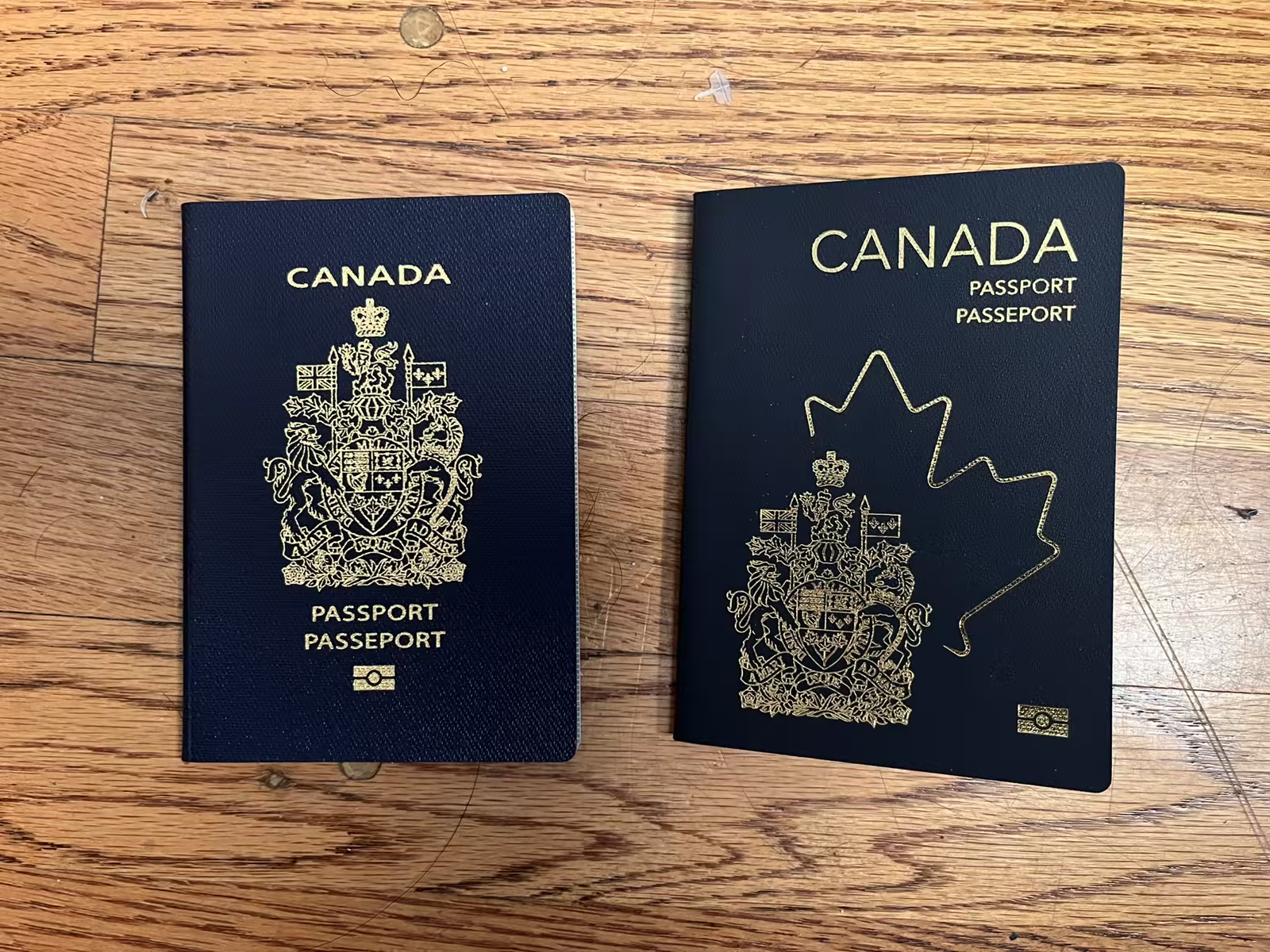
This is where applicants underestimate local instructions. IRCC’s study-permit document page explicitly says there may be other documents based on the country or territory you apply from, and that you should use the local visa-office instructions to see them before you submit.
3. Proof of funds
IRCC treats funds as an always-required part of the file. The study-permit finance page says you must prove you can pay for:
- tuition fees
- living expenses
- transportation to and from Canada
That is why the statement, GIC, tuition receipt, loan letter, or sponsor evidence has to match the full first-year plan, not just a single balance snapshot. If money evidence is the weak point in your file, keep the route-neutral proof of funds guide and the Canada-specific bank statement for Canada visa guide open while you build this section.
4. Letter of explanation
IRCC lists the letter of explanation as recommended, but in practice it is one of the highest-value documents in a Canada study-permit file because it lets you explain:
- why you chose the school and program
- how the funds story works
- what you understand about your responsibilities as an international student
The key rule is simple: the letter should organize the evidence, not replace it.
Money checklist: what proof of funds must cover
IRCC’s proof of financial support page is precise about both the amount and the acceptable document types.
As of September 1, 2025, IRCC says a study-permit applicant outside Quebec needs these first-year living amounts, excluding tuition and transportation:
| Family members included | Amount required per year |
|---|---|
| 1 | CAN$22,895 |
| 2 | CAN$28,502 |
| 3 | CAN$35,040 |
| 4 | CAN$42,543 |
IRCC also says you can prove the funds requirement with documents such as:
- proof you paid first-year tuition and housing
- a Canadian bank account in your name
- a Guaranteed Investment Certificate (GIC)
- proof of a student or education loan
- bank statements for the past 4 months
- a bank draft convertible to Canadian dollars
- a letter from the person or institution giving you money
- scholarship or Canadian-funded support evidence
That is the part most generic “Canada student visa checklist” posts flatten badly. The official rule is not “show one bank statement.” The rule is “show that the first year works financially, and explain how the rest of the program will be paid for if it lasts longer than a year.”
If your funding plan depends on parents, sponsors, or loans, the money story needs to match the LOA dates, tuition amount, and program duration. If the school letter says one tuition amount and the sponsor proof only covers a fraction of it, the officer sees the gap immediately.
PAL, TAL, Quebec CAQ, and the 2026 graduate exception
IRCC’s PAL/TAL page says that most study permit applicants need a provincial or territorial attestation letter. The same page is explicit that you must submit it:
- with your application, not after
- for prerequisite courses or programs, including language programs
- for each study permit applicant, even if the family applies together
It also says a PAL or TAL issued in the 2026 study-permit cap year is generally valid until December 31, 2026, unless the letter itself shows an earlier expiry date.
If you plan to study in Quebec, the route changes slightly. IRCC says Quebec applicants need to meet the province’s rules, which usually means the Quebec Acceptance Certificate (CAQ) becomes part of the checklist.
The important 2026 update is the graduate exception. In IRCC’s November 25, 2025 notice on the 2026 provincial and territorial allocations under the international student cap, the department states that as of January 1, 2026, master’s and doctoral degree students enrolled at public DLIs do not need to submit a PAL/TAL with their study permit application.
That same notice says:
- the 2026 total study-permit target is 408,000
- 180,000 of those are for PAL/TAL-required applicants
- 49,000 are master’s and doctoral students at public DLIs in the PAL/TAL-exempt cohort
If you are in a public graduate program, do not blindly follow a checklist that still treats PAL/TAL as mandatory for every applicant. If you are not in that exempt group, do not do the opposite and assume the cap rules no longer matter.
Apply online, pay the right fees, and finish biometrics on time
IRCC’s How to apply page says study-permit applicants must generally apply online whether they are outside Canada or already in Canada. Paper applications are limited to narrow exceptions, such as a disability that prevents online filing or certain identity/travel-document categories.
The same official pages give the key processing-step numbers:
- study permit fee: CAN$150
- biometrics fee: CAN$85 for one person
- family biometrics cap: CAN$170
- biometrics usually apply to ages 14 to 79
- you have 30 days from the date on the instruction letter to give biometrics
IRCC’s official “Save Time: Send a Complete Application” page links the video below. It is not study-permit-specific, but it is directly relevant because the same incomplete-package mistakes still get Canada study files delayed or returned:
IRCC’s official biometrics explainer is also worth watching if the timing or appointment step is still fuzzy:
If you want the full pre-submit workflow rather than just the document list, review how Vidicy works and then move to sign up when the file is organized.
Common missing items that still get study-permit files returned
The file usually breaks on details, not on the headline checklist.
1. LOA uploaded in the wrong place
IRCC says to attach the LOA only in the LOA-specific space. If you attach other documents there, you are also giving consent to disclose those extra documents to the school. Keep the LOA field clean.
2. Waiting to submit PAL/TAL later
IRCC says the PAL/TAL must be submitted with the application. Treat it as a pre-submit item, not a follow-up item.
3. Treating bank statements like the whole funds story
Four months of statements can be one accepted proof type. They do not remove the need to show how tuition, living costs, and return travel will actually be paid.
4. Ignoring country-specific instructions
IRCC says your local visa office may ask for extra documents based on where you apply from. This is exactly where people discover they needed more than a passport bio page or that translations had to be handled differently.
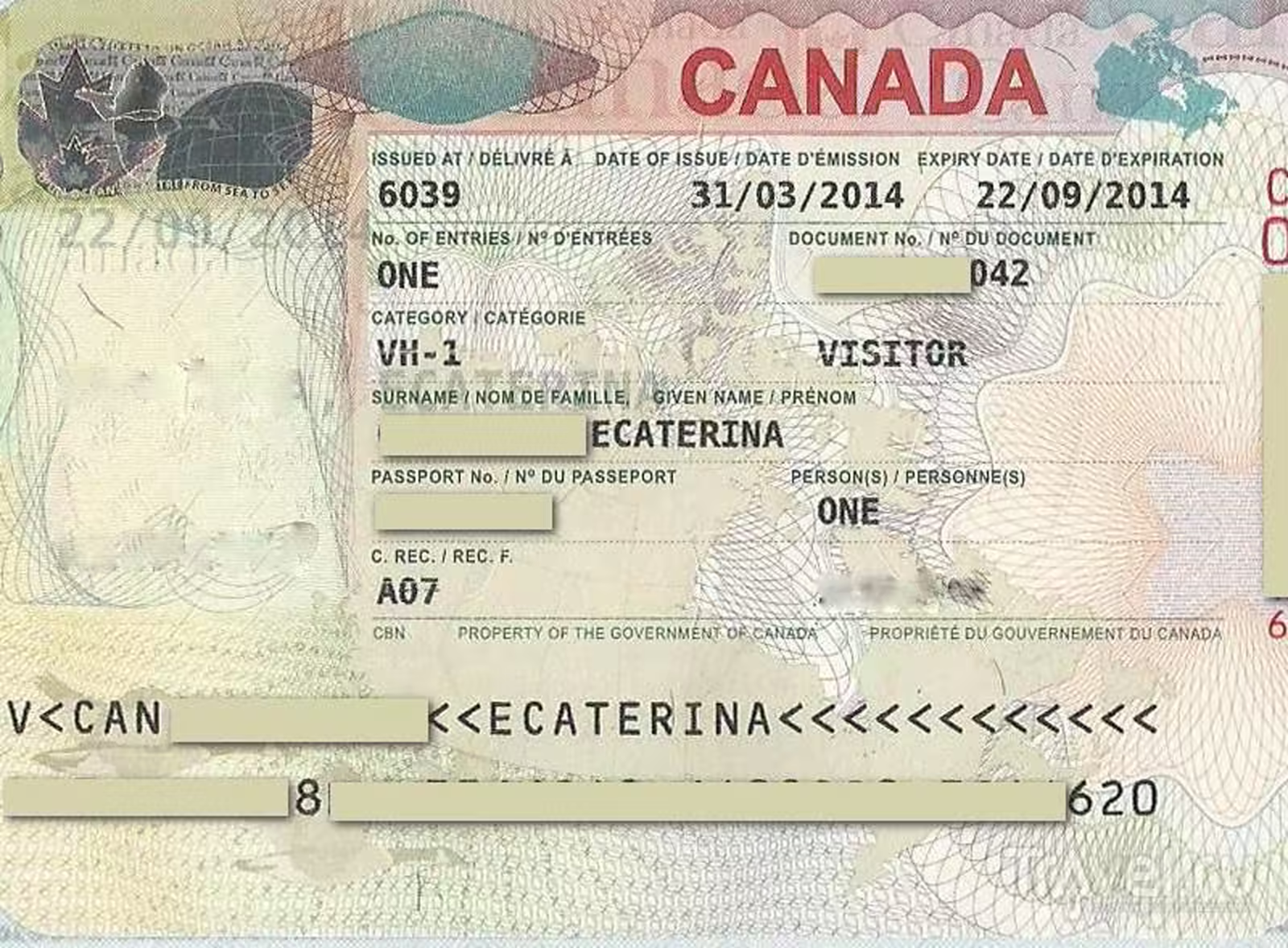
5. Forgetting that the study permit is not the travel document
IRCC says the study permit is not a visa. If approved, Canada issues the matching TRV or eTA automatically. A checklist that ignores that distinction creates confusion at the travel stage.
Official sources
- IRCC study permit overview
- IRCC study permit: get the right documents
- IRCC proof of financial support for study permits
- IRCC study permit: how to apply
- IRCC PAL/TAL rules
- IRCC 2026 provincial and territorial allocations under the international student cap
- IRCC graduate-student page
- IRCC application package for study permits made outside Canada
- Canada.ca video: Save Time: Send a Complete Application
- Canada.ca video: A step-by-step look at biometrics
FAQ
What documents are mandatory in a study visa checklist Canada application?
For a standard outside-Canada study-permit file, IRCC’s core list is a valid passport or travel document, an LOA, proof of funds, and in most cases a PAL/TAL. IRCC also says applicants need 2 recent passport-size photos, and may need medical, police, custodian, or country-specific documents depending on the case.
How much money do I need for a Canada study permit in 2026?
IRCC’s current table says that if you apply on or after September 1, 2025, one applicant outside Quebec must show CAN$22,895 in first-year living funds, excluding tuition and transportation. The amount rises to CAN$28,502 for two people and CAN$35,040 for three.
Do I need a PAL or TAL for a Canada study permit in 2026?
Usually yes. IRCC says most applicants need a PAL/TAL and must submit it with the application. A major 2026 exception is for master’s and doctoral students at public DLIs, who became PAL/TAL-exempt on January 1, 2026. Quebec applicants still need to follow the province’s rules, which often means a CAQ.
Is a Canada study permit the same as a visa?
No. IRCC says the study permit authorizes study, but it is not the travel visa itself. If your application is approved, Canada issues either a TRV or an eTA automatically, depending on your passport.
Do I have to apply online for a Canada study permit?
Generally, yes. IRCC says study-permit applicants must usually apply online. Paper filing is reserved for limited exceptions such as certain identity-document cases or a disability that prevents online filing.
When do I give biometrics for a Canada study permit?
IRCC says that if biometrics apply to you, you must pay the fee when you submit the application, wait for the instruction letter, and then give your biometrics within 30 days. For temporary-resident applications, biometrics are usually valid for 10 years.
Conclusion
The cleanest 2026 version of a study visa checklist Canada file is not a giant list of random PDFs. It is a current IRCC package built around the passport, LOA, PAL/TAL where required, proof of funds for tuition + living costs + return travel, and the conditional documents your exact situation triggers.
The numbers worth remembering are concrete: CAN$150 for the study permit fee, CAN$85 for individual biometrics, CAN$22,895 for one outside-Quebec applicant’s first-year living funds on post-September-2025 applications, and 30 days to finish biometrics after the instruction letter. Use the route-level Canada visa checklist to organize the pack, then move from how Vidicy works to sign up when you want a second set of eyes before you submit.