


If you are searching for documents required for Canada student visa, start with this direct answer: for a program longer than 6 months, IRCC says you need a valid passport or travel document, a letter of acceptance (LOA) from a designated learning institution, and proof you can pay tuition, living expenses, and return transportation. In most cases, you also need a provincial or territorial attestation letter (PAL/TAL). If your application is approved, IRCC says your study permit is not a visa. They automatically issue either a visitor visa (TRV) or an eTA, depending on your passport.
This article is for applicants applying from outside Canada for a course or program longer than six months. It is built around current IRCC pages, not recycled SDS-era checklists. As of September 1, 2025, IRCC’s proof-of-funds table says a single student applying outside Quebec must show CAN$22,895 in living funds for the first year, excluding tuition and transportation. If your goal is to organize the whole Canada route first, start with Vidicy’s Canada visa checklist, the broader Canada Visa Document Checklist for 2026, or the newer study visa checklist Canada guide. If your weak point is money evidence, keep the proof of funds guide open beside this post.
If you are still choosing between countries rather than locking into Canada, use Documents Required for Student Visa in 2026 first. It compares the Canada study permit pack with the U.S., UK, and Australia student routes so you do not reuse the wrong checklist.
| Document or rule | Status | Current IRCC detail | Why applicants miss it |
|---|---|---|---|
| Passport or travel document | Always required | Must be valid for travel | People upload only the bio page and ignore country-specific instructions |
| LOA from a DLI | Always required | Post-secondary LOAs are validated by the school | Applicants assume the PDF alone is enough |
| PAL or TAL | Required for most applicants | Must be submitted with the application, not later | Old checklists often predate the cap system |
| Proof of funds | Always required | CAN$22,895 for 1 person outside Quebec if applying on or after September 1, 2025 | Many guides still cite older SDS or pre-2025 numbers |
| Biometrics | Required for many applicants | Usually ages 14 to 79; fee is CAN$85 for one person | People forget the 30-day post-letter deadline |
| Apply online | Usually required | Paper filing is limited to narrow exceptions | Some local guides still describe old paper-first workflows |
Table of Contents
- What IRCC means by “Canada student visa”
- Mandatory documents IRCC checks first
- Proof of funds and financial documents that actually work
- Case-dependent documents people still forget
- Why older Canada student visa checklists are outdated in 2026
- Official sources
- FAQ
- Conclusion
What IRCC means by “Canada student visa”
A lot of search results use Canada student visa as shorthand, but IRCC’s current language is more precise. For studies longer than 6 months, you need a study permit. IRCC’s study-permit tool also says that if the permit is approved, they will automatically issue either a visitor visa or an Electronic Travel Authorization (eTA), depending on your passport or travel document. That distinction matters because the study permit authorizes study, while the TRV or eTA is what lets you travel to Canada.
This is the baseline official checklist for a normal outside-Canada application:
- Valid passport or travel document
- LOA from a DLI
- Proof of funds for tuition, living costs, and return travel
- PAL/TAL in most cases
- Any country-specific visa office instructions
- Any extra admissibility documents IRCC requests, such as medical exams or a police certificate
The official How to apply page also says most applicants must apply online. Paper filing is generally limited to applicants with a disability that prevents online filing or those holding certain identity or travel documents for non-national residents, refugees, or stateless persons.
If you are comparing this route with a standard visitor file, the biggest difference is that study-permit applicants must prove both academic legitimacy and financial sustainability, not just short-term travel purpose. That is why a good study-permit pack usually needs more structure than a normal Canada visitor visa checklist. If you still want the cross-route view before committing to Canada, use Documents Required for Student Visa in 2026.
Mandatory documents IRCC checks first
The official Get the right documents page is the cleanest starting point because it separates always required documents from recommended or situation-specific evidence.
1. Letter of acceptance from a DLI
IRCC says your school gives you the LOA and you must upload it to your online application. For post-secondary students, there is another important rule: the school will be asked to make sure the LOA is valid. If the school does not respond by the deadline, IRCC says they will return the application and refund the processing fee. That means a real 2026 checklist is not just “get the LOA PDF.” It is also “confirm the school will validate it.”
Guide 5269 adds more detail. It says the LOA should be on official letterhead and show:
- the exact amount of tuition fees you are required to pay
- the anticipated start and end dates
- the date by which you need to register
If you are applying to multiple schools or shifting intakes, this is exactly where files become inconsistent. Your tuition amount, intake term, and funding story all need to match the LOA you submit.
2. Valid passport or travel document
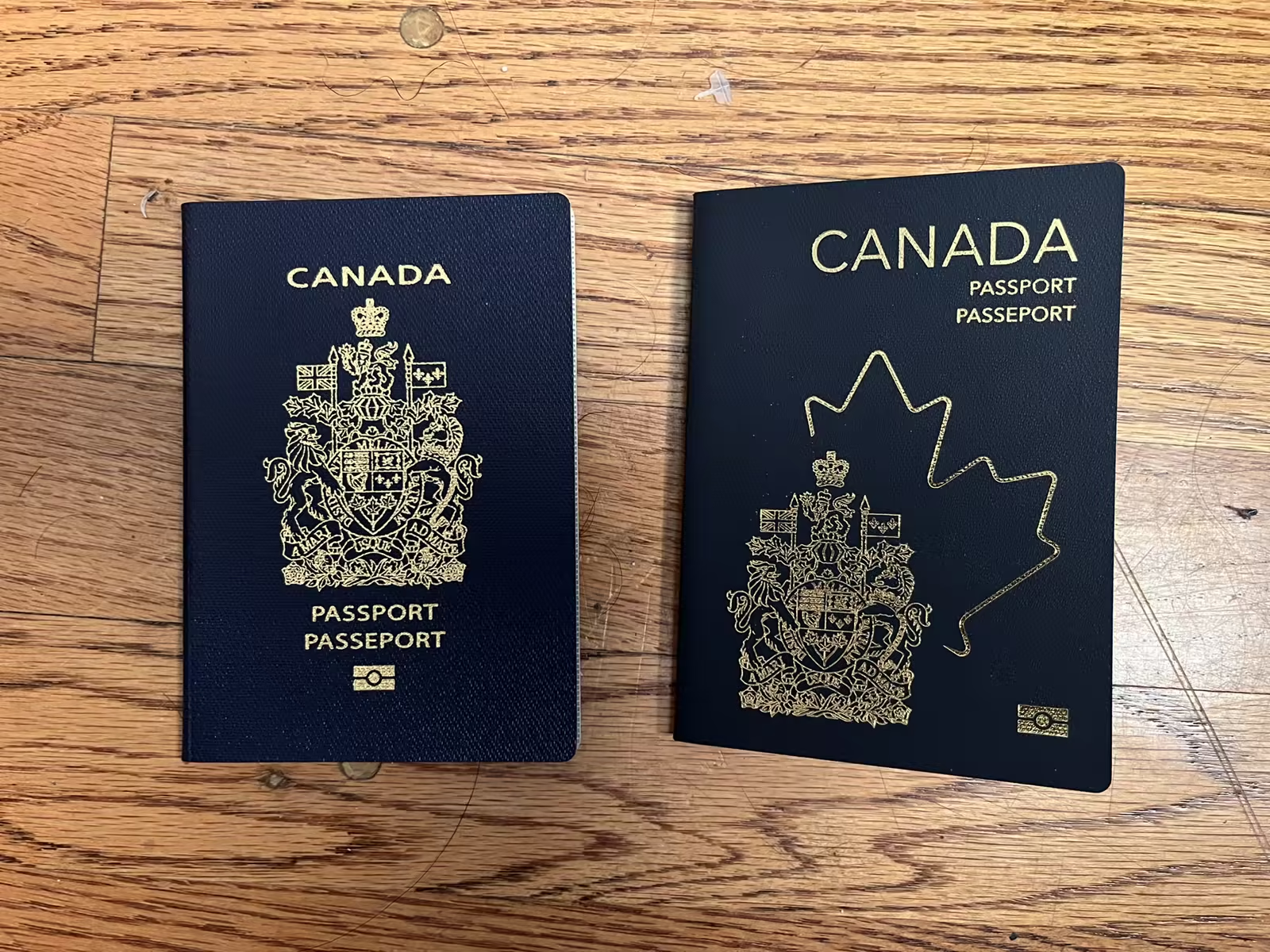
IRCC’s study-permit pages consistently list a valid passport or travel document as core identity proof. The study-permit document page says that when you apply online, you should upload a copy of the information page of your passport. Country-specific instructions may ask for more, so the safer move is to use the country/territory instructions selector and swap IN to your own filing location if needed.
3. PAL or TAL in most cases
IRCC’s PAL/TAL page says most study permit applicants need to provide a PAL or TAL when they apply, unless they meet one of the exemptions. IRCC is also explicit that you must submit it with your application, not after.
That page adds three timing rules many blog posts skip:
- a 2025 PAL/TAL is valid until December 31, 2025
- a 2026 PAL/TAL is valid until December 31, 2026
- you cannot use a PAL/TAL issued for a previous cap year
If you are reapplying after a refusal, school change, or level change, read the reuse rules carefully. In many cases, you need a new PAL/TAL before you submit again.
4. A letter of explanation
IRCC marks the letter of explanation as recommended, not always mandatory. But in practice, this is one of the highest-value documents in a Canada student visa file because it gives you one place to connect:
- why this school and program make sense for your background
- how you will pay for the course
- why the study plan fits your longer-term goals
- why your overall file still supports temporary-resident intent
That does not replace the evidence. It makes the evidence easier for an officer to understand.
Proof of funds and financial documents that actually work
The official proof of financial support page says you must prove you have enough money, without working in Canada, to pay for:
- tuition fees
- living expenses for yourself and any accompanying family members
- transportation to and from Canada
The current 2026 living-cost number
If you apply on or after September 1, 2025, IRCC says the first-year living-funds requirement for 1 person outside Quebec is CAN$22,895, excluding tuition and transportation. For 2 people it is CAN$28,502, and for 3 people it is CAN$35,040. IRCC also shows the older table for applications filed between January 1, 2024 and August 31, 2025, where the single-applicant amount was CAN$20,635.
That change matters because many “Canada student visa documents required” articles still repeat the old amount or still build the advice around SDS-era shortcuts.
What IRCC accepts as proof
IRCC says you do not need to upload every proof-of-funds document on the list. But the page does give clear examples of what can work:
- proof you paid first-year tuition and housing
- proof of a Canadian bank account in your name
- a Guaranteed Investment Certificate (GIC)
- proof of a student or education loan
- bank statements for the past 4 months
- a bank draft convertible to Canadian dollars
- a letter from the person or institution giving you money
- proof of scholarship or Canadian-funded support
The important point is not to dump every PDF you have. It is to make the funding story coherent. If your parents sponsor you, their employment or business documents should support the money flow. If you rely on a loan, the approval letter should line up with the tuition amount and intake. If you already paid tuition or residence, include that receipt because it lowers the amount you still need to explain.
If this is the weakest part of your file, use the route-neutral proof of funds guide before you submit. The same “quiet mismatch” problem that hurts visitor visas also hurts study permits. If you specifically want the side-by-side difference between visitor-visa bank statements and study-permit bank evidence, use the new bank statement for Canada visa guide.
Case-dependent documents people still forget
IRCC’s core checklist is short. Real refusals usually happen in the documents around the edges.
| Situation | Document | Current official rule |
|---|---|---|
| Biometrics needed | Fingerprints and photo | Usually required for applicants aged 14 to 79; fee is CAN$85 for one person and CAN$170 for a family cap |
| Biometrics request received | Appointment timing | IRCC says you have 30 days from the date on the letter to give biometrics |
| Applying to Quebec | CAQ | Most students studying in Quebec need a CAQ even if they do not need a PAL/TAL |
| Minor child studying alone | Custodianship | Minor children applying from outside Canada for study over 6 months need a study permit and may need custodianship documents |
| Medical or criminal admissibility issue | Medical exam or police certificate | IRCC may request either to establish admissibility |
| Identity documents | Photos | Study-permit document guidance says 2 recent passport-size photos with the person’s name and date of birth written on the back |
IRCC’s biometrics workflow is worth checking visually because it is a separate part of the process from your uploaded application documents. This official IRCC video is linked from the government’s own “Save time” page:
IRCC’s instructions on biometrics also say you should pay the biometrics fee when you submit the application, otherwise you may face delays.
Quebec is its own branch
If you plan to study in Quebec, IRCC’s PAL/TAL page says you generally need the attestation of issuance of your Quebec Acceptance Certificate (CAQ). It also says most students who do not need a PAL or TAL and want to study in Quebec still need a CAQ. That is why a generic non-Quebec checklist can mislead Quebec applicants very quickly.
Country-specific instructions still matter
The study-permit application package page says you must select the country or territory from which you are applying to get local visa office instructions. That is where applicants discover extra document formatting, translation, or office-specific requirements that broader blog posts often miss.
Why older Canada student visa checklists are outdated in 2026
The biggest content gap in this SERP is not structure. It is freshness.
1. The Student Direct Stream is closed
IRCC’s official notice says the Student Direct Stream (SDS) ended on November 8, 2024, at 2:00 p.m. ET. Applications submitted on or after that moment are processed under the regular study permit stream.
So if a guide still says:
- “use SDS for faster study permit processing”
- “you need the SDS-specific GIC path”
- “these SDS countries still get a separate checklist”
it is outdated for new applications.
2. PAL/TAL rules changed the package
Newer checklists need to account for PAL/TAL documents. IRCC’s page says most applicants need one, and it must be submitted with the study-permit application. Starting January 1, 2026, applicants to degree-granting master’s and doctoral programs at public DLIs do not need a PAL or TAL, but they still need the rest of the study-permit package. That is a real 2026 nuance many older pages do not mention.
3. LOA validation is now a real application risk
IRCC’s “Get the right documents” page makes post-secondary LOA validation explicit. If the school does not validate the LOA by the deadline, IRCC says they return the application and refund the fee. That makes school-side responsiveness part of your checklist now.
If you want a pre-submit workflow that helps you check cross-document consistency before IRCC sees the file, review how Vidicy works and then move to sign up when the documents are ready.
Related guides
If you're building the rest of the application pack, these companion guides help:
- Documents Required for Student Visa in 2026
- Documents Required for Student Visa UK: 2026 Checklist
- Bank Statement for Canada Visa: Visitor vs Study
- Visa Application Documents: How to Prepare Them
Official sources
- IRCC study permit tool: what you need for studies over 6 months
- Study permit: get the right documents
- Study permit: how to apply
- Proof of financial support for study permits
- PAL/TAL requirements and exemptions
- Guide 5269: applying for a study permit outside Canada
- IRCC notice on the end of SDS and NSE
- 2026 PAL/TAL exemption notice for public master’s and doctoral programs
- Country and territory specific study-permit instructions
FAQ
Is a Canada student visa the same as a study permit?
Not exactly. IRCC says that for programs longer than 6 months, you need a study permit. If the permit is approved, IRCC also automatically issues either a visitor visa or an eTA, depending on your passport. The study permit authorizes study; the visa or eTA authorizes travel.
What are the minimum documents required for Canada student visa applications?
For a standard outside-Canada application, IRCC’s baseline list is a valid passport or travel document, an LOA from a DLI, and proof you can pay tuition, living expenses, and return transportation. In most cases, you also need a PAL/TAL and any country-specific instructions tied to your filing location.
How much money do I need to show for a Canada study permit in 2026?
IRCC’s current proof-of-funds table says that if you apply on or after September 1, 2025, a single applicant outside Quebec must show CAN$22,895 for living expenses for the first year, excluding tuition and transportation. Quebec follows its own financial framework, so Quebec applicants should check the CAQ-linked rules separately.
Is SDS still available for Canada student visa applications?
No. IRCC’s official notice says the Student Direct Stream ended on November 8, 2024, at 2:00 p.m. ET. Applications submitted after that are processed through the regular study-permit stream. If a blog post still frames SDS as the current fast-track path, it is outdated.
Do I need a PAL or TAL for a Canada study permit?
Most applicants do. IRCC says the PAL/TAL must be submitted with the application, not later. A major 2026 exception is for applicants to degree-granting master’s or doctoral programs at public DLIs, who became PAL/TAL-exempt starting January 1, 2026. Quebec applicants often still need a CAQ.
What happens if my school does not validate my LOA?
IRCC’s study-permit document page says that for post-secondary students, the school is asked to validate the LOA. If the school does not respond by the deadline, IRCC says they will return the application and refund the processing fee. In other words, school-side validation is part of your real checklist now.
Conclusion
The best 2026 answer to documents required for Canada student visa is not a recycled SDS checklist. It is a current IRCC package: passport, LOA, PAL/TAL where required, proof of funds for tuition + living costs + return travel, and the case-specific documents that apply to your province, school type, biometrics status, and family situation.
The numbers worth remembering are concrete: 6 months of study is the threshold where you usually need the permit, CAN$22,895 is the current outside-Quebec single-student living-funds figure for post-September-2025 applications, CAN$85 is the individual biometrics fee, and you usually have 30 days after the instruction letter to give biometrics. Build the file around those facts, then make sure every document tells the same believable story.
If you want a route-level checklist first, start with Canada visa checklist. If you want the more submission-ordered version of this same route, use the new study visa checklist Canada guide. If you want a second set of eyes on the whole package before you upload it, move from how Vidicy works to sign up.