



If you are searching for documents required for student visa UK applications, start with the direct answer: most applicants need a current passport, a Confirmation of Acceptance for Studies (CAS), and the documents that prove they meet the money, English, and identity rules for the Student route. Some applicants also need a TB certificate, an ATAS certificate, parental consent, or a financial sponsor consent letter. According to the current GOV.UK Student visa guidance, the fee is GBP 558, you can apply up to 6 months before your course starts, and standard processing is usually 3 weeks if you apply from outside the UK.
If you want the cross-country version before you stay on the UK route, use Documents Required for Student Visa in 2026. It compares the UK pack with the U.S., Canada, and Australia so you do not mix up route-specific documents.
This guide is for applicants aged 16 or over using the Student route, not the Child Student route. It separates the fixed documents from the profile-based documents so you can avoid the most common UKVI problem: a file that looks complete at first glance but still misses the one conditional document your case actually depends on. If you want a route-level pre-check before you upload anything, start with Vidicy's UK visa checklist. If you want the scannable companion version built around filing order rather than explanation depth, use this documents required for student visa UK.
| Document area | Who needs it | Current official rule | What UKVI is checking |
|---|---|---|---|
| Passport or travel document | Everyone | Mandatory | Identity, validity, consistency across the file |
| CAS | Everyone | Mandatory | Licensed sponsor, course details, fees, route fit |
| Financial evidence | Most applicants | Course fees plus living costs | Whether the money exists and was held correctly |
| English-language evidence | Usually required | B2 for degree level or above, B1 below degree level | Student-route eligibility |
| TB certificate | Only if residence history triggers it | Conditional | Public-health requirement |
| ATAS certificate | Only if subject and nationality trigger it | Conditional | Sensitive-course clearance |
| Parent or guardian consent | Applicants aged 16 or 17 | Conditional | Visa, travel, and care permission |
| Official sponsor consent letter | Anyone funded by an official sponsor in the last 12 months | Conditional | Permission to rely on that funding history |
| Identity and eVisa steps | Everyone after submission or approval | Required operational step | Whether your digital status matches your travel document |
Table of Contents
- Documents required for student visa UK: core checklist
- Financial evidence and sponsor documents that actually get checked
- English, ATAS, TB, and other profile-based documents
- Apply online, prove your identity, and set up your eVisa
- Common mistakes that delay a UK student visa file
- Official sources
- FAQ
- Conclusion
Documents required for student visa UK: core checklist
The official Student visa documents page is the cleanest starting point because it separates must-have documents from only-if-they-apply documents.
The fixed checklist is short:
- a current passport or other valid travel document
- your CAS from a licensed student sponsor
The profile-based checklist is where most mistakes happen. GOV.UK says you may also need:
- proof you have enough money to support yourself and pay for your course
- a valid ATAS certificate
- proof of parental or legal guardian consent if you are under 18
- proof of your relationship to your parent or guardian if you are under 18
- TB test results
- written consent from your financial sponsor if they paid your fees and living costs in the last 12 months
Two definitions make the rest of the file easier to manage:
- CAS means Confirmation of Acceptance for Studies. It is the sponsor reference UKVI uses to connect you to a licensed university or college, not just an offer letter.
- Official financial sponsor usually means a government, an international scholarship body, a university, or another formal sponsor that already paid for your fees or living costs.
According to the Student visa course page, you need a CAS before you can apply, and it must come from a licensed student sponsor. That makes the CAS the control document for both timing and money calculations. If your course fees, study location, or start date change, the rest of the file has to change with it.
If you need the wider route comparison first, use Documents Required for Student Visa in 2026 to compare the U.S., UK, Canada, and Australia before you commit to one checklist. If your trip is a short visit rather than a study route, switch to Documents Required for UK Visitor Visa before you prepare the wrong evidence pack. If you are moving to the UK for a sponsored job rather than study, use Documents Required for UK Work Visa (2026 Guide). The Skilled Worker and Health and Care Worker routes depend on a certificate of sponsorship, work-route salary rules, and a different set of conditional documents.
Financial evidence and sponsor documents that actually get checked
For many applicants, the hardest part of the documents required for student visa UK checklist is not the passport or the CAS. It is the money section.
According to the current Student visa money guidance, you need enough money for:
- your course fees for 1 academic year, as shown on the CAS
- your living costs while you are in the UK
The current maintenance figures are:
- GBP 1,529 per month if you will study in London
- GBP 1,171 per month if you will study outside London
Those living costs are counted for up to 9 months. GOV.UK also says the money must usually have been held for 28 consecutive days, and the end of that 28-day period must be within 31 days of the date you apply.
This is where strong files often become weak ones. Applicants use the right bank account but the wrong maintenance figure, or they show the right balance on one statement day without satisfying the full 28-day rule.
GOV.UK also says you do not need to prove you have the money if you have already been living in the UK with a valid visa for at least 12 months before the Student visa application. Applicants from a differential-evidence country may not need to upload the money evidence upfront, but UKVI can still ask for it before making a decision. The safe approach is to prepare the bank set anyway.
If someone else paid your fees or living costs in the last 12 months, GOV.UK says you may also need written consent from that official sponsor. If you are relying on your own bank statements or family funds, the money trail still needs to make sense against the story in your form and CAS.
For a stronger finance review before submission, pair this route guide with Vidicy's proof of funds guide, the route-specific Proof of Funds for UK Student Visa: 2026 Rules, and How to Prepare Visa Application Documents. Those companion pages are useful when the documents exist but the evidence story still feels weak.
English, ATAS, TB, and other profile-based documents
This is the section that usually decides whether your file is merely complete or actually Student-route compliant.
English-language evidence
According to the Student visa English-language page, you will usually need to prove your knowledge of English unless you are exempt or your higher-education provider is allowed to assess it for you.
The required level is:
- CEFR B2 for study at degree level or above
- CEFR B1 for study below degree level
That page also explains that some applicants can meet the rule with a degree taught in English, a UK school qualification, or another approved route. The point is not to upload random English documents. It is to prove the exact version of the rule that applies to your course and sponsor.
ATAS certificate
According to the Academic Technology Approval Scheme guidance, ATAS applies to some foreign students studying sensitive subjects, mainly at masters or PhD level. If it applies to you, you must receive the certificate before you submit the Student visa application, and the certificate is valid for 6 months for visa-use purposes.
TB certificate
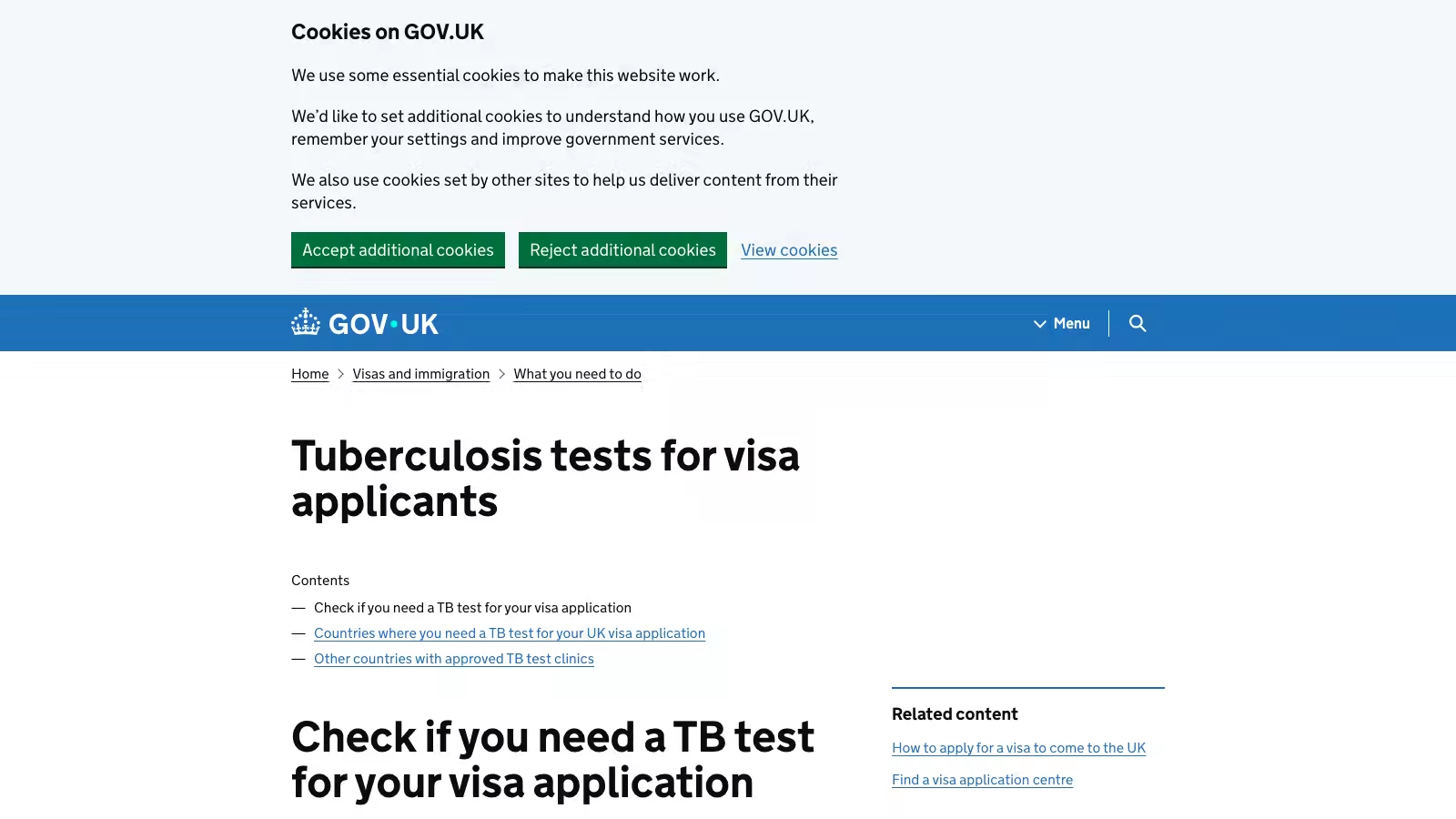
According to the TB test guidance, you need a TB certificate if you are coming to the UK for 6 months or more, have lived in a listed country for 6 months or more, and were living there within the last 6 months. If the clinic clears you, the certificate is valid for 6 months from the x-ray date.
Under-18 and sponsor-consent documents
If you are 16 or 17, GOV.UK says you need written consent from your parents or legal guardians covering:
- the visa application
- your living and care arrangements in the UK
- your travel to the UK
If an official financial sponsor paid your fees and living costs in the last 12 months, you may also need the sponsor's written consent for your new application.
These documents are easy to underestimate because they look administrative. UKVI does not treat them that way. If they apply to your case, they are part of the route rules.
Apply online, prove your identity, and set up your eVisa
According to the apply online page, you apply for a Student visa online and then prove your identity either through the process UKVI assigns to you or through a visa application centre if required.
The current Student visa overview page says:
- the fee is GBP 558 whether you apply from outside the UK or switch or extend from inside the UK
- standard processing is usually 3 weeks if you apply from outside the UK
- standard processing is usually 8 weeks if you apply from inside the UK
- you can usually arrive up to 1 month before your course starts if the course lasts more than 6 months
- you can usually arrive up to 1 week before the course starts if it lasts 6 months or less
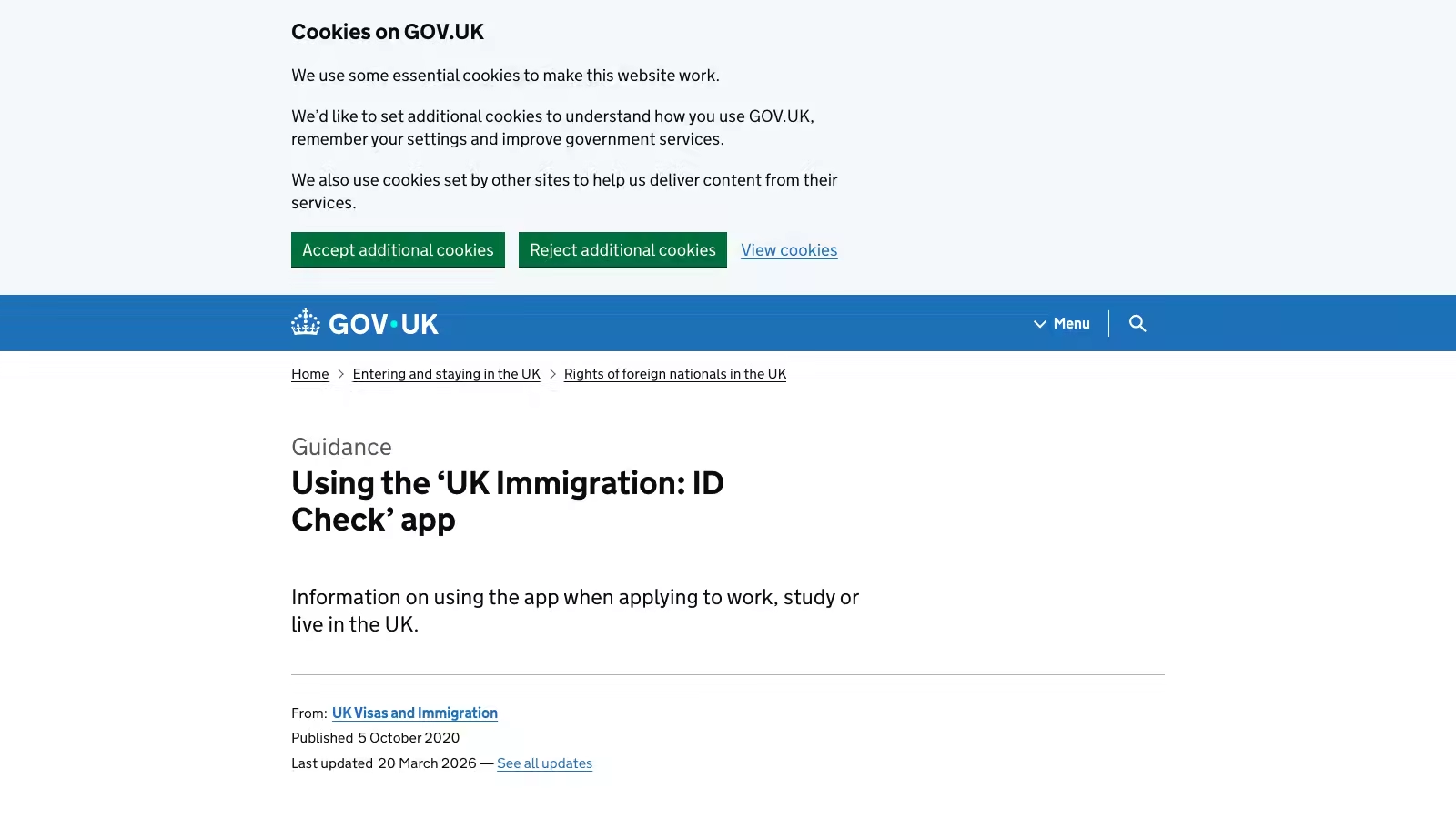
The UK Immigration: ID Check app guidance explains the digital identity option some applicants can use during the application flow. After approval, the eVisa account guidance and travel-with-eVisa guidance explain how to create your UKVI account, link the correct travel document, and avoid carrier or border delays.
That post-decision step matters. A technically approved student can still create avoidable travel friction if the passport used for travel does not match the passport linked to the UKVI account and eVisa.
The official Home Office YouTube explainer below is useful for the digital-status step. Use it as a walkthrough, but follow the written GOV.UK rules if the two ever differ.
If you want a structured second pass before you submit, review Vidicy's how it works flow and then start your case in sign up. That gives you a cleaner checklist-to-review workflow than trying to patch the file together from memory.
Common mistakes that delay a UK student visa file
The most common failure patterns in a UK student file are not mysterious. They are operational mismatches:
- CAS mismatch: the sponsor, course dates, or fee numbers in the application do not match the CAS.
- Wrong maintenance calculation: the file uses the outside-London rate when the course is in London, or vice versa.
- Broken bank-timing rule: the account shows the right balance eventually, but not for the full 28 consecutive days.
- Differential evidence confusion: the applicant assumes they never need financial proof, when UKVI can still request it.
- Late ATAS or TB planning: the application window opens, but the required pre-application certificate is still missing or expired.
- Missing sponsor or guardian consent: the sponsor paid, or the applicant is 16 or 17, but the consent document was left out.
- eVisa handoff errors: the applicant gets approved and then forgets to set up the UKVI account or link the correct travel document.
If you are already worried about hidden contradictions, use How to Catch the Hidden Document Errors That Reject Visa Applications before you file. That guide focuses on the quiet mismatches that generic checklists usually miss.
Related guides
If you're building the rest of the application pack, these companion guides help:
- Documents Required for Student Visa UK: 2026 Checklist
- Documents Required for Student Visa in 2026
- Proof of Funds for UK Student Visa: 2026 Rules
- Employment Letter for UK Visa: Sample + UKVI Checks
Official sources
- GOV.UK Student visa overview
- GOV.UK Student visa course requirements
- GOV.UK Student visa documents you must provide
- GOV.UK Student visa money guidance
- GOV.UK Student visa English-language guidance
- GOV.UK Student visa apply online
- GOV.UK tuberculosis tests for visa applicants
- GOV.UK Academic Technology Approval Scheme guidance
- GOV.UK using the UK Immigration: ID Check app
- GOV.UK set up a UKVI account to access your eVisa
- GOV.UK travel with your eVisa
- Home Office YouTube: What is an eVisa?
FAQ
What documents are required for student visa UK applications?
At minimum you need a valid passport or travel document and a CAS from a licensed student sponsor. Depending on your profile, UKVI may also require financial evidence, English-language proof, a TB certificate, an ATAS certificate, parent or guardian consent, or written consent from an official financial sponsor.
How much money do I need for a UK Student visa?
According to GOV.UK, you need enough money for the first academic year's course fees plus living costs of GBP 1,529 per month in London or GBP 1,171 per month outside London, counted for up to 9 months. The funds usually need to satisfy the 28-day and 31-day timing rules.
Do I need bank statements if I am from a differential-evidence country?
You may not need to upload them upfront, but you should still prepare them. UKVI can still ask for the evidence before a decision is made. The safe approach is to treat differential evidence as an upload shortcut, not as permission to ignore the money rules.
Does every UK Student visa applicant need ATAS?
No. ATAS only applies to certain foreign students in sensitive subjects, mainly at masters or PhD level. If it applies to your course and nationality, you must receive the certificate before you apply, and it is valid for 6 months for visa-use purposes.
When do I need a TB certificate for a UK Student visa?
You need a TB certificate if you are coming for 6 months or more, have lived in a listed country for 6 months or more, and were living there within the last 6 months. A clear certificate is valid for 6 months from the x-ray date.
How much is the UK Student visa fee and when can I travel?
As of April 16, 2026, GOV.UK lists the Student visa fee at GBP 558 whether you apply from outside the UK or extend or switch from inside. You can usually arrive up to 1 month early for courses longer than 6 months, or 1 week early for shorter courses.
Conclusion
The safest way to handle documents required for student visa UK cases is to think in layers: passport and CAS first, then the money rule, then the profile-based documents such as English, ATAS, TB, or sponsor consent. UKVI is not looking for a thick PDF stack. It is looking for a route-accurate evidence set that matches your course, funding, age, and travel document.
If you want a second set of eyes before you submit, start with the UK checklist, review how Vidicy works, and then move to sign up when your file is ready for a structured check.