


If you are searching for documents required for Australian student visa applications, start with this direct answer: for a Student visa (subclass 500), Home Affairs says the core file is a passport copy, a current Confirmation of Enrolment (CoE) for all intended courses, Overseas Student Health Cover (OSHC), financial evidence covering travel, 12 months of living costs, tuition, and any school costs for school-aged dependants, plus Genuine Student (GS) answers backed by documents. If you are under 18, you also need parental consent and evidence of approved welfare arrangements.
That matters because Australia’s student route is document-heavy before a caseworker even reaches your personal story. Home Affairs says GS answers must be written in English with a 150-word maximum per question, and the Department’s February 2026 median processing time table lists 33 days for Student visas. Study Australia’s official 2024 visa-change update also says the individual financial-capacity benchmark became AUD 29,710 for Student visa applications lodged on or after 10 May 2024. If you want the route-level product checklist first, start with Vidicy’s Australia visa checklist. If you are still comparing countries, use Documents Required for Student Visa in 2026 before you lock into subclass 500.
This guide is for applicants building a subclass 500 file from scratch or checking whether an existing document pack is actually decision-ready.
| Document bucket | Current official benchmark | Why applicants still get stuck |
|---|---|---|
| Identity | Passport copy required; birth certificate, national ID, or driver licence should be added where available | Applicants upload only one passport page and skip secondary identity evidence |
| Intended study | A current CoE for all intended courses is required to make a valid application unless a listed special category applies | Old offer letters and outdated course packs still appear in refused files |
| Health insurance | OSHC must cover you from at least 1 week before the course starts and for the duration of your stay | Students buy too little cover and later discover the visa end date cannot be stretched |
| Financial capacity | Evidence must cover travel, 12 months of living, tuition, and school costs for school-aged dependants | Generic bank-balance screenshots do not explain the full study-cost story |
| Genuine Student | 4 core questions, each capped at 150 words, plus supporting documents in ImmiAccount | Applicants paste a generic SOP and forget the evidence layer |
| Processing and priority | 33-day median in the February 2026 table; Priority 1 aims at 1 to 4 weeks, Priority 2 at 5 to 8 weeks, Priority 3 at 9 to 12 weeks | Students confuse a median with a promise and ignore provider-priority rules |
At a glance
- The subclass 500 core file is built around a passport, a current CoE, OSHC, financial capacity evidence, and GS answers backed by documents.
- The current official numbers that matter most are AUD 29,710 as the benchmark in the Study Australia government update, 150 words per GS answer, and a 33-day median in the February 2026 processing table.
- Under-18 applicants need extra welfare and consent evidence, including Form 1229 or a statutory declaration plus the correct welfare record.
- CoE dates, OSHC dates, and the funding story must align, because Australia checks the whole study plan rather than one document in isolation.
Table of Contents
- What Home Affairs means by “Australian student visa”
- Mandatory documents that make a subclass 500 application valid
- Genuine Student answers and financial evidence officers cross-check
- English evidence, under-18 documents, and other conditional uploads
- Processing times, work limits, and how long the visa lasts
- Official sources
- FAQ
- Conclusion
What Home Affairs means by “Australian student visa”
Searchers usually say Australian student visa, but the official route is the Student visa (subclass 500). The file is not considered complete just because a school issued an offer. Home Affairs’ Document Checklist Tool says that, unless you fall into a specific exempt category, you must provide a Confirmation of Enrolment (CoE) for all intended courses when you apply. The separate Applying for a student visa page adds a practical rule many applicants miss: upload a current CoE to ImmiAccount, not a stale letter that no longer matches your intake or package.
That distinction is why subclass 500 packs go wrong so easily. The school side and the visa side must match:
- Your passport identity must match the CoE.
- Your course dates must match the OSHC period you buy.
- Your funding documents must make sense for the course length and tuition.
- Your GS answers must line up with the course, provider, and your current circumstances.
If you need the broader route-comparison first, keep Documents Required for Student Visa in 2026 open in another tab. If you already know Australia is the destination, treat this article as the upload-by-upload subclass 500 checklist that sits beside your Australia visa checklist.
Mandatory documents that make a subclass 500 application valid
The Home Affairs evidence tool is the cleanest place to start because it separates what makes the application valid from the extra documents that depend on your profile.
1. Evidence of identity
Home Affairs says you must attach a copy of your passport. The same tool says you should also include a certified copy of your birth certificate, national identity card, or driver licence where you have these. That does not mean every applicant has to hunt down every document, but it does mean a one-page passport upload is not the strongest possible identity pack.
For subclass 500 files, this is the practical identity baseline:
- passport biodata page
- any required secondary identity document you already hold
- name-change evidence if your records do not match
If names differ across school records, bank statements, and civil documents, fix that before you submit. A strong student file does not make the caseworker guess whether one person is showing up under two spellings.
2. Evidence of intended study
The Document Checklist Tool is explicit: evidence of intended study must be provided to make a valid application. For most applicants, that means a CoE for all intended courses when you apply. The listed exceptions are narrow:
- DFAT-sponsored students
- Defence-sponsored students
- secondary exchange students
- postgraduate research students staying for thesis marking
The separate student-visa guidance reinforces that point by telling applicants to upload a current CoE to ImmiAccount. That wording matters. If you defer your course, change provider, or repackage courses, the visa file needs the current version, not the PDF you first received months ago.
3. Health insurance
Home Affairs says adequate health insurance for this route must be Overseas Student Health Cover (OSHC). The evidence tool also gives a timing rule many generic checklists blur: you must obtain OSHC for yourself and any accompanying dependants from at least one week before your course starts and for the duration of your stay in Australia.
That single requirement creates three common failure points:
- students buy cover only for the teaching period, not the visa period
- applicants forget dependants need matching cover
- the OSHC dates do not match the course dates shown in the CoE
There is also a nationality-specific note: Home Affairs says applicants from Norway, Sweden, or Belgium might not need OSHC and should check the official private-health guidance. Everyone else should assume OSHC is a core subclass 500 document, not an afterthought.
4. ImmiAccount and translation readiness
The Home Affairs “decision ready” page says you need an ImmiAccount to apply and should agree to receive electronic communication there so you see requests quickly. The same page adds a translation rule that matters more than many students realise: for non-English supporting documents, include the translator’s NAATI practitioner number if the translator is in Australia, or the translator’s full name, address, phone number, and qualifications if outside Australia.
That means “I will translate it later if they ask” is the wrong mindset. Home Affairs’ own student-visa guidance says incomplete or missing evidence slows cases and can lead to refusal.
If your supporting documents are already spread across banks, schools, and sponsors, use Visa application documents: how to prepare them before you upload anything. It is easier to fix cross-document errors before the subclass 500 file reaches ImmiAccount.
Genuine Student answers and financial evidence officers cross-check
This is where most real subclass 500 files stop being a checklist and become an assessment.
Genuine Student requirement
Home Affairs says student visa applications lodged on or after 23 March 2024 are assessed under the Genuine Student (GS) requirement. The evidence tool lists the four core questions directly:
- your current circumstances, including family, community, employment, and economic ties
- why you want to study this course in Australia with this provider, and your understanding of the course and living in Australia
- how completing the course will benefit you
- any other relevant information you want to include
Answers must be in English, and Home Affairs sets a 150-word maximum per question. There is an additional question for applicants who previously held a student visa or are applying in Australia from a non-student visa.
Home Affairs also tells applicants not to rely on generic claims. The evidence tool says you must attach supporting documents to ImmiAccount, and the GS pages say statements supported by evidence carry more weight than unsupported assertions.
The current evidence examples include:
- academic transcripts and certificates
- Australian study records, where relevant
- payslips, contracts, and current-employment proof
- a recent CV or resume
- documents showing economic circumstances in your home country
- bank statements or tax returns where those support the GS story
This is the practical takeaway: a subclass 500 file is weaker when the GS answers live in one narrative and the evidence lives somewhere else. The strongest cases let the caseworker verify each claim quickly.
Financial capacity
The Document Checklist Tool says you must show enough funds to cover:
- travel costs
- 12 months of living
- tuition fees for you and accompanying family members
- school costs for any school-aged dependants
It also says that, as an alternative, you can show your spouse or parents are willing to support you and meet the minimum annual income threshold. The tool itself does not print one universal figure because evidence can vary by circumstance, but Study Australia’s official government update on the 2024 visa changes says the individual financial-capacity benchmark for Student and Student Guardian visas became AUD 29,710 for applications lodged on or after 10 May 2024.
That number helps frame the file, but the real assessment is broader than one figure. Home Affairs still wants the funding story to make sense for:
- course length
- tuition amount
- living location
- travel costs
- any accompanying family members
If a parent or spouse sponsors you, the supporting documents must show both the relationship and the ability to provide the money. If you rely on loans, scholarships, or savings, those records should line up with the dates and amounts elsewhere in the file.
If the funding trail is the part you trust least, use the route-neutral proof of funds guide before you submit. Student-route refusals often look like “GS problems” when the real issue is a money story that does not hold together.
English evidence, under-18 documents, and other conditional uploads
After the core file and GS section, subclass 500 becomes highly profile-dependent.
English evidence
The Document Checklist Tool says you must provide evidence of English ability if the route requires it, unless you fall into an exemption category. The same tool lists several common exemptions, including applicants who:
- hold a passport from the UK, USA, Canada, New Zealand, or Republic of Ireland
- are DFAT- or Defence-sponsored students, or secondary exchange students
- are enrolled in a registered school course
- are enrolled in a standalone ELICOS course
- are enrolled in a registered postgraduate research course
- completed at least 5 years of study in English in listed countries
- completed certain Australian study in English while holding a Student visa in the previous 2 years
Home Affairs’ “decision ready” guidance adds a blunt operational rule: if the Document Checklist Tool says English evidence is required, include it when you apply.
Under-18 applicants
Home Affairs is even more explicit for minors. The under-18 welfare page says applicants under 18 must provide:
- Form 1229 or a statutory declaration from each parent or legal guardian with consent
- evidence of adequate welfare arrangements
Depending on the arrangement, welfare evidence can be:
- Form 157N
- a Confirmation of Appropriate Accommodation and Welfare (CAAW) letter from the education provider
- an AASES form for exchange students
- a relevant support letter for DFAT or Defence students
The same page adds two timing rules that are easy to miss:
- welfare arrangements must stay in place until the student turns 18
- when the provider approves welfare, the minimum CAAW period must cover the CoE period plus 7 days at the end, or until the student turns 18
Home Affairs also says the student must not enter Australia before the welfare arrangements start.
Other conditional documents
Depending on the case, the same evidence tool may also ask for:
- change-of-name documents
- spouse or de facto relationship evidence
- recent employment-history evidence
- Form 956 or Form 956A where an authorised representative is involved
The point is not to upload every possible document. It is to identify which conditional uploads your profile actually triggers and make sure the file is internally consistent.
Processing times, work limits, and how long the visa lasts
A good subclass 500 checklist should also tell you what happens after the upload.
Processing time and provider priority
The Home Affairs February 2026 processing-times table shows a 33-day median for Student visas. That is the broad program figure, not a promise for your case. The more detailed Home Affairs processing-priorities page explains that offshore applications lodged on or after 14 November 2025 are prioritised under Ministerial Direction 115, which uses three levels:
- Priority 1: processing aimed to commence within 1 to 4 weeks
- Priority 2: processing aimed to commence within 5 to 8 weeks
- Priority 3: processing aimed to commence within 9 to 12 weeks
For many higher-education and VET students, the provider’s threshold status determines whether the file sits in Priority 1, 2, or 3. Home Affairs also says packaged-course applications are prioritised by the main CoE, usually the final course in the package.
That is why “my friend got a decision in two weeks” is not useful planning data. The provider, course package, completeness, and integrity checks matter.
Work rights once granted
Study Australia’s official subclass 500 guidance says student visa holders can work up to 48 hours a fortnight while the course is in session. Students who have started a master’s by research or doctoral degree have no work-hour limit. The same official work-rights pages say offshore-granted student visa holders can start working once their course begins, and they can work unlimited hours during study breaks.
That matters for documents too. A subclass 500 file is not supposed to prove you can survive only by breaching work-hour limits. The funding pack should already show the course is financially realistic before Australian wages enter the picture.
How long the visa usually lasts
Home Affairs’ dedicated length-of-stay page gives more precise timing than most blog posts:
- for courses 10 months or longer ending in November or December, the visa stay is usually granted to 15 March of the following year
- for courses 10 months or longer ending from January to October, the visa stay is usually 2 months longer than the course
- for courses less than 10 months, the visa stay is usually 1 month longer than the course
Home Affairs also says the visa’s length is tied to the OSHC end date, and the visa end date generally cannot be changed later just because you bought too little insurance. That is why the OSHC period is not a housekeeping detail. It is part of the actual visa-length calculation.
If you want a pre-submit workflow that checks whether the passport, CoE, GS answers, and funding documents tell one believable story, review how Vidicy works and move to sign up when your file is ready for a second pass.
Related guides
If you're building the rest of the application pack, these companion guides help:
- Documents Required for Student Visa in 2026
- Visa application documents: how to prepare them
- Proof of funds for visa applications
- Why visa applications get rejected because of document mistakes
Official sources
- Department of Home Affairs: Document Checklist Tool
- Department of Home Affairs: Disclaimer for Document Checklist Tool
- Department of Home Affairs: Genuine Student requirement
- Department of Home Affairs: Applying for a student visa
- Department of Home Affairs: Student visa processing priorities
- Department of Home Affairs: Visa processing times
- Department of Home Affairs: Length of stay for Student visas
- Department of Home Affairs: Welfare and custody arrangements for students under 18
- Study Australia: Student and Temporary Graduate visa changes 2024
- Study Australia: Student visa (subclass 500)
- Study Australia: Work in Australia
Image credits
- Hero image: Australian passport, photo by Evisa Express via Wikimedia Commons, licensed CC BY 2.0
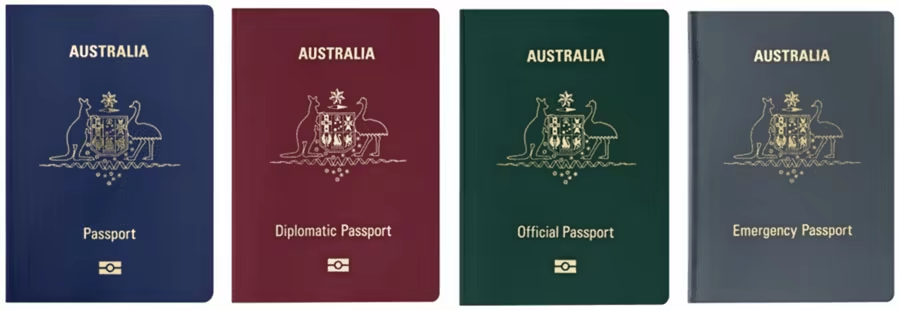
- Inline image 1: Type of Australian Passport, Department of Foreign Affairs and Trade via Wikimedia Commons, licensed CC BY 4.0
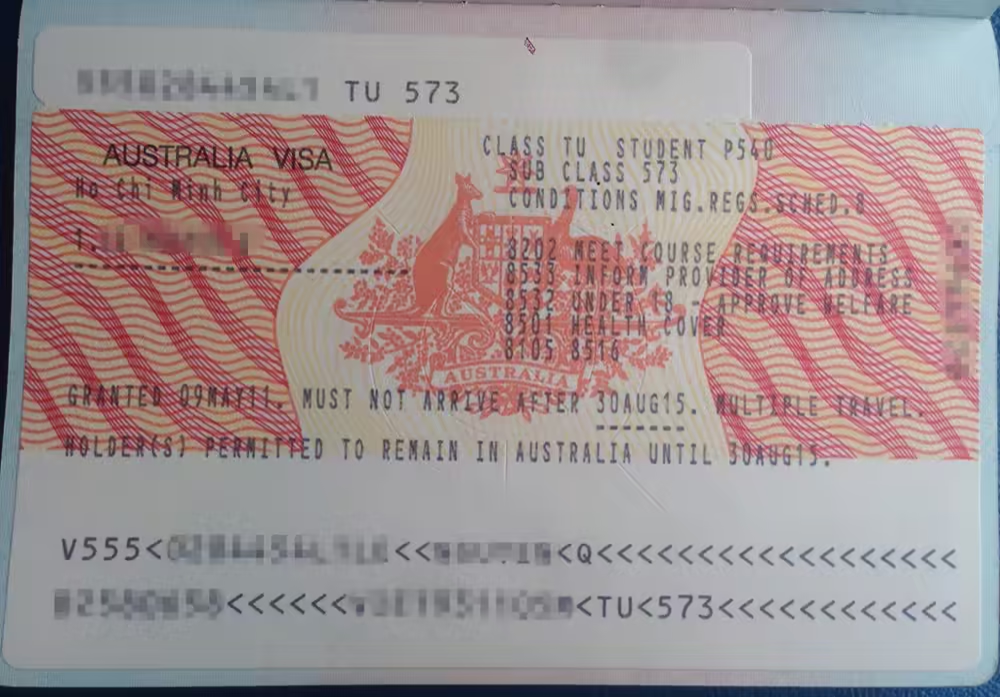
- Inline image 2: Australia Visa, by Top-Gman3304 via Wikimedia Commons, licensed CC0 1.0


FAQ
What documents are required for Australian student visa applications?
For most subclass 500 applicants, the non-negotiable core is a passport copy, a current CoE, OSHC, financial evidence, and GS answers with support documents. Depending on your case, you may also need English evidence, under-18 welfare documents, relationship evidence for dependants, or representative forms.
Is a CoE mandatory before I apply for a subclass 500 visa?
Usually yes. Home Affairs says a CoE for all intended courses is required to make a valid Student visa application unless you fall into a limited special category such as a sponsored student, exchange student, or a postgraduate researcher remaining for thesis marking.
How much money do I need to show for an Australian student visa in 2026?
Home Affairs requires evidence covering travel, 12 months of living costs, tuition, and any school costs for school-aged dependants. Study Australia’s official government update says the individual benchmark became AUD 29,710 for Student visa applications lodged on or after 10 May 2024, but your supporting documents still need to explain the full course-cost story.
Do I need OSHC before I submit the application?
Yes, in most cases. Home Affairs says student applicants must hold OSHC from at least one week before the course starts and for the duration of their stay in Australia. The insurance dates are part of how the visa period is calculated, so short cover can create problems later.
Do the GS answers replace a statement of purpose?
Not really. The official subclass 500 process uses GS questions inside the online form, each capped at 150 words, and Home Affairs expects supporting documents to back up what you write. A generic SOP without matching evidence is a weak substitute for the official GS structure.
Can I work while studying on a Student visa (subclass 500)?
Yes, but within limits. Study Australia’s official visa guidance says most subclass 500 holders can work up to 48 hours a fortnight while the course is in session and unlimited hours during study breaks. Students in a master’s by research or doctoral program have no work-hour cap once the course has started.
Conclusion
The safest answer to documents required for Australian student visa searches is not “passport and school letter.” A strong subclass 500 file is a matched set of identity, CoE, OSHC, funding, GS evidence, and any conditional documents your profile triggers.
The numbers worth remembering are concrete: AUD 29,710 as the official individual financial-capacity benchmark in the current government update, 150 words per GS answer, 33 days as the February 2026 median processing figure, and 48 hours a fortnight as the standard work cap while classes are in session. Build around those rules, use the Australia visa checklist for the route overview, and move from how Vidicy works to sign up when you want the full package reviewed before lodgement.