

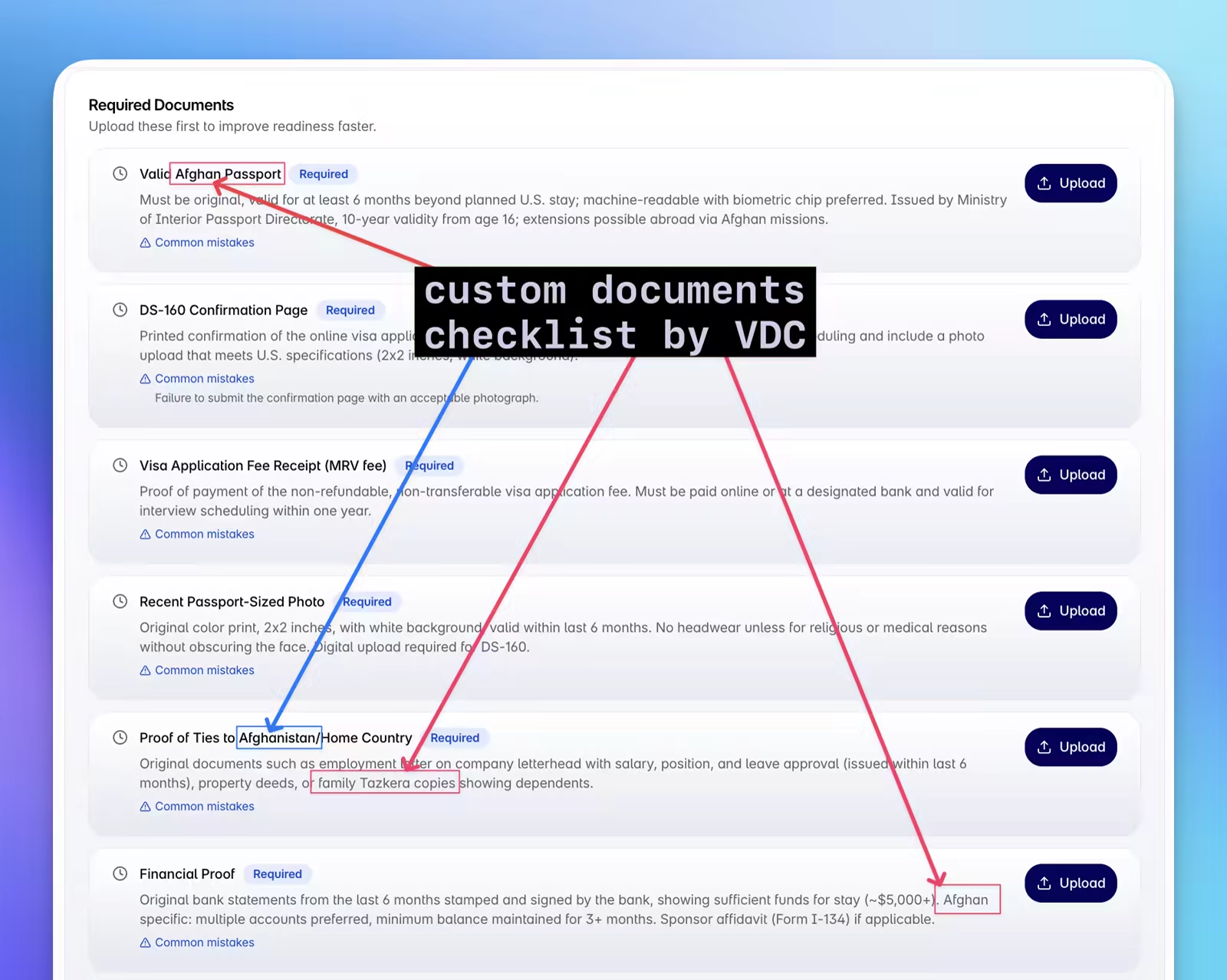

If you are searching for documents required for student visa applications, start with the direct answer: every serious student-route file is built around a valid passport, the school-issued admission document for that country, the correct online application record, proof of funds, a compliant photo or biometrics trail, and any route-specific extras such as UK ATAS or TB evidence, Canada PAL/TAL evidence, or Australia OSHC and Genuine Student answers. According to the current U.S. State Department student visa page, GOV.UK Student visa overview, Canada study permit pages, and Australia's Department of Home Affairs Student visa guidance, the broad logic is shared but the actual documents are not.
That matters because searchers often use one phrase for four different systems. As of April 16, 2026, the U.S. still lists the student visa application fee at $185, GOV.UK lists the Student visa fee at GBP 558 with a usual decision time of 3 weeks from outside the UK, IRCC says a single outside-Quebec study-permit applicant filing on or after September 1, 2025 must show CAN$22,895 in living funds excluding tuition and transportation, and Home Affairs says Australia Student visa applicants should use the Document Checklist Tool and answer the Genuine Student questions in English with a 150-word limit per response. If you want the route-first product workflow after this research step, start with Vidicy's U.S. visa checklist, UK visa checklist, Canada visa checklist, or Australia visa checklist.
This guide is for students comparing the U.S., UK, Canada, and Australia before they pay a fee, book biometrics, or start collecting sponsor documents for the wrong route.
| Route | Core school document | Extra evidence people miss | Current official benchmark |
|---|---|---|---|
| United States | Form I-20 from the SEVP-certified school | DS-160 confirmation, SEVIS fee receipt, and funding proof that matches the I-20 cost estimate | State says the visa fee is $185, visas may be issued up to 365 days before the start date, and initial students may enter no more than 30 days early |
| United Kingdom | CAS from a licensed student sponsor | Money evidence, ATAS, TB, and sponsor-consent letters when relevant | GOV.UK says the fee is GBP 558, you can apply up to 6 months before the course starts, and decisions are usually made in 3 weeks |
| Canada | LOA from a DLI and, for most applicants, PAL/TAL | Proof of funds, biometrics, and country-specific document instructions | IRCC says the fee is CAN$150, the current outside-Quebec living-funds amount is CAN$22,895, and biometrics usually cost CAN$85 per person |
| Australia | CoE for each intended course | OSHC, financial capacity, English evidence or exemption, and Genuine Student answers | Home Affairs says Student visa applicants need funding for travel, 12 months of living, tuition, and school costs for dependants |
At a glance
- Every student-route file is anchored by a passport, a school-issued admission document, an application record, and proof of funds.
- The control document changes by country: I-20, CAS, LOA, or CoE.
- The most common failure point is a funding story that does not match the course dates, sponsor explanation, or official minimums.
- Once you stop comparing routes, switch to the destination-specific checklist and finance guide for that country.
Key takeaways
Use this guide to verify the route, evidence, and next action before you finalize the file. Student visa files usually turn on admission proof, funds, identity, academic history, intent, and country-specific health or biometrics requirements.
Table of Contents
- Documents required for student visa applications: the universal checklist
- Country-by-country student visa checklist
- Proof of funds and sponsor documents officers actually cross-check
- Timing, biometrics, and the mistakes that delay student visas
- Official videos worth using before you submit
- Official sources
- FAQ
- Conclusion
Documents required for student visa applications: the universal checklist
No matter which country you target, most student visa documents required lists collapse into six buckets.
1. Identity documents
This is always the first gate:
- a valid passport or travel document
- any passport pages the country specifically asks for
- civil-status or name-change documents if the name on the school paperwork and the passport do not line up
According to the U.S. State Department, the passport for a student visa interview should usually stay valid for at least six months beyond your period of stay unless a country-specific exception applies. Canada and Australia also explicitly ask for a passport copy as identity evidence.
2. The school-issued document that anchors the case
This is the document that proves you are not just a traveler saying you plan to study.
- U.S.: Form I-20
- UK: CAS, short for Confirmation of Acceptance for Studies
- Canada: LOA, short for letter of acceptance
- Australia: CoE, short for Confirmation of Enrolment
These documents are not interchangeable. A strong student-route file uses the school document as the control document for course dates, tuition, sponsor details, and travel timing.
3. The application record
Student visas are not decided from admission papers alone. You also need the government-side application record:
- U.S.: the DS-160 confirmation page
- UK: the Student visa application and identity step
- Canada: the online study-permit application flow
- Australia: the Student visa application in ImmiAccount
If you already know the destination, stop comparing and move to the route checklist page that matches your case: U.S. visa checklist, UK visa checklist, Canada visa checklist, or Australia visa checklist.
4. Proof of funds
Every country still wants the same basic answer: Who pays, how is the money available, and does the amount make sense for the course and stay length?
What changes is the format:
- the U.S. focuses on whether you can cover educational, living, and travel costs
- the UK focuses on whether you hold the required money in the right way when the rule applies
- Canada publishes a current living-funds table
- Australia asks for evidence covering travel, 12 months of living, tuition, and school costs for dependants
If this is the weakest part of your file, open the proof of funds guide before you do anything else. Financial contradictions are one of the easiest ways to turn a complete-looking student file into a refusal-risk file.
5. Photo, biometrics, and identity verification
Student routes still have technical identity steps:
- printed or digital photo rules
- biometrics, where required
- app-based identity proof in some UK cases
- country-specific exceptions for age or prior biometrics
These are operational steps, but they still matter. A technically correct student file can still stall if the photo fails, biometrics are missed, or the passport linked to the application is not the passport used for travel.
6. Country-specific extra documents
This is the section students underestimate most. Examples:
- UK: ATAS, TB certificate, parent consent, financial sponsor consent
- Canada: PAL/TAL, letter of explanation, biometrics, and extra identity or photo documents
- Australia: OSHC, Genuine Student responses, welfare arrangements for minors, and English evidence or exemptions
- U.S.: SEVIS fee receipt, interview-focused supporting evidence, and embassy-specific instructions
That is the real reason generic blog posts fail. They tell you the universal documents and skip the route-specific extras that actually trigger refusals or delays.
Country-by-country student visa checklist
United States: F-1 interview documents still drive most search intent
For the U.S., the generic keyword usually means an F-1 student visa file. According to the State Department's student visa page, you should gather required documentation before the interview. That includes:
- a passport valid for travel to the United States and usually 6 months beyond your period of stay unless exempt
- the DS-160 confirmation page
- the visa-fee receipt where required
- a compliant photo if the upload fails
- the Form I-20
- the I-901 SEVIS fee receipt
The same page says officers may also ask for proof of your academic preparation, your intent to depart the United States, and your ability to pay educational, living and travel costs. That means an F-1 file is not just identity paperwork. It is also a credibility file.
Three current numbers matter:
- the application fee remains $185
- your visa can be issued up to 365 days before the program start date
- new students may not enter the U.S. more than 30 days before the program starts
If your main problem is organizing the U.S. interview folder, use the U.S. visa checklist. If your weak point is the form, use the DS-160 guide.
United Kingdom: the Student route is document-light until a conditional rule applies
The UK Student route looks simple until a conditional document applies to your case. The current GOV.UK Student visa overview says you can apply from outside the UK up to 6 months before your course starts. The same live route pages say:
- the Student visa fee is GBP 558
- you will usually get a decision within 3 weeks from outside the UK
- you can usually arrive up to 1 month before the course starts if it lasts more than 6 months
The GOV.UK documents page says you must provide:
- a current passport or other valid travel document
- a CAS
And you may also need:
- proof you have enough money
- an ATAS certificate
- proof of parental or guardian consent if you are under 18
- TB test results
- written consent from your financial sponsor if they paid your fees and living costs in the last 12 months
That is why a UK student file often looks "done" too early. The passport and CAS are easy. The real work is deciding whether you also need ATAS, TB, sponsor consent, or extra money evidence.
One practical rule explains most UK Student-route confusion: the CAS proves the offer, but it does not prove the rest of the visa file is ready. The conditional documents usually decide that part.
If you are already committed to the UK route, the route-specific UK visa checklist is the better next step.
Canada: the study permit file changed when PAL/TAL and the new funds table arrived
Canada's current study-permit guidance is more document-specific than many older guides reflect. IRCC says most applicants need:
- a valid passport or travel document
- a letter of acceptance from a designated learning institution
- a provincial or territorial attestation letter (PAL/TAL) unless an exemption applies
- proof of funds
- any identity, biometrics, and additional documents requested in the route flow
IRCC's current financial-support page says that if you apply on or after September 1, 2025, a single applicant outside Quebec must show CAN$22,895 in living funds for the first year, excluding tuition and transportation. IRCC also lists examples of acceptable proof such as:
- proof you paid first-year tuition and housing
- a Canadian bank account in your name
- a Guaranteed Investment Certificate (GIC)
- proof of a student or education loan
- bank statements for the past 4 months
Canada's study-permit process is also more precise about route structure. IRCC says a study permit is not a visa. If approved, they automatically issue either a visitor visa or an eTA, depending on your passport. IRCC's current fee guidance still states that the study-permit application fee is CAN$150.
If Canada is your actual route, use the product-side Canada visa checklist. If you are still comparing routes, stay on this hub until you know which country-specific extras apply.
Australia: subclass 500 is document-heavy even before the decision
Australia's Department of Home Affairs makes the Student visa checklist unusually explicit through its Document Checklist Tool. The live tool says applicants should attach:
- a copy of the passport
- a Confirmation of Enrolment (CoE) for all intended courses unless a listed special category applies
- evidence of Overseas Student Health Cover (OSHC)
- evidence of financial capacity covering travel, 12 months of living, tuition, and school costs for school-aged dependants
- evidence of English-language ability, unless an exemption applies
- extra documents for minors, dependants, name changes, or research students when relevant
The same tool says OSHC must cover you from at least one week before your course starts and last for the duration of your stay. Home Affairs also says Student visa applications lodged on or after 23 March 2024 are assessed under the Genuine Student (GS) requirement, with answers written in English and capped at 150 words per question.
If Australia is your actual destination rather than one option on a comparison list, use the dedicated documents required for Australian student visa guide next. It breaks subclass 500 down into the current CoE, OSHC, GS, welfare, timing, and work-rights rules in more detail.
For under-18 applicants, Home Affairs says they must provide:
- Form 1229 or a statutory declaration from each parent or legal guardian
- evidence of adequate welfare arrangements
If Australia is the route you settle on, keep the Australia visa checklist open beside the Home Affairs evidence tool while you prepare the actual upload set. If you want the scannable, submission-order version after that, use the Australian student visa checklist as the subclass 500 companion.
Proof of funds and sponsor documents officers actually cross-check
The most reusable part of this topic is not the passport checklist. It is the logic behind the money trail.
According to the official pages reviewed for this article, officers keep asking the same questions:
- Is the money enough for this specific course and stay length?
- Is the source of the money believable and documented?
- Do the school document, bank evidence, and written explanation tell the same story?
- If a parent or sponsor is paying, is that relationship documented?
That logic shows up differently by route:
- the U.S. asks whether you can pay educational, living and travel costs
- the UK asks for money evidence when the rule applies and adds sponsor-consent rules in some cases
- Canada gives a current living-funds figure and specific examples of acceptable documents
- Australia asks for evidence that covers travel, 12 months of living, tuition, and any relevant dependant costs
The mistake pattern is consistent too:
- using an old bank statement without the matching school costs
- showing sponsor money without sponsor identity or relationship proof
- explaining funding in one way on the form and another way in the letter of explanation
- forgetting that tuition already paid can change the amount you still need to prove
If your file needs a second set of eyes before submission, that is the point where Vidicy becomes useful. Use the proof of funds guide first, then move the full document set into a structured review through sign up.
Timing, biometrics, and the mistakes that delay student visas
Students usually worry about the document list, but the timing rules matter just as much.
| Route | Current official timing signal | Delay risk |
|---|---|---|
| U.S. | Visa can be issued up to 365 days before the start date, but new students cannot enter earlier than 30 days before the program starts | Students confuse visa issuance timing with travel timing |
| UK | Apply up to 6 months before the course starts; decision usually 3 weeks from outside the UK | Applicants wait too long to check TB, ATAS, or sponsor-consent requirements |
| Canada | Biometrics are usually required for study-permit applicants unless exempt, and current biometrics remain valid for 10 years if already given | Students assume old visitor or work-route rules still control the study-permit flow |
| Australia | Home Affairs still recommends lodging well in advance with all supporting documents | Applicants wait for the "final" upload round instead of submitting a complete first file |
Three errors show up across almost every student route:
- using a visitor checklist for a student file
- uploading the right PDF but the wrong version of it, such as an outdated LOA, old bank statement, or missing CoE
- skipping the country-specific add-on because a generic blog post made the route look simpler than it is
That is also where route-specific companion posts help. If you already know the destination, stop comparing and switch to the detailed post for that country. If you still do not know whether your file is coherent, keep this hub as the master checklist and compare each upload against it before you submit.
Official videos worth using before you submit
This article only includes videos that can be traced to official government pages used during the research run.
IRCC links this complete-application walkthrough from its official Canada.ca video page:
For U.S. applicants, EducationUSA’s verified channel hosts this student-visa Q&A moderated by a U.S. Department of State official:
Related guides
If you're building the rest of the application pack, these companion guides help:
- Documents Required for Canada Student Visa (2026)
- Documents Required for Student Visa UK: 2026 Checklist
- F1 Visa Checklist for 2026: Documents + Rules
- German Student Visa Checklist for 2026
- Proof of Funds for UK Student Visa: 2026 Rules
Official sources
- U.S. State Department student visa overview
- U.S. State Department student visa required documents view
- U.S. State Department DS-160 online nonimmigrant visa application
- GOV.UK Student visa overview
- GOV.UK Student visa documents you must provide
- GOV.UK Student visa money you need
- Canada study permit overview
- Canada study permit how to apply
- IRCC proof of financial support
- IRCC fee list
- Canada.ca complete-application video page
- Department of Home Affairs Student visa (subclass 500)
- Department of Home Affairs Document Checklist Tool
- Department of Home Affairs Genuine Student requirement
- Department of Home Affairs welfare arrangements for students under 18
- Department of Home Affairs applying for a student visa
FAQ
What documents are required for most student visa applications?
Across the U.S., UK, Canada, and Australia, the recurring baseline is a valid passport, an acceptance or enrollment document from the school, the correct application record or confirmation page, a compliant photo, and funding evidence. The part that changes is the route-specific extra layer such as I-20, CAS, PAL/TAL, CoE, TB, or OSHC.
Is a university acceptance letter enough for a student visa?
No. The school document is only one layer of the file. A strong offer letter does not fix a missing CAS, I-20, PAL/TAL, CoE, funding record, or route-specific identity step.
How much money do I need to show for a student visa?
There is no one global number. The UK uses fixed monthly maintenance amounts. Canada publishes a living-cost table by family size. The U.S. compares your funding story with the cost estimate on the I-20, and Australia checks whether the evidence supports the study plan and route requirements.
Do student visa applications always need biometrics and translations?
Not always, but many do. Canada study permits frequently involve biometrics, and IRCC says temporary residents only need to enroll biometrics once every 10 years. Australia explicitly says non-English documents need translations, and the UK also requires certified translations when documents are not in English or Welsh.
Can I use the same checklist for the U.S., UK, Canada, and Australia?
No. That is the main trap this article is trying to prevent. The four routes share a core logic, but the actual documents are not interchangeable. An I-20 is not a CAS, a PAL/TAL is not a CoE, and Australia's GS evidence is not the same thing as a U.S. interview packet.
Conclusion
The safest answer to documents required for student visa searches is not one universal packing list. It is a route-specific document stack built around the school document that controls the case, the funding rule that applies to that country, and the conditional extras your profile triggers.
Use this article to separate the shared logic from the country-specific rules. Then move to the route page that matches your case: U.S. visa checklist, UK visa checklist, Canada visa checklist, or Australia visa checklist. When the checklist is assembled and you want a second set of eyes on the full package, review how Vidicy works and then sign up.