



If you need proof of funds for UK student visa applications, start with the shortest accurate answer: UKVI expects you to show any outstanding first-year course fees on your CAS plus living costs of GBP 1,529 per month in London or GBP 1,171 per month outside London, counted for up to 9 months. In most cases, the money must be held for 28 consecutive days, and your most recent financial evidence must be dated within 31 days of the date you apply. If you use a parent’s bank account, you also need written consent and proof of the relationship. If you have already been in the UK with valid permission for at least 12 months, you usually do not need to upload the financial evidence at the point of application.
That is the rule in plain English. The part that still catches applicants is the document logic behind the numbers: which accounts count, when a student loan letter works, when partner funds are allowed, when an accommodation deposit can reduce the amount, and which files get refused because the balance dipped on the wrong day. As of 16 April 2026, the current Home Office fee table effective 8 April 2026 lists the Student visa fee at GBP 558. If you want the broader route pack before you audit the finances, start with Vidicy’s UK visa checklist and the full documents required for student visa UK guide.
Key takeaways
- Add any outstanding first-year tuition on your CAS to the maintenance amount.
- Show GBP 1,529 per month in London or GBP 1,171 outside London, counted for up to 9 months.
- Keep the required amount in the account for 28 consecutive days.
- Make sure the latest statement or bank letter is no more than 31 days old when you apply.
- Parent funds work only if you add written consent and proof of the relationship.
| Finance checkpoint | Current UK rule | Why it matters |
|---|---|---|
| Student visa fee | GBP 558 from the Home Office fee table effective 8 April 2026 | Use the live fees table when older route snippets still show pre-April pricing. |
| Living costs in London | GBP 1,529 per month | London students need a higher maintenance buffer. |
| Living costs outside London | GBP 1,171 per month | Non-London students still need a full maintenance calculation. |
| Time period for living costs | Up to 9 months | UKVI caps the maintenance calculation even on longer courses. |
| Holding period | 28 consecutive days | One dip below the required amount can break the evidence. |
| Freshness of evidence | Dated within 31 days of the application | Old statements can fail even when the balance is real. |
| In-country exemption | Valid UK permission for at least 12 months | Some applicants meet the rule without uploading bank evidence. |
| Accommodation deposit offset | Up to GBP 1,529 if paid to the sponsor and confirmed correctly | This can reduce the amount you still need to show. |
Table of Contents
- Proof of funds for UK student visa: what UKVI actually means
- How much money do you need for a UK Student visa?
- Which proof of funds documents does UKVI accept?
- The 28-day and 31-day rules that get refusals
- Parent money, partner money, loans, and sponsorship
- After the money proof is ready: what still matters
- Official sources
- FAQ
- Conclusion
Proof of funds for UK student visa: what UKVI actually means
For the Student route, proof of funds means evidence that you can cover two different costs at the same time:
- any outstanding course fees for the first academic year, as shown on your CAS
- your living costs in the UK, using the maintenance figures in the Student rules
According to Immigration Rules Appendix Student, the money requirement is not a generic “show some savings” test. It is a route-specific calculation tied to your study location, course length, CAS fee balance, and sometimes your sponsor setup.
That is why the term maintenance funds matters. It is UKVI’s way of separating ordinary savings from route-specific money evidence. The officer is not only asking whether you have cash. They are asking whether the amount, source, and timing of that cash fit the exact Student application you filed.
If you are applying as a visitor, this is the wrong finance logic. Use the visitor-route bank statement for visa guide or the documents required for UK visitor visa guide instead of mixing short-visit rules into a Student route file.
How much money do you need for a UK Student visa?
The current Student rules are straightforward once you separate fees from living costs.
According to Appendix Student, non-boarding Student applicants must show any outstanding course fees on the CAS, plus:
- GBP 1,529 per month if the main study site is in London
- GBP 1,171 per month if the main study site is outside London
Those living costs are counted for up to 9 months, and any part-month is rounded up to a full month. That means the living-cost ceiling works out like this:
| Study location | Monthly maintenance | 9-month total | What you still add |
|---|---|---|---|
| London | GBP 1,529 | GBP 13,761 | Any outstanding first-year course fees on the CAS |
| Outside London | GBP 1,171 | GBP 10,539 | Any outstanding first-year course fees on the CAS |
If your CAS shows part of the tuition has already been paid, UKVI only expects you to prove the remaining first-year balance. The same Appendix Student rule also says that if you paid an accommodation deposit to the student sponsor, that deposit can be offset by up to GBP 1,529 against the funds you still need to show.
That offset is useful, but it is not unlimited. If your university accommodation deposit was GBP 2,000, the maximum deduction is still GBP 1,529. Everything above that does not reduce the finance requirement further.
Here is a simple example:
- CAS outstanding tuition: GBP 17,000
- Main study site: London
- Course length: 12 months
- University accommodation deposit already paid and confirmed: GBP 1,000
Your living-cost amount is GBP 13,761 for the 9-month cap. Add the GBP 17,000 outstanding tuition, then subtract the GBP 1,000 allowable accommodation deposit. In that scenario, your target proof amount would be GBP 29,761.
If you want a second check before you rely on that number, compare the full file against Vidicy’s how it works flow and the broader Bank Statement for Visa: What Officers Check guide.
Which proof of funds documents does UKVI accept?
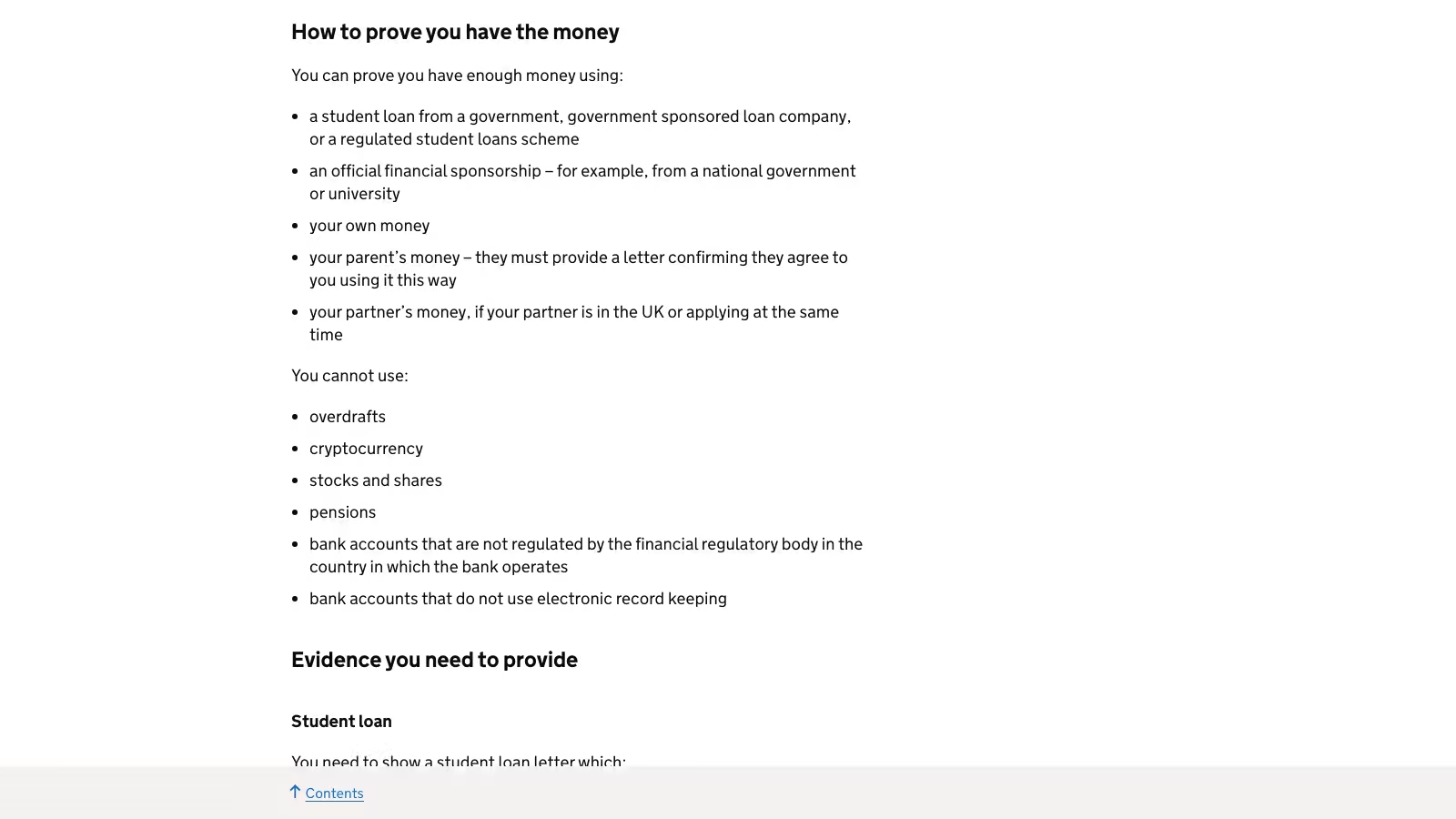
According to the current GOV.UK financial evidence guidance for Student and Child Student applicants, UKVI accepts five broad routes for proof of funds for UK student visa cases:
- a student loan from a government, government-sponsored loan company, or regulated student-loans scheme
- official financial sponsorship
- your own money
- your parent’s money, with consent
- your partner’s money, if the partner is in the UK or applying at the same time
The same page also lists what you cannot use:
- overdrafts
- cryptocurrency
- stocks and shares
- pensions
- bank accounts that are not properly regulated
- bank accounts without electronic record keeping
That matters because many applicants still assume that “money I can access somehow” is enough. UKVI is narrower than that. It wants evidence from accounts and funding routes it can actually verify.
| Funding route | What to upload | What usually breaks it |
|---|---|---|
| Own money | Bank statements, bank letter, certificate of deposit, or passbook | The balance drops below the requirement during the 28-day window |
| Parent money | Parent-controlled bank evidence + written consent + proof of relationship | Missing consent or no relationship proof |
| Partner money | Partner-controlled bank evidence, but only if the partner is in the UK or applying at the same time | Using a partner account that does not meet the route condition |
| Student loan | Loan letter dated within 6 months with no release condition beyond successful UK study | A generic finance letter that does not confirm UK-study availability |
| Official sponsorship | CAS entry or sponsor letter with amount, duration, and contact details | Sponsorship not shown on CAS and no sponsor letter uploaded |
The guidance also says the account must allow immediate access to the money and that UKVI may verify the evidence with the bank. If the bank cannot verify it, the application may be refused.
The 28-day and 31-day rules that get refusals
For most applicants, the hardest part of proof of funds for UK student visa cases is not the headline amount. It is the timing.
The current GOV.UK financial evidence page says:
- you must have had enough money for 28 days in a row
- the 28 days are counted back from the date of the closing balance on your most recent evidence
- the evidence must be from no more than 31 days before the date you apply
That produces four common refusal patterns:
- The balance was high on the statement date, but it dipped below the threshold three weeks earlier.
- The statement is genuine, but it is older than 31 days by the time the application is submitted and paid for.
- The amount is correct in local currency, but exchange-rate movement on the application date drops it below the sterling requirement.
- The account belongs to the right parent, but the consent or relationship proof is missing.
The same page says foreign-currency accounts are converted into pounds using the OANDA spot rate on the date of application. That means a close-margin file can fail even if it looked safe when the statement was printed.
The practical fix is simple:
- leave headroom above the minimum
- do not wait until the last day of the 31-day window
- keep the required amount untouched for the full 28-day period
- line up the application payment date with the evidence date before you submit
If you are the kind of applicant who tends to fix things at the last minute, this is the section to slow down on. UKVI does not award partial credit for a balance that was right “most of the time.”
Parent money, partner money, loans, and sponsorship
This is where the Student route becomes more technical than most comparison blogs admit.
Using a parent’s bank account
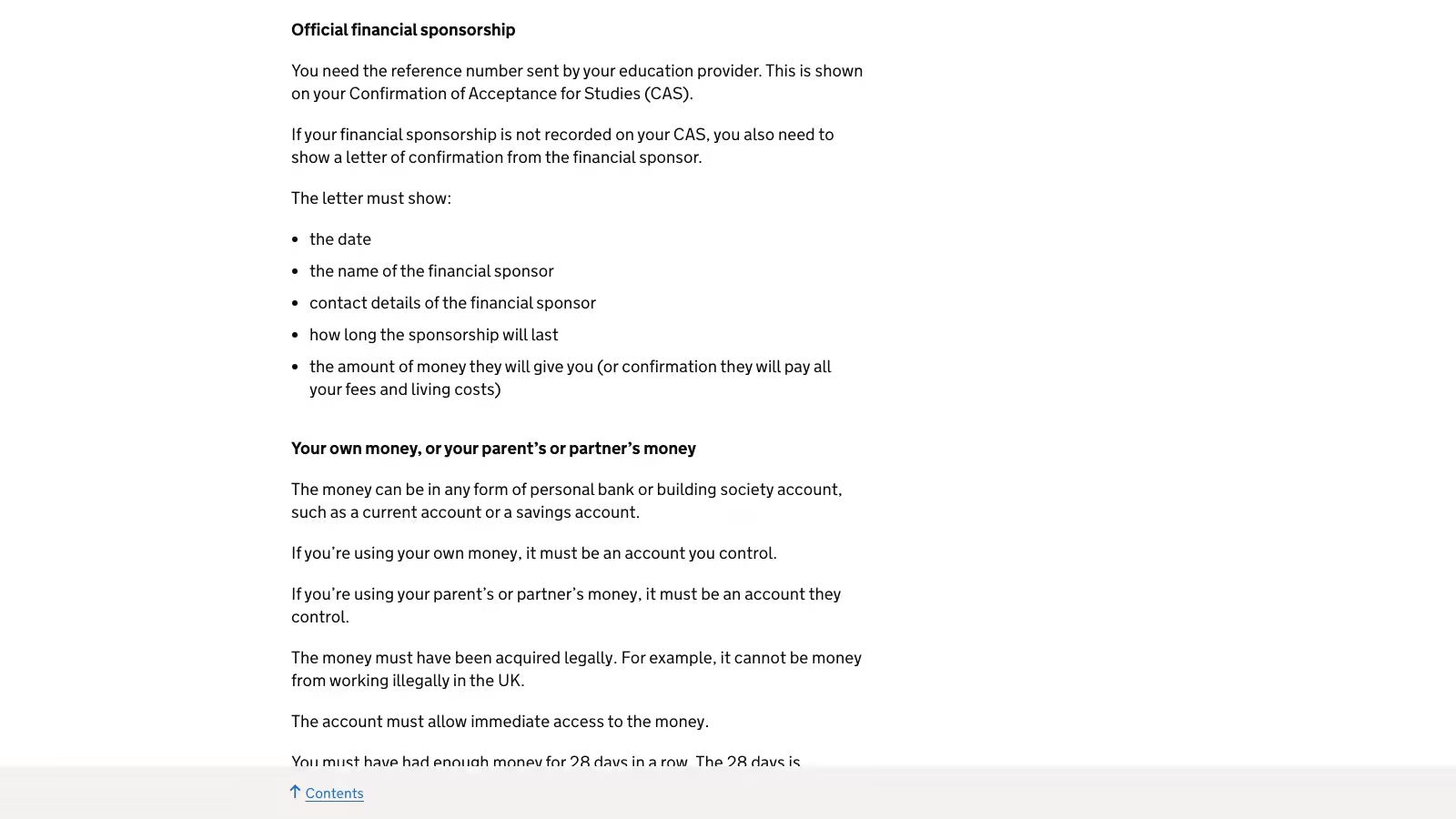
Appendix Finance says Student applicants can rely on an account in the name of a parent or legal guardian, but they must provide proof of the relationship and written consent to use those funds.
That makes parent money perfectly valid, but only if the documentary chain is clean. A parent statement without consent is not complete evidence. Consent without relationship proof is not complete evidence either.
Using a partner’s bank account
The GOV.UK financial evidence guidance is narrower on partner funds. You can use your partner’s money only if your partner is in the UK or applying at the same time. If that condition is not true, a partner statement is not the route-safe answer.
Using a student loan
The Student guidance and Appendix Finance are both precise here. A student loan letter must:
- be dated no more than 6 months before the application
- confirm the loan is a genuine student loan
- confirm there are no release conditions other than successful UK study
- confirm the amount
- confirm the funds will be available before travel or before the course begins, depending on the lender structure
This is why a generic “education finance approval” letter is often weaker than applicants think. UKVI is not checking whether someone might lend you money. It is checking whether the approved loan meets the exact Student-route conditions.
Using official financial sponsorship
If a government, university, or another accepted sponsor covers your fees or living costs, the GOV.UK guidance says the evidence must be stated on the CAS or confirmed in a sponsor letter. The letter must show:
- the date
- the sponsor’s name
- the sponsor’s contact details
- how long the sponsorship lasts
- how much the sponsor will pay, or confirmation they will cover all fees and living costs
If your sponsor paid fees or living costs in the last 12 months, the Student documents page also says you may need written consent from that financial sponsor for the new application.
After the money proof is ready: what still matters
A strong Student file still needs more than the finance pack.
According to the current Student documents page, the core document set starts with:
- a current passport or other valid travel document
- a Confirmation of Acceptance for Studies (CAS)
You may also need:
- proof you have enough money
- a valid ATAS certificate
- TB test results
- proof of parental or guardian consent if you are under 18
- written consent from a financial sponsor if they funded you in the last 12 months
The English-language page says applicants usually need CEFR B2 at degree level or above and CEFR B1 below degree level. The current TB page says the certificate is valid for 6 months from the x-ray date. The ATAS guidance says applications take at least 30 working days (6 weeks) and can take longer during the busy April to August period.
For timing, there are three dates worth keeping in one place:
- the Student route overview says you can apply up to 6 months before your course starts
- you will usually get a decision within 3 weeks if you apply from outside the UK
- if you apply from inside the UK, the usual decision time is 8 weeks
The safest official video for the application stage is the Home Office explainer below, published on GOV.UK’s own video page:
If the visa is approved, the same Student route pages say you will get an eVisa and need to link your travel document to your UKVI account. GOV.UK also publishes a dedicated What is an eVisa? explainer through its eVisa support pages.
If you want a structured pre-submission check before you pay the application fee, use the UK checklist, then move into sign up when the finance pack and the rest of the file are ready for a second pass.
Related guides
If you're building the rest of the application pack, these companion guides help:
- Documents Required for Student Visa UK: 2026 Checklist
- Documents Required for Student Visa UK: 2026 Checklist
- Bank Statement for Visa: What Officers Check
- UK Visitor Visa Bank Statement Requirement (2026)
- Sponsor Letter for Student Visa: Sample + Rules
Official sources
- Home Office immigration and nationality fees, 8 April 2026
- Immigration Rules Appendix Student
- Immigration Rules Appendix Finance
- Student visa money guidance
- Financial evidence for Student and Child Student visa applicants
- Student visa documents you'll need to apply
- Student visa knowledge of English
- Tuberculosis tests for visa applicants
- Academic Technology Approval Scheme (ATAS)
- How to apply for a visa or permission to come to the UK: video
- How to travel with your eVisa: video
FAQ
How much money do I need for a UK Student visa in 2026?
You need any outstanding first-year course fees on your CAS plus living costs of GBP 1,529 per month in London or GBP 1,171 per month outside London, counted for up to 9 months. That means the living-cost cap is GBP 13,761 in London or GBP 10,539 outside London before tuition is added.
Can I use my parent’s bank account for proof of funds for a UK Student visa?
Yes, if the account is controlled by a parent or legal guardian and you provide both written consent and proof of the relationship. Parent money is allowed under Appendix Finance, but the relationship and consent documents are part of the evidence pack, not optional extras.
Can I use a student loan instead of bank statements?
Yes, if the loan meets the Student-route rules. The loan letter must be dated within 6 months, confirm it is a real student loan, confirm the amount, and show that the money will be available in time for your UK study. A vague finance approval letter is weaker than a route-compliant student loan letter.
What happens if the balance drops below the required amount during the 28 days?
That can break the evidence. GOV.UK says you must have the required funds for 28 days in a row, counted back from the closing balance on the most recent evidence. If the balance drops below the required amount during that period, the application can fail even if the final statement looks healthy.
Do I need to upload bank evidence if I’ve already been in the UK for 12 months?
Usually not at the point of application. GOV.UK says applicants who have already been in the UK with valid permission for at least 12 months usually do not need to prove the money by uploading financial evidence upfront. But you still need to meet the route requirement.
Can a university accommodation deposit reduce the proof-of-funds amount?
Yes, but only in a limited way. Appendix Student says an accommodation deposit paid to the student sponsor can be offset by up to GBP 1,529 against the money you need to show. Paying more than that does not create a larger deduction.
Conclusion
The strongest proof of funds for UK student visa file is not the one with the biggest balance. It is the one where the amount, account holder, 28-day history, 31-day freshness, and funding route all match the Student application cleanly. UKVI wants evidence it can verify, not a last-minute screenshot that only looks right on the final day.
If you want a route-specific second set of eyes before you submit, start with the UK visa checklist, compare your full pack against the documents required for student visa UK guide, and then use Vidicy sign up when you are ready to pressure-test the file before submission.