

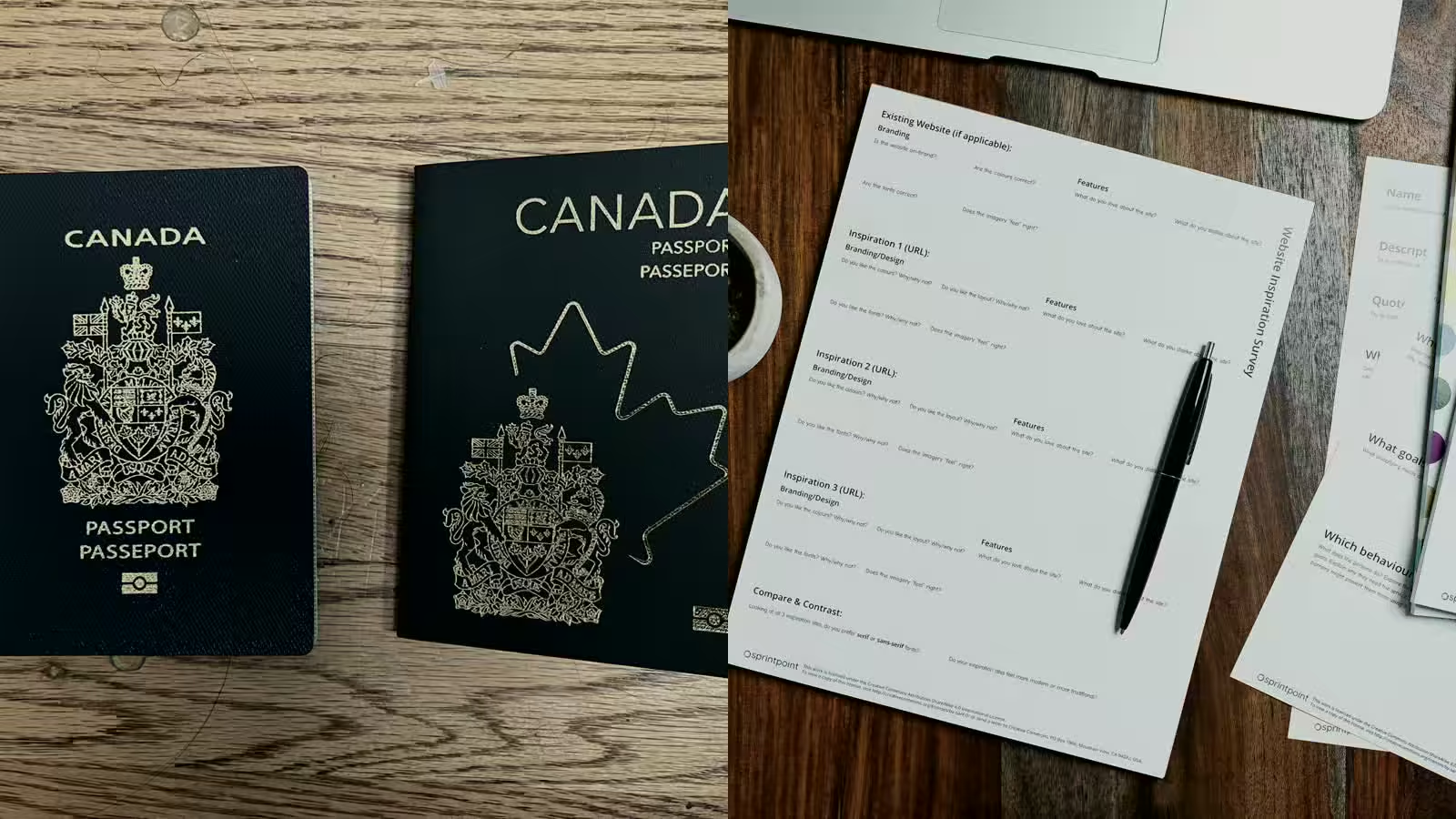

If you are searching for documents required for spouse visa Canada, start with the direct answer: Canada does not run this route as a short-stay visitor visa. The current IRCC path is family sponsorship for permanent residence, and most couples need the IMM 5533 checklist, sponsor-status proof, the main sponsorship and permanent-residence forms, relationship evidence, police certificates, and biometrics if IRCC asks for them. As of April 18, 2026, IRCC’s live fee list shows CAD 1,205 for sponsoring a spouse or partner, and IRCC has already published a higher fee table that takes effect on April 30, 2026.
That distinction matters because many searchers use “spouse visa Canada” when they actually mean spousal sponsorship leading to Canadian permanent residence. According to IRCC’s Complete Guide (IMM 5289), the sponsor and principal applicant file together, the application is now mandatory online, and incomplete packages are rejected and must be fixed and resubmitted. If your case is only a temporary visit to Canada, use the regular Canada visa checklist instead. If you are still sorting whether your Canada file is a visitor, study, or spouse-sponsorship application, compare it first with the broader Canada Visa Document Checklist for 2026. This guide is for the permanent-residence spouse route.
If you want the cross-country version before you lock in the Canada-only checklist, use Documents Required for Spouse Visa in 2026 to compare the UK, Canada, Australia, and U.S. document stacks side by side.
| Document bucket | Who provides it | What IRCC is checking |
|---|---|---|
| Sponsor eligibility and status | Sponsor | Age, status in Canada, ability to sponsor under the correct class |
| Core forms | Sponsor + principal applicant | Whether the case is complete and signed correctly |
| Civil-status and identity documents | Principal applicant and sponsor | Identity, marriage validity, family composition |
| Relationship proof | Both | Whether the relationship is genuine and continuing |
| Police, biometrics, and country-specific documents | Principal applicant and adult dependants | Admissibility and background checks |
| Fees and receipt | Usually uploaded with the main application | Whether the application can be processed without delay |
At a glance
- Use this page only if the real route is family sponsorship for permanent residence, not a short visitor trip.
- Build the file around IMM 5533, then match every form, civil-status record, and police certificate to that checklist.
- Treat completeness as the first decision gate because IRCC can return the file before it reaches relationship assessment.
- Use a route-level QA pass before submission so names, dates, addresses, and dependants stay consistent across every form.
Key takeaways
Use this guide to verify the route, evidence, and next action before you finalize the file. Canada spouse files need forms, identity records, relationship proof, sponsor eligibility, police certificates, medical steps, and country-specific civil documents.
Table of Contents
- Documents required for spouse visa Canada: what the route means
- Documents required from the sponsor
- Documents required from the principal applicant
- Relationship proof and conditional documents couples miss
- Fees, biometrics, and processing time in 2026
- Common file mistakes that get applications rejected or returned
- Official sources
- FAQ
- Conclusion
Documents required for spouse visa Canada: what the route means
The keyword spouse visa Canada is real search language, but IRCC uses more precise labels:
- Spouse means a legally valid marriage recognized where it took place and in Canada.
- Common-law partner means you have lived together in a marriage-like relationship for at least 12 consecutive months.
- Conjugal partner means a partner outside Canada in a genuine conjugal relationship of at least 1 year where marriage or cohabitation has not been possible.
According to IRCC’s who you can sponsor guidance and the IMM 5289 complete guide, the person being sponsored must be at least 18 years old, and the sponsor must also be at least 18.
IRCC also splits spouse sponsorship into two application classes:
- Family Class if the person being sponsored lives outside Canada, or is in Canada but does not plan to remain in Canada during processing
- Spouse or Common-Law Partner in Canada Class if the spouse or common-law partner lives with the sponsor in Canada
That class choice affects the checklist. The IMM 5533 document checklist specifically asks the principal applicant to confirm which class applies. If you choose the wrong one, you can create avoidable delays before the file even reaches substantive review.
If you want the broader workflow for reviewing multi-document immigration files before upload, this companion guide on how to prepare visa application documents is the best preflight read. If you want the broader Canada route map first, keep Canada Visa Document Checklist for 2026 open beside this article while you sort the pack.
Documents required from the sponsor
The sponsor’s documents prove that the person filing the sponsorship is legally eligible to do it.
According to the IMM 5289 guide, you can sponsor if you are:
- 18 or older
- a Canadian citizen, permanent resident, or a person registered under the Indian Act
- living in Canada, unless you are a Canadian citizen abroad who can prove you will return to Canada when the sponsored person becomes a permanent resident
IRCC is also explicit that permanent residents living outside Canada cannot sponsor this route.
Sponsor checklist
Most sponsor files should include these items:
- IMM 5533 — the spouse sponsorship document checklist
- IMM 1344 — Application to Sponsor, Sponsorship Agreement and Undertaking
- IMM 5532 — Relationship Information and Sponsorship Evaluation
- Proof of status in Canada
- Fee receipt
- IMM 1283 Financial Evaluation, but only in the narrower cases where the sponsored spouse has a dependent child who also has a dependent child
The sponsor-status proof depends on status category. The IMM 5533 checklist PDF says:
- permanent residents should upload a PR card or Confirmation of Permanent Residence (CoPR/eCoPR)
- Canadian citizens can use a citizenship certificate, citizenship card, accepted birth certificate, or the identification page of a Canadian passport
- a person registered under the Indian Act can use an Indian status card
One number many guides skip is the sponsor’s legal commitment after approval. IRCC says the undertaking lasts 3 years from the day the spouse, common-law partner, or conjugal partner becomes a permanent resident in all parts of Canada outside Quebec. That matters because the sponsorship is not just a formality. It is a binding promise of support.
Documents required from the principal applicant
The principal applicant’s section is where most of the evidentiary weight sits. This is the part that proves identity, family composition, admissibility, and the route-specific facts of the case.
According to the IMM 5533 checklist, the principal applicant normally needs to submit:
- IMM 0008 — Generic Application Form for Canada
- IMM 5406 — Additional Family Information
- IMM 5669 — Schedule A, for the principal applicant and family members 18 or older
- Country-specific forms if the residence country instructions require them
- Civil-status and identity documents
- Police certificates
- Photographs
- Medical, biometrics, or other admissibility-stage items when requested
The documents IRCC expects most often
| Document | Why IRCC asks for it | Practical note |
|---|---|---|
| Passport identity pages | Identity and travel document validity | Keep names, dates of birth, and passport numbers consistent across all forms |
| Marriage certificate or relationship-status records | Legal route fit | This is the baseline document for spouse cases, but not the whole relationship story |
| Birth certificates for dependent children | Family composition | Needed even for non-accompanying family members in many cases |
| Police certificates | Criminality screening | IRCC’s Help Centre says they should be provided with the application package |
| Country-specific forms | Local requirements | The checklist tells you to review the country instructions before submission |
IRCC’s Help Centre answer on police certificates is unusually direct: you should send the police certificates when you submit your spousal sponsorship application. That is one of the most common “I thought they would ask later” mistakes.
The principal applicant also has to be careful with representation and correspondence. The checklist says that if the sponsor will receive correspondence for, or act on behalf of, the principal applicant or any dependent child over 18, each affected person must complete their own IMM 5476 Use of a Representative form. If not, the application can be returned without being processed.
If you want a general system for checking dates, names, and supporting PDFs before upload, use Vidicy’s workflow explainer. It is built for exactly the kind of cross-document review this route needs.
Relationship proof and conditional documents couples miss
This is where a lot of thin spousal files fall apart. A marriage certificate proves the legal relationship. It does not prove the relationship is genuine by itself.
The official Relationship Information and Sponsorship Evaluation form (IMM 5532) and the IMM 5289 guide are designed to make couples document the story around the relationship, not just the legal status. In practice, that usually means assembling a pack that may include:
- marriage certificate or civil-registration proof
- evidence of cohabitation for common-law cases
- travel records showing time together
- communication history
- financial interdependence evidence
- photos and timelines that make the relationship easy to follow
- explanations for long periods apart, unusual living arrangements, or cross-border constraints
The checklist also imposes two rules couples routinely miss:
- If a required document is missing, IRCC says you must include a detailed written explanation for each missing document plus any other evidence you have.
- If documents are not in English or French, you need a certified translation and the required copy or affidavit structure described in the checklist.
That second rule matters more than applicants expect. A good document translated badly can still slow the whole case down. According to the first page of IMM 5533, translations must be certified, and the original-language document still has to be part of the upload package.
If your evidence set is getting large, the safest move is to organise it around questions IRCC is actually asking:
- Are these two people in a genuine relationship?
- Does the legal route claimed on the forms match the evidence?
- Do names, dates, addresses, and dependants stay consistent across every document?
- Is every missing item explained instead of left blank?
For a reusable checklist on hidden documentation problems, see Avoid Visa Rejection Document Mistakes. It is visitor-visa branded, but the inconsistency patterns it covers show up in family sponsorship files too.
Fees, biometrics, and processing time in 2026
These are the most useful current numbers for planning a spouse sponsorship file.
Current fee as of April 18, 2026
IRCC’s live fee list shows the standard spouse-or-partner sponsorship total at:
- CAD 85 sponsorship fee
- CAD 545 sponsored principal applicant processing fee
- CAD 575 right of permanent residence fee
That totals CAD 1,205 before any dependent-child add-ons.
Fee change effective April 30, 2026
IRCC’s separate fee changes page says permanent residence fees will increase on April 30, 2026. For family reunification files, that page shows:
- sponsorship fee increasing from CAD 85 to CAD 90
- sponsored principal applicant fee increasing from CAD 545 to CAD 570
- right of permanent residence fee increasing from CAD 575 to CAD 600
That means the same spouse sponsorship will total CAD 1,260 for applications received under the new table.
Biometrics
IRCC’s biometrics guidance says:
- CAD 85 for an individual applicant
- CAD 170 maximum for families applying at the same time
- applicants should book as soon as they receive the biometric instruction letter
- they generally have 30 days from the date on the letter
The spouse sponsorship application page also notes that many permanent-residence applicants between 14 and 79 may need biometrics.
Processing time
IRCC’s current family sponsorship infographic says new spouse, partner, or child sponsorship applications are expected to take 12 months until a decision is made, including a 2 to 3 month wait while IRCC checks that the application is complete and ready for processing.
That is a benchmark, not a promise. IRCC’s broader program page says actual timing still depends on completeness, verification difficulty, and how quickly you respond to requests.
This official IRCC video is still worth embedding because it is directly about the exact failure mode that hurts spousal files: incomplete packages.
The video is published through IRCC’s official Save Time: Send a Complete Application page, which is also linked from IRCC’s spouse-sponsorship materials.
Common file mistakes that get applications rejected or returned
IRCC is explicit about the consequence here. On the live spouse sponsorship application page, it says that if the application is incomplete, IRCC will reject it, and you will have to fix the errors and resubmit it.
The highest-risk document mistakes are usually these:
1. Using the wrong Canada route
Applicants search for “spouse visa Canada” and accidentally build a temporary-visit style package. Spousal sponsorship is a permanent residence file. The forms, fee structure, and supporting documents are different.
2. Treating the marriage certificate as the full relationship case
IRCC wants the legal document and the broader proof that the relationship is genuine. A thin package with only a few civil-status documents can look under-explained.
3. Missing police certificates or country-specific forms
The checklist tells applicants to check country-specific requirements. The Help Centre separately says to include police certificates with the application. These are easy to miss because many applicants assume IRCC will ask for them later.
4. No explanation for missing documents
IMM 5533 specifically says you must include a written explanation for each missing required document. Leaving a gap unexplained is worse than documenting the problem clearly.
5. Fee timing confusion around April 30, 2026
As of April 18, 2026, the live fee list still shows CAD 1,205, but IRCC has already published the higher April 30, 2026 fee table. If you are applying close to the change date, check the effective fee again before you pay.
If you want to review the entire package before submission, use Vidicy sign-up to run the documents through a structured pre-submit check instead of relying on a last-minute manual scan.
Related guides
If you're building the rest of the Canada relationship or refusal-recovery pack, these companion guides help:
- Employment Letter for Spouse Visa: Sample + Rules
- Documents Required for Spouse Visa in 2026
- Canada Visa Document Checklist for 2026
- Visa Application Documents: How to Prepare Them
- Documents Required for Visa Applications in 2026
- Canada Visa Refused: What to Fix Before Reapplying
Official sources
- IRCC Complete Guide IMM 5289
- IRCC spouse sponsorship application page
- IMM 5533 spouse document checklist PDF
- IRCC who you can sponsor page
- IRCC biometrics: how to give your fingerprints and photo
- IRCC family sponsorship infographic
- IRCC fee list
- IRCC fee changes page
- IRCC Help Centre: police certificates for spousal sponsorship
- IRCC official video landing page: Save Time: Send a Complete Application
FAQ
What documents are required for spouse visa Canada in 2026?
For most cases, you need the IMM 5533 checklist, IMM 1344, IMM 5532, applicant identity and civil-status documents, police certificates, relationship proof, sponsor-status proof, and the fee receipt. The exact extras depend on country-specific rules, dependants, and whether the case is Family Class or in-Canada spouse sponsorship.
Is there a Canada “spouse visa” or is it permanent residence?
In normal search language, people say “spouse visa Canada,” but the actual route is family sponsorship for permanent residence. That is why the file uses sponsorship forms and permanent-residence fees, not visitor-visa forms.
How much is a spouse sponsorship application for Canada right now?
As of April 18, 2026, IRCC’s live fee list shows CAD 1,205 for sponsoring a spouse or partner: CAD 85 sponsorship fee, CAD 545 processing fee, and CAD 575 right of permanent residence fee. IRCC has also published a higher fee schedule effective April 30, 2026.
Do I submit police certificates with the spousal sponsorship package?
Yes. IRCC’s Help Centre says police certificates should be provided when you submit the spousal sponsorship application package. Do not assume this is a later-stage request unless the current official instructions for your country say otherwise.
How long does Canada spouse sponsorship take in 2026?
IRCC’s current family sponsorship infographic says new applications are expected to take about 12 months, including a 2 to 3 month completeness-review period before normal processing begins. Individual timelines can still move depending on document quality, verifications, and response speed.
Conclusion
The practical answer to documents required for spouse visa Canada is not “upload a marriage certificate and wait.” IRCC wants a permanent-residence sponsorship file that is complete, internally consistent, and backed by the right forms, police certificates, translations, fee receipt, and relationship evidence. The cleaner the package, the less likely you are to lose months to a preventable return.
If you want a second pass before submission, use Vidicy’s workflow to understand the review steps, then create an account to pressure-test the document pack before you send it to IRCC.