


If you are searching for documents required for spouse visa, the first thing to fix is the route name. There is no single global spouse-visa checklist. Most applicants actually mean one of four routes: a U.S. IR1/CR1 immigrant visa, a UK partner or spouse family visa, Canada spousal sponsorship for permanent residence, or an Australia partner visa. In every route, officers want the same core story to hold together: identity, legal relationship, sponsor status, financial or civil documents, and police or medical evidence where the route requires it.
That is why the safest answer is route-specific: use the right government checklist first, then organize your file so names, dates, addresses, and relationship history say the same thing everywhere. If your goal is a faster pre-submit QA pass, pair this guide with how Vidicy works and how to avoid visa rejection document mistakes.
| Route | What officers expect first | Core documents | Current timing and fee signal |
|---|---|---|---|
| U.S. spouse immigrant visa | A valid marriage-based immigrant case, not a visitor file | I-130, DS-260, I-864, passport, civil documents, two 2x2 photos, medical exam | Travel.State.Gov lists $675 for the I-130, $325 for the immigrant visa application, and $120 for Affidavit of Support review |
| UK partner or spouse visa | A family-settlement file with relationship and income proof | passport, marriage or partnership evidence, sponsor-status proof, £29,000 income evidence, English evidence, TB evidence when required | GOV.UK lists £1,938 outside the UK or £1,321 inside, plus £3,105 adult IHS for 2 years and 9 months; typical outside-UK decision target is 12 weeks |
| Canada spousal sponsorship | A permanent-residence sponsorship package, not a visitor visa | IMM 5533, IMM 1344, IMM 5532, IMM 0008, IMM 5406, IMM 5669, police certificates, relationship proof | As of April 27, 2026, the standard total is CAD 1,205; IRCC’s published April 30, 2026 table raises that to CAD 1,260; new cases are expected to take 12 months |
| Australia partner visa | An online partner-visa case with relationship and history evidence | ImmiAccount upload set, previous-relationship records, relationship evidence, translations, health and character items, Form 888 statements | Home Affairs’ March 2026 processing guide shows a median of 18 months for Partner (Provisional/Temporary) visas |
Key takeaways
Use this guide to verify the route, evidence, and next action before you finalize the file. Spouse visa document lists change by country, but every strong file proves identity, relationship authenticity, sponsor eligibility, admissibility, and consistency across dates.
Table of Contents
- Documents required for spouse visa: the universal checklist
- U.S. spouse immigrant visa documents
- UK spouse visa documents
- Canada spouse sponsorship documents
- Australia partner visa documents
- How to organize a spouse visa file without creating contradictions
- Official sources
- FAQ
- Conclusion
Documents required for spouse visa: the universal checklist
Across countries, the most common spouse visa documents fall into five buckets:
- Identity documents such as current passports, previous passports where asked, and birth records
- Civil-status records such as a marriage certificate, divorce judgment, or death certificate from a previous relationship
- Relationship evidence proving the relationship is genuine and ongoing, not just legally registered
- Sponsor-side proof showing citizenship, immigration status, financial ability, or sponsorship forms
- Admissibility evidence such as police certificates, medical exams, biometrics, or translations
What changes from country to country is the weight of each bucket. The UK leans heavily on relationship evidence plus sponsor income. Canada leans heavily on the formal checklist and police timing. Australia leans heavily on relationship history, translations, and long-range timeline accuracy. The U.S. spouse route leans heavily on the petition, Affidavit of Support, and civil documents.
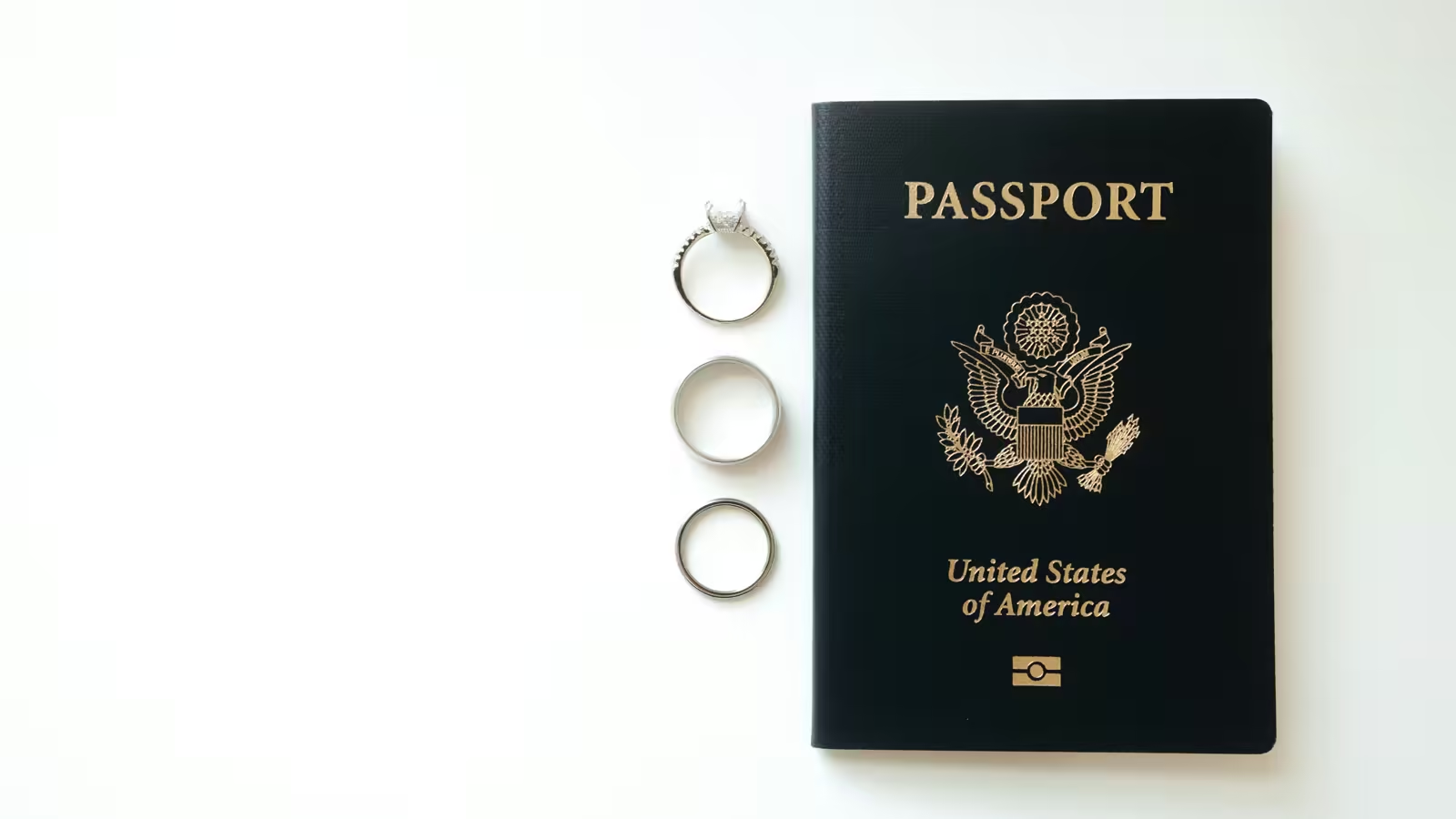
The important practical point is this: a marriage certificate starts the route, but it almost never finishes the proof burden by itself.
U.S. spouse immigrant visa documents
For U.S. applicants, the keyword spouse visa usually means the IR1 or CR1 immigrant visa route on Travel.State.Gov, not a short visitor stay. According to the State Department’s Immigrant Visa for a Spouse of a U.S. Citizen (IR1 or CR1), the base document stack includes:
- a passport valid for 6 months beyond the intended date of entry
- an Affidavit of Support such as I-864
- Form DS-260
- two 2x2 photographs
- civil documents such as birth and marriage certificates, plus translations where required
- completed medical examination forms from an authorized panel physician
The same page says the sponsor does not need a minimum age to file the I-130, but must be at least 18 and domiciled in the United States before signing the Affidavit of Support. That matters because many couples collect the civil documents early but leave the support package fuzzy until NVC, which creates avoidable delay.
The current State Department visa fee page lists:
- $675 for an immigrant petition for relative (I-130)
- $325 for the immigrant visa application processing fee
- $120 for Affidavit of Support review
That totals $1,120 before medical, police, translation, and courier costs.
One more U.S.-specific rule is easy to miss. Travel.State.Gov says that if you have been married for less than two years when the spouse enters the United States, the spouse receives conditional residence and later has to remove conditions. So the document pack should not just prove the marriage happened. It should also prove the relationship is genuine enough to survive later review.
If your biggest weak point is sponsor-side evidence rather than the marriage certificate, tighten the employer and income side with the employment letter for visa application guide before you submit.
UK spouse visa documents
For the UK, documents required for spouse visa means the family-visa partner or spouse route on GOV.UK. The current partner or spouse page says both partners must be 18 or over and must intend to live together permanently in the UK.
GOV.UK says you must prove one of these relationship routes:
- a marriage or civil partnership recognized in the UK
- 2 years of living together in a relationship
- a fiance or proposed civil partner route
- a relationship of at least 2 years where living together has not been possible for a stated reason
The relationship evidence on the same page must come from reliable sources, confirm the relationship, and be less than 4 years old. GOV.UK gives examples such as:
- marriage or civil-partnership certificates
- tenancy agreements
- utility or Council Tax bills
- joint bank statements
- doctor or dentist letters confirming the same address
The financial side is now stricter than many older blog posts still claim. GOV.UK’s current partner income page says the combined income threshold is usually £29,000 a year.
The current GOV.UK family visa overview lists:
- £1,938 to apply from outside the UK
- £1,321 to apply inside the UK
- £3,105 adult immigration health surcharge if the grant is for 2 years and 9 months
And the partner or spouse page says outside-UK decisions usually take 12 weeks.
That means a clean UK spouse file normally includes:
- current passports
- marriage or partnership proof
- sponsor-status proof
- relationship evidence from the last four years
- financial evidence matching the £29,000 rule or the relevant exemption
- English-language evidence
- TB evidence if your residence history triggers it
For a country-specific document walk-through, use the full UK spouse visa checklist. If your sponsor now proves status digitally instead of by physical card, GOV.UK’s official publication links this Home Office video on viewing and proving online immigration status.
Canada spouse sponsorship documents
In Canada, the phrase spouse visa usually means spousal sponsorship for permanent residence, not a visitor visa. IRCC’s complete guide (IMM 5289) says the sponsor and the sponsored person both need to be at least 18 years old.
The core file usually includes:
- IMM 5533 document checklist
- IMM 1344 sponsorship application
- IMM 5532 relationship information and sponsorship evaluation
- IMM 0008, IMM 5406, and IMM 5669 for the principal applicant side
- sponsor status proof
- marriage, common-law, or conjugal relationship evidence
- police certificates
- translations and country-specific forms where required
IRCC’s help centre is unusually explicit on police timing. Its current answer to when to send police certificates for spousal sponsorship says you must provide them when you submit your application package. And IRCC’s police certificate page says you and any family member 18 or older may need one for permanent residence.
Canada also has a clear sponsor-liability rule. The IMM 5289 guide says the undertaking for a spouse, common-law partner, or conjugal partner lasts 3 years from the day the person becomes a permanent resident.
The fee timing matters right now. The same guide’s fee table shows the standard spouse-or-partner package at CAD 1,205 today, made up of:
- CAD 85 sponsorship fee
- CAD 545 sponsored principal applicant fee
- CAD 575 right of permanent residence fee
IRCC’s published fee changes page says that on April 30, 2026, those numbers change to CAD 90, CAD 570, and CAD 600, raising the total to CAD 1,260.
For planning, IRCC’s official spouse, partner, or child sponsorship infographic says new applications are expected to take 12 months, including a 2 to 3 month completeness check at the front.
The IRCC video below comes from the department’s own video page and is directly relevant because incomplete files are returned before deeper relationship review begins.
If you need the full Canada-only checklist after this comparison, use Documents Required for Spouse Visa Canada.
Australia partner visa documents
For Australia, the search phrase spouse visa usually maps to a partner visa rather than a visitor visa. Home Affairs’ Applying for a family visa page says partner applications are made online through ImmiAccount.
The same Home Affairs page tells partner applicants to:
- provide all required documents and correct information up front
- translate all non-English documents into English
- include the translator’s NAATI number if translated in Australia
- list full residential and travel history for the past 10 years
- provide previous relationship records such as marriage certificates, divorce documents, death certificates, separation documents, or statutory declarations
Australia is the route where document chronology matters a lot. If the relationship timeline, address history, and passport history do not line up, the file becomes harder to trust even if the relationship is genuine.
Home Affairs’ partner visa FAQ adds three more details that matter:
- health examinations can be completed after you apply
- health results are usually valid for 12 months
- if you hold a temporary partner visa, 2 years must pass before permanent partner assessment becomes eligible
And the official Form 888 PDF says applicants may be asked to submit up to 3 separate statements about the social aspects of the relationship.
For planning expectations, Home Affairs’ visa processing times page shows a March 2026 median of 18 months for Partner (Provisional/Temporary) visas.
That makes a practical Australia partner-visa checklist look like this:
- passports and identity documents
- marriage or de facto relationship proof
- previous-relationship records
- a no-gap 10-year address and travel history
- translated non-English documents
- health and character items when requested
- Form 888 or other relationship-support statements where relevant
The Department of Home Affairs has also published an official channel video on using ImmiAccount, which is the right companion for the online side of the process.
If you want the Australia-only version after this route comparison, use Documents Required for Spouse Visa Australia.
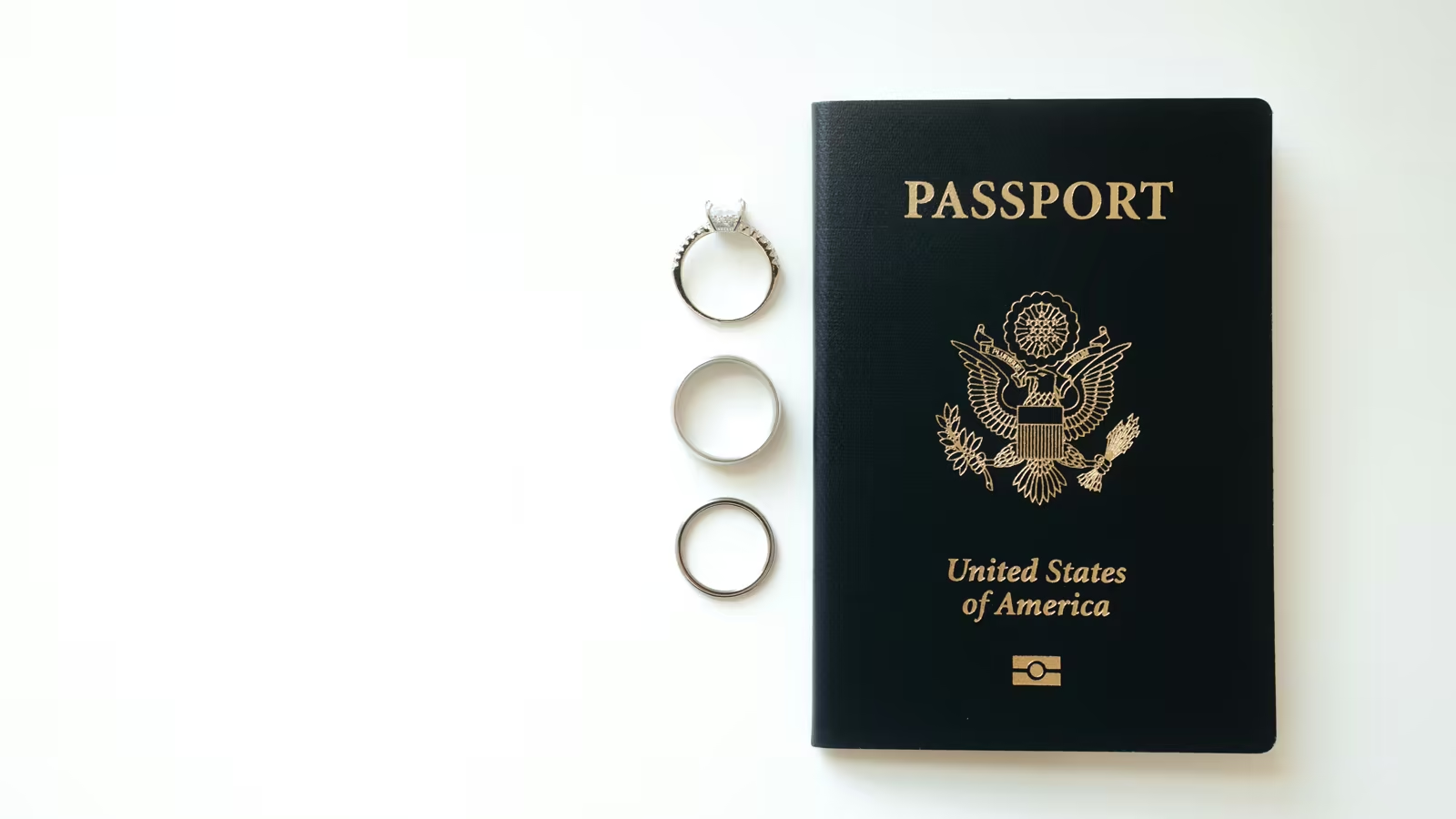
A marriage certificate is the legal anchor. It is rarely the entire file.
How to organize a spouse visa file without creating contradictions
The biggest mistake in a spouse visa documents pack is not usually the absence of one PDF. It is a mismatch between documents that should tell the same story.
Use this order:
- Route label first. State clearly whether the case is U.S. CR1/IR1, UK partner/spouse, Canada spousal sponsorship, or Australia partner visa.
- Index second. Put a one-page contents sheet at the front so an officer can jump to passports, civil records, relationship evidence, finances, and police or health items.
- Timeline third. Build one clean relationship and address timeline before you upload anything.
- Evidence buckets last. Group documents by topic, not by who scanned them.
Before you submit, run four checks:
- Do names match across passports, certificates, forms, and translations?
- Do addresses and dates match across relationship proof, sponsor records, and government forms?
- Have you used the route’s official checklist rather than a generic visitor-visa checklist?
- Have you explained missing documents with the exact fallback the government page allows, instead of leaving a silent gap?
If the sponsor side is strong but the supporting narrative is thin, add a short explanation letter only where the official route allows context. If the underlying evidence is weak, fix the evidence first. A letter should clarify a real file, not try to rescue a contradictory one.
This is also the point where Vidicy is most useful. The workflow at How Vidicy Works is built for cross-document checking, and you can sign up when you want a second set of eyes before submission.
Official sources
- Travel.State.Gov: Immigrant Visa for a Spouse of a U.S. Citizen (IR1 or CR1)
- Travel.State.Gov: Fees for Visa Services
- GOV.UK: Family visas overview
- GOV.UK: Apply as a partner or spouse
- GOV.UK: Financial requirements if you’re applying as a partner or spouse
- IRCC: Complete Guide IMM 5289
- IRCC: Fee changes
- IRCC: When should I send in my police certificates for my spousal sponsorship application?
- IRCC: Who needs a police certificate
- IRCC: Infographic for spouse, partner, or child sponsorship
- Home Affairs: Applying for a family visa
- Home Affairs: Partner Visa Frequently Asked Questions
- Home Affairs: Visa processing times
- Home Affairs: Form 888 supporting statement PDF
- GOV.UK: eVisa support videos
- IRCC: Save Time: Send a Complete Application
FAQ
Is a spouse visa the same as a visitor or tourist visa?
No. A spouse visa is usually a family-settlement or immigrant route. A visitor visa is a temporary-stay route. That distinction changes the documents completely. If you use a visitor-style checklist for a spouse case, you usually under-document the relationship and sponsor side.
Do all spouse visa routes require police certificates?
No, but many do. Canada explicitly says police certificates belong with the spousal sponsorship package. Australia asks for character checks when required. The U.S. immigrant-spouse route includes civil and background-stage documents. The UK spouse route does not run on the same police-certificate model as Canada PR sponsorship.
Do I need a medical exam for a spouse visa?
Often yes, but timing differs. The U.S. immigrant-spouse route requires a panel-physician medical before visa issuance. Australia says you can do health examinations after applying, and the results are usually valid for 12 months. Canada and UK timing depends on the route and official instructions attached to the application process.
Is a marriage certificate enough for a spouse visa?
Almost never. A marriage certificate proves the legal relationship. Officers still need the broader file that proves identity, sponsor status, relationship reality, and admissibility. That is why UK cases ask for recent cohabitation or relationship evidence, Canada asks for relationship forms plus police certificates, and Australia may ask for Form 888 statements.
What if my document is not in English?
Do not guess. Use the route’s translation rule. Australia says non-English documents must be translated, with a NAATI number if translated in Australia or full translator details if translated outside Australia. Canada requires certified translation structures, and the UK expects translated evidence where the officer cannot read the original.
Which document mistakes delay spouse visa decisions most often?
The repeat offenders are route confusion, missing police or health items, outdated or mismatched translations, weak relationship chronology, and sponsor evidence that does not match the form answers. In practical terms, the delay usually starts when two documents disagree and the officer has to stop trusting the file.
Conclusion
The right answer to documents required for spouse visa is not one universal list. It is the correct route-specific checklist plus a file that tells one consistent story. For the U.S., that means the petition, Affidavit of Support, civil records, photos, and medical. For the UK, it means relationship proof, sponsor status, £29,000 financial evidence, English, and the current fee set. For Canada, it means the IMM checklist, police certificates at submission, and current fee timing. For Australia, it means ImmiAccount, translations, 10-year history accuracy, and relationship evidence strong enough to stand on its own.
If you want a second set of eyes before you upload, use Vidicy’s workflow or go straight to sign up and run the package through a structured pre-submit check.