


If you are searching for documents required for Korean visa applications, start with the shortest accurate answer: some travelers need only a passport because they are currently exempt from K-ETA through December 31, 2026, while others need a consular visa file built around Form No. 17, a valid passport, one recent photo, the visa fee, and purpose-specific supporting documents. According to the Korea Visa Portal, the official K-ETA site, and current embassy pages, the document list changes quickly once your purpose becomes tourism, visiting family or relatives, or business meetings. If you already know your trip is ordinary tourism only, the narrower documents required for Korean visa is the faster route.
This article is for people using a generic search query who need to stop collecting the wrong PDFs before they even know which Korea entry track applies.
Key takeaways
The documents required for Korean visa applications depend on entry track, purpose, and filing mission. The stable baseline is identity, form, photo, fee, and purpose proof; the variable layer is K-ETA status, local residence proof, financial evidence, invitation documents, and whether the mission accepts your filing method.
| Travel path | What to check first | Core documents | What changes most often |
|---|---|---|---|
| K-ETA or temporary exemption | Whether your nationality is exempt through December 31, 2026 or still needs K-ETA | Passport details, online application if you choose or need K-ETA | Exemption status, arrival-card benefit, processing time |
| Tourist visa C-3-9 | Whether you actually need a consular visa instead of K-ETA | Form No. 17 or e-Form barcode, passport, photo, fee, bank proof, itinerary, accommodation | Residence-card rules, statement freshness, home-country filing limits |
| Visiting family or relatives | Whether the trip stays within short-term visit logic | Core short-term visit file plus host or stay details the mission asks for | Bank-statement window, hotel or host proof, cover-letter expectations |
| Business meeting or conference | Whether the activity is unpaid short-term business, not work | Core file plus employer letter, Korean invitation, flight details | Who pays for the trip, business-registration copy, mission filing method |
| Sponsor-backed or portal-assisted visa routes | Whether the route uses e-Visa or confirmation of visa issuance | Electronic form, passport-page scans, digital photo, fee, status-specific soft copies | Which routes the sponsor can file online and which still require embassy issue |
Table of Contents
- Documents required for Korean visa start with K-ETA vs embassy visa
- What counts as a Korean visa document?
- Core documents every Korean embassy visa file needs
- How the Korean visa document list changes by purpose
- Fees, e-Form steps, and current processing examples
- Mission-level rules that change the file
- Official sources
- FAQ
- Conclusion
Documents required for Korean visa start with K-ETA vs embassy visa
The first job is not printing forms. The first job is deciding whether you need a visa file at all.
According to the official U.S. embassy notice published on December 29, 2025, the Ministry of Justice extended the temporary K-ETA exemption through December 31, 2026 (KST) for countries and regions that are already exempt. The current K-ETA site also says the application fee is KRW 10,000 (about USD 7 to 8) and the assessment is generally completed within 72 hours.
That creates a simple decision tree:
- If your nationality is temporarily exempt or otherwise visa-free for the exact trip purpose, do not build a Korea visa file just because a blog said “everyone needs one.”
- If your passport is not exempt, or your travel plan does not fit the visa-free or K-ETA track, move to the consular visa route.
- If the route is a sponsored, medical, student, or other special status, use the Korea Visa Portal carefully because the status of stay changes the document list immediately.
The K-ETA guide itself surfaces an application video, and the official English version is published on the Korea Immigration YouTube channel:
That video is useful for the visa-free / K-ETA branch of the decision, not for the embassy document stack. Once you know you actually need a visa, the Korea Visa Portal warns that its required-document lists are only minimum requirements and that the instructions of the specific diplomatic mission override them.
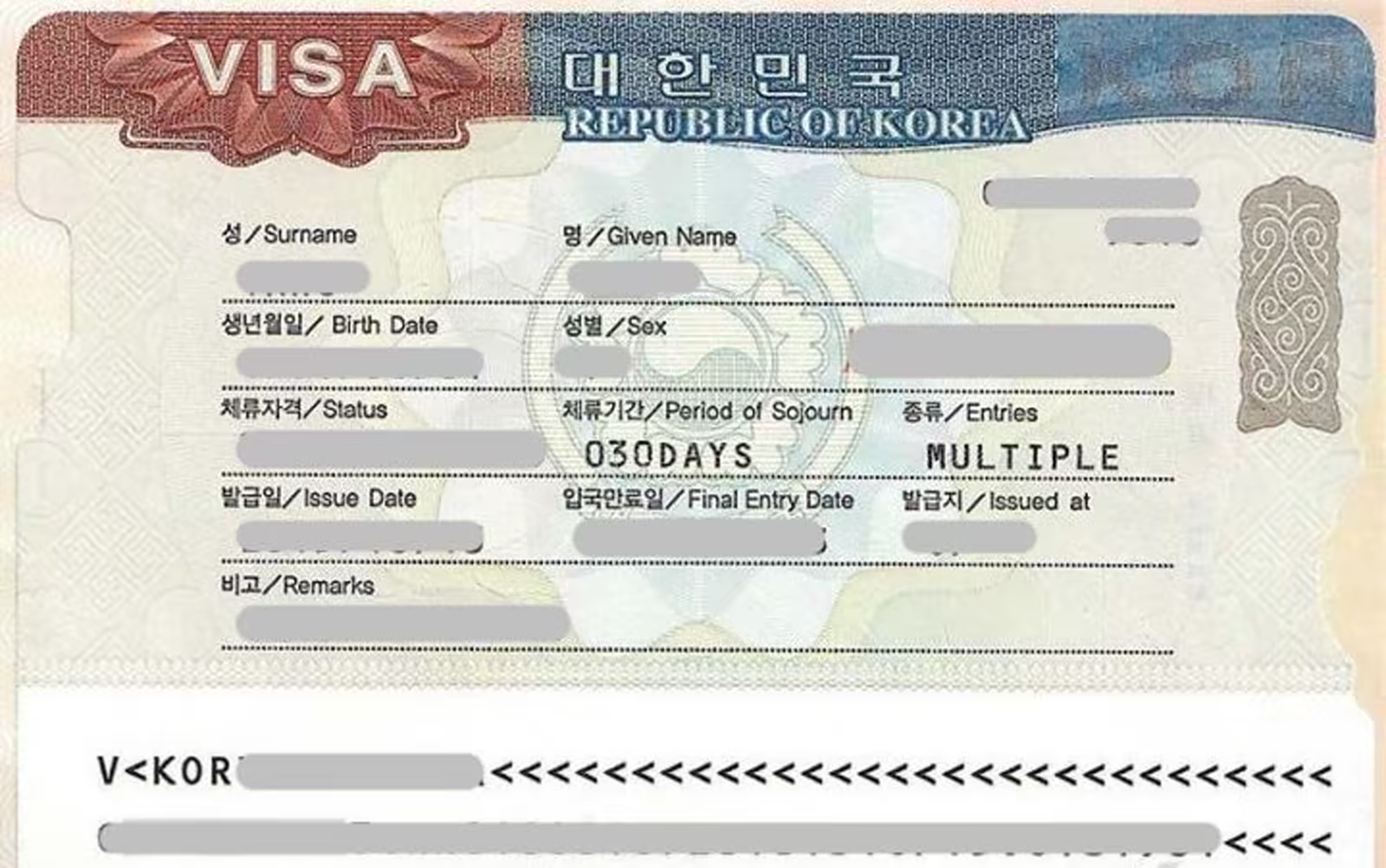
What counts as a Korean visa document?
A Korean visa document is any identity, eligibility, purpose, financial, residence, or sponsor record used by the Republic of Korea's immigration authorities or overseas diplomatic missions to decide whether a traveler qualifies for a specific status of stay. The document is only useful if it matches the applicant's route and mission instructions.
In practice, this means a passport and Form No. 17 prove identity and filing intent, while bank statements, employment letters, itineraries, invitation letters, and accommodation proof explain why the trip is credible. A document can be official and still be the wrong evidence if it belongs to the wrong Korea visa route.
Core documents every Korean embassy visa file needs
For embassy-filed short-term Korean visas, the stable baseline is more consistent than many search results make it sound.
According to the Korea Visa Portal page for Visa Application via Korean Diplomatic Missions Abroad, the base file includes:
- Visa Application Form (Form No. 17) or the electronic form printed with a barcode
- Passport
- Photo in natural color
- Fee in U.S. dollars or the mission-approved local equivalent
- Required documents for the corresponding status of stay
The same portal page also says two things that matter more than most generic checklists:
- short-term C-type routes usually sit under 90 days or less single-entry or multiple-entry rules depending on the status and nationality
- the mission can request additional documents or exempt some items depending on local circumstances
The e-Form page adds another practical layer. Before you visit the embassy or consulate, you may need:
- scanned passport-page files
- a digital photograph in 3.5 cm x 4.5 cm
- the printed barcode application
- the physical passport
- the photo, fee, and supporting documents at the in-person step
The photo rule is one of the easiest places to lose time. Sweden’s current tourist page uses 3.5 cm x 4.5 cm, while the New York mission page currently describes a 2 x 2 inch photo for some short-term visit categories. That is why the safest practice is to check the mission page last and keep the broader Korean visa photo size guide open when you prepare the image file.

How the Korean visa document list changes by purpose
This is the part hidden by the generic keyword. “Korean visa” is not one document list. It is a family of short-term and special-status routes.
Tourist visa (C-3-9)
Norway’s current Tourist Visa (C-3-9) page says the tourist route is for people visiting Korea for holidays or leisure, and it requires:
- a visa application form filled out online, then printed and signed
- a physical passport with more than 6 months of validity
- a copy of the passport identity section
- a residence card copy
- proof of strong ties to the country of residence
- proof of funds, such as a payslip or bank-balance certificate for the last 3 months
- the application fee
Sweden’s current tourist page is even more exact. It requires the barcode form, one recent photo, a passport valid for 6 months, a passport copy, and an original bank statement with bank stamp that:
- covers the last 3 months
- includes the current balance and account-holder information
- is issued within 3 days of the application date
That is a strong example of why the Korea Visa Portal’s “minimum requirements” language matters. The mission-level page is where the rough category becomes a real file checklist.
Visiting family or relatives
For short-term family or relatives visits, some missions keep the route under the short-term visit umbrella rather than a separate long-term family-joining status.
The current New York mission page lists these documents for visiting family or relatives cases:
- visa application form
- passport valid for more than 6 months and a copy
- U.S. permanent resident card or another valid long-term U.S. visa if the applicant is not a U.S. citizen
- natural-color photo taken within 6 months
- hotel reservation information document
- flight itineraries
- a recent 1-month bank statement with an ending balance over $3,000
- the applicable fee
That is a useful reminder that some missions test a family-visit file as a short-term stay file first: trip plan, stay plan, passport status, and money trail. The route can become much more document-heavy if the real status is joining family, long-term stay, or another status outside the simple short-term visit bucket.
Business meeting or attendance at a conference
The same New York mission page separates short-term business cases from tourism and says business visitors should prepare:
- the visa application form
- passport valid for more than 6 months and copy
- residence-status proof in the U.S. if relevant
- recent photo
- a letter from the current U.S. company
- an invitation letter from the Korean partner company
- flight itineraries
- a copy of the Korean organization’s business-registration certificate
- a recent 1-month bank statement if the company is not covering the travel cost
This is one of the cleanest current official examples of how the document stack changes with purpose. A tourist file centers on funds, itinerary, and accommodation. A business file adds corporate purpose, employer backing, Korean counterpart proof, and a clear answer to who pays.
If the itinerary is the weakest part of the package, this route-neutral Flight itinerary for visa guide is the right supporting read before you finalize dates, bookings, and trip-purpose wording. If the mission asks you to explain the trip in writing, use the Korean visa cover letter guide to connect the invitation, funding, employment, and travel dates without contradicting the checklist.
Fees, e-Form steps, and current processing examples
The official Korea Visa Portal fee page currently lists these base amounts:
| Visa type | Current base fee |
|---|---|
| 90 days or less single-entry visa | USD 40 |
| 91 days or longer single-entry visa | USD 60 |
| Double-entry visa usable up to 2 times | USD 70 |
| Multiple-entry visa | USD 90 |
The same page says the fee may be adjusted by nationality or reciprocity rules, and that the visa fee is not refundable even if the application is denied.
For timing, current official mission examples do not all say the same thing:
| Mission example | Current timing signal | Why it matters |
|---|---|---|
| Norway tourist visa page | About 10 working days after all physical documents are submitted | Good baseline for in-person embassy processing |
| Sweden tourist visa page | 2 to 3 weeks and no expedited service | Tells readers not to build travel around optimistic forum estimates |
| K-ETA site | Usually assessed within 72 hours | Only relevant for the visa-free or ETA branch |
The e-Form workflow is also easy to misunderstand. The Visa Portal’s e-Form page says applicants prepare the barcode form online first, but they still complete the process by visiting the Korean embassy or consulate with:
- the printed barcode form
- the passport
- the photo
- the visa fee
- the supporting documents
That is why “I filled out the online form” is not the same thing as “I finished the visa application.”
Mission-level rules that change the file
The biggest practical mistake is assuming one embassy page covers everyone.
Here are four live examples of mission-specific rules that can materially change the file:
- Norway says citizens of certain countries must apply from their home country, unless they fall into narrow residence exceptions.
- Sweden requires bank statements from a Swedish bank account in SEK and wants them issued within 3 days of application.
- New York says tourism visa (C-3-9) is not accepted via mail, even though some other categories can be mailed in.
- Nepal’s tourist-visa page asks for a visa cover letter, a detailed travel schedule, a hotel booking voucher, and round-trip flight bookings whose departure is at least 21 days after the application date.
That final example from Nepal is especially useful because it shows how fast the checklist can become more detailed once a mission adds local intake controls.
A strong rule of thumb is this: use the Korea Visa Portal for the route, then use the mission page for the actual filing behavior. If the document set still feels messy after that, review it as one story using How to prepare visa application documents before you submit.
If you want to see how Vidicy structures case-specific checklist review on routes it already exposes publicly, the closest live example is the Canada visa checklist. The same logic applies here: the file should prove identity, purpose, funds, and return intent without contradiction.
Related Korean visa guides
Use these next if you already know your Korea route:
- Documents Required for Korean Visa in 2026
- Korean Visa Photo Size: 35x45 mm Rules (2026)
- Korean Visa Cover Letter: Sample + What to Include
Official sources
- Korea Visa Portal: visa application procedures and minimum required documents
- Korea Visa Portal: visa application fee table
- Korea Visa Portal: e-Form workflow
- Official K-ETA application site
- Embassy of the Republic of Korea in the USA: K-ETA temporary exemption through December 31, 2026
- Embassy of the Republic of Korea to Norway: Tourist Visa (C-3-9)
- Embassy of the Republic of Korea in Sweden: Ordinary Tourist Visa (C-3-9)
- Consulate General of the Republic of Korea in New York: Visa Information
- Embassy of the Republic of Korea in Nepal: Visa Issuance
FAQ
Do I need K-ETA or a Korean visa?
Check that first. The current official notices say some nationalities remain temporarily exempt from K-ETA through December 31, 2026, while others still need K-ETA or a consular visa depending on nationality and purpose. A generic blog answer is less reliable than the official status check and mission page.
What documents are usually required for a Korean tourist visa?
For current C-3-9 tourist examples, the stable core is the barcode or Form No. 17 application, passport, recent photo, fee, financial proof, itinerary, and accommodation evidence. Missions then add their own rules on residence cards, statement freshness, country of application, and whether host documents are needed.
How much bank balance do I need for a Korean visa?
There is no one universal public number across all embassies. What the live mission pages show instead is a pattern: recent readable bank evidence, enough funds to cover the trip, and a financial story that matches the itinerary. Sweden and Norway currently use the last 3 months as a working financial-proof window.
Can I use the same document stack for family visits and business trips?
No. The baseline identity file overlaps, but the purpose proof changes. Family or relatives visits may require hotel or stay details plus a recent bank statement, while business visits add employer letters, Korean company invitations, and sometimes a Korean business-registration certificate. The mission page decides the final mix.
How recent do the photo and bank statements need to be?
The official examples are specific. Mission pages commonly require a photo taken within the last 6 months. Sweden currently wants a bank statement covering the last 3 months and issued within 3 days of the application date. Those kinds of local freshness rules are exactly why one-size-fits-all checklists fail.
How long does Korean visa processing take?
It depends on the filing path and the mission. The K-ETA site says assessment is generally within 72 hours. Norway currently gives a tourist-visa example of about 10 working days, while Sweden says 2 to 3 weeks and explicitly says there is no expedited service. Use your own mission page as the final benchmark.
Conclusion
The right answer to documents required for Korean visa is not one global checklist. It is the correct entry track first, then the correct mission-level file second.
For short-term cases, that usually means deciding between K-ETA, temporary exemption, tourist C-3-9, family-visit short-term evidence, or business-visit proof before you upload anything. If you want a structured second pass on the full package after you build it, review How Vidicy works and then sign up when the file is ready for a document-level QA pass.