


A Korean visa cover letter is a short applicant-written explanation that ties your visa type, travel dates, itinerary, funding, and return plan to the exact checklist your Korean embassy or consulate uses. The safest current rule is not "always include one" or "never include one." The official Korea Visa Portal says its document list is only the minimum requirement, and if the rules on a diplomatic mission's page differ, you should follow the mission page instead.
That mission-level detail matters on this keyword. The Embassy of the Republic of Korea in Nepal currently explicitly requires a visa cover letter for tourist, business, family-visit, student, and dependent filings, while other mission pages focus more on the form, passport, bank statements, and itinerary. So the practical answer is simple: write the letter when your mission asks for it, or when your file needs one clean page that explains the same facts already shown elsewhere in the application.
If you want the route-level document logic first, use the newer documents required for Korean visa and Korean visa photo size guide before you draft the note itself. If you want to see how Vidicy structures checklist-style review on live routes, compare the UK visa checklist or Canada visa checklist and then come back to the Korea-specific wording here.
| Korean visa cover letter checkpoint | Current official benchmark | Why it matters |
|---|---|---|
| Base visa fee | Korea Visa Portal lists USD 40 for a 90 days or less single-entry visa | Your letter should not describe a route that conflicts with the fee bucket you are paying for. |
| Application form photo | Official Form No. 17 uses 35 mm x 45 mm and says the photo must be taken within the last 6 months | Your cover letter should match the same identity and current-appearance story as the form. |
| e-Form workflow | The Visa Portal says short-term C-3 applicants can submit an online e-Form and then print the barcode version for the appointment | If you use the e-Form, the cover letter still has to align with the printed barcode application. |
| Tourist filing example | Sweden asks for a bank statement covering the last 3 months, and it must be issued within 3 days of the application date | Your letter should summarize the funds proof you actually have, not a generic internet template. |
| U.S. mission example | The Embassy in the USA lists recent 3 months of bank statements and a typical processing window of 2 to 3 weeks for short-term cases | Your letter should support realistic timing and document freshness. |
| Nepal mission example | Nepal's guide says the visa process can take 21 working days or more and requires a cover letter that explains purpose, itinerary, and who pays | This is the clearest official example of what a Korea cover letter needs to say. |
Key takeaways
Use this guide to verify the route, evidence, and next action before you finalize the file. A Korean visa cover letter should explain the trip purpose, C-3 route, travel dates, funding, accommodation, and return plan without contradicting the mission checklist.
Table of Contents
- When you need a Korean visa cover letter
- What to include in a Korean visa cover letter
- How the content changes by visa type
- Korean visa cover letter sample
- Mistakes that weaken the letter
- Official sources
- FAQ
- Conclusion
When you need a Korean visa cover letter
The first job is to confirm that you are actually on the visa track.
According to the Embassy of the Republic of Korea to Norway, K-ETA has been temporarily exempted for certain countries and regions until December 31, 2026 (KST), and K-ETA applies to eligible visa-waiver or visa-free travelers entering for tourism, visiting relatives, events, meetings, or non-profit business purposes. If your trip falls under visa-free entry or K-ETA, you are not building the normal consular visa package that this article is about.
That route check is why the official Korea Immigration video below is still relevant before you write anything:
Once you know you really do need a Korean visa, the next rule comes from the central Visa Portal. The portal says the required documents on its Visa Navigator are only the minimum list, and the head of the diplomatic mission may request or exempt additional documents for further evaluation. In plain English: the embassy page wins.
That is also why this keyword is confusing. Some Korea mission pages say visa cover letter directly. Others do not use that exact label, but they still require the underlying facts the letter usually explains:
- exact purpose of visit
- tentative itinerary
- address in Korea, including hotel or host details
- who covers the travel costs
- proof of employment, study, or sponsor relationship
So the clean working rule is:
- If your mission page explicitly asks for a visa cover letter, submit one.
- If your mission page does not use that phrase but your case has a sponsor, a host, a mixed funding story, or an unusual itinerary, a one-page cover letter is still useful.
- If your letter says anything that the form, bank statements, employer proof, inviter documents, or hotel booking cannot support, rewrite the file before you submit.
If you want the broader file-level QA once you know the route, use How to Prepare Visa Application Documents before you upload.
What to include in a Korean visa cover letter
The fastest way to write a strong Korean visa cover letter is to use the official visa form as your outline.
The current Korea visa application form PDF tells you what officers already expect to reconcile:
- your full name in English as shown in the passport
- whether the stay is short-term or long-term
- your purpose of visit
- your address in Korea, including hotel details
- whether there is an inviting person or organization
- the estimated travel costs
- who will pay for the trip
That means a one-page Korean cover letter should usually include these seven blocks:
- Applicant identification Your name, passport number, nationality, current residence, and the visa type you are applying for.
- Purpose of visit Tourism, family visit, business trip, study, training, dependent stay, or another valid route.
- Travel dates and Korea itinerary Intended arrival, intended departure, cities, hotel or host address, and major activities.
- Funding Whether you, your employer, your school, or your host is paying, plus which supporting documents prove that.
- Home-country ties Job, school enrollment, business activity, family obligations, or residence status that show why you will leave after the visit.
- Attachment map A short list of the documents the officer should check beside the letter.
- Polite closing A simple request to consider the application, not a dramatic appeal.
The cover letter works best when it reads like a map, not like an essay.
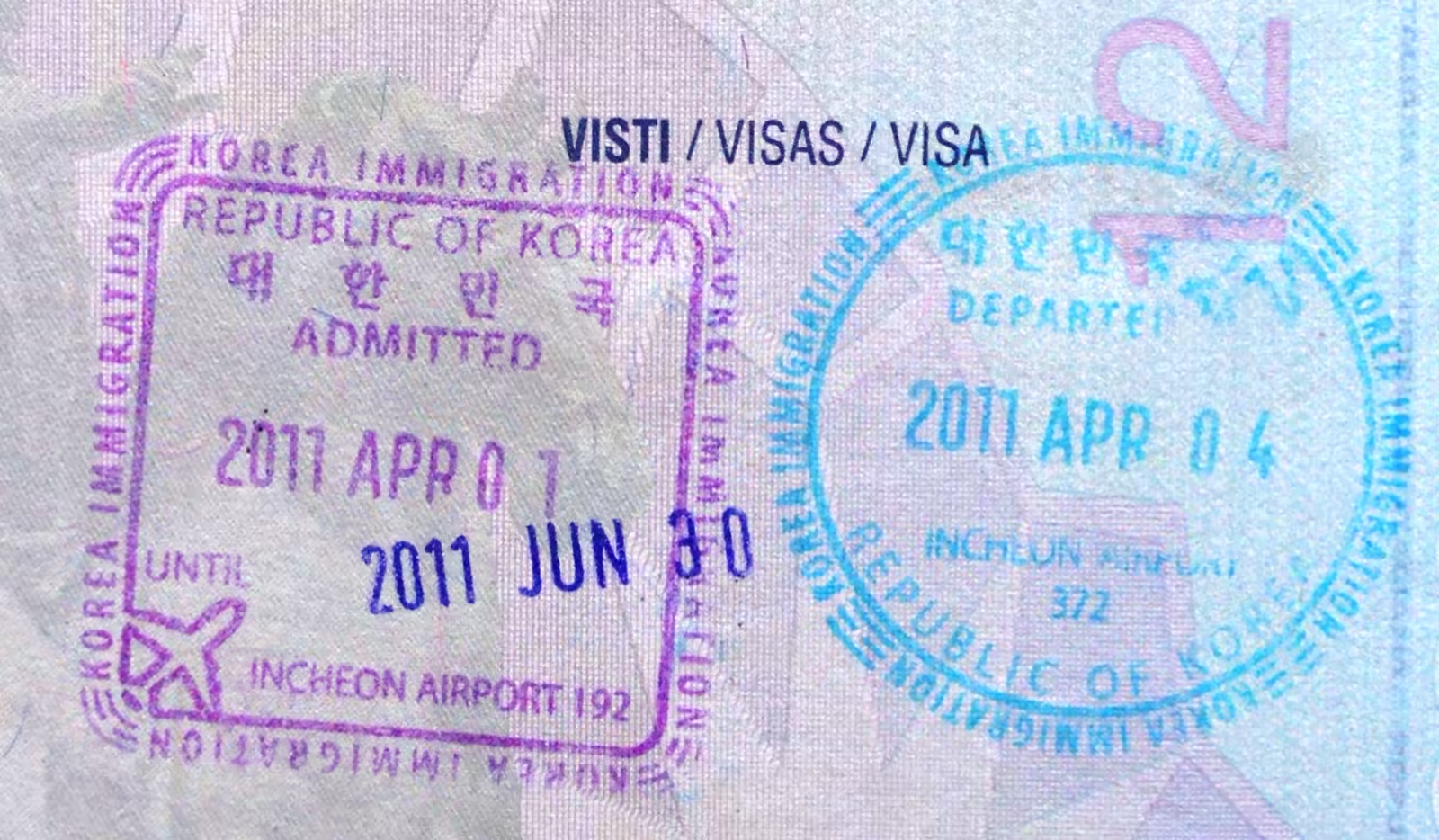
According to the Embassy of the Republic of Korea in Nepal, tourist applicants should furnish a cover letter with the purpose of the visit, a tentative itinerary, and who will cover the expenses during the visit. That same mission page repeats the same idea for business and family-visit cases. The exact phrasing changes by route, but the core logic does not.
So the best sentence-level test is simple:
If a sentence in your Korean visa cover letter does not help an officer verify purpose, dates, address, funding, or return logic, it probably does not belong there.
How the content changes by visa type
The structure stays stable, but the emphasis changes by route.
| Visa type | What the letter should emphasize | Current official examples |
|---|---|---|
| Tourist C-3-9 | Travel purpose, round-trip timing, hotel or host plan, personal funds, and return ties | Sweden asks for a barcode form, passport, bank statement, ticket schedule, accommodation proof, and detailed itinerary. Nepal asks for a cover letter, round-trip flight, hotel booking, and personal bank statements. |
| Business C-3-4 / C-3-1 | Meeting purpose, daily schedule, Korean inviter, employer authorization, and who pays | Nepal asks for a cover letter, daily business schedule, invitation letter, business registration, and employer proof that the company can cover costs and that the applicant intends to return. |
| Family visit C-3-9 | Relationship to the inviter, host status in Korea, sponsor responsibility, and where you will stay | Nepal asks for a cover letter, family relationship documents, inviter proof in Korea, and sponsor details for expenses. |
| Student D-2 / D-4-1 | School, course, funding source, accommodation, and why the stay fits the study plan | Nepal's mission guide asks for a cover letter, SOP, school documents, TB report, bank statements, and family or sponsor papers where relevant. |
Two practical patterns show up across these official pages.
1. Tourist letters should mirror the itinerary pack
The Embassy in Sweden currently requires:
- Form No. 17 with a bar code
- one photo
- physical passport with at least 6 months validity
- bank statement for the last 3 months
- round-flight ticket schedule
- hotel or accommodation reservation
- detailed travel itinerary
That means a tourist cover letter should summarize those same documents in the same order. If your bank statement is stamped but your letter says the host pays for everything, you create an avoidable contradiction unless the file explains the split clearly.
2. Business and family-visit letters need a clearer sponsor story
The Embassy in Nepal is especially useful here because it shows what Korea missions often want to see in writing. For business cases, the page asks for a cover letter, a daily business schedule, an invitation letter, and employer proof. For family visits, it asks for a cover letter plus inviter records, relationship proof, and sponsor information.
So if another person or organization is involved, your letter should answer four direct questions:
- Who invited you?
- What exactly will happen in Korea?
- Who pays which part of the trip?
- Why does the rest of the evidence support that story?
If your case is an invited family stay rather than a normal hotel-based trip, pair this guide with Invitation Letter for Visa: Country Rules + Sample before you finalize the host-side paperwork.
Korean visa cover letter sample
Use this sample as a structure, not as text to paste unchanged.
[Your full name]
[Your address]
[Email]
[Phone number]
[Date]

To: Visa Officer
[Embassy / Consulate of the Republic of Korea]

Subject: Cover letter for Korean visa application

Dear Visa Officer,

I am applying for a [tourist / business / family visit / student / dependent] visa to the Republic of Korea for travel from [arrival date] to [departure date].

The purpose of my visit is [brief reason]. During this trip, I will stay at [hotel name and address / host name and address] and my planned activities are [short itinerary summary].

I will pay for [flights / daily expenses / the full trip]. [If relevant: My host / employer / sponsor, [name], will cover [accommodation / local costs / tuition / other costs].] The attached [bank statements / sponsor documents / employer letter / invitation letter] support this funding plan.

I am currently [employed at / enrolled at / self-employed through] [organization name]. I have attached [employment letter / school letter / business documents] to confirm my current commitments in [home country or country of residence]. After the visit, I will return to [country] to continue these obligations.

For ease of review, I have attached:
- visa application form
- passport and passport copy
- photograph
- [bank statements / sponsor proof]
- [ticket itinerary]
- [hotel booking / host documents]
- [employment or school proof]

Thank you for considering my application.

Sincerely,
[Your full name]
This sample stays deliberately plain because the official form and mission checklists already carry the heavy legal details. Your job is to make the officer's review easier, not to outperform the documents.
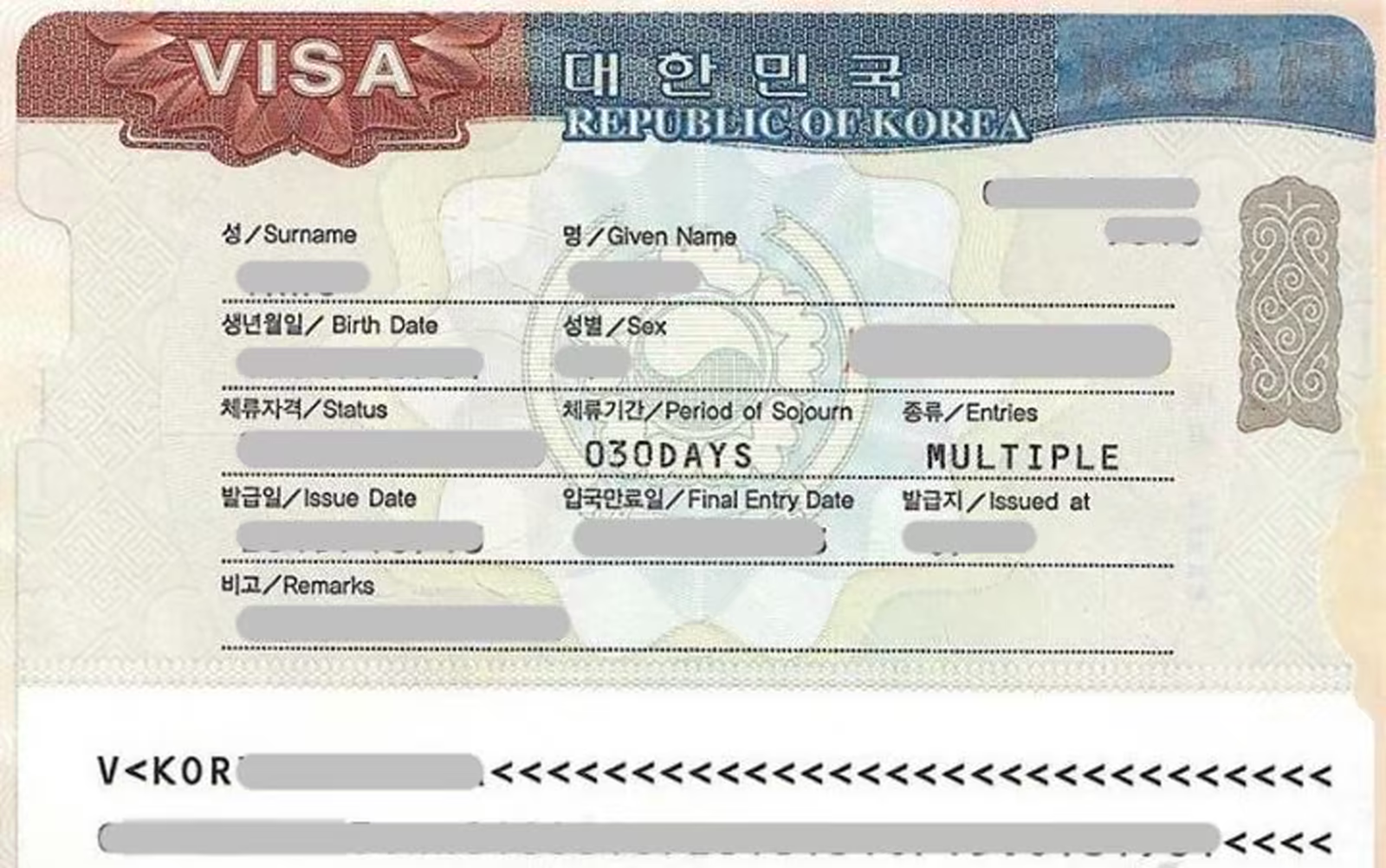
If your case is a tourist file with one sponsor or one host, keep the letter to about one page. If the case is more complex, add a short attachment list rather than turning the letter into a narrative.
Mistakes that weaken the letter
The biggest failures on this query are not grammar problems. They are evidence mismatches.
Writing a generic letter that ignores the mission page
The Korea Visa Portal says its lists are minimum requirements and that the diplomatic mission may request or exempt extra documents. That means a letter copied from a generic internet template can easily miss a local rule about residence cards, bank-statement freshness, invitation documents, or filing location.
Using the letter as a substitute for missing proof
According to the notice section of the official visa application form, failure to submit all required documents may cause delay or denial of a visa. A cover letter can explain evidence. It cannot replace evidence.
Letting the story drift from the form
If the application form says "tourism" but the cover letter reads like a business visit, or if the form lists hotel accommodation but the letter says you will stay with a relative, the file becomes harder to trust.
Describing funds vaguely
Official mission pages repeatedly ask who pays and how the traveler is supported. Do not write "I am financially capable" with no concrete document trail. Instead, say who pays and which attached document proves it.
Using the wrong portal or fake agencies
The Consulate General of the Republic of Korea in Chennai warned on January 30, 2025 that fraudulent visa-agency schemes were targeting Indian applicants with fake Korea Visa Portal websites and fake visas, and it pointed applicants back to the official portal at https://www.visa.go.kr. If your letter, booking flow, or application receipt is built around an unofficial site, stop and reset the process before you submit anything.
If your broader concern is refusal-proofing rather than just letter wording, use Avoid visa rejection due to document mistakes before you finalize the package.
Official sources
- Korea Visa Portal - Visa application fees
- Korea Visa Portal - e-Form guide
- Korea Visa Portal - Visa application via diplomatic missions abroad
- Korea Visa Application Form (Form No. 17) PDF
- Embassy of the Republic of Korea in the Kingdom of Sweden - Ordinary Tourist Visa (C-3-9)
- Embassy of the Republic of Korea in the USA - Visa Application Guide
- Embassy of the Republic of Korea in Nepal - Visa Issuance
- Embassy of the Republic of Korea to Norway - K-ETA
- Consulate General of the Republic of Korea in Chennai - Warning about counterfeit Korea Visa Portal Websites and Fake Korean Visa
FAQ
Is a Korean visa cover letter mandatory?
Not always. The safest answer is that it is mission-specific. The Korea Visa Portal says embassy pages can request extra documents beyond the portal minimums, and Nepal's mission currently names a visa cover letter directly for several visa categories. If your mission asks for one, treat it as required.
How long should a Korean visa cover letter be?
Usually one page is enough for tourist, family-visit, and straightforward business cases. The letter should summarize purpose, dates, funding, and return logic, then point to the attachments. If it becomes long, the real problem is usually that the evidence stack is still unclear.
What should I write if someone else is paying for my trip?
Name the sponsor, explain the relationship, say exactly which costs they cover, and make sure the supporting sponsor or invitation documents match the same story. Do not write a vague sentence about support if the bank, inviter, and accommodation documents say something different.
Do I need a Korean visa cover letter if I am traveling on K-ETA?
Normally no, because K-ETA is a different entry track for eligible visa-free travelers. This article is for people who are actually filing a Korean visa through a diplomatic mission. Always check first whether your nationality is on a visa-free, K-ETA, or current exemption path.
Can I use the same cover letter for tourist and business travel?
No. A tourist letter centers on itinerary, hotel or host stay, and personal funds. A business letter needs the business purpose, meeting schedule, employer backing, and Korean inviter context. Reusing one format across both routes is a common way to make the application look inconsistent.
Do I still need a cover letter if I submit the Korea visa e-Form?
Possibly yes. The e-Form changes how you complete the application form, but it does not remove mission-level supporting-document rules. The Visa Portal says you still need to print the barcode application and visit the diplomatic mission with the required documents, so follow the mission checklist for your route.
Conclusion
The strongest Korean visa cover letter is not the most persuasive one. It is the one that makes your Korea file easy to verify: route, dates, address, funding, inviter details, and return ties all match the official form and the mission checklist.
Start with the correct route, match the embassy page where you will apply, and keep the letter factual. If you want a second pass before you submit, review How Vidicy works or go straight to sign up to run the wider document set through the same consistency check.