



If you need an invitation letter for visa applications, write one that proves five things quickly: who is inviting whom, why the trip makes sense, where the visitor will stay, who pays, and when the visitor will leave. The exact weight of the letter changes by route. Canada's official guidance tells hosts exactly which visitor and host details to include. UKVI asks sponsor evidence to show what support is being provided, how it is provided, whether the sponsor has enough funds, and the relationship. Australia's Sponsored Family stream may require Form 1149. The U.S. Department of State says a letter of invitation is not needed to apply for a visitor visa.
That is why the best invitation letter for visa cases is not one universal template copied into every file. It is one clean base format adapted to the country, visa type, and sponsor role. If you want the route checklist before you draft the letter, start with Vidicy's UK visa checklist, Canada visa checklist, or Schengen visa checklist. If the host is a relative and you want the cross-country family version, use the Family Invitation Letter for Visa guide.
| Route | Official position | What the host should focus on |
|---|---|---|
| UK visitor visa | UKVI says sponsor evidence should show what support is being provided, how it is provided, whether the sponsor has enough funds, and the relationship | identity, immigration status, funding, accommodation, relationship |
| Canada visitor visa | IRCC publishes a field-by-field invitation-letter guide and says the letter does not guarantee visa issuance | visitor details, host details, status proof, trip purpose, stay dates |
| Australia visitor visa | For Sponsored Family stream cases, Form 1149 says the sponsor must be an Australian citizen or permanent resident aged 18+ and settled in Australia | sponsor eligibility, relationship proof, security-bond risk, dates |
| Schengen / Germany | The European Commission says Schengen applications can be filed no earlier than 6 months and are normally processed in 15 days; Germany says private visits usually need an invitation, and host-funded trips need a declaration of commitment | purpose of stay, accommodation, funds, return plan |
| U.S. B-1/B-2 | The State Department says an invitation letter or Affidavit of Support is not needed for a visitor visa | trip explanation only; ties abroad still matter more |
At a glance
- Use this page when you need a cross-country invitation-letter format before switching to a route-specific sample.
- The letter should prove the host identity, visitor identity, relationship, trip purpose, stay address, payment split, and exit date.
- Canada and the UK tell hosts exactly which support details to include, while the U.S. does not treat an invitation letter as required visitor-visa evidence.
- If the host is paying, pair the invitation letter with sponsor and bank evidence instead of expecting one host note to carry the whole file.
Key takeaways
Use this guide to verify the route, evidence, and next action before you finalize the file. A visa invitation letter is support evidence, not a guarantee; it should state the host, visitor, purpose, dates, address, and financial responsibility clearly.
Table of Contents
- What an invitation letter for visa applications must prove
- Country rules: UK, Canada, Australia, Schengen, Germany, and the US
- Invitation letter for visa sample
- What documents the host should attach
- Official sources
- FAQ
- Conclusion
What an invitation letter for visa applications must prove
A strong invitation letter for visa cases does not try to sound impressive. It tries to make the visitor's story easy to verify. In practice, the letter should answer these questions:
- Who is the host?
- Who is the visitor?
- Why is the trip happening now?
- Where will the visitor stay?
- Who pays for flights, accommodation, and day-to-day costs?
- How long will the visitor stay, and when will they leave?
If one of those answers is vague, the letter becomes weak evidence. A host who says "my cousin is visiting for a while" gives an officer almost nothing to test. A host who gives full names, address, dates, relationship, accommodation, and funding creates a statement the rest of the file can support.
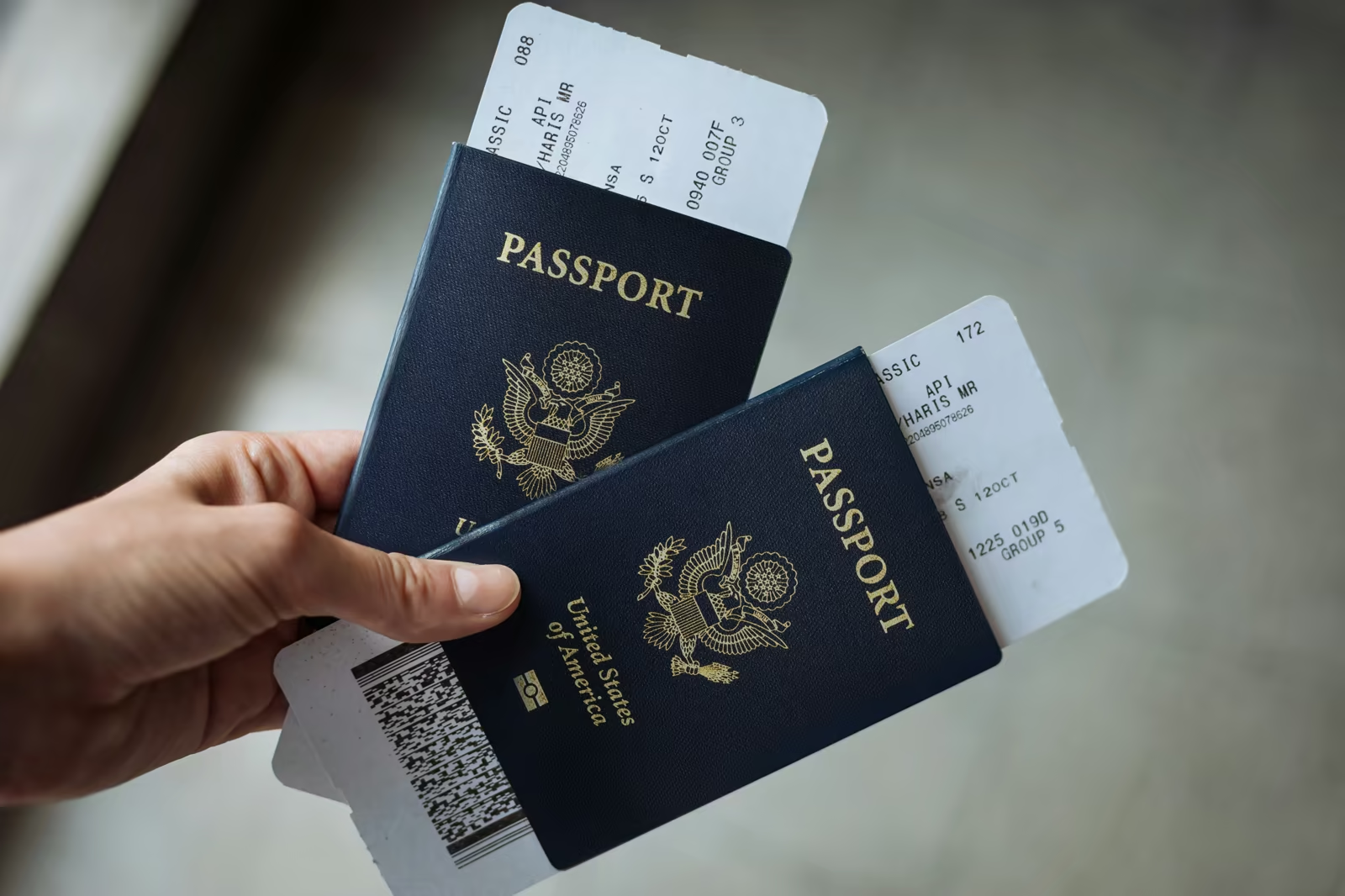
The letter also has to match the other documents. If the letter says the host will pay, the host's bank evidence should make that believable. If the letter says the visitor will stay from June 10 to June 24, the travel bookings and form answers should use the same dates. If you are checking the rest of the evidence pack at the same time, the Bank Statement for Visa: What Officers Check guide and the Employment Letter for Visa: Sample + Checklist guide help tighten the financial and employer side of the story.
Country rules: UK, Canada, Australia, Schengen, Germany, and the US
This is the part most generic templates skip. The same invitation letter does not carry the same weight everywhere.
UK visitor visa
The current UKVI guide, updated on 25 February 2026, says that if someone else is providing your travel, maintenance, or accommodation, the application should show:
- what support is being provided
- how that support is being provided
- that the sponsor has enough funds to support themselves and their dependants
- the relationship between visitor and sponsor
- that the supporter is legally in the UK where relevant
That means a UK host letter should do more than say "you can stay with me." It should state the accommodation address, the dates, whether the host pays for anything, and the host's immigration status. It also helps to attach the host's passport or residence document plus financial proof if the visit is sponsor-funded.
If your case is UK-specific, the route-level version is in Invitation Letter for UK Visa, and you can compare the rest of the file against the UK visa checklist.
The GOV.UK visitor-visa guidance page links to this official explainer:
Canada visitor visa
Canada is much less vague. IRCC's invitation-letter page says the host should include the visitor's complete name, date of birth, address, phone number, relationship, purpose of trip, planned length of stay, where the person will stay, how they will pay, and when they plan to leave Canada. It also says the host should include their own complete name, date of birth, address and phone number in Canada, job title, status in Canada, status document, and family details.
IRCC also makes two practical points people miss:
- an invitation letter does not guarantee visa issuance
- a visitor visa may be valid for up to 10 years, but most visitors are allowed to stay for up to 6 months at a time
That is why a Canada invitation letter works best when it is specific but modest. Do not over-promise. Say what support is real, attach status proof, and let the rest of the file carry the financial and return-home logic.
For the visitor-only version, use Invitation Letter for Visitor Visa Canada. For the broader Canada-only breakdown across regular visitor, business, and super visa cases, use Invitation Letter for Visa Canada. Before you submit, compare the file against Vidicy's Canada visa checklist.
Canada.ca also links to this official IRCC video about avoiding incomplete visitor applications:
Australia visitor visa
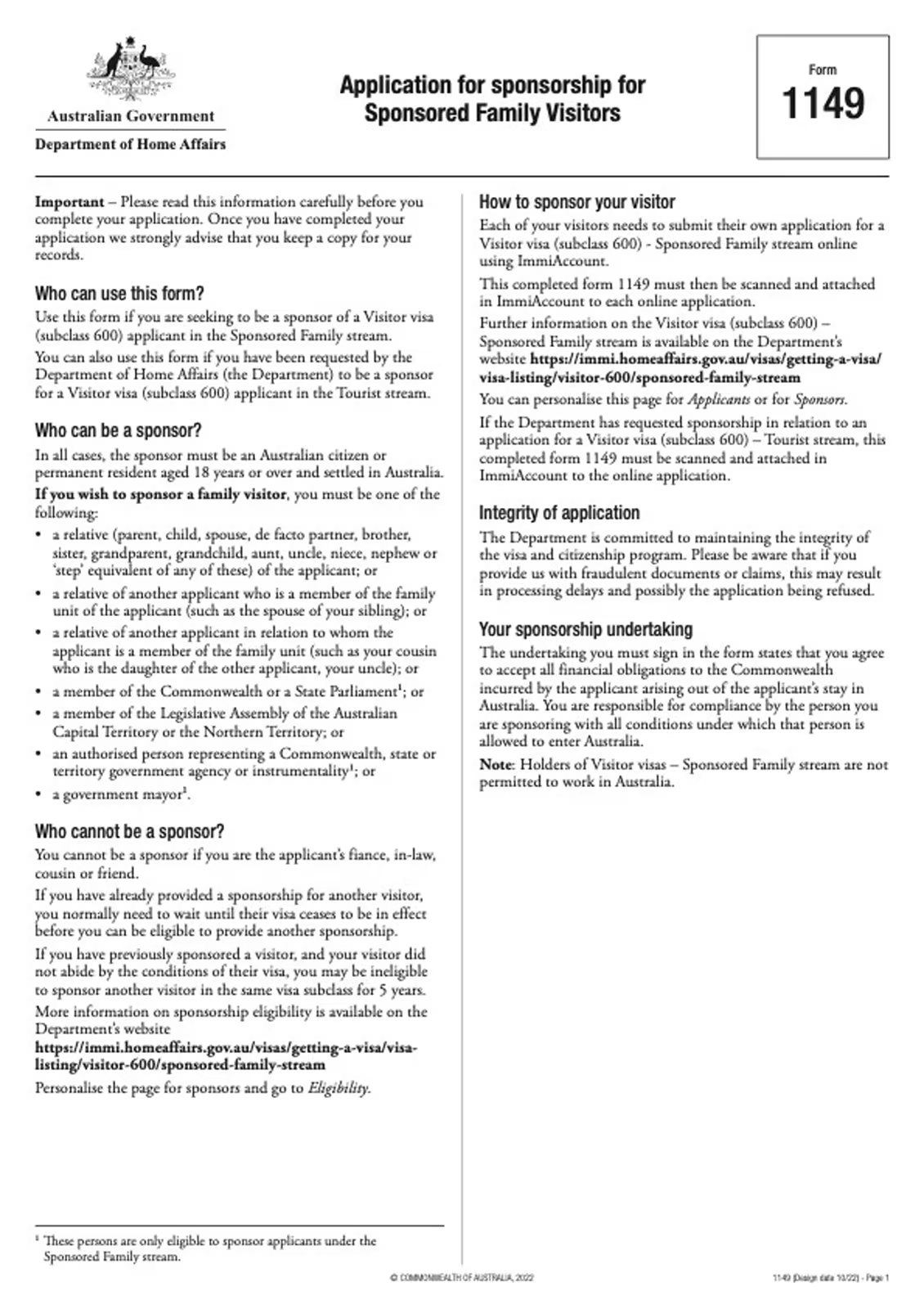
Australia is where many applicants mix up a normal host letter with a formal sponsor workflow. Form 1149 for the Sponsored Family stream says the sponsor must be an Australian citizen or permanent resident aged 18 years or over and settled in Australia. The same form warns that sponsorship does not guarantee visa grant and that a sponsor can face a 5-year bar in some breach situations.
Two details matter here:
- Some family-visit cases stay in the ordinary tourist-stream lane with a host letter plus relationship proof.
- Sponsored Family stream cases may require Form 1149 and can trigger a security-bond request.
Form 1149 also says the Minister must not approve a sponsorship if the person is already sponsoring another Visitor (Class FA) holder, unless the new applicant is part of the same family unit travelling for the same purpose. In other words, sponsorship capacity is not unlimited.
If the host is in Australia, compare your draft against Invitation Letter for Australian Tourist Visa and the broader Australia visa checklist.
Schengen and Germany
The Schengen-wide rule is broader than many host letters suggest. The European Commission says you must file a Schengen application at least 15 days before travel and no earlier than 6 months ahead. The same page says the normal processing time is 15 days and the standard short-stay visa fee is EUR 90 for adults.
The key document rule is also broader than "bring an invitation." The Commission says applicants should provide supporting documents tied to the purpose of stay, financial means, accommodation, and intention to return. So a host letter is only one part of the file.
Germany's Federal Foreign Office makes that point directly. Its FAQ says that for private visits, an invitation is usually required to confirm the purpose of the journey. But if the visitor cannot fully cover trip expenses, a formal pledge to cover all costs - the declaration of commitment, or Verpflichtungserklaerung - has to be filed with the visa application.
That is the right way to think about a Schengen invitation letter: it proves the reason for the visit and the accommodation story. It does not replace proof of funds unless the route accepts a formal host commitment and the host completes the correct local procedure.
If your trip is Europe-focused, combine this article with Schengen visa requirements explained for 2026 travelers and the Schengen checklist.
U.S. visitor visa
The U.S. is the clearest counterexample. The State Department says visitor visa applicants must qualify based on their ties abroad rather than assurances from U.S. family and friends, and that a letter of invitation or Affidavit of Support is not needed to apply for a visitor visa.
That does not make a host letter useless. It can still help organize the travel story, accommodation details, and host identity. But it should never be treated as the core approval argument. The core argument is still that the traveler has a believable short trip and good reasons to return home.
For the country-specific format, use How to Write an Invitation Letter for US Visa. Then keep the US visa checklist open while you line the letter up with the DS-160 and interview pack.
Invitation letter for visa sample
Use this as a base format, then adapt the funding, status, and attachments to the route you are applying for.
[Host full name]
[Full address]
[Phone number]
[Email]
[Date]

To the Visa Officer,

I am writing to invite [visitor full name], born on [date of birth], passport number [passport number], to visit me in [country] from [arrival date] to [departure date].

I live at [full address]. [Visitor name] is my [relationship], and the purpose of the trip is [tourism / family visit / business event / conference / other].

During the visit, [visitor name] will stay at [address]. [Explain who will pay for accommodation, daily expenses, flights, insurance, or other costs.]

I am currently [citizen / permanent resident / visa holder] in [country]. [If relevant, mention job title and employer.]

I confirm that the information in this letter is true and that I understand this letter does not guarantee visa issuance.

Sincerely,

[Signature]
[Host full name]
What should you customize?
- UK: make the funding and legal-status evidence stronger
- Canada: include every field IRCC lists for both the visitor and the host
- Australia: check whether a normal host letter is enough or whether Form 1149 is required
- Schengen / Germany: clarify whether the host is only inviting or is formally accepting the cost burden
- U.S.: keep the letter factual and avoid acting as if it replaces proof of ties abroad
What documents the host should attach
Most weak letters fail because the text says one thing and the attachments prove nothing. A host-backed file is usually stronger when the host attaches:
- passport or residence-status proof
- proof of current address
- proof of relationship where relevant
- proof of funds if the host is paying
- employment proof if the country expects it
- event or trip details if this is a conference, business visit, or family occasion
The exact attachment pack changes by route:
- UK: host passport or BRP plus funding proof if the host is paying
- Canada: status proof in Canada plus household context where relevant
- Australia: relationship evidence and, for Sponsored Family stream, the correct sponsor form
- Germany: declaration of commitment when the host covers costs
- U.S.: keep attachments light and factual because ties abroad still matter more than the invitation
If you are building the full visitor file, Vidicy's how it works page shows the document-review flow, and sign up is the shortest route to a final cross-check before submission.
Related guides
If you're building the rest of the application pack, these companion guides help:
- Invitation Letter for Visa: Country Rules + Sample
- Family Invitation Letter for Visa: Sample + Rules
- Invitation Letter for Spouse Visa: What to Include
- Sponsor Letter for Visa: Sample + Official Rules
- Visa Cover Letter Format: Tourist Sample + Official Tips
- Employment Letter for Visa: Sample + Checklist
Official sources
- Canada.ca, Letter of invitation for visitors to Canada: https://www.canada.ca/en/immigration-refugees-citizenship/services/visit-canada/letter-invitation.html
- Canada.ca, Visitor visa overview: https://www.canada.ca/en/immigration-refugees-citizenship/services/visit-canada/visitor-visa.html
- GOV.UK, Visiting the UK: guide to supporting documents: https://www.gov.uk/government/publications/visitor-visa-guide-to-supporting-documents/guide-to-supporting-documents-visiting-the-uk
- GOV.UK, applying for a UK visitor visa (page that links the official video): https://www.gov.uk/guidance/applying-for-a-uk-visitor-visa
- Australian Department of Home Affairs, Form 1149: https://immi.homeaffairs.gov.au/form-listing/forms/1149.pdf
- European Commission, Applying for a Schengen visa: https://home-affairs.ec.europa.eu/policies/schengen/visa-policy/applying-schengen-visa_en
- Federal Foreign Office, Visa for Germany FAQ: https://www.auswaertiges-amt.de/en/visa-service/buergerservice/faq/606848-606848
- U.S. Department of State, Visitor Visa: https://travel.state.gov/content/travel/en/us-visas/tourism-visit/visitor.html
- Canada.ca, "Save Time: Send a Complete Application" video page: https://www.canada.ca/en/immigration-refugees-citizenship/news/video/save-time-send-complete-application.html
FAQ
Does an invitation letter guarantee visa approval?
No. Canada says the letter does not guarantee a visa, Australia's sponsor form says sponsorship does not guarantee grant, and the U.S. says an invitation letter is not needed for a visitor visa. Treat the letter as supporting evidence, not as the whole approval argument.
What should an invitation letter for visa applications always include?
At minimum, include the host's full identity, the visitor's full identity, the relationship, the purpose of the trip, where the visitor will stay, who pays, and the planned arrival and departure dates. Then match those details to the form answers and supporting documents.
Do I need to notarize an invitation letter?
Usually not unless a country-specific process or local mission asks for it. The bigger issue is whether the facts are specific and supported. A clear unsigned or lightly signed letter with strong attachments is often better than a notarized letter that still leaves funding or accommodation unclear.
Is the same template safe for the UK, Canada, Australia, Schengen, and the US?
No. The base structure can be similar, but the legal weight changes. Canada publishes a field list, the UK focuses on sponsor support evidence, Australia may need Form 1149, Schengen still needs broader proof, and the U.S. does not treat the letter as a required visitor-visa factor.
What should a host attach if they are paying for the trip?
Attach identity proof first, then evidence that the host can really cover the promised costs. That usually means bank statements, employment or income proof, address proof, and sometimes route-specific forms such as Germany's declaration of commitment or Australia's Form 1149 in Sponsored Family stream cases.
How long should an invitation letter for visa applications be?
Usually one page is enough. Keep it long enough to answer the verification questions but short enough that an officer can scan it quickly. If you need extra explanation, move it into the supporting evidence instead of padding the main letter with narrative.
Conclusion
The best invitation letter for visa applications is short, specific, and route-aware. It explains the trip clearly, names the host and visitor, states who pays, and matches the rest of the evidence pack. What changes is the rule set around it: Canada gives hosts a checklist, the UK asks sponsor evidence to prove support, Australia can escalate into Form 1149, Schengen still needs broader proof, and the U.S. does not require the letter at all.
If you want the country-specific follow-up, use Invitation Letter for Visitor Visa Canada, Invitation Letter for UK Visa, or How to Write an Invitation Letter for US Visa. If you want a final pre-submission review, start with Vidicy sign-up.