



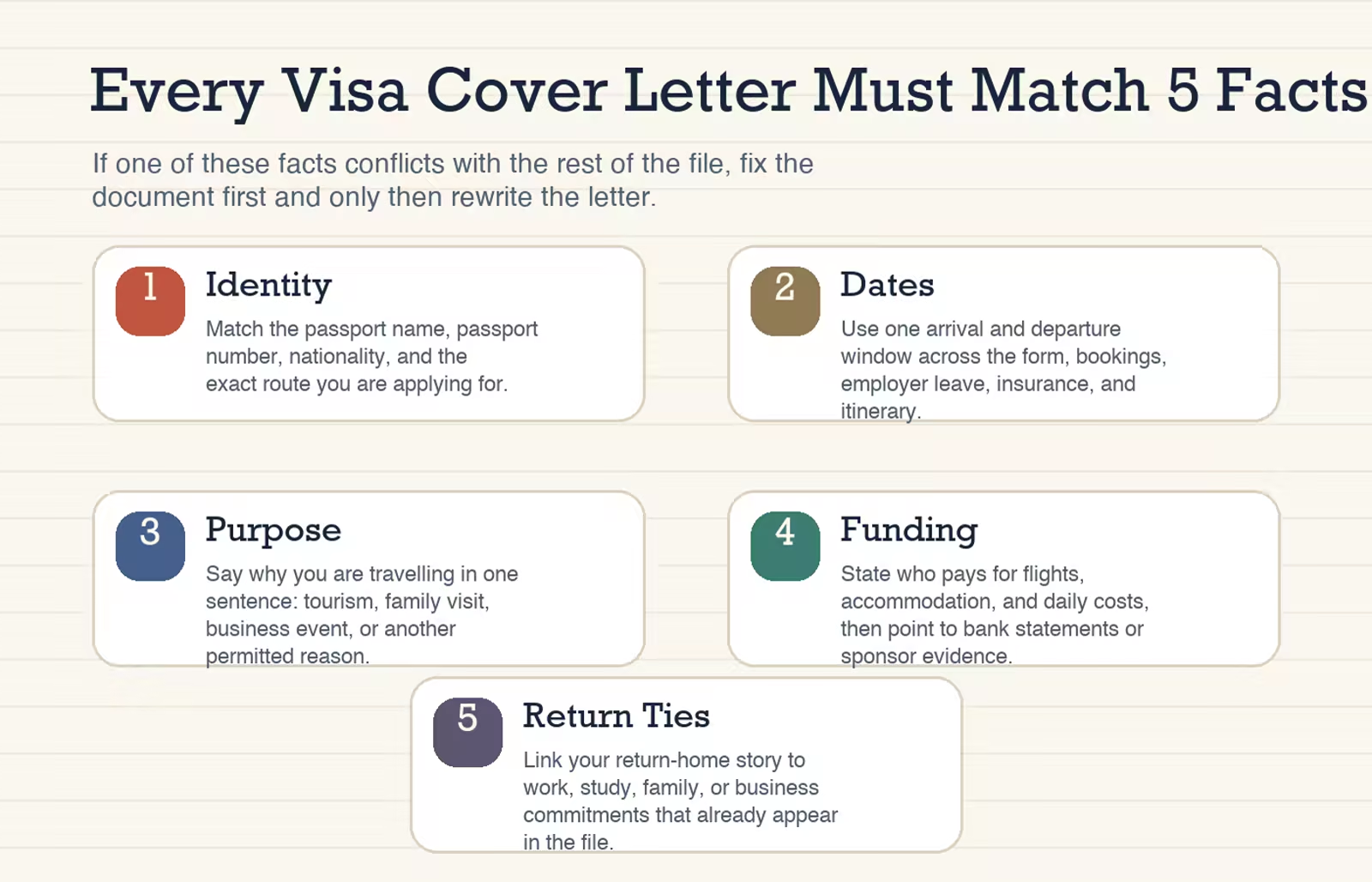
A visa cover letter format is a short applicant-written explanation that connects the official application form to the documents you upload. For most visitor or tourist routes, it is supporting evidence, not a mandatory standalone form. According to current guidance from GOV.UK, the European Commission, IRCC, Australia’s Department of Home Affairs, and Travel.State.Gov, officers are really checking the same five things: identity, route, dates, funding, and return ties. A good cover letter puts those facts on one page and points to the proof.
If you are searching for a sample cover letter for tourist visa application cases, start with the structure in this guide and then adapt it to the country-specific rules below. If you want the route checklist first, use Vidicy’s UK visa checklist, Schengen visa checklist, or Canada visa checklist before you draft anything. If the real use case is a short visitor trip and you want the narrower version, use the cover letter for visit visa guide after this umbrella article.
Quick rule: if the same date, money figure, or travel purpose cannot be found elsewhere in the file, it usually does not belong in your cover letter.
| Route | Official facts your letter should not contradict | Why the cover letter helps |
|---|---|---|
| UK Standard Visitor | Up to 6 months per stay, apply up to 3 months before travel, and officers check purpose, funds, sponsor support, and return plans | It explains how trip cost, host support, and return-home evidence fit together |
| Schengen short-stay | 90 days in any 180-day period, apply no earlier than 6 months and usually no later than 15 days, standard fee EUR 90 | It clarifies the main destination, itinerary order, accommodation, and funding story |
| Canada visitor visa | Visa starts at CAN$100, biometrics are CAN$85 per person, bank statements should show at least 6 months, and travel history can go back 10 years | It turns host support, travel history, and funds proof into one readable narrative |
| Australia visitor visa | Decision-ready files should explain the itinerary, return reasons, current payslip, employer leave, host invite, and recent bank statements | It keeps the trip purpose and return-home logic explicit instead of scattered |
| U.S. B visitor | Application fee is US$185, ties abroad matter, and invitation letters are not needed for the decision | It helps summarize purpose and funding without pretending the host letter is decisive |
At a glance
- Use this page when the application needs one applicant-written note tying together purpose, dates, funds, and return ties.
- A cover letter should summarize the file, not introduce new facts that cannot be proved elsewhere in the packet.
- It is usually optional supporting evidence, but it becomes useful when funding, host support, or itinerary details need context.
- If someone else is hosting or paying, keep that in separate invitation and sponsor letters and make sure all dates and amounts match.
Key takeaways
Use this guide to verify the route, evidence, and next action before you finalize the file. The best visa cover letter format is a short evidence roadmap, with purpose, dates, funding, accommodation, ties, and document references in a scannable order.
Table of Contents
- What a visa cover letter format actually does
- Visa cover letter format: universal one-page structure
- Sample cover letter for tourist visa application
- How official rules change by route
- Common mistakes that weaken the letter
- Official videos
- Official sources
- FAQ
- Conclusion
What a visa cover letter format actually does
The simplest definition is this: a cover letter is the applicant’s explanation layer. Your passport, bank statements, itinerary, employment proof, and invitation letter are the evidence. The cover letter is the map that helps an officer read those documents in the right order.
That is why a strong visa cover letter format does four jobs well:
- states the exact route and travel purpose
- matches the same dates and trip plan used in the rest of the file
- explains who pays for what
- points to the attachments that prove the story
Applicants often mix the cover letter up with other documents. That creates avoidable contradictions.
| Document | Who writes it | Main job | Use it when |
|---|---|---|---|
| Cover letter | The applicant | Explains the whole file in one page | The case needs context or a clean summary |
| Invitation letter | The host or organizer | Explains who is inviting you, where you will stay, or why the event is real | You are visiting family, friends, or attending an event |
| Sponsor letter | The host or financial supporter | Explains what support is being provided and how | Someone else is paying for accommodation, local costs, or the whole trip |
| Employment letter | Your employer | Confirms role, salary, leave dates, and expected return to work | Work ties are part of your return-home evidence |
That distinction matters because the same route can need more than one letter. If a host in Canada writes an invitation letter, that does not replace your own cover letter. If your employer writes a leave letter, that still does not explain why your bank balance, hotel booking, and travel dates all make sense together. If the host side is the part you still need to draft, use the separate sponsor letter for visa guide instead of forcing that job into the applicant letter.
Visa cover letter format: universal one-page structure
For most visitor routes, the safest format is one page with short paragraphs, exact dates, and no emotional filler. You are not trying to write a persuasive essay. You are making the file easier to verify.
Use this structure.
| Section | What to include | Why it matters |
|---|---|---|
| Header | Full name, passport number, nationality, contact details, and visa route | Lets the officer match the letter to the file quickly |
| Trip purpose | Tourism, family visit, business event, medical treatment, or another permitted reason | Stops the officer from reconstructing the trip from scattered documents |
| Travel dates + stay details | Exact arrival and departure dates, destination(s), and accommodation plan | Keeps the letter aligned with bookings, insurance, and forms |
| Funding | Who pays for flights, stay, and daily costs | Makes bank statements or sponsor support easier to read |
| Return ties | Job, study, business, family, property, or other reasons to return home | Supports the temporary-visit logic |
| Attachment guide | Short list of the main documents attached | Helps the officer navigate the file faster |
The wording should stay factual. Good cover letters use language like:
- "I am applying for a Standard Visitor visa to travel from 12 June 2026 to 22 June 2026 for tourism."
- "My host will provide accommodation, while I will pay for flights and daily expenses."
- "My employer letter and approved leave confirmation are attached."
Weak cover letters usually do the opposite:
- they repeat generic promises without evidence
- they hide the real funding split
- they use different dates from the itinerary
- they copy a route-specific sample from another country
If your finances or employment proof are still weak, fix those first with the Bank Statement for Visa: What Officers Check guide and the Employment Letter for Visa: Sample + Checklist guide. A cover letter cannot rescue underlying documents that do not hold up on their own. If your case is a student route rather than a visitor route, use Documents Required for Student Visa before you draft the letter so the school-issued document, funding proof, and route-specific extras are in place first.
Sample cover letter for tourist visa application
Use this as a structure, not as text to copy blindly.
[Your full name]
[Your full address]
[Email address]
[Phone number]
[Date]

To [Embassy / Consulate / Visa Officer],

Subject: Cover letter for [visa route] application

I am applying for a [visitor / tourist / short-stay] visa to travel from [arrival date] to [departure date] for [tourism / family visit / business meetings / event].

The purpose of my trip is [brief reason]. During this visit, I plan to stay at [hotel / host address], and my main activities will be [short itinerary summary].

I will pay for [flights / daily expenses / full trip costs]. [If relevant: My host, [name], will provide accommodation / partial support.] I have attached my bank statements, itinerary, and [host or sponsor documents, if relevant] as supporting evidence.

I am currently employed as [job title] at [company name] and have attached my employer letter and approved leave confirmation. [Or: I am self-employed / a student, and have attached the documents that confirm my current commitments.] After the visit, I will return to [home country] because of my ongoing [work / studies / family / business] commitments.

For ease of review, I have attached:
- passport copy
- itinerary / accommodation proof
- bank statements
- employment or study evidence
- [host invitation / sponsor documents if relevant]
- [any route-specific document]

Thank you for reviewing my application.

Sincerely,
[Your full name]
How to adapt the sample
- UK or Canada hosted trip: make the funding split explicit instead of writing "my sponsor will support me" in vague terms.
- Schengen itinerary: say which country is the main destination and why you are applying through that consulate.
- Australia family visit: mention the host letter separately and keep your own return-home explanation clear.
- U.S. B visitor: do not over-invest in invitation-letter language; purpose, funds, and ties abroad matter more.
If you need route-specific wording after the generic template, use the dedicated cover letter for UK visa, cover letter for Schengen visa, or cover letter for Canada visitor visa guide. If the file is a family-settlement case instead of a short trip, switch to the focused cover letter for spouse visa guide so the relationship, sponsor, and route-language sections stay aligned with partner-route evidence.
How official rules change by route
The structure above is reusable, but the official pain points are not identical across countries.
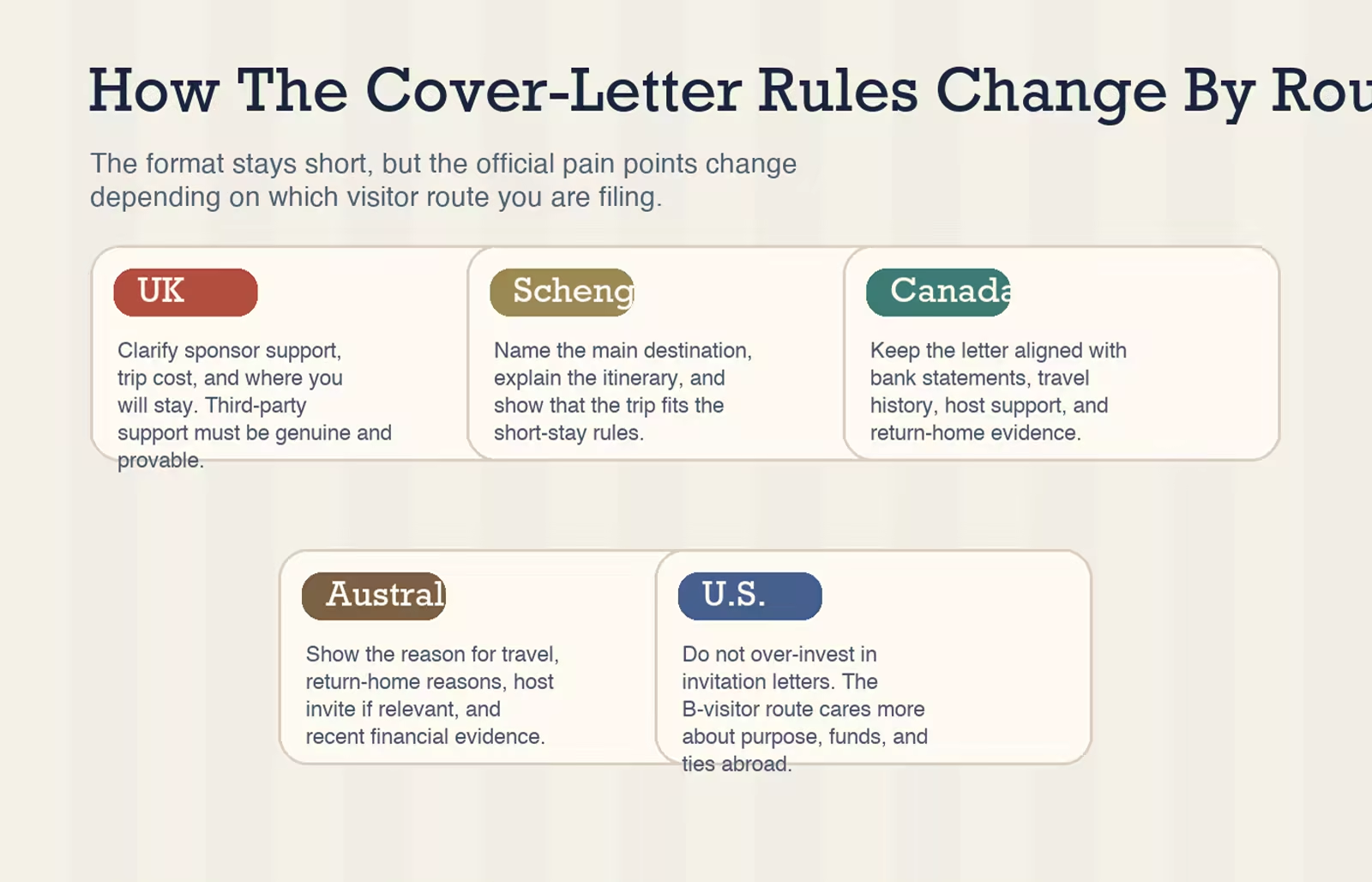
UK Standard Visitor
According to GOV.UK’s current Standard Visitor pages, the route usually allows stays of up to 6 months, and applications can normally be filed up to 3 months before travel. Appendix V also says third-party support only counts when the relationship is genuine and the third party can and will support the visitor for the intended stay.
As of April 15, 2026, the current GOV.UK Standard Visitor apply page and the Home Office fee table both show the short Standard Visitor visa at GBP 135. That means if you mention the visa fee in a cover letter or trip-cost summary, use the current figure and keep it consistent with the rest of the file.
For UK files, the cover letter usually works best when it clarifies:
- where you will stay
- who pays for the trip
- whether a host supports accommodation or maintenance
- why your return-home evidence is stronger than your short stay in the UK
If your file is specifically UK-focused, the route-specific cover letter for UK visa guide is the better second read after this hub.
Schengen short-stay
The European Commission’s Schengen applying page says short stays are limited to 90 days in any 180-day period. It also says you can usually apply no earlier than 6 months before travel and no later than 15 calendar days before departure. The standard fee is EUR 90 for adults, and normal processing is 15 days, though cases can stretch to 45 days if a deeper review or extra documents are needed.
That is why Schengen cover letters need to be strict about the itinerary. The officer should be able to see:
- which country is the main destination
- why you are applying through that country
- where you will stay
- how the itinerary fits the short-stay limit
If the trip includes more than one Schengen country, the cover letter becomes more useful, not less. It is the easiest place to explain the travel order without forcing the officer to decode hotel bookings city by city.
Canada visitor visa
IRCC’s visitor-visa application guidance asks applicants to be ready with travel history from the last 10 years, itinerary details, and at least 6 months of bank account history. It also says employer letters should be dated no earlier than 3 months before you apply. Canada’s visitor-visa pages say the visa starts at CAN$100, biometrics are CAN$85 per person or CAN$170 per family, the visa may be valid for up to 10 years, and most visitors can stay up to 6 months at a time.
Canada’s help-centre guidance is also unusually direct about host letters: a letter of invitation can help, but it does not guarantee the person will get a visa. That is exactly why the applicant cover letter matters. It explains how the host support, the applicant’s own money, and the return-home logic fit together.
For Canada files, the cover letter is especially useful when:
- a host pays for some but not all of the trip
- the itinerary is split between hotels and a private address
- the applicant has a longer travel history that needs a clean summary
Australia visitor visa
Australia’s Department of Home Affairs says decision-ready visitor applications should explain the trip purpose and include an itinerary where helpful. The same page says applicants should show why they intend to return home and gives concrete examples: a current payslip, a letter from your employer granting leave, a letter from family or friends inviting you to visit, and recent bank statements. If documents are not in English, translated copies are expected.
Australia is also the route where applicants often confuse a normal host letter with Form 1149. That form is tied to the Sponsored Family stream, not every ordinary visitor application. So your cover letter should not promise a sponsorship form unless your actual stream requires it or the department asks for it.
For Australia, the cover letter usually helps most when it explains:
- why the trip is temporary
- which return-home documents support that claim
- how the host letter fits a wider visitor file
U.S. B visitor
Travel.State.Gov’s visitor-visa page puts the B-1/B-2 application fee at US$185. It says additional documents may be requested to show the purpose of the trip, intent to depart the United States after the trip, and ability to pay all costs of the trip. If the applicant cannot cover all the costs, the page says they may show evidence that another person will cover some or all of them.
The same official page is clear about invitation letters: a letter of invitation or Affidavit of Support is not needed to apply for a visitor visa, and it is not one of the factors used to issue or deny the visa. That is the cleanest reminder that your cover letter should not sound like a host’s sponsorship promise. On U.S. visitor files, the officer is mainly checking whether the applicant has a credible temporary reason to travel and strong ties abroad.
Common mistakes that weaken the letter
| Mistake | Why it hurts | Better fix |
|---|---|---|
| Using different dates from the itinerary or insurance | The letter creates a contradiction instead of solving one | Match every date before you sign the letter |
| Writing "my sponsor will support me" without saying what that means | The funding story stays vague | State exactly who pays for flights, stay, and daily costs |
| Copying a UK or Canada sample into a U.S. B-visitor case | Route rules are not interchangeable | Start with the generic format, then localize it |
| Using emotional language instead of documents | Officers still need proof, not promises | Point to evidence and stay factual |
| Treating the cover letter like a replacement for bank statements or work proof | Weak underlying evidence stays weak | Fix the documents first, then rewrite the letter |
| Making the letter too long | Important facts get buried | Keep it to one clean page whenever possible |
One practical test helps: if a sentence in your cover letter cannot be backed by a document in the file, either fix the document or delete the sentence.
Official videos
GOV.UK links this official visitor-visa walkthrough from its own video page:
Canada.ca hosts this official IRCC video about avoiding common application mistakes and sending a complete file:
Related guides
If you're building the rest of the application pack, these companion guides help:
- Cover Letter for UK Visa: Sample + What UKVI Checks
- Cover Letter for Schengen Visa: Step-by-Step Guide
- Cover Letter for Canada Visitor Visa: Sample + Guide
- Sponsor Letter for Visa: Sample + Official Rules
- Employment Letter for Visa: Sample + Checklist
Official sources
- GOV.UK Standard Visitor overview
- GOV.UK apply for a Standard Visitor visa
- Home Office immigration and nationality fees, 8 April 2026
- Immigration Rules Appendix V: Visitor
- European Commission: Applying for a Schengen visa
- IRCC: Application for a Visitor Visa (Temporary Resident Visa - TRV)
- IRCC help centre: How do I help a family member or friend apply to visit Canada?
- Canada.ca biometrics guidance
- Australia Department of Home Affairs: Applying for a visitor visa
- Australia Department of Home Affairs Form 1149 (Sponsored Family stream reference)
- Travel.State.Gov visitor visa page
- GOV.UK video page: How to apply for a UK visitor visa
- Canada.ca video page: Save Time: Send a Complete Application
FAQ
Is a cover letter mandatory for every visa application?
No. There is no universal rule saying every visitor or tourist route requires a separate cover letter. Official pages often treat it as supporting evidence instead. The safer rule is this: if your case needs context, add one. If the form and documents already explain the case clearly, the letter may be optional.
How long should a tourist visa cover letter be?
For most visitor files, one page is the safest format. That is usually enough space to explain the trip purpose, dates, funding, return ties, and attachment list without burying the key facts. A longer letter is only useful when the case has an unusual timeline, mixed funding, or a prior refusal.
What should I attach with a visa cover letter?
Attach the documents the letter refers to directly: passport copy, itinerary, accommodation proof, bank statements, work or study evidence, and any host or sponsor document that supports the funding story. Do not treat the cover letter as a substitute for those documents. It should organize the evidence, not replace it.
Is a sponsor letter the same as a cover letter?
No. A sponsor letter or invitation letter is usually written by the host or financial supporter. A cover letter is written by the applicant. The sponsor letter explains what support the host gives. The cover letter explains how the entire file fits together, including the applicant’s own dates, funds, and return-home story.
Can a cover letter fix weak proof of funds or a prior refusal?
Not by itself. A cover letter can explain what changed after a refusal or clarify who pays for the trip, but it cannot convert weak evidence into strong evidence. If your bank trail, employment proof, or travel logic is thin, improve those documents first and then update the letter so the explanation matches the improved file.
Conclusion
The best visa cover letter format is not the fanciest template. It is the one that matches your passport, route, dates, funding, and return ties with zero contradictions. Start with the generic structure above, then tighten it to the country-specific rules that actually apply to your file.
If you want a second set of eyes before you submit, start a free Vidicy review. It is the fastest way to turn a generic cover letter into a route-specific file that is easier for an officer to understand and harder to reject over preventable document mistakes.