



If you need a cover letter for visit visa applications, treat it as a short applicant-written note that makes five things easy to verify: who you are, why you are visiting, when you will travel, who pays, and why you will leave on time. For most visitor routes, it is supporting evidence, not a universal mandatory form. Current guidance from UKVI, IRCC, the European Commission, Australia’s Department of Home Affairs, and the U.S. Department of State points officers back to the same checks: permitted purpose, funds, accommodation, and return-home logic.
If your route is already clear, start with Vidicy’s UK visa checklist, Canada visa checklist, Australia visa checklist, US visa checklist, or Schengen visa checklist, then use this article to tighten the applicant-written explanation.
| Route | Current official facts | What the cover letter should clarify |
|---|---|---|
| UK Standard Visitor | GBP 135, usually up to 6 months, apply 3 months before travel, usually 3 weeks for a decision | Purpose, funding split, accommodation, and why you still qualify as a genuine visitor |
| Canada visitor visa | Starts from CAN$100, biometrics usually CAN$85, bank statements should show at least 6 months, employer letter dated no earlier than 3 months before applying | Why the trip is temporary, what the itinerary means, and how funds and employment records fit together |
| Schengen short-stay | Up to 90 days in any 180-day period, apply at least 15 days and no earlier than 6 months, standard fee EUR 90, normal processing 15 days | Main destination, stay dates, accommodation, funds, and return-home evidence |
| Australia Visitor (subclass 600) | Lodged online through ImmiAccount, Home Affairs says complete files get a faster outcome, and Form 1149 only applies in formal sponsorship situations | Why the trip is temporary, how sponsor or host evidence fits, and whether the case is ordinary visitor travel or formal sponsored-family support |
| U.S. B visitor | Non-petition visitor fee US$185, passport usually valid 6 months beyond stay, invitation letter not needed | Purpose of trip, intent to depart, and ability to pay without relying on a host promise as the core case |
Key takeaways
Use this guide to verify the route, evidence, and next action before you finalize the file. A visit visa cover letter should be a document map: who is traveling, why, when, who pays, where they stay, and why they return.
Table of Contents
- Cover letter for visit visa: what it should prove
- Cover letter for visit visa sample
- How to adapt the sample by trip type
- Country rules that change the letter
- What to attach with the letter
- Official videos
- Official sources
- FAQ
- Conclusion
Cover letter for visit visa: what it should prove
A strong cover letter for visit visa cases does not replace the rest of the file. It organizes the rest of the file.
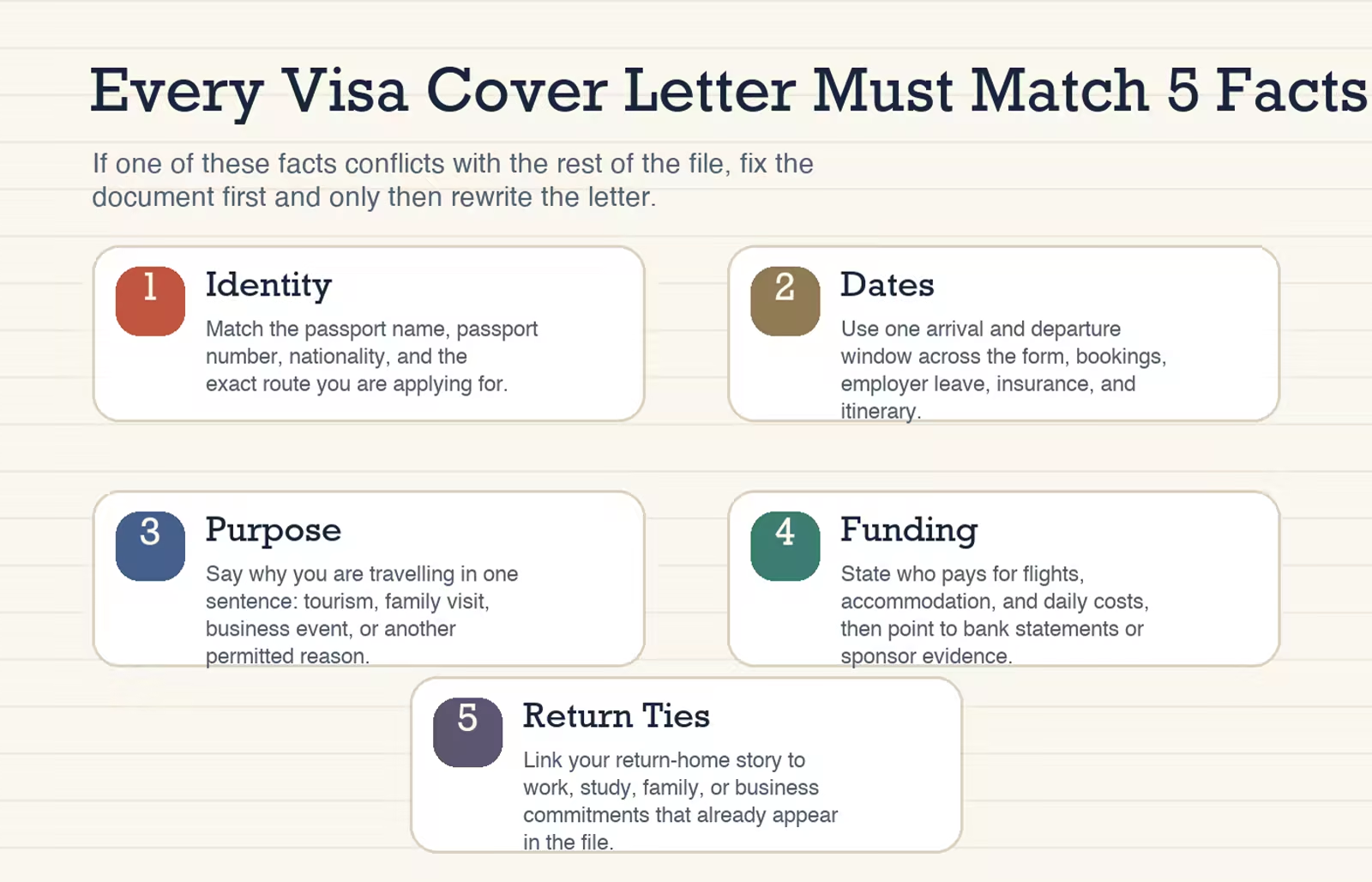
In practice, the letter should answer these questions:
- What exact visitor route am I using?
- What is the permitted reason for the trip?
- What dates and accommodation plan support that reason?
- Who pays for flights, stay, and daily costs?
- Which documents show I will leave at the end of the visit?
That structure matters because visitor applications usually fail on contradictions, not on formatting.
The safest rule is simple: if a sentence in your letter cannot be backed by a document in the file, rewrite it or remove it.
If you want the broader route-agnostic template first, keep Vidicy’s visa cover letter format guide open beside this page. If the real issue is document organization before writing anything, start with how to prepare visa application documents.
Cover letter for visit visa sample
Use this as a structure, not as text to copy without checking the underlying documents:
[Your full name]
[Your full address]
[Email address]
[Phone number]
[Date]

To [Embassy / Consulate / Visa Officer],

Subject: Visit visa application for [destination] from [arrival date] to [departure date]

I am applying for a visit visa to travel to [destination country] from [arrival date] to [departure date] for [tourism / family visit / business meetings / event attendance].

The purpose of my trip is [short reason]. During this visit, I will stay at [hotel name and address / host address]. My planned activities include [brief and realistic itinerary summary].

I will pay for [flights / accommodation / daily expenses / the full trip]. [If relevant: My host or sponsor, [name], will provide accommodation / partial support.] I have attached the financial documents that support this arrangement.

I am currently [employed / self-employed / a student] in [home country]. I have attached [employer letter / business records / enrolment documents] as evidence of my current commitments and my return after the trip.

I have also attached my [passport copy, itinerary, bank statements, and other key documents] to support this application.

Thank you for considering my application.

Sincerely,
[Your name]
If someone else is paying, do not force that explanation into vague wording. Pair the applicant letter with the right host-side evidence, such as an invitation or support note, and make the amounts match. Vidicy’s sponsor letter for visa guide, bank statement for visa guide, and employment letter for visa guide help with those surrounding documents.
How to adapt the sample by trip type
The phrase visit visa hides different trip patterns. Your cover letter should change with the purpose.
| Trip type | What to emphasize | What to avoid |
|---|---|---|
| Tourism | Cities, dates, accommodation, self-funding, leave approval | Adding sponsor claims you cannot prove |
| Family or friend visit | Relationship, host address, whether the host provides accommodation or money, and your own reason to return home | Treating the host letter as a substitute for your own job or funds evidence |
| Business visit | Invitation or organiser letter, employer support, who pays, and why the activity is permitted under the visitor route | Writing a tourist-style letter for a conference or meetings trip |
This is also where route mistakes show up.
- If the real case is family migration, a visitor-style cover letter is the wrong tool.
- If the real case is study longer than the visitor route allows, the route itself is wrong.
- If the real case is mixed funding, the letter should explain the split exactly instead of pretending one side pays for everything.
For a full pre-submit logic check after you draft the letter, use the travel visa checker guide and then compare the file against how Vidicy works.
Country rules that change the letter
This is the section most generic template pages flatten. The same letter does not carry the same weight in every visitor system.
UK Standard Visitor
GOV.UK’s current Standard Visitor application page says the standard fee is GBP 135, the maximum stay is normally 6 months, you can apply 3 months before travel, and you will usually get a decision within 3 weeks after applying, proving your identity, and providing documents.
UKVI’s supporting-documents guide is useful because it explains the tests behind the file. It says genuine visitors should be able to show that they are coming for a permitted activity, that they will leave at the end of the visit, that they can support themselves and any dependants, and that they can pay for the return or onward journey. If someone else is helping, UKVI says sponsor evidence should show what support is provided, how it is provided, the relationship, whether the sponsor has enough funds, and whether the sponsor is legally in the UK where relevant.
If your UK route is confirmed, keep the UK visa checklist and the route-specific cover letter for UK visa guide beside this article while you draft.
Canada visitor visa
IRCC’s current visitor-visa pages are unusually specific about what a strong file looks like. Canada says a visitor visa starts from CAN$100. Biometrics are generally CAN$85 for one person and CAN$170 for a family applying at the same time. On the live visitor-visa apply page, IRCC says an itinerary can include flight details, proof of accommodation, or event registration. The same page says bank statements should show at least 6 months of account details, including balances, and an employer letter should be dated no earlier than 3 months before you apply.
IRCC’s invitation-letter page is also helpful because it shows the level of detail officers expect around hosted trips. It says the invitation should include the visitor’s complete name, date of birth, address, telephone number, relationship, purpose of trip, planned length of stay, where the person will stay, how the person will pay, and when the person plans to leave Canada. It also reminds applicants that a letter of invitation does not guarantee visa issuance.
That means a Canada visit-visa cover letter should explain how the itinerary, funds, and employment records fit together without treating the host letter as if it guarantees approval.
If you are building a Canada visitor file, use the Canada visa checklist and then the narrower cover letter for Canada visitor visa guide.
Schengen short-stay
The European Commission’s Schengen application page says a short-stay visa allows visits of up to 90 days in any 180-day period. You must apply at least 15 days before travel and no earlier than 6 months ahead. The standard adult fee is EUR 90, and the normal processing time is 15 days, though it can extend to 45 days if more checks are needed.
For cover letters, the key Schengen rule is not the fee. It is the filing logic. The Commission says you need supporting documents tied to the purpose of stay, financial means, accommodation, and intention to return. If you are visiting more than one Schengen country, you apply through the country where you will spend the longest time, or the first country if the stays are equal. That is exactly the kind of issue a cover letter can clarify in one paragraph.
A Schengen letter is strongest when it explains the main destination, the travel sequence, the accommodation plan, and why the return-home evidence still points to a temporary trip.
If Europe is your route, keep the Schengen visa checklist and cover letter for Schengen visa open as you tailor the sample.
Australia Visitor (subclass 600)
Australia’s Home Affairs guidance is less about a formal “cover letter” and more about decision-ready evidence. The Check twice, submit once page says you should get the application right the first time for a faster visa process, include English translations for non-English documents, check your ImmiAccount inbox regularly, and book your flight after visa grant. The same page also says most visas are applied for online through ImmiAccount.
For visitor-specific evidence, the current Australian Consulate-General Ho Chi Minh City checklist is useful because it spells out what decision-ready visitor files often contain. It asks for recent bank statements, recent credit-card statements showing available balance, and, for employed applicants, employment details plus a letter from the employer confirming leave has been approved for the time in Australia.
Australia is also where applicants confuse a normal visitor explanation with Form 1149 sponsorship. Form 1149 says a sponsor in the formal Sponsored Family stream must be an Australian citizen or permanent resident, aged 18 or over, and settled in Australia. It also says each visitor must submit their own online subclass 600 application and attach the completed form where it is required. The form warns that a security bond may be requested and is generally between AUD 5,000 and AUD 15,000 per person.
That means an Australia visitor cover letter should never casually promise formal sponsorship unless the actual stream requires it.
If Australia is the target route, compare your draft against the Australia visa checklist before you upload it.
U.S. B visitor
Travel.State.Gov is the clearest source on what a visitor cover letter can and cannot do. The current fee page lists US$185 for the non-petition visitor category. The visitor-visa page says applicants may be asked for extra documents showing the purpose of the trip, intent to depart the United States after the trip, and ability to pay all costs of the trip. The same page says the passport should usually be valid for at least 6 months beyond the period of stay in the United States unless a country-specific exemption applies.
The most important U.S. sentence is the one many generic template sites ignore: a letter of invitation or Affidavit of Support is not needed to apply for a visitor visa, and it is not one of the factors used to issue or deny the visa.
So the safest U.S. cover letter is narrow. It should summarize the trip purpose, dates, accommodation, and funding without pretending the host promise is the approval basis. The approval logic is still whether the officer believes the applicant has a credible short trip and strong ties abroad.
If your destination is the United States, use the US visa checklist and the documents required for US tourist visa guide after you draft the letter.
What to attach with the letter
The letter should point to real documents, not float above them.
For most visitor files, the safest supporting pack includes:
- passport or travel-document copy
- itinerary and accommodation proof
- bank statements or other financial records
- employer, student, or self-employment proof
- host invitation or sponsor evidence if someone else is supporting the trip
- translations where the official route requires them
- previous travel records where they actually help prove compliance
One useful negative rule comes from UKVI: some items are generally less useful in visit applications, including old bank statements, personal photos, sponsor utility bills, and hotel bookings used as if they were core evidence. That does not make them irrelevant in every case. It means your file should not lean on low-signal documents when stronger proof is available.
The cleanest workflow is to build the route checklist first, fix the bank, employer, host, and itinerary documents, and write the cover letter last so it reflects the final evidence pack.
If you want a structured pre-submit review after that, move from how Vidicy works to sign up.
Official videos
GOV.UK’s official visitor-visa video page links this UKVI walkthrough:
Canada.ca’s official IRCC video page links this complete-application tutorial:
Official sources
- GOV.UK: Apply for a Standard Visitor visa
- GOV.UK: Visiting the UK guide to supporting documents
- GOV.UK: Home Office immigration and nationality fees, 8 April 2026
- Canada.ca: Visitor visa (temporary resident visa)
- Canada.ca: How to apply for a visitor visa
- Canada.ca: Letter of invitation for visitors to Canada
- European Commission: Applying for a Schengen visa
- Department of Home Affairs: Check twice, submit once
- Australian Consulate-General Ho Chi Minh City: Visitor visa (subclass 600) document checklist PDF
- Department of Home Affairs: Form 1149 PDF
- Travel.State.Gov: Visitor visa
- Travel.State.Gov: Fees for visa services
- GOV.UK: How to apply for a UK visitor visa video
- Canada.ca: Save Time - Send a Complete Application video
FAQ
Is a cover letter mandatory for every visit visa?
No. Most visitor systems do not treat a cover letter as a universal mandatory form. It becomes useful when the file needs context, such as mixed funding, a host-backed stay, a business-visitor itinerary, or a previous refusal. If the forms and documents already explain the case clearly, the letter may be optional.
How long should a cover letter for a visit visa be?
For most visitor routes, one page is the safest target. That is usually enough space to state the route, dates, accommodation, funding, and return-home ties without burying the important facts. A longer letter only helps when the case has a non-routine timeline or something material needs explanation.
If a host is paying, should the cover letter say that?
Yes, but only with precision. State exactly what the host covers, such as accommodation only or accommodation plus local expenses, and make sure the host-side documents prove the promise. Do not use vague lines like “my relative will take care of everything” unless the bank and status evidence truly support that statement.
Can I reuse one country’s sample for another?
You should not. The structure can stay similar, but the rules behind the file change. UK visitor cases care about sponsor-proof points. Canada focuses heavily on itinerary, bank history, and invitation details. The United States does not treat invitation letters as required. A reusable template still has to be localized.
Can a cover letter fix a past refusal or weak proof of funds?
Not by itself. A cover letter can explain what changed after a refusal, or clarify a sponsor arrangement that is already documented, but it cannot rescue weak underlying evidence. The stronger move is to repair the finances, employer proof, or route logic first, then update the letter so the explanation matches the rebuilt file.
Conclusion
The best cover letter for visit visa cases is the one that makes the officer’s job easier: clear route, clear dates, clear funding, clear stay plan, and clear reason to return home. Start with the sample here, then cut or adapt it to the exact visitor system you are using instead of copying a generic internet template unchanged.
If you want the full pack reviewed after the letter is drafted, start with how Vidicy works and then sign up for a route-specific document check before you submit.