



A cover letter for Schengen visa applications is a short, signed note from the applicant that explains the trip in one clean narrative: why you are traveling, where you will stay, who is paying, which documents you attached, and why you will return home. It is not a substitute for the required evidence. It is the page that tells the consulate how your itinerary, bank statements, insurance, and employment proof fit together.
If you want the broader reusable template before narrowing it to Schengen rules, start with this companion guide: visa cover letter format. If your trip purpose is specifically a short private stay with relatives, the more targeted cover letter for Schengen visa visiting family guide is the cleaner next read.
That distinction matters because Schengen files are still processed at scale. The European Commission says the Schengen area now applies the same visa rules across 29 countries, and its July 29, 2025 update says consulates processed almost 11.7 million visas (11,733,097) in 2024. In queues that large, officers do not have time to decode a messy file. A good cover letter makes your supporting documents easier to trust. If you want the route-level checklist first, start with Vidicy’s Schengen visa checklist.
| Official point | Current source | Why it matters in your cover letter |
|---|---|---|
| Short stays are limited to 90 days in any 180-day period | European Commission visa policy | Your letter should describe a trip that clearly fits the short-stay rule. |
| You can usually apply up to 6 months before travel, but no later than 15 calendar days before departure | European Commission applying page | Your dates should sound realistic for the filing window. |
| The standard visa fee is €90 for adults and €45 for children aged 6 to under 12 | European Commission applying page | If you mention family applications, your timing and supporting documents must stay organized. |
| Normal processing is 15 calendar days and can stretch to 45 days in individual cases | European Commission applying page | A vague letter leaves less room to fix questions inside the processing window. |
| The Embassy of Switzerland to India and Bhutan’s visitor checklist asks for a personal cover letter with the travel plan, and says family applications should each include a copy | VFS Global Switzerland checklist | Some Schengen routes explicitly ask for the letter, not just “supporting documents.” |
| Switzerland’s SEM says a host’s invitation letter has no formal requirements and is only a copy-level supporting document | SEM FAQ / invitation guidance | Your own cover letter and a host’s invitation letter are different documents with different jobs. |
| Biometrics are generally reused for 59 months from age 12 after first recording | Swiss FDFA procedure page | Mentioning a prior Schengen filing can help explain why your appointment flow may be simpler. |
Key takeaways
Use this guide to verify the route, evidence, and next action before you finalize the file. Keep the Schengen cover letter short, itinerary-led, and consistent with your accommodation, funds, insurance, and return evidence.
Table of Contents
- What a cover letter for Schengen visa actually does
- When you should include one even if the checklist looks silent
- How to write a cover letter for Schengen visa step by step
- Cover letter for Schengen visa sample
- Common mistakes that make the letter weaker
- Official sources
- FAQ
- Conclusion
What a cover letter for Schengen visa actually does
The quickest definition is this: a Schengen cover letter is the applicant’s explanation letter. It connects the purpose of travel with the evidence already in the file. If your supporting documents are the proof, the cover letter is the map.
That is why a strong letter does four things in one page:
- states the exact trip purpose
- identifies the main destination and travel dates
- explains funding and accommodation
- points the officer to the documents that prove the story
The letter should sound factual, not emotional. Consulates are not looking for a dramatic appeal. They are looking for a file that is internally consistent.
Cover letter vs invitation letter vs employment letter
Applicants often mix these up. That creates avoidable confusion.
| Document | Who writes it | What it proves | Official grounding |
|---|---|---|---|
| Cover letter | The applicant | Purpose of trip, itinerary, funding story, attached evidence, return ties | Some Schengen checklists explicitly request it, including the Swiss visitor checklist via VFS Global |
| Invitation letter | The host in the Schengen state | That a private person is inviting or accommodating you | SEM says invitation letters for Switzerland have no formal requirements and are separate from other proof |
| Employment / introduction letter | Employer or HR | Your role, salary, leave approval, and expected return to work | The Swiss visitor checklist says the employer letter should be on letterhead, signed, and show position, duration of service, travel dates, and no-objection language |
That separation matters. If your host writes an invitation letter, that does not replace your own cover letter. If your HR team writes an employment letter, that does not explain why you chose Italy as the main destination or why your spouse is traveling with you. Each document has a different evidentiary role. For the employer side, use Vidicy’s Employment Letter for Visa: Sample + Checklist guide before you ask HR for a revision. If the host-side document is the part you still need to draft, use the dedicated invitation letter for Schengen visa guide so you do not mix up a normal host letter with country-specific sponsorship forms.

When you should include one even if the checklist looks silent
Not every Schengen consulate labels the document the same way. Some checklists say “cover letter.” Some only ask for travel purpose evidence, itinerary, and supporting documents. In practice, a cover letter becomes more useful when the file needs context.
You should almost always include one when:
- your trip covers more than one Schengen country
- you are staying with a host instead of in hotels
- someone else is paying for the trip
- the file includes a recent large deposit or unusual funding pattern
- one required document is missing and you are submitting an alternative
- you had a recent refusal and need to explain what changed
- you are applying as a family and one story needs to stay aligned across multiple forms
The Swiss visitor checklist is a good example of why this matters. It asks for a personal cover letter with the travel plan and separately asks for an introduction letter from the employer. That is a clear signal: the officer may want both the applicant’s narrative and the employer’s confirmation, because those two documents answer different questions.
According to Switzerland’s State Secretariat for Migration, a host invitation letter can be simple and has no rigid format. That means the applicant’s cover letter becomes the better place to explain the full itinerary, the reason for the visit, and how the host relationship fits the trip. If you are still assembling the whole evidence pack, how to prepare visa application documents is the best companion read before you draft the letter.
How to write a cover letter for Schengen visa step by step
The safest way to write the letter is to mirror the actual order in which a consular officer reviews the file.
Step 1: Address the right consulate and identify the visa type
Start with the date, the name of the embassy or consulate, the city of submission, and a clear subject line.
Your subject line can be simple:
Subject: Cover letter for Schengen tourist visa application
If you are applying through the country where you will spend the most time, say that clearly. If the trip is evenly split, say that this is the country of first entry. That mirrors the European Commission’s main-destination rule instead of forcing the officer to guess why you filed through that mission.
Step 2: State the trip purpose in one direct paragraph
The first paragraph should answer three questions immediately:
- Why are you traveling?
- Which countries are you visiting?
- On what dates?
Do not bury the purpose in the middle of the letter. A strong first paragraph might say that you are applying for a short-stay tourist visa to visit France and Spain from June 12 to June 24, with France as the main destination because you will spend eight nights there and four nights in Spain.
That is better than “I would like to humbly request a visa for my dream trip to Europe.” The second sentence is softer, but the first one is more useful.
Step 3: Summarize the itinerary exactly as the supporting documents show it
Your itinerary paragraph should match the bookings already in the file. Mention:
- arrival city and departure city
- date range
- main hotel or host arrangements
- any internal travel that explains the main destination
If the letter says Paris for seven nights but your hotel booking shows five nights, the cover letter does not help you. It exposes the mismatch.
This is also the place to explain any slightly unusual but legitimate travel pattern, such as landing in one country, attending a short conference in another, and returning from the original main destination. If your insurance certificate is part of the file, cross-check its dates against the itinerary before you sign anything. Vidicy’s Schengen visa travel insurance guide shows how even one wrong date can weaken the application.
Step 4: Explain who is paying and reference the proof
The funding paragraph is usually one of the most important parts of the letter. Keep it plain.
If you are self-funding, say that the trip will be funded from your personal savings and salary income, then point to the supporting evidence. If a host or sponsor is covering accommodation or part of the costs, say that directly and list the documents that support that claim.
For example:
- recent bank statements
- payslips
- employment letter
- sponsor letter or host invitation
- tax returns or business registration if self-employed
The cover letter should never create a new financial story that the attachments cannot prove. If your bank statements are the weak point, fix them before drafting. Use the Proof of Funds for Schengen Visa: 2026 Amounts guide first.
Step 5: Show your return ties without overexplaining
The return-home paragraph is where many applicants either become too vague or too dramatic. You do not need to write a life story. You need to show why returning home is the normal outcome after the trip.
Useful points include:
- ongoing employment and approved leave
- business responsibilities
- studies that resume after travel
- family responsibilities at home
- property or tenancy commitments
According to official Schengen practice, officers are assessing whether the stay is temporary. Your letter should make that temporary nature easy to see.
Step 6: List the attached documents like a checklist
A concise attachments paragraph helps the officer move through the file faster. You do not need to repeat every photocopy, but you should list the important evidence categories:
- passport and application form
- travel itinerary and bookings
- accommodation proof or host invitation
- insurance certificate
- bank statements and salary proof
- employment letter
- any special explanation documents
If you are filing as a family, add one sentence explaining that each application includes a copy of the shared travel plan and supporting narrative, because some local checklists explicitly expect that.
Step 7: Close with a factual request and your signature
End with one short paragraph requesting the visa and thanking the officer for reviewing the file. Then sign it. A signed, dated letter looks deliberate. An unsigned one looks like an afterthought.
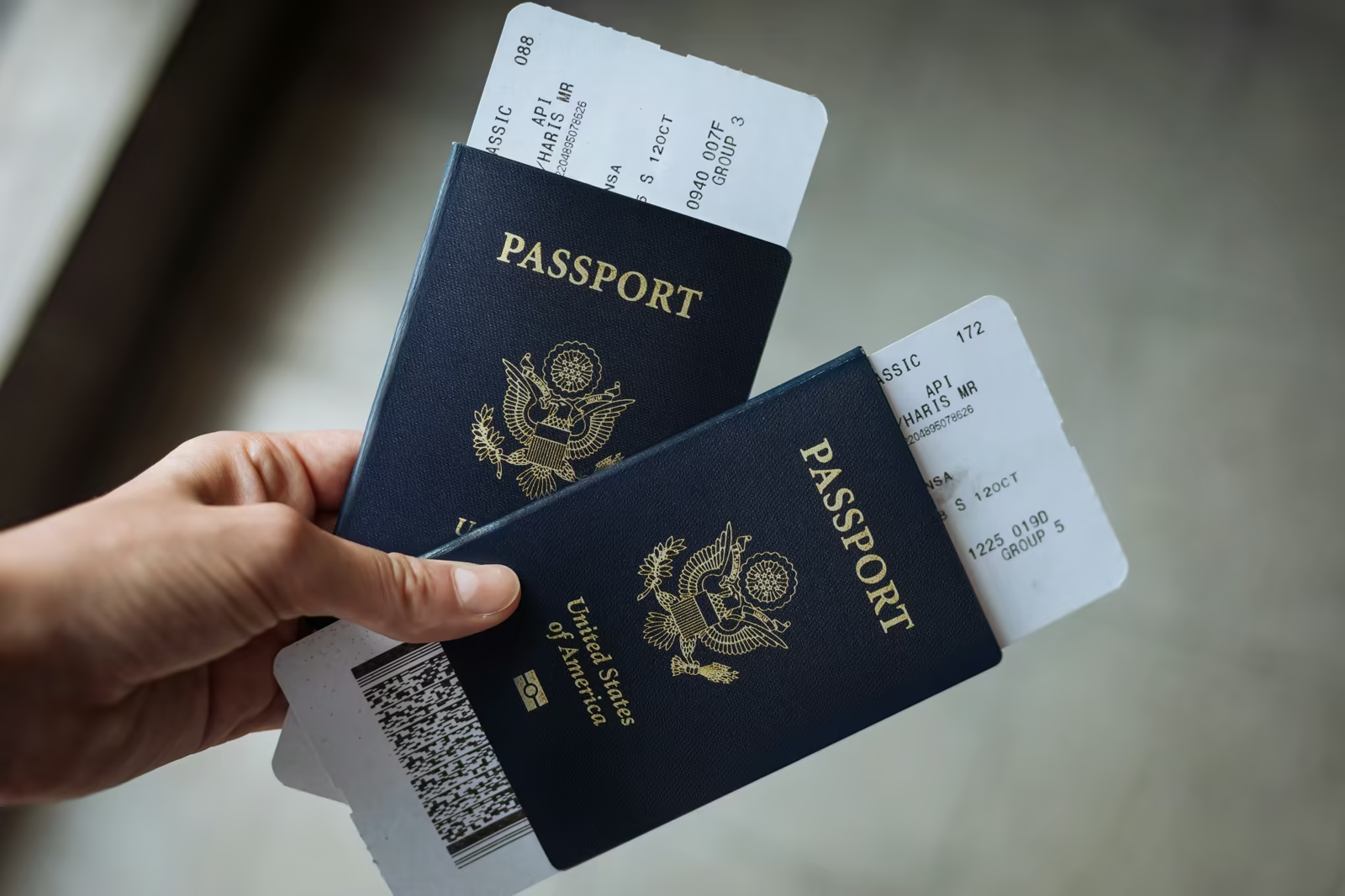
Cover letter for Schengen visa sample
Use this as a structure, not a script to copy blindly.
[Your full name]
[Your address]
[Your phone number]
[Your email]
[Date]

To
The Visa Officer
[Embassy / Consulate name]
[City]

Subject: Cover letter for Schengen tourist visa application

Dear Visa Officer,

I am applying for a short-stay Schengen visa for tourism from [start date] to [end date]. My main destination is [country], where I will stay for [number] days, and I will also visit [other country/countries] during the same trip. I am submitting my application through [consulate name] because [main-destination / first-entry reason].

The purpose of my trip is [tourism / family visit / business], and my itinerary includes [brief route summary]. I will stay at [hotel name / host name and address], and the accommodation documents are attached. My travel insurance certificate covering the full stay in all Schengen states is also enclosed.

I will fund this trip through [personal savings / salary income / sponsor support]. To support this, I have attached my recent bank statements, [payslips / tax records / sponsor documents], and my employment letter. I am currently employed as [job title] at [company], and my approved leave for these travel dates is confirmed in the attached letter.

I will return to [home country] after the trip because of my ongoing [employment / studies / business / family] commitments. For ease of review, I have attached my passport, application form, itinerary, accommodation proof, insurance certificate, financial documents, and employment evidence.

I kindly request that my application be considered for the requested travel period. Thank you for your time and consideration.

Sincerely,
[Your signature]
[Your full name]
This sample works best for tourism. For a business route, replace the accommodation paragraph with the conference or company invitation details. For a family visit, explain the host relationship and attach the invitation letter separately instead of trying to fold the host’s statement into your own letter. If the trip is specifically a host-based family visit, use the more focused cover letter for Schengen visa visiting family guide so your applicant letter lines up with the invitation, relationship proof, and sponsorship details.
Common mistakes that make the letter weaker
The cover letter is supposed to reduce doubt. These mistakes do the opposite.
| Mistake | Why it hurts | Safer fix |
|---|---|---|
| Writing a generic letter with no dates or main destination | The officer still has to reconstruct the trip from scattered documents | Put the exact dates, country of application, and route in the first paragraph |
| Describing an itinerary that does not match bookings or insurance | The letter highlights a contradiction instead of resolving one | Match every date and city against the attachments before signing |
| Saying “my sponsor will pay” without showing who the sponsor is | The financial story stays incomplete | Add the sponsor’s letter, ID, relationship proof, and funding evidence |
| Using the invitation letter as if it were your cover letter | Host documents and applicant explanations are different pieces of evidence | Keep the host letter separate and use your own letter to connect the whole file |
| Making the letter too emotional or too long | Emotional persuasion does not replace factual clarity | Keep it to about one page, direct and evidence-led |
| Forgetting to explain a missing or unusual document | Silence makes the gap look suspicious | Use one short sentence to explain the gap and identify the alternative document |
If you want the refusal patterns behind those mistakes, read why visa applications get rejected before your final review. The broader rule is simple: a cover letter for Schengen visa applications should make the file easier to verify, not harder to interpret.
Related guides
If you're building the rest of the application pack, these companion guides help:
- Schengen Visa Checklist: Documents You Need in 2026
- Documents Required for Schengen Visa (2026 Checklist)
- Schengen Visa Photo Requirements (2026): Size, Rules, Examples
Official sources
- European Commission visa policy
- European Commission: applying for a Schengen visa
- European Commission: new rules for Turkish citizens applying for Schengen visas
- Swiss FDFA: application for Schengen visa and procedure
- Switzerland VFS Global checklist for Schengen visitor visa (India)
- Swiss State Secretariat for Migration: FAQ on entry and host invitations
FAQ
Is a cover letter mandatory for Schengen visa applications?
Not every Schengen mission uses the same wording, so the safest answer is: sometimes explicitly, often practically. Some official checklists, such as the Swiss visitor checklist via VFS Global, clearly request a personal cover letter. Even where it is not named, the same explanation still helps the officer connect purpose, itinerary, funds, and return ties.
How long should a cover letter for Schengen visa be?
Usually one page is enough. If the file is simple, six to eight short paragraphs is plenty. If the file is more complex, such as a multi-country itinerary or sponsor-funded trip, keep the extra detail factual and still try to stay under roughly 400 words.
Can my sponsor or host write the cover letter for me?
No. Your host can write an invitation letter and your employer can write an employment letter, but your cover letter should come from you as the applicant. It is your explanation of the trip and your explanation of how the attached evidence fits together.
Should each family member have a separate cover letter?
If the family is traveling on one itinerary, one well-written master narrative can work, but local checklists may ask for a copy in each file. The Swiss visitor checklist explicitly says that if a family application is submitted together, all applications should include a copy of the cover letter.
What if I am missing one standard document?
Say so directly in one sentence and name the alternative you are providing. For example, if hotel bookings are not relevant because you are staying with a host, explain that and point to the invitation letter and host ID. A clear explanation is safer than pretending the gap does not exist.
Should I mention a previous Schengen refusal?
If the refusal was recent and relevant to the current file, yes. Briefly state that you were previously refused, name the general issue if known, and explain what has changed in the new application. Keep the tone factual. The purpose is to show that the current file is stronger, not to argue emotionally with the old decision.
Conclusion
The best cover letter for Schengen visa applications is short, specific, and fully aligned with the evidence. It should tell the officer your purpose, your route, your funding story, your return ties, and the exact documents that prove those points. If the letter says one thing and the attachments say another, the letter becomes a liability.
Use this step-by-step format, then review the whole route against the official checklist before you apply. If you want a second set of eyes on the full package, start with Vidicy’s Schengen checklist, read how it works, and start your application review once the cover letter, insurance, itinerary, and financial documents all line up.