


If you need an invitation letter for Schengen visa applications, here is the shortest accurate answer: the letter is usually a host-side supporting document that explains who is inviting you, where you will stay, the dates of the visit, your relationship, and who pays for what. But there is no single universal Schengen template. The European Commission says every short-stay applicant still has to prove the purpose of stay, accommodation, financial means, and intention to return, and Member States add their own host-document rules on top. France often requires an attestation d'accueil validated by the mairie. Germany says a basic invitation needs no special formalities, but host-funded trips require a Verpflichtungserklaerung. The Netherlands uses a municipality-legalised proof of sponsorship and/or private accommodation form. Austria can require an Electronic Guarantee Letter (EVE) when self-funding proof is not enough.
That difference matters because generic blog templates often merge four different documents into one. A Schengen invitation letter is not automatically a financial guarantee, and a host promise in one country may need an official municipal form in another. If you want the route-level preflight first, start with Vidicy's Schengen visa checklist and then use this guide to tighten the host side of the file. If the host letter is ready but you still need the applicant-side explanation note, use the dedicated cover letter for Schengen visa visiting family guide.
| Country example | What the host-side document is called | Current official position | Why applicants get this wrong |
|---|---|---|---|
| France | Attestation d'accueil |
For private or family visits under 3 months, the host must obtain it from the mairie before the visa request; the validated original must be sent to the visitor | People submit a casual invitation email instead of the mairie-validated form |
| Germany | Invitation letter or Verpflichtungserklaerung |
The Federal Foreign Office says a normal invitation has no special formalities, but host-funded trips need a declaration of commitment | Applicants treat a normal host letter as if it were a binding financial undertaking |
| Netherlands | Proof of sponsorship and/or private accommodation | The inviter signs the official form and has it legalised by the Dutch municipality | Applicants forget that the host form, sponsorship, and accommodation statements may need separate documents |
| Austria | Invitation plus possible EVE | Austria allows an Electronic Guarantee Letter when self-financing proof is insufficient; the authority forwards it to the embassy within 48 hours | Old notarised guarantee letters are reused even though Austria no longer accepts them |
Key takeaways
Use this guide to verify the route, evidence, and next action before you finalize the file. A Schengen invitation letter is strongest when it matches the itinerary, accommodation plan, host identity proof, funds, insurance, and return evidence.
Table of Contents
- What an invitation letter for Schengen visa applications actually proves
- What to include in a Schengen invitation letter
- Country-specific rules that change the document
- Supporting documents the host should attach
- Invitation letter for Schengen visa sample
- Mistakes that make invitation letters look weak
- Official sources
- FAQ
- Conclusion
What an invitation letter for Schengen visa applications actually proves
At EU level, the invitation letter is only part of a larger evidence pack. The European Commission's current Schengen guidance says a short-stay visa covers up to 90 days in any 180-day period, and applicants must show a valid passport, application form, photo, medical insurance, and supporting documents proving purpose, accommodation, financial means, and intention to return. That is why the invitation letter works best as a bridge document. It helps the consulate understand the host relationship and accommodation plan, but it does not replace the rest of the evidence.
Three practical rules follow from that:
- Use the invitation letter to prove the visit is real.
- Use financial documents to prove the trip is affordable.
- Use employment, study, business, or family-tie documents to prove the stay is temporary.
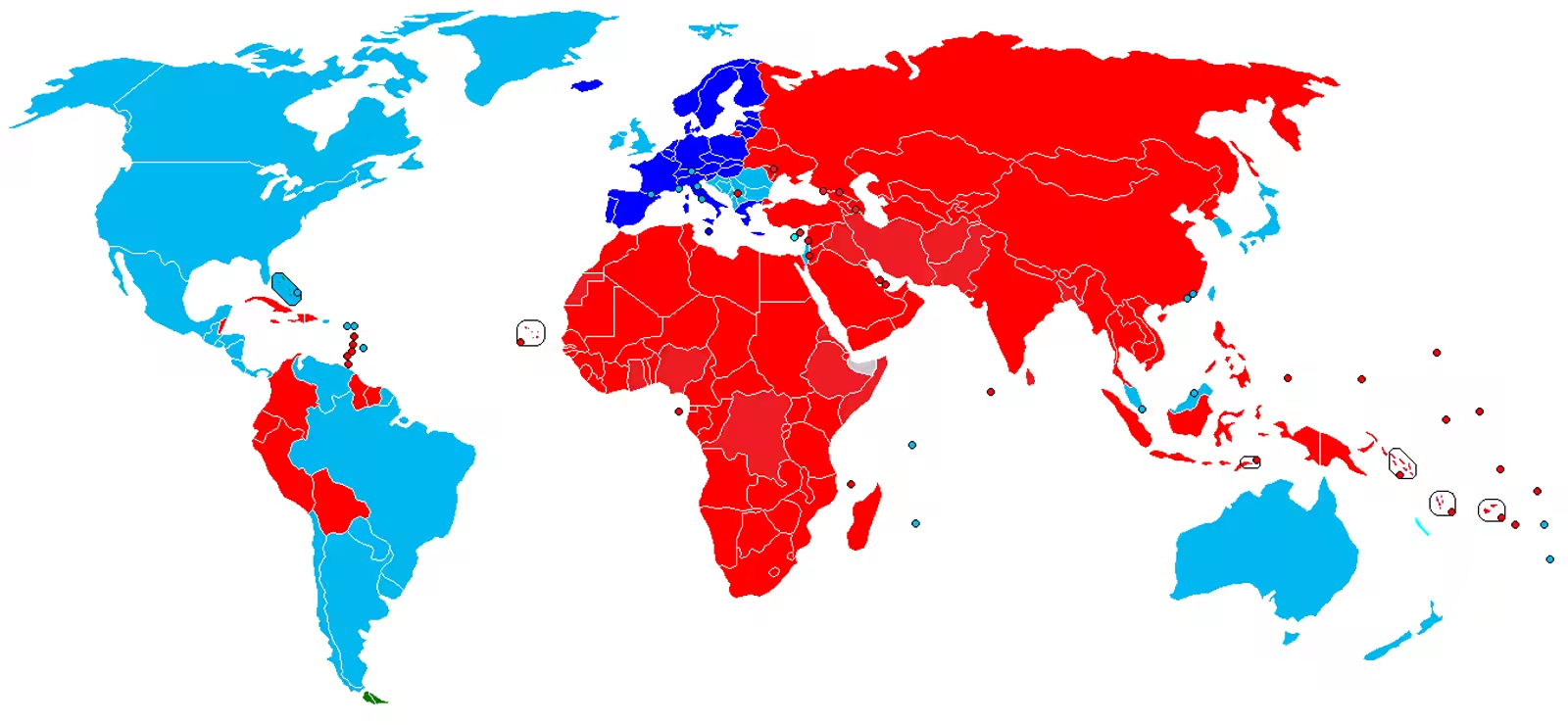
The Schengen system also spans 29 countries as of 2025, which is exactly why one copied template can fail across borders. The Commission's current applying page also lists the standard short-stay fee at €90 for adults and €45 for children aged 6 to under 12, with a normal processing time of 15 calendar days that can extend to 45 days in individual cases. The EU's China delegation campaign page warns applicants to check the embassy or consulate of the main destination country because document requirements vary by trip purpose and by state.
If your full file still needs work beyond the invitation itself, use the companion guides for documents required for Schengen visa and cover letters for Schengen visa applications before you submit. If the applicant is visiting parents, siblings, or other relatives and needs a matching applicant-side explanation, send them to the dedicated cover letter for Schengen visa visiting family guide.
What to include in a Schengen invitation letter
A strong invitation letter for Schengen visa files should read like a factual note, not a plea. Even where no formal template exists, the safest structure stays the same.
| Section | What to include | Why it matters |
|---|---|---|
| Host identity | Full name, full address, phone, email, nationality, and residence status | The consulate needs to know the inviter is real and legally present |
| Visitor identity | Full name, passport number, date of birth, and current address | The letter must match the passport and visa form exactly |
| Relationship | How you know each other and for how long | This explains why the visit is plausible |
| Dates | Planned arrival date, departure date, and total stay | These dates must match the application, insurance, and itinerary |
| Accommodation | Exact address where the visitor will stay | This supports the accommodation part of the Schengen checklist |
| Cost split | What the host covers and what the visitor covers | This is where many refusals start if the story stays vague |
| Attachments | Host passport or residence-card copy, municipal form, proof of funds, relationship proof | Unsupported claims stay weak even if the wording is good |
Keep the wording direct. For example:
- Good: "I invite Maria Santos to stay at my home in Amsterdam from 3 July 2026 to 14 July 2026."
- Weak: "I would be very happy if she could maybe visit me in Europe this summer."
The invitation letter should also match the wider route logic. The European Commission says applicants can usually apply no earlier than 6 months before travel and normally no later than 15 days before the trip. In practice, that means a stale host letter can look recycled, especially if the dates do not match the appointment file.
Country-specific rules that change the document
This is the section most searchers actually need, because "invitation letter for Schengen visa" means different things depending on where the host lives.
France: the host usually needs an attestation d'accueil
France is the clearest example of why a simple invitation letter is not always enough. Service-Public, verified on 21 October 2025, says that if a non-EU national is being hosted in France for a tourist stay of less than 3 months, the host must request an attestation d'accueil from the mairie. The page says the attestation must be validated by the mairie before the visa application, then sent to the visitor before departure. The current local tax for that process is €30.
That changes the drafting logic. For France, the host should not rely on a casual free-form letter alone when the official attestation is required. The attestation is the primary host document, and any extra invitation letter should only clarify context, not substitute for the mairie form.
Service-Public also says the host must present proof of identity, address, housing, and resources, and it notes that the attestation records the expected arrival and departure dates plus who is responsible for insurance of at least €30,000.
Germany: normal invitation vs declaration of commitment
Germany's Federal Foreign Office draws an important line. Its public FAQ says an invitation first proves the purpose of the journey, so no special formalities are required. But the same official answer says that if the host intends to cover the expenses associated with the trip, the file must include a formal pledge to cover costs, called a Verpflichtungserklaerung, signed through the local authority in Germany.
That means Germany uses two different host-side tools:
- a normal invitation letter for purpose and accommodation
- a formal declaration of commitment for financial responsibility
If you need the Germany-only version of this distinction, read the country-specific guide: Invitation Letter for German Visa.
Netherlands: official sponsorship and private accommodation form
The Netherlands is formal even when the trip is a normal family or friend visit. NetherlandsWorldwide's current family-and-friends checklist says applicants must provide a completed proof of sponsorship and/or private accommodation form, signed by the inviter and legalised by the Dutch municipality where that person is registered.
The official checklist also adds an important nuance: if the person paying the visitor's costs is not the same person providing accommodation, the accommodation host must provide a separate invitation or complete a separate sponsorship form. That is exactly the kind of detail generic templates miss.
NetherlandsWorldwide also asks for the inviter's Dutch passport, ID card, or residence permit copy, and for family visits it asks for proof of immediate family ties.
Austria: EVE can replace weak self-funding evidence
Austria's Foreign Ministry says that when it is not feasible to provide evidence for self-financing, funding can be verified by an Electronic Guarantee Letter from a resident in Austria. The ministry page says the authority handling the EVE forwards the information to the Austrian embassy within 48 hours, and the applicant then gives the ID number during the visa process.
Austria also makes one thing explicit: notarised Verpflichtungserklaerungen are no longer accepted. So if an applicant shows up with an old notarised guarantee letter copied from another Schengen country, the document logic is already broken before the consulate reads the rest of the file.
Supporting documents the host should attach
A good invitation letter becomes much stronger when the attachments prove each claim directly. Across the official pages reviewed for this run, the safest host-side pack is:
- Passport, national ID, or residence permit copy of the host
- Proof of address or legal residence where the visitor will stay
- Relationship proof if the trip is a family visit
- Municipal or authority form where the country requires one
- Proof of funds or sponsor liability if the host covers costs
- Accommodation proof if the host is giving a room in their own home
Here is the practical breakdown:
| Host claim | Best supporting proof |
|---|---|
| "I live legally in the Schengen state" | Passport, ID card, or residence permit copy |
| "The visitor will stay with me" | Official host form, attestation, or address proof |
| "We are family" | Birth certificate, marriage certificate, family record, or other civil-status proof |
| "I will pay" | Declaration of commitment, EVE, sponsor form, or the country's specific financial undertaking |
| "The visit is temporary and planned" | Dated letter plus matching arrival/departure dates in the wider file |
If the cost side is still the weakest part of the application, fix that before you polish the invitation wording. Vidicy's Proof of Funds for Schengen Visa: 2026 Amounts guide is the better place to tighten the money story.
Invitation letter for Schengen visa sample
Use this as a purpose-and-accommodation sample. If your country requires an official host form, attach that form and keep the free-form letter as a short supporting note.
[Host full name]
[Full address]
[Phone number]
[Email]
[Date]

To the Visa Officer,

I, [host full name], living at [full address], invite [visitor full name],
passport number [passport number], to visit me in [country] from [arrival date]
to [departure date].

We are [relationship], and we have known each other since [year/context].
During this visit, [visitor name] will stay with me at the address above.

The purpose of the trip is [family visit / private visit / tourism with host stay].
[Visitor name] will return to [home country] after the visit.

[Cost split sentence:
- The visitor will pay for flights and personal expenses, and I will only provide accommodation.
- I will cover accommodation and living costs, and the required sponsorship /
  declaration of commitment document is attached.]

Attached are copies of my [passport / residence permit / national ID] and
the supporting documents referred to in this letter.

Sincerely,
[Host full name]
This sample works only if the rest of the file tells the same story. If the application is a France private visit, the attestation d'accueil remains the key document. If the application is host-funded in Germany, the Verpflichtungserklaerung is the stronger financial proof. If the trip is to the Netherlands, the municipality-legalised sponsorship/private accommodation form is the official backbone.
Mistakes that make invitation letters look weak
The main failure pattern is not "forgot the letter." It is "the letter says one thing and the rest of the file says something else."
| Mistake | Why it hurts | Better move |
|---|---|---|
| Using one generic template for every country | Member States do not all use the same host-document rules | Match the letter to the main destination country |
| Treating a host letter as proof of sponsorship everywhere | In Germany, host-funded visits need a declaration of commitment; in the Netherlands, the municipality-legalised form matters | Use the correct financial form when the host pays |
| Missing host ID or residence proof | The consulate cannot verify who invited the visitor | Attach passport, ID, or residence-permit copy |
| Dates that do not match the visa form or insurance | A contradiction in dates makes the whole file less credible | Use one exact itinerary across all documents |
| Vague wording about costs | Officers cannot tell who pays for what | State the cost split plainly and prove it |
| Sending only scans where the country expects an original validated form | France and some other host-document systems still depend on originals | Follow the consulate's original-vs-copy rule exactly |
If you want the whole package checked, not just the host letter, run the file through Vidicy's How it works flow before submission.
Official sources
- European Commission: Applying for a Schengen visa
- EEAS China campaign: Schengen visa application process: essential guide
- Federal Foreign Office (Germany): FAQ on invitation from a relative or acquaintance
- NetherlandsWorldwide: Checklist for a Schengen visa to visit family or friends
- Austrian Foreign Ministry: Schengen visa application requirements
- Service-Public (France): Attestation d'accueil
- Schengen area overview (29 countries)
- Short-stay visa statistics by Schengen countries
Related guides
- Schengen Visa Sponsor Letter: 2026 Country Rules
- Documents Required for German Visa: 2026 Checklist
- Proof of Funds for Schengen Visa: 2026 Amounts
- Schengen Visa Checker: What to Verify Before You Apply
FAQ
Is an invitation letter mandatory for a Schengen visa?
Not everywhere and not in the same way. EU rules require proof of purpose and accommodation, but the host-side document changes by Member State. Germany says a normal invitation has no special formalities, while France often requires a mairie-validated attestation d'accueil and the Netherlands requires a municipality-legalised sponsorship/private accommodation form.
What should an invitation letter for Schengen visa applications include?
At minimum: the host's full identity and address, the visitor's passport details, the relationship, the exact visit dates, where the visitor will stay, and a clear statement about who pays for which expenses. The letter should also list the supporting documents attached.
Can a host letter replace proof of funds?
Usually no. A host letter may explain accommodation or relationship, but it does not automatically become a financial guarantee. Where the host pays, countries such as Germany, the Netherlands, or Austria may expect a separate formal sponsorship or guarantee document.
What is the French attestation d'accueil fee in 2026?
The current Service-Public page lists the local tax for an attestation d'accueil at €30. That fee is for the French host-side process at the mairie, not the Schengen visa fee itself.
How early should the host prepare the invitation documents?
Early enough that the document dates still match the filing window. The European Commission says Schengen applications are usually allowed up to 6 months before travel and normally should be filed at least 15 days before departure. Municipal forms and authority guarantees can take additional time.
How long can a Schengen invitation-based visit last?
The underlying short-stay visa rule remains up to 90 days in any 180-day period. An invitation letter does not extend that limit; it only supports the visa file for a temporary trip.
Conclusion
The simplest way to handle an invitation letter for Schengen visa applications is to stop treating it like a universal template. First confirm the main destination country, then match the host document to that country's rule: normal letter, mairie attestation, municipality-legalised sponsorship form, or formal guarantee.
Once that host-side document is right, make sure the rest of the file agrees with it: same dates, same address, same cost split, and the same temporary-trip story. Start with Vidicy's Schengen checklist, then use sign up when you want the whole pack checked before you submit.