

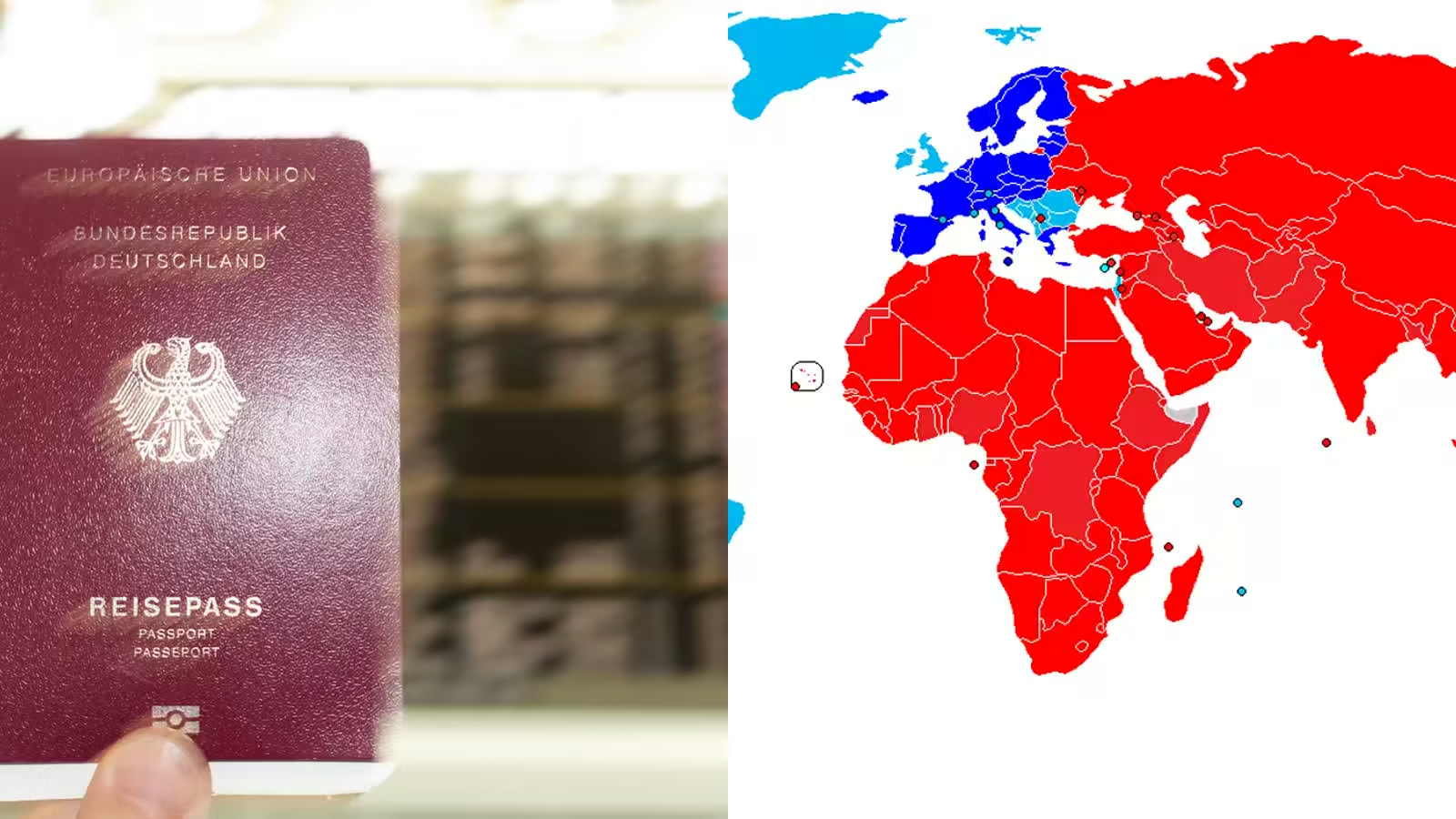

If you need a Schengen visa sponsor letter, the direct answer is this: there is no single Schengen-wide sponsor-letter form. The European Commission sets the short-stay baseline, but the host document changes by destination country. Germany says a private visit usually needs an invitation to confirm the purpose of the trip, while a host-funded visit needs a formal declaration of commitment. The Netherlands splits the problem into proof of private accommodation and proof of sponsorship, and the sponsorship step only applies if the visitor has less than EUR 55 per person per day. France requires an attestation d'accueil validated by the town hall for a private or family stay of less than 3 months.
That difference matters because generic sponsor-letter templates often mix up three separate jobs: proving where you will stay, proving who pays, and proving why the trip is temporary. For a Schengen application, the safest workflow is to match the host document to the destination country first, then line it up with your Proof of Funds for Schengen Visa: 2026 Amounts, insurance, and itinerary. If you want the route-level upload checklist first, start with Vidicy's Schengen visa document checklist.
| Baseline rule | Current official figure | Why it matters for sponsor-letter cases |
|---|---|---|
| Short-stay limit | Up to 90 days in any 180-day period | A host letter supports a temporary visit, not a move. |
| Earliest filing window | Up to 6 months before travel | Formal host documents take time to obtain and post. |
| Latest safe filing floor | At least 15 calendar days before travel | Last-minute host paperwork is a common avoidable risk. |
| Standard visa fee | EUR 90 for adults, EUR 45 for children aged 6 to under 12 | The host letter does not replace the visa fee or the rest of the file. |
| Normal processing target | 15 calendar days, sometimes up to 45 calendar days | If a municipality or local authority must validate the host paperwork, build in more time. |
Table of Contents
- What a Schengen visa sponsor letter actually is
- Country rules that change the document
- Schengen visa sponsor letter sample
- What to attach with the letter
- Mistakes that still lead to refusals
- Official sources
- FAQ
- Conclusion
What a Schengen visa sponsor letter actually is
A Schengen visa sponsor letter is a host-side document that explains who is inviting the traveller, where the traveller will stay, what costs the host will cover, and which supporting documents prove those promises. In practice, searchers often mean one of four different documents:
| Document | Who writes or issues it | What it proves | When to use it |
|---|---|---|---|
| Invitation letter | The host | Purpose of trip, relationship, and accommodation | Family or friend visit where the visitor mostly pays their own way |
| Sponsor letter | The host | What costs the host will pay and why the support is credible | Host-funded or partly host-funded visit |
| Country-specific host form | A local authority or government form completed by the host | Accommodation and/or financial responsibility under local rules | France and the Netherlands are the clearest examples in this article |
| Applicant cover letter | The traveller | How the full document pack fits together | When the traveller needs to explain itinerary, finances, or a prior refusal |
The key point is that a Schengen visa sponsor letter does not replace the rest of the file. It only works if the other documents tell the same story. If the host says they will cover accommodation, the address evidence should match. If the host says they will pay local costs, the financial evidence should support that. If the visit is a private stay, the itinerary and relationship proof should make the purpose credible.
Another detail many applicants miss: the host document is country-specific, but the visa itself is still Schengen-wide. According to the European Commission, short-stay applications are still governed by the same regional rules on timing, fee bands, and the 90/180 limit. That means your sponsor paperwork needs to fit two layers at once:
- the Schengen baseline for short stays
- the destination-country host rules for accommodation and sponsorship
If you only need a Germany-specific version of this question, use the dedicated invitation letter for German visa guide. If you are still building the full application pack, the broader Schengen visa checklist is the better first read.
If your file is specifically about a host paying for a Germany visit, the narrower sponsor letter for German visa guide is the better next step because it focuses on when Germany expects a Verpflichtungserklärung instead of a casual host promise.
Country rules that change the document
The best way to avoid template mistakes is to stop treating Schengen sponsorship as one universal form. The rules below are all from current official pages read during this run.
Germany: invitation for purpose, formal commitment for host-funded trips
Germany's Federal Foreign Office draws the cleanest distinction. Its official visa FAQ says for private visits, an invitation is usually required to confirm the purpose of the journey. But it immediately adds the financial exception: if the visitor cannot fully cover the expenses associated with the trip, a formal pledge to cover all costs must be presented with the visa application. That formal pledge is the Verpflichtungserklaerung signed through the local authority in Germany.
That means a plain invitation letter is usually enough only when:
- the host is mainly explaining the relationship and accommodation
- the visitor can still prove enough personal funds for the rest of the trip
- the trip is clearly temporary and consistent with the rest of the evidence
If the host pays for the stay, Germany's own official wording pushes the file into the formal commitment category. In other words, a sentence such as "I will cover everything" is weaker than the actual Verpflichtungserklaerung.
Netherlands: accommodation and sponsorship are separate forms
The Netherlands is more process-driven. NetherlandsWorldwide says anyone outside the Schengen area who will stay with a host in the Netherlands for 90 days or less needs proof of private accommodation. If the visitor has less than EUR 55 per person for each day of the trip, the same official site says the visitor also needs a sponsor.
That split matters because it creates two different host documents:
- a proof of private accommodation form when the traveller will stay with you
- a proof of sponsorship form when the traveller's own money falls below the official threshold
The sponsorship page adds specific host rules that generic blog templates usually skip. A Dutch sponsor must:
- live in the Netherlands
- be 18 years old or over
- have a citizen service number
- have steady and sufficient income in the Netherlands for at least the next 12 months
The same page lists the supporting evidence for employed sponsors, including:
- an employment contract valid for at least 12 months from the visitor's visa application date
- a recent employer's declaration
- copies of the 3 most recent salary statements
NetherlandsWorldwide also says that once the sponsor's signature has been legalised, the visitor must apply for the visa within 6 months, even if the actual trip happens later.
France: the town hall validates the host document
France uses a more formal host document than a plain letter for private and family visits. Service Public says that if you want to host a non-EU foreign national in France for a tourist stay of less than 3 months, you must request a certificate of acceptance (attestation d'accueil) with your town hall before the visa application.
That official page is useful because it gives hard numbers and document rules:
- the certificate costs EUR 30
- the host must show housing and residence evidence
- the host must show means such as the last 3 pay slips or last tax assessment
- the visitor must have insurance covering up to EUR 30,000 minimum for care received during the stay in France
The same page also says the validated original must be sent to the visitor abroad and, if the visitor needs a visa, the visitor must attach the reception certificate to the short-stay visa application.
What the comparison means in practice
If you are searching for a Schengen visa sponsor letter, the practical rule is simple:
- Germany: a basic invitation can prove purpose, but host-funded trips need the formal commitment.
- Netherlands: accommodation and sponsorship are separate questions, with a public money threshold of EUR 55/day.
- France: for private or family stays, the host-side document is not just a casual letter. It is a town-hall validated certificate.
That is why one generic Word template is rarely enough. The safest approach is to use the country-specific host document where required, then add a clean explanatory letter only if it actually helps the rest of the file.
Schengen visa sponsor letter sample
Use the sample below as the plain explanatory version for host-supported private visits. Then adapt it to the country rules above. If the destination country requires a formal form or certificate, that government document should stay central.
[Host full name]
[Full address]
[Phone number]
[Email address]
[Date]

To the Visa Officer,

I am writing to support the Schengen visa application of [visitor full name],
passport number [passport number], who is my [relationship].

[Visitor name] plans to visit from [arrival date] to [departure date].
During this trip, [he/she/they] will stay with me at [full address].

The purpose of the visit is [family visit / private stay / short holiday].

I will provide [accommodation only / accommodation and meals / partial
financial support / full financial support]. The support I will provide is:
[clear cost split].

Attached are copies of my [passport / residence permit / accommodation proof /
financial documents / country-specific host form if required].

I confirm that the information in this letter is true.

Sincerely,

[Host name]
[Signature]
How to adapt the sample
- If the destination is Germany and the host pays, mention the attached
Verpflichtungserklaerunginstead of pretending the plain letter is enough. - If the destination is the Netherlands, pair the letter with the right proof of private accommodation or proof of sponsorship form.
- If the destination is France, the town-hall validated attestation d'accueil should do the formal work, and the plain letter should only add context if needed.
- If the traveller still needs to explain the broader trip story, use an applicant-side cover letter for Schengen visa rather than forcing the host to explain everything.
What to attach with the letter
A good Schengen visa sponsor letter is only useful when the evidence behind it is equally clear.
For most host-based short stays, the strongest attachment set is:
- Host identity proof: passport or residence permit copy, depending on the country rule.
- Host address proof: proof the visitor will actually stay at the named address.
- Host financial proof if the host pays: salary statements, employer declaration, tax assessment, or other country-specific income evidence.
- Traveller's own proof of funds if the trip is only partly sponsored.
- Insurance showing the Schengen medical baseline.
- Travel dates that match the host document, itinerary, and application form.
Where applicants usually get into trouble is the cost split. A sponsor letter should say exactly which costs the host covers:
- accommodation only
- accommodation plus meals
- accommodation plus daily costs
- full support for the stay
That exact wording matters because the officer is comparing the host's promise to the rest of the file. If the host says "full support" but the bank evidence is thin, the letter becomes a liability instead of a benefit.
If you are not sure whether the host-side document and the traveller's document pack still tell one consistent story, run the file against the Schengen route checklist before you submit. That is usually more useful than polishing the wording one more time.
Mistakes that still lead to refusals
The common failure pattern is not "missing host letter." It is "wrong document for the wrong country" or "the host letter says one thing and the rest of the file says another."
| Mistake | Why it hurts | Better move |
|---|---|---|
| Using one generic sponsor template for every Schengen country | France, the Netherlands, and Germany each handle host documents differently | Match the document to the destination country first |
| Treating a plain letter as a financial guarantee | Germany and the Netherlands publish more formal sponsorship steps | Use the official host form or commitment document when the host pays |
| Leaving the cost split vague | The officer cannot tell who covers flights, stay, or daily costs | State exactly what the host covers and back it with evidence |
| No host status or address proof | The host's identity and accommodation claims stay unproven | Attach the proof named in the official host rules |
| Dates do not match the rest of the file | The host letter, form, insurance, and itinerary contradict each other | Keep one exact arrival and departure window everywhere |
| Assuming sponsorship replaces the visitor's own evidence | Host support does not erase the need for a coherent temporary-visit story | Keep the traveller's funds, insurance, and return-tie evidence aligned |
One more practical rule: a sponsor letter should stay factual. Do not promise approval. Do not over-argue. Do not try to sound like a lawyer. The strongest host letters are usually the simplest ones because they are easy to verify against the rest of the file.
Related guides
If you're building the rest of the application pack, these companion guides help:
- Invitation Letter for Schengen Visa: 2026 Guide
- Sponsor Letter for Visa: Sample + Official Rules
- Family Invitation Letter for Visa: Sample + Rules
- Proof of Funds for Schengen Visa: 2026 Amounts
Official sources
- European Commission: Applying for a Schengen visa — https://home-affairs.ec.europa.eu/policies/schengen/visa-policy/applying-schengen-visa_en
- Federal Foreign Office: German visitor-visa FAQ — https://www.auswaertiges-amt.de/en/visa-service/buergerservice/faq/606848-606848
- NetherlandsWorldwide: How can I sponsor a visitor from abroad? — https://www.netherlandsworldwide.nl/visa-the-netherlands/sponsoring
- NetherlandsWorldwide: How can I provide accommodation for a visitor from abroad? — https://www.netherlandsworldwide.nl/visa-the-netherlands/provide-accommodation
- Service Public: Certificate of acceptance (attestation d'accueil) — https://www.service-public.gouv.fr/particuliers/vosdroits/F2191?lang=en
FAQ
Is there one standard Schengen visa sponsor letter for every country?
No. There is one Schengen short-stay framework, but host documents still change by destination country. Germany distinguishes between an invitation and a formal commitment, the Netherlands splits accommodation and sponsorship, and France uses a town-hall validated certificate for private or family stays.
When do I need more than a plain invitation letter?
You usually need more than a plain letter when the host is paying for the stay or when the destination country publishes a specific host form. Germany's formal commitment rule, the Dutch sponsorship form, and France's attestation d'accueil are three current official examples.
How much money matters in Dutch host-based Schengen cases?
NetherlandsWorldwide says the visitor does not need a sponsor if they have at least EUR 55 per person for each day of the trip. If the visitor has less than that amount, the host must arrange proof of sponsorship and meet the official sponsor-income rules.
Does France really require a stamped host certificate?
For private or family visits of less than 3 months, Service Public says the host must request the certificate with the town hall, pay the EUR 30 tax stamp, and send the validated original to the visitor abroad for the short-stay visa application.
Can a Schengen sponsor letter replace my own bank statements?
Usually no. A host document can strengthen accommodation or financial support, but the application still needs a coherent overall story. If your own finances, itinerary, insurance, or return-home evidence do not line up, the host letter alone will not fix the file.
Conclusion
A strong Schengen visa sponsor letter starts with the right question: which country-specific host document does this destination actually require? Once you answer that, the rest becomes simpler. Germany uses a basic invitation for purpose and a formal commitment for host-funded trips. The Netherlands separates accommodation from sponsorship and publishes the EUR 55/day threshold. France routes private visits through the attestation d'accueil process at the town hall.
Build the host document first, then line it up with the traveller's funds, insurance, and dates. If you want a final cross-check before you upload anything, start with Vidicy's Schengen checklist, review how the workflow works, and then create an account to pressure-test the full document pack before submission.