



If you need an employment letter for spouse visa applications, the safest direct answer is this: there is no single global spouse-visa employer letter. The UK family route is the clearest current example because GOV.UK explicitly lists the employer-letter fields it expects. Canada, Australia, and the United States still care about employment proof, but they usually assess it through a sponsorship undertaking, relationship-finance evidence, or Form I-864 income rules rather than one standalone HR letter.
This article is for sponsors and applicants using a broad search phrase before they know which spouse route they actually fit. According to current official pages from GOV.UK, IRCC, Australia Home Affairs, and USCIS, the real question is not "Do I have an employment letter?" It is "What must my employment evidence prove in this specific spouse route, and what other documents does it have to match?" If your case is already clearly UK-only, use the dedicated Employment Letter for Spouse Visa UK guide alongside Vidicy's UK visa checklist.
| Route | What the employment letter does | Current official signal | What usually matters more than the letter |
|---|---|---|---|
| UK family visa | Helps prove the partner-route financial requirement | GOV.UK says employed cases can include 6 months of payslips, bank statements, and a headed-paper employer letter | Matching salary history, contract type, and finance evidence |
| Canada spousal sponsorship | Supports the sponsor's ability to meet the undertaking or explain current work | IRCC says there is usually no minimum necessary income requirement in most spouse or partner cases | The 3-year undertaking, checklist completeness, and relationship evidence |
| Australia partner visa | Can support shared-finance or work-history explanations | Home Affairs focuses on financial aspects of the relationship like joint bills and joint accounts | Relationship evidence across financial, social, domestic, and commitment categories |
| U.S. spouse immigration | Secondary support for the Affidavit of Support | USCIS centers the case on Form I-864 and poverty-guideline thresholds | Tax returns, W-2s, pay stubs, and I-864 rules |
Key takeaways
Use this guide to verify the route, evidence, and next action before you finalize the file. Employment letters for spouse visas should verify stable work, income, role, start date, and employer contact details without overstating immigration conclusions.
Table of Contents
- Employment letter for spouse visa: what it should prove
- UK spouse visa: the route with the clearest employer-letter rule
- Canada spouse sponsorship: employment proof supports the undertaking
- Australia partner visa: shared finances matter more than one HR letter
- U.S. spouse visa: Form I-864 is the real income test
- Employment letter sample for spouse visa applications
- Mistakes that weaken spouse-visa employment proof
- Official sources
- FAQ
- Conclusion
Employment letter for spouse visa: what it should prove
An employment letter for spouse visa applications is a document from an employer that confirms a real job, a real pay level, and dates that can be checked against the rest of the file. In high-stakes family routes, that matters because officers do not read the letter as a nice extra. They use it to test whether the financial story is coherent.
In practice, a strong spouse-visa employment letter usually needs to answer five questions:
- Who is employed?
- What is the role and contract type?
- How much is the person paid, and on what basis?
- How long have they been employed or paid at the current rate?
- Which other documents prove the same facts?
That last question is the one applicants miss. A spouse-route employment letter is only strong when it matches the file around it: payslips, bank credits, tax records, sponsorship forms, and relationship evidence. If you still need the basic employer-letter format before you specialize it for a family case, start with Vidicy's employment letter guide and then come back to this spouse-route version.
UK spouse visa: the route with the clearest employer-letter rule
The UK family route is where the phrase employment letter for spouse visa is most literal. On the current GOV.UK family-visa evidence page, proof of finances for an employed applicant or sponsor can include bank statements, 6 months of payslips, and a letter from an employer, dated and on headed paper.
GOV.UK says that employer letter should confirm:
- the person is employed there
- the job title or position
- how long they have worked there
- the type of contract
- what they earn before tax and National Insurance
- how long they have been paid the current salary
- that the payslips are genuine
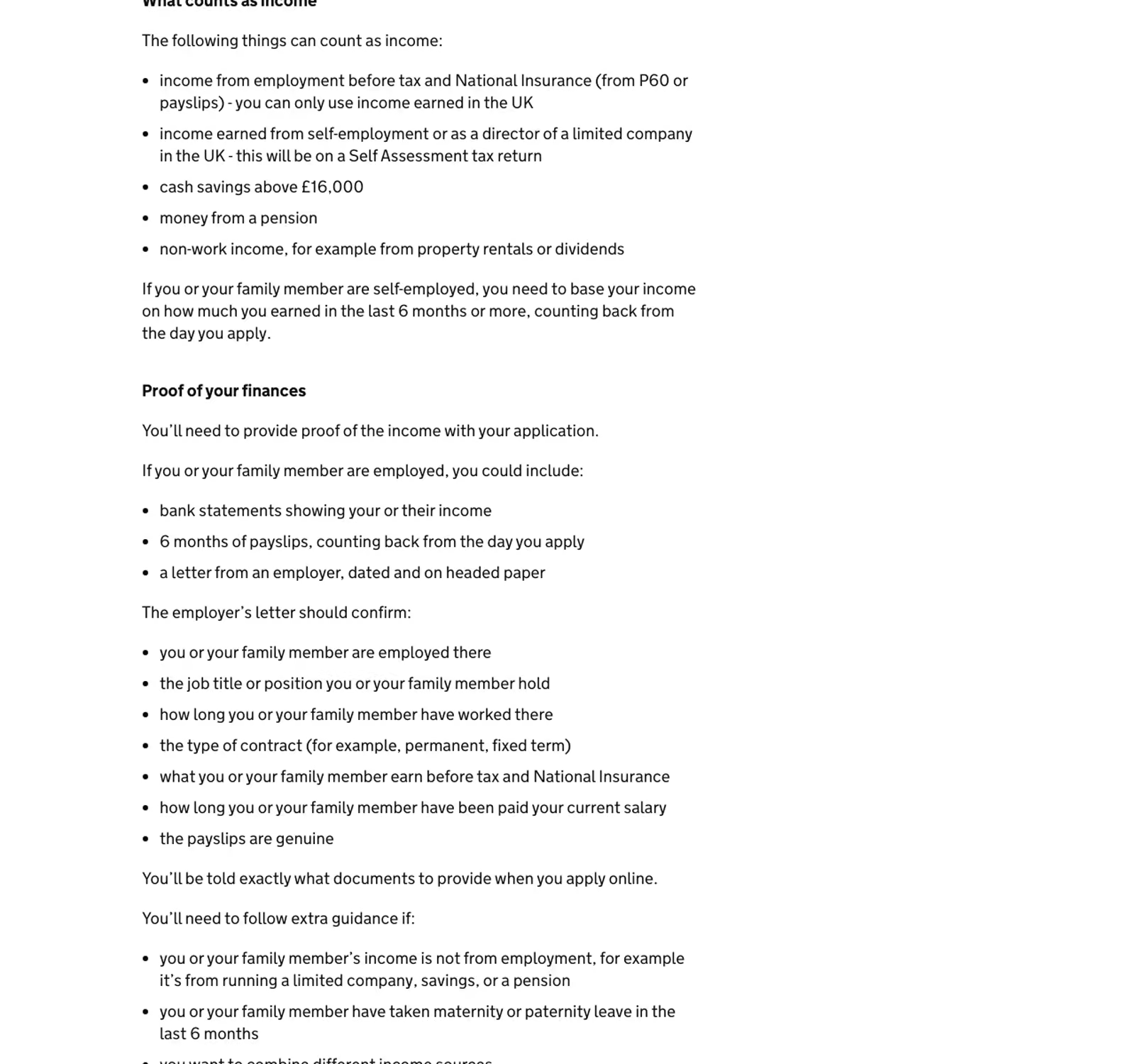
That is much more specific than the average template page. It also explains why UK spouse cases go wrong when an HR letter only says "X works here."
The same live GOV.UK proof-of-income page says partners usually need a combined income of at least GBP 29,000 a year, and cash savings above GBP 16,000 can count. Current UKVI processing pages also say partner or spouse decisions usually take 12 weeks outside the UK and 8 weeks inside the UK when the minimum-income and English-language requirements are met.
So the UK rule is simple: the employment letter matters, but it is only one part of a finance bundle. If you already know the route is UK-only, use the focused Employment Letter for Spouse Visa UK guide and then pressure-test the wider finance stack against the UK spouse visa checklist.
GOV.UK links this official UKVI walkthrough on the visa-application process:
The video comes from the official GOV.UK page How to apply for a visa or permission to come to the UK: video. It is not spouse-route-only, but it is useful for understanding how the final upload flow works after you build the finance pack.
Canada spouse sponsorship: employment proof supports the undertaking
Canada is where many searchers get misled by UK-style advice. The current IRCC spousal sponsorship guide says the sponsor signs a binding undertaking to support the spouse or partner, and for most spouse or partner cases there is no minimum necessary income requirement.
IRCC's guide also says three other things that matter here:
- spousal sponsorship is mandatory online as of September 23, 2022
- the sponsor's undertaking for a spouse, common-law partner, or conjugal partner lasts 3 years
- a minimum-income test is triggered only in narrower cases, such as when the spouse or partner being sponsored has a dependent child who has a dependent child of their own
That changes what an employment letter is doing. In Canada spouse cases, it is usually supporting context, not the main legal test. It can help explain current employment, how the couple expects to meet everyday costs, or why a sponsor meets a specific income-related requirement when one applies. But the backbone of the file is still the IRCC checklist, the sponsorship forms, the relationship evidence, and the undertaking.
IRCC's current application page also says fees to sponsor a spouse or partner start at CAD 1,205. And the current in-Canada open-work-permit page says a spouse or partner living in Canada who is being sponsored for permanent residence can apply for an open work permit if they have an acknowledgement of receipt (AOR) and meet the listed conditions. That same page says eligible applicants can extend the open work permit for 2 more years under the public policy it describes.
The practical Canada rule is this: if you use an employment letter, use it to support the sponsor story, not to pretend the whole case is an employment case. If your next step is sorting the full Canadian pack, use Vidicy's Canada visa checklist and the route-specific Documents Required for Spouse Visa Canada guide.
Australia partner visa: shared finances matter more than one HR letter
Australia's partner route is another place where a generic "employment letter for spouse visa" template is too narrow. The current Home Affairs Partner Visa FAQ says applicants must apply online using ImmiAccount, and the department's current processing page shows a 17-month median for Partner (Provisional/Temporary) visas in February 2026.
But the more important clue comes from Home Affairs' relationship-evidence guidance. In the current official page on relationship evidence, the financial aspects of your relationship section points to evidence such as:
- household bills in both names
- joint bank account statements
- joint loan documents
- joint mortgage or lease documents
That tells you something important: for Australia partner visas, the department is often looking less for a standalone employer letter and more for proof that the relationship itself has a shared financial life. A job letter can still help, especially if it explains income, leave, location, or continuity. But it is not the main document category the way it can be in the UK.
Home Affairs' current health page also says visa health-exam results are generally valid for 12 months, which matters because slow or incomplete partner files can outlast the first medical validity window.
So if your route is Australia, use an employment letter as a supporting document only when it helps the bigger relationship narrative. Then build the core file around joint-finance evidence, relationship history, and the ImmiAccount checklist. If you need the route-level document version next, use Vidicy's Australia visa checklist and the companion documents required for spouse visa Australia guide.
U.S. spouse visa: Form I-864 is the real income test
For U.S. spouse immigration, the better question is not "Do I need an employment letter?" It is "How does my employment proof fit inside Form I-864, Affidavit of Support?"
USCIS describes Form I-864 as a legally enforceable contract used in most family-based immigrant cases. The current USCIS Affidavit of Support page says the sponsor usually stays responsible until the immigrant either becomes a U.S. citizen or is credited with 40 qualifying quarters of work, which is usually about 10 years.
USCIS also says the sponsor must usually show household income at 125% of the U.S. poverty level. If the sponsor is on active duty in the U.S. Armed Forces and sponsoring a spouse or child, the threshold falls to 100%. The latest official USCIS I-864P page available as of April 27, 2026 still lists the 2025 HHS poverty guidelines, including:
- USD 26,437 at 125% for a household size of 2 in the 48 contiguous states, D.C., Puerto Rico, the U.S. Virgin Islands, Guam, and the Northern Mariana Islands
- USD 21,150 at 100% for an active-duty sponsor petitioning for a spouse or child in that same household-size example
The current USCIS Form I-864 filing checklist also says sponsors should provide a copy of the most recent federal tax return with W-2s and may submit the most recent three tax years, pay stubs from the most recent six months, and a letter from the employer if those items help qualify.
That is the U.S. pattern in one sentence: the employment letter can help, but the real center of gravity is the I-864 rules, tax documents, and poverty-guideline math.
If your file still feels too brittle to trust after you draft the employment proof, compare it against Vidicy's How It Works flow and then start a workspace before you upload the final pack.
Employment letter sample for spouse visa applications
Use this as a structure, not as a script to copy word for word.
[Employer letterhead]
[Date]

To Whom It May Concern,

This letter confirms that [full name] is employed by [company name] as [job title].

[He / She / They] has worked for us since [start date] under a [permanent / fixed-term / part-time / full-time] contract.

[His / Her / Their] current gross [annual / monthly / weekly] salary is [amount and currency]. [He / She / They] has been paid at this rate since [date].

If relevant, we confirm the attached payslips issued by [company name] are genuine.

If relevant, approved leave has been granted from [date] to [date], and [full name] is expected to continue employment after that period.

If you require further information, please contact:
[name]
[job title]
[company email]
[company phone]
[company address]

Yours faithfully,
[signature]
[name]
The safest drafting rules are consistent across routes:
- Use gross pay unless the route specifically asks for something else.
- State whether the figure is annual, monthly, weekly, or hourly.
- Include the contract type.
- Say when the current salary started, not just when the job started.
- Make sure the dates and pay figures match the rest of the file.
If HR refuses to include enough detail, do not guess. Use the strongest official alternative the route accepts, then explain the limitation in a short note and back it with payslips, tax records, or sponsorship documents.
Mistakes that weaken spouse-visa employment proof
These are the patterns that cause avoidable problems across spouse routes:
- Using a visitor-visa employment letter for a family-settlement case. A tourist leave letter is not the same thing as family-route finance evidence.
- Giving net pay without clarifying the pay period. Officers need to understand what the figure actually means.
- Leaving out the contract type or current-salary start date. That matters especially in UK family cases.
- Submitting a nice employer letter that contradicts the payslips or bank trail. A clean PDF cannot fix a mismatch.
- Relying on the employment letter where the route really needs other proof. Canada needs the sponsorship pack, Australia needs relationship-finance evidence, and the U.S. centers the case on I-864 rules.
- Using stale evidence. The longer a family file takes to prepare, the more important it is to refresh dates, salary facts, and supporting statements.
If you want to catch those contradictions before an officer does, use Vidicy's hidden document errors guide and then move into a full pre-submit review from sign up.
Official sources
- GOV.UK: family visa information and evidence
- GOV.UK: proof of income for partner or spouse family visas
- GOV.UK: visa processing times outside the UK
- GOV.UK: visa processing times inside the UK
- IRCC: Complete Guide (IMM 5289) for sponsoring a spouse, partner, or dependent child
- IRCC: how to apply to sponsor a spouse or partner
- IRCC: open work permit for spouses or partners being sponsored in Canada
- Australia Home Affairs: Partner Visa FAQs
- Australia Home Affairs: relationship evidence
- Australia Home Affairs: visa processing times
- Australia Home Affairs: when to have health examinations
- USCIS: Affidavit of Support
- USCIS: Form I-864
- USCIS: 2025 HHS Poverty Guidelines for Affidavit of Support
- GOV.UK: How to apply for a visa or permission to come to the UK: video
- GOV.UK: Visa processing times video
FAQ
Is an employment letter mandatory for every spouse visa application?
No. The UK partner route is the clearest case where an employer letter is explicitly described on the official page for employed finance evidence. Canada, Australia, and the U.S. can still use employment proof, but their spouse routes are usually decided through undertakings, relationship-finance evidence, or I-864 rules rather than one standalone HR letter.
What should an employment letter for spouse visa cases include?
At minimum, it should identify the employer, role, start date, contract type, current pay, pay period, and a contact person who can verify the facts. In UK family cases, GOV.UK is even more specific: it wants the letter to confirm how long the current salary has been paid and that the payslips are genuine.
Who should sign the letter?
An HR representative, manager, finance officer, or another authorized company contact is usually the safest choice. The key is not seniority for its own sake. It is whether the signatory can verify the employment facts if the visa authority checks them. A signature without contact details is weaker than a simpler letter with verifiable details.
Can payslips replace the employment letter?
Sometimes they carry more weight, but they do not always replace the same function. Payslips show payment history. The employment letter explains the role, contract, salary basis, and job continuity. In the U.S., USCIS centers the case on tax and I-864 evidence first. In the UK, the official page still specifically lists the employer letter as part of employed evidence.
What if the sponsor is self-employed or has no employer letter?
Use the route's accepted alternative proof instead of inventing a letter. UK family cases may need the self-employment path under the detailed guidance. U.S. I-864 cases center on tax returns and supporting income evidence. Canada and Australia may care more about sponsorship and relationship-finance evidence than a nonexistent HR certificate. The rule is simple: prove the income in the format the route actually accepts.
How recent should the letter be?
There is no universal "must be dated within X days" rule across all spouse routes. But stale financial evidence is weaker than current evidence, especially when the salary or job changed recently. The safest practice is to use a recently dated employer letter that matches the pay level, documents, and application version you are actually filing.
Conclusion
A strong employment letter for spouse visa applications is not a decorative extra. It is a verification document that only works when it matches the route around it.
The key difference is route-specific. The UK route names the employer-letter fields directly. Canada treats employment proof as support for the sponsorship undertaking and checklist. Australia cares more about shared financial life than a single HR certificate. The U.S. centers the case on Form I-864 and poverty-guideline evidence.
If you want a second set of eyes before you submit, build the case in Vidicy, compare it against the official sources above, and then move through the full review flow from How It Works to sign up.