

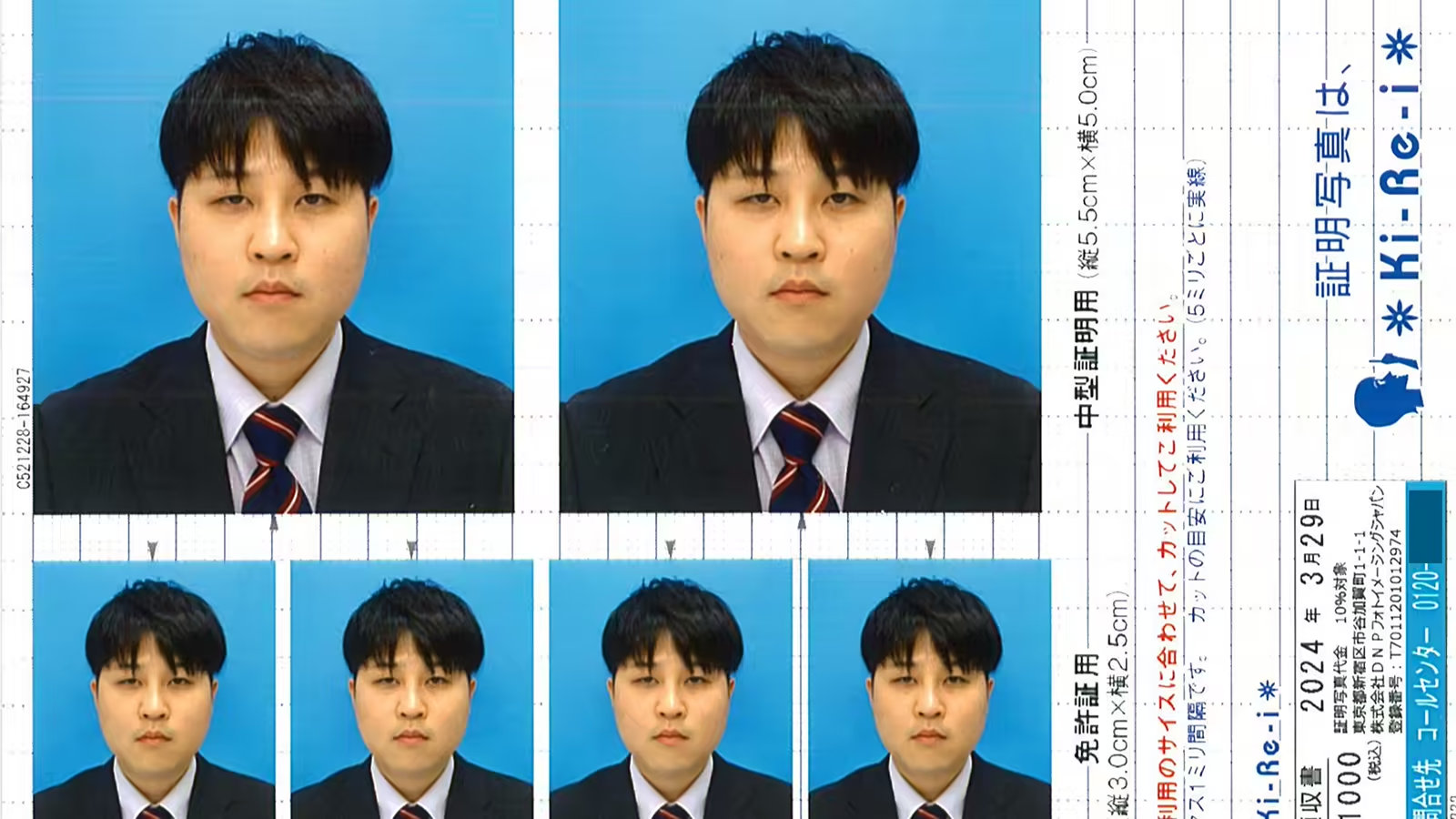

If you need the direct answer first, Canada visitor visa photos must be at least 35 mm x 45 mm, with your face measuring 31 mm to 36 mm from chin to crown, a neutral expression, and a plain white or light-coloured background. IRCC’s visitor-visa photograph sheet also says the photos must be identical, taken within the last 6 months, printed on quality photographic paper, and not digitally altered. That is the core of the current Canada visa photo requirements.
The part that confuses applicants is that Google results often mix up visitor visa photos, biometrics photos, and Canadian passport photos. They overlap on expression and lighting, but they do not use the same dimensions or the same workflow. This guide separates those rules, links each important number back to the live Canada.ca source, and shows you where applications usually go wrong. If you want the rest of your file around the photo, start with the full Canada Visitor Visa Checklist for 2026, the broader Canada Visitor Visa Checklist for 2026, or, for study-permit applicants, Documents Required for Canada Student Visa (2026).
| Check | What IRCC says now | Source |
|---|---|---|
| Visitor visa photo size | 35 mm x 45 mm minimum frame | Temporary Resident Visa application photograph specifications |
| Head height | 31 mm to 36 mm from chin to crown | Temporary Resident Visa application photograph specifications |
| Recency | Taken within the last 6 months | Temporary Resident Visa application photograph specifications |
| Number of photos | 2 identical photos, unless biometrics replace paper photos | IMM 5484 document checklist (Canada.ca) |
| Visitor visa fee | Starting from CAN$100 | Visitor visa overview |
| Biometrics fee | CAN$85 individual, CAN$170 family cap | How to give biometrics |
| Biometrics validity | Valid for 10 years for temporary residents | When to give biometrics |
Table of Contents
- Canada Visa Photo Requirements at a Glance
- Official Canada Visitor Visa Photo Specifications
- Do Not Confuse the Visa Photo with Passport Photos or Biometrics
- How to Get a Compliant Canada Visa Photo the First Time
- Common Canada Visa Photo Mistakes
- Official Sources
- FAQ
- Conclusion
Canada Visa Photo Requirements at a Glance
The current IRCC visitor-visa photo sheet is still the fastest way to brief your photographer. In one place, it says your Canada visa photo must:
- be 35 mm x 45 mm
- show a head height between 31 mm and 36 mm
- be taken within the last 6 months
- be either colour or black and white
- show your face square to the camera
- use a neutral expression with your mouth closed
- be taken against a plain white or light-coloured background
- be printed on quality photographic paper
IRCC also says you may wear non-tinted prescription glasses only if your eyes are clearly visible and the frames do not cover any part of your eyes. Sunglasses are not acceptable. Religious head coverings are allowed, but your full facial features still need to be visible.
The IRCC photo sheet itself includes examples of blurred, tilted, shadowed, and underlit shots, so it is worth showing that PDF to the studio instead of assuming they will automatically know the visitor-visa crop.
If your photo is the only part you want to isolate before checking the rest of the package, keep this guide open beside the broader Canada visitor visa checklist. The checklist covers the whole file, while this article stays focused on the photograph itself.
Official Canada Visitor Visa Photo Specifications
The official temporary resident visa application photograph specifications page is the primary public source for Canada visitor visa photos. These are the details most applicants need to quote exactly.
Size and head measurement
IRCC says the frame size must be at least 35 mm x 45 mm. The face, measured from chin to crown, must be 31 mm to 36 mm. That head measurement matters because many studios get the outer paper size right but still crop the face too small.
Background and lighting
The background must be plain white or light-coloured, and the photograph must be clear, well defined, and free of shadows. If the background is textured, grey in patches, or darker around the ears, you are already outside the official spec.
Expression and posture
Your face must be square to the camera, with a neutral expression, mouth closed, and the full front view of your head visible. IRCC’s examples explicitly reject blurred images, tilted heads, non-neutral expressions, shadows on the face, and underlit or overlit shots.
Glasses, head coverings, and digital edits
You may wear non-tinted prescription glasses only if your eyes remain clearly visible and there is no glare or frame obstruction. Sunglasses are not accepted. Head coverings worn for religious reasons are permitted, but they cannot hide facial features. If your photo is digital, IRCC says it must not be altered in any way.
How many photos to prepare
The official IMM 5484 document checklist tells applicants to provide two photos and then adds one important note: if you are required to provide biometric fingerprints and a biometric photo, you do not need to include paper photos with the application. That is one of the most useful small details in the whole process.
Practical takeaway: when you visit a photographer, bring the IRCC photo sheet, ask for two identical prints, and ask for an unaltered digital copy of the same shot in case your visa office or upload workflow asks for it. That last point is an inference from IRCC’s online-application flow plus the photograph sheet, not a separate pixel spec that IRCC publishes for visitor visas.
If you are checking the rest of the package at the same time, how to prepare visa application documents is the best companion guide.
Do Not Confuse the Visa Photo with Passport Photos or Biometrics
This is the biggest point of confusion in the current SERP. Canada uses different photo rules for different workflows.
| Workflow | What it is | Key spec or rule | Why people mix it up |
|---|---|---|---|
| Visitor visa photo | The photograph tied to your temporary resident visa application | 35 mm x 45 mm, face 31 mm to 36 mm, 2 photos unless biometrics replace paper photos | Search results often call this a “Canada visa photo” without explaining the paper-photo geometry |
| Biometrics photo | The live photo collected with fingerprints at an official collection site | Paid separately in many cases; CAN$85 individual or CAN$170 family cap | Applicants assume this appointment means they can ignore the application photo rules |
| Canadian passport photo | A different document workflow entirely | 50 mm x 70 mm for printed passport photos | Many photo studios know passport sizes better than visa sizes and give the wrong crop by default |
| Online passport digital photo | Only for Canadian passport renewals done online | 3:2 aspect ratio, 1,800 x 1,200 to 4,500 x 3,000, 200 KB to 5 MB | People wrongly apply these digital passport numbers to visitor visa uploads |
The official passport photo requirements page is explicit that Canadian passport photo requirements are different from those of other countries and uses 50 mm x 70 mm for printed passport photos. For online passport renewals, the same page lists a separate digital range of 1,800 x 1,200 to 4,500 x 3,000 pixels with a 3:2 aspect ratio. Those numbers are for passport renewals, not for a visitor visa.
If you are preparing both Canada and Australia files in the same season, do not reuse the Canadian 35 mm x 45 mm crop for subclass 600. Australia's visitor route is better read through the Australian Tourist Visa Photo Requirements (2026), which explains the wider 35-40 mm by 45-50 mm frame and the Home Affairs digital JPEG rules.
On the biometrics side, IRCC’s who needs to give biometrics and how to give your fingerprints and photo pages say most visitor-visa applicants need biometrics unless exempt, that children under 14 and applicants over 79 are exempt in most temporary-residence cases, and that biometrics are valid for 10 years for temporary residents who already gave them.
Australia is another route people often mix into this workflow. The official Australian print range is 35-40 mm by 45-50 mm, not Canada’s fixed 35 mm x 45 mm, so use the dedicated Australian tourist visa photo requirements guide instead of reusing a Canada crop.
IRCC links this biometrics explainer from its biometrics guidance. Use it to understand the appointment workflow, not to size your application photo:
How to Get a Compliant Canada Visa Photo the First Time
The safest route is still to use a professional studio or booth, but you need to brief them correctly. Many photographers will default to the Canadian passport size unless you tell them this is a visitor visa photo.
Tell the photographer these exact numbers
Show them the official IRCC visa photo sheet and say:
- This is for a Canada visitor visa, not a passport.
- The photo must be 35 mm x 45 mm.
- The face must measure 31 mm to 36 mm.
- The background must be plain white or light-coloured.
- The expression must be neutral, with the face square to the camera.
- The photo must be taken within the last 6 months and left unaltered.
Check the shot before you leave the studio
Before you pay, look for the failure points IRCC lists on its examples:
- tilted head
- shadow behind the ears
- glare on glasses
- face too small
- background disturbance
- smile or non-neutral expression
This illustrative image is not an IRCC government source, but it is a useful visual example of the kind of straight, centered white-background setup that helps you stay within the visitor-visa photo spec.
Be careful with online uploads
IRCC’s current steps to apply for a visitor visa says most applicants should apply online and upload documents. That does not mean you should switch to the Canadian passport digital-photo crop. Keep the visitor-visa geometry unless your visa office explicitly gives you a different instruction.
For a visual walkthrough of framing, background, and upload prep, this third-party tutorial is useful. It is not official IRCC guidance, so use it only as a practical visual companion and let the IRCC PDF win if the two ever differ.
If you want a second set of eyes on the entire package, not just the image, review how Vidicy works before you submit.
Common Canada Visa Photo Mistakes
Most Canada visa photo rejections come from small execution errors, not from mysterious consular discretion.
| Mistake | Why it fails | Safer fix |
|---|---|---|
| Using the Canadian passport size | Passport photos are 50 mm x 70 mm, not 35 mm x 45 mm | Tell the photographer this is a visitor visa photo and show the IRCC visa PDF |
| Making the face too small | IRCC requires 31 mm to 36 mm chin-to-crown | Measure the preview before printing |
| Using a patterned or dark background | IRCC requires a plain white or light-coloured background | Retake against a flat, bright background |
| Smiling or tilting your head | IRCC requires a neutral expression and a square pose | Retake with your mouth closed and face straight to camera |
| Wearing tinted lenses | Sunglasses and tinted glasses are not accepted | Remove them or use clear prescription lenses with no glare |
| Editing the image | IRCC says digital photos must not be altered | Do not retouch shadows, skin, or background in software |
| Using an old photo | The photo must be within the last 6 months | Retake it close to your application date |
| Sending paper photos when biometrics replace them | The checklist says biometrics can remove the paper-photo requirement | Check your current instruction letter before mailing extras |
The strongest way to avoid those mistakes is to treat the photo as part of the full application story. If the rest of your file is still messy, read Why Visa Applications Get Rejected: 7 Document Mistakes before you upload anything.
Official sources
- Temporary Resident Visa application photograph specifications
- Visitor visa (temporary resident visa)
- Steps to apply for a visitor visa
- How to apply for a visitor visa
- IMM 5484 document checklist (Canada.ca)
- Who needs to give their biometrics
- How to give your fingerprints and photo
- When to give biometrics for temporary residence
- Passport photo requirements
Related guides
If you're building the rest of the application pack, these companion guides help:
- Visa photo requirements (2026): size, pixels, background
- US visa photo requirements (2026): size, rules, upload
- Canada Visitor Visa Checklist for 2026
- Canada Visitor Visa Checklist for 2026
FAQ
What size is a Canada visitor visa photo?
IRCC’s visitor-visa photo sheet says the frame must be at least 35 mm x 45 mm, and the face must measure 31 mm to 36 mm from chin to crown. That is the current official Canada visitor visa photo size.
Can I wear glasses in a Canada visa photo?
Yes, but only if they are non-tinted prescription glasses, your eyes are clearly visible, there is no glare, and the frame does not cover any part of your eyes. Sunglasses are not accepted.
Do I still need paper photos if I have to give biometrics?
Not always. The live IMM 5484 checklist says that if you are required to provide biometric fingerprints and photo, you are not required to include paper photos with the application. Check the latest instruction tied to your route before you submit.
Is a Canada passport photo the same as a Canada visa photo?
No. The printed Canadian passport photo is 50 mm x 70 mm, while the visitor-visa photo uses 35 mm x 45 mm. The passport page’s digital 3:2 upload specs are also a separate workflow for online passport renewals, not for visitor visas.
How long are Canada biometrics valid?
For temporary-resident applications such as a visitor visa, IRCC says biometrics are valid for 10 years if you already gave them during that period. That does not change the basic visa-photo rules, but it can change whether you need another biometrics appointment.
Who is exempt from biometrics for a Canada visitor visa?
IRCC’s biometrics pages say children under 14 and applicants over 79 are exempt in most temporary-resident cases. There are also other exemptions, such as certain diplomatic and transit situations, so always check the live IRCC list for your case.
Conclusion
The simplest way to remember the Canada visa photo requirements is this: 35 mm x 45 mm, 31 mm to 36 mm face height, neutral expression, plain light background, and no digital retouching. Once you stop mixing those numbers with the larger Canadian passport-photo format, the whole process gets easier.
If you want a final review before you upload the rest of your Canada file, use the route-specific Canada visitor visa checklist, then start a Vidicy review once the photo and supporting documents are ready.