


If you need proof of funding for visa applications, start with this direct answer: most embassies are not checking one magic bank-balance number. They are checking whether your money is available, lawful, recent, and believable for the trip or study plan. Depending on the route, proof can include bank statements, salary slips, employment letters, sponsor evidence, prepaid accommodation, financial-aid letters, or a formal host guarantee.
The official rules prove the point. Canada asks visitor applicants for bank statements with at least 6 months of account details. The UK Student route uses a 28-day funds rule and support amounts of GBP 1,529/month in London or GBP 1,171/month outside London for up to 9 months. The European Commission says Schengen applicants need supporting documents showing financial means and accommodation, while Belgium publishes short-stay reference amounts of EUR 45/day with a private host or EUR 95/day in a hotel. New Zealand publishes a clearer visitor benchmark: NZD 1,000/month, or NZD 400/month if accommodation is already paid.
That is why weak proof of funding is rarely just "not enough money." The usual problem is that the bank statement, sponsor letter, itinerary, employment proof, and application form do not tell the same story. If you want route-level prep first, start with Vidicy's visa document checklist hub, then use this guide to pressure-test the finance layer before you upload anything.
| Route example | Official funding signal | What it means for your file |
|---|---|---|
| Canada visitor visa | IRCC asks for bank name/contact, proof the account is yours, and at least 6 months of account details | Show a money pattern, not just a one-day balance |
| US B1/B2 visitor visa | State Department says additional evidence may include your ability to pay all costs of the trip | Funds matter, but ties abroad and trip purpose still matter too |
| UK Student visa | GOV.UK lists GBP 1,529/month in London or GBP 1,171/month outside London, held for 28 days | The required amount is formula-driven and tied to CAS/course costs |
| Schengen short stay | EU guidance requires evidence of financial means and accommodation; Belgium publishes EUR 45/day or EUR 95/day examples | The country and accommodation plan change the number |
| New Zealand visitor visa | Immigration New Zealand lists NZD 1,000/month, or NZD 400/month with prepaid accommodation | Prepaid accommodation can change the amount you need to show |
Table of Contents
- What proof of funding means in a visa file
- What documents count as proof of funding
- How much money do you need to show?
- Sponsor funding: when another person pays
- Bank statement red flags officers notice
- How to build a stronger funding packet
- Official sources
- FAQ
- Conclusion
What proof of funding means in a visa file
Proof of funding is the evidence that you can pay for the trip, study period, medical visit, family visit, or temporary stay you are asking a government to approve. It is sometimes called proof of funds, financial evidence, sufficient means, financial requirement, or evidence of ability to pay.
Those phrases do not always mean the same thing. For a visitor visa, funding usually proves that the trip is affordable and temporary. For a student visa, funding may be an eligibility requirement with a fixed formula. For a host-backed family visit, funding may be split between the applicant and the person inviting them.
The core question is the same across routes:
Can an officer understand where the money comes from, who controls it, what it will pay for, and why it matches the rest of the application?
That is why a clean bank statement can still fail if the itinerary is unrealistic, the sponsor story is vague, or the employment letter does not match salary deposits. Officers review the package as a whole. Applicants often review one PDF at a time.
If you are still building the rest of the file, pair this guide with Bank Statement for Visa: What Officers Check and Visa Application Documents: How to Prepare Them.
What documents count as proof of funding
The strongest proof of funding packet usually has a primary money document and a source-of-money explanation.
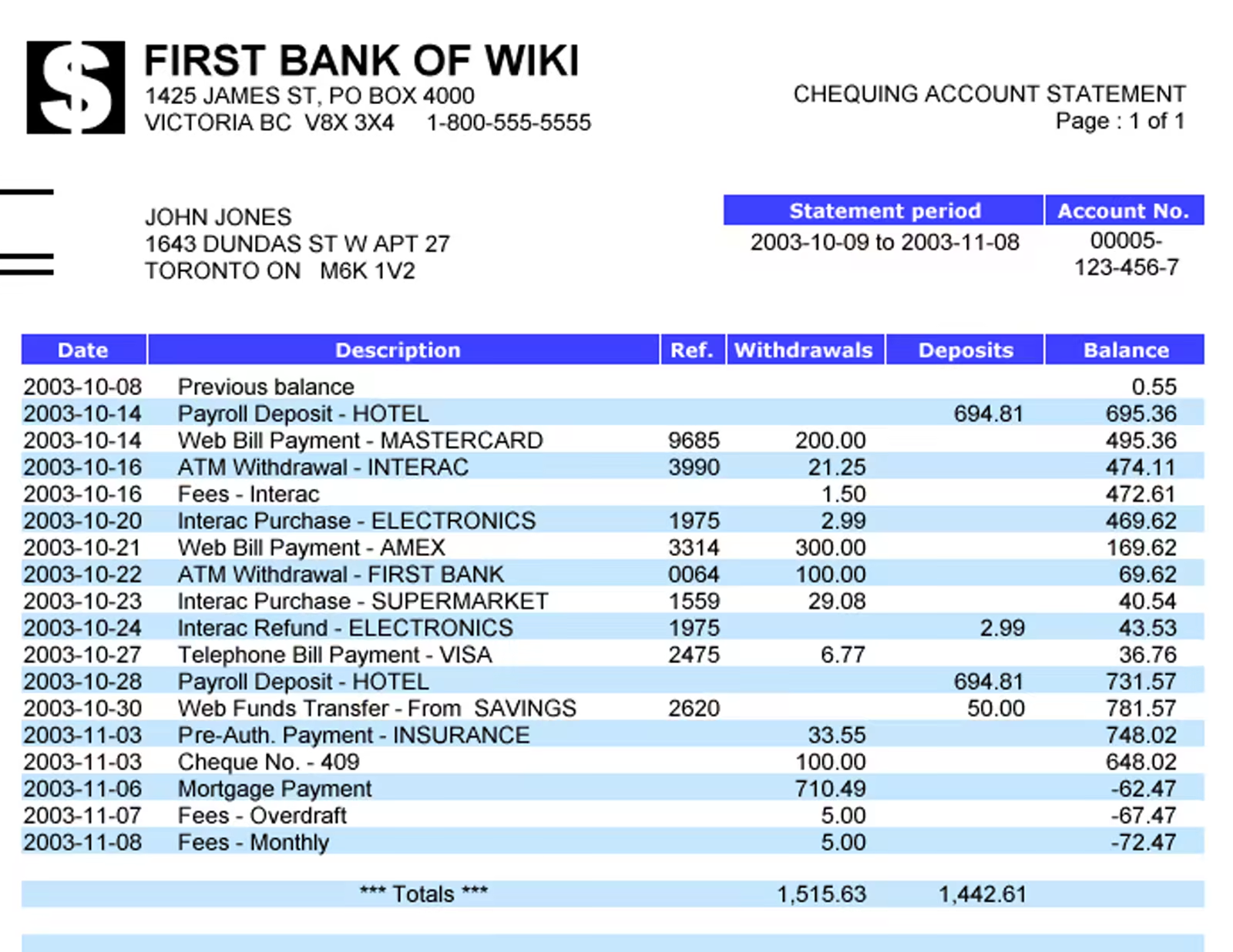
Primary financial documents
These documents show available money:
- bank statements
- bank balance letters or bank certificates
- savings account statements
- current account statements
- fixed deposit or term deposit letters, if the funds are accessible
- official loan sanction letters for study routes
- scholarship or financial sponsorship letters
- credit card or prepaid card evidence where the official route accepts it
Canada's official visitor visa apply page is unusually specific. IRCC says a bank account statement can help officers understand whether you have enough money to support yourself in Canada, and it asks for bank name/contact, proof the account is yours through your name and address, and at least 6 months of account details, including balances.
Schengen examples show a different framing. The European Commission says short-stay applicants need supporting documents relating to the purpose of stay, financial means, accommodation, and intention to return. Belgium's official short-stay page says proof may include cash, bank/credit/prepaid card access, or a formal obligation from a guarantor.
Source-of-money documents
These documents explain why the money is credible:
- employment letter with salary and leave approval
- payslips
- tax records
- business registration and business bank records
- property or rental-income records
- sponsor letter and sponsor bank statements
- scholarship, grant, or loan documents
- parental or partner consent where their account is used
The source document matters because a bank statement without context can look temporary. If a large deposit appears two weeks before submission, the officer needs a paper trail. If salary is the source, salary credits should broadly match the employment letter or payslips. If a parent, spouse, host, or school is paying, the relationship and payment responsibility should be documented.
How much money do you need to show?
There is no universal proof-of-funding number across all visa applications. The number depends on the country, route, applicant profile, stay length, accommodation, dependants, and whether a sponsor pays.
| Situation | How the amount is usually calculated | Risk if you guess |
|---|---|---|
| Short tourist visit | trip length, hotel or host stay, local costs, return travel | a balance that looks fine may be too thin for the itinerary |
| Student visa | tuition/CAS/I-20/course fees plus official living-cost formula | the file can fail even if the account looks healthy |
| Family visit | applicant funds plus host support and accommodation proof | the host promise may not be backed by documents |
| Medical visit | treatment quote, travel costs, living costs, payer evidence | ordinary travel funds may not cover the medical estimate |
| Sponsored trip | sponsor income, legal status, relationship proof, applicant ties | sponsorship can look like a weak promise rather than real funding |
For the US visitor route, the State Department says additional documents may be requested to establish the purpose of the trip, intent to depart, and ability to pay all costs of the trip. It also warns that applicants must qualify based on their own ties abroad, not merely assurances from US family and friends. That means a rich sponsor does not automatically solve a weak applicant story.
For Schengen, the European Commission gives the regional baseline, but country amounts still vary. Belgium lists EUR 45 per day for a person staying with friends or family and EUR 95 per day for a hotel stay. The same page says proof above the reference amount may be required if the purpose justifies it, such as a luxury tourist stay or medical treatment.
For New Zealand visitor visas, Immigration New Zealand gives a cleaner public benchmark: you must have at least NZD 1,000 per month, or NZD 400 per month if accommodation is already paid. The same page says evidence can include recent bank or credit card statements and proof of prepaid accommodation.
For UK students, GOV.UK is formula-driven. The Student visa money page says applicants need enough money for course fees for one academic year, up to 9 months, plus living costs. It currently lists GBP 1,529 per month in London and GBP 1,171 per month outside London, for up to 9 months. The money must usually be held for at least 28 days in a row, with the end date within 31 days of the application date.
The practical rule is simple: use the official formula when one exists. When no formula exists, calculate the real cost of the application and make the proof easy to verify.
Sponsor funding: when another person pays
Sponsor funding can help, but it also raises the evidence standard. The officer now has to understand two financial stories: the applicant's and the sponsor's.
For a sponsored or host-backed file, show:
- who the sponsor is
- the sponsor's legal status in the destination country, if relevant
- the relationship between applicant and sponsor
- exactly what the sponsor will pay for
- the sponsor's bank evidence or income evidence
- why the applicant still has a credible reason to return home
The cost split should be explicit. "My uncle will support me" is weak. "My uncle will provide accommodation at his home in Toronto from June 4 to June 18; I will pay my flights and daily expenses from my savings account" is easier to check.
That split is especially important for family visits. If you are visiting relatives in Canada, pair the funding story with Invitation Letter for Visitor Visa Canada. If you are using a host or sponsor for Schengen, compare the sponsor evidence against Schengen Visa Sponsor Letter: Rules + Sample. If your route is UK visitor, use Sponsor Letter for Visitor Visa UK before you finalize the wording.
The US route needs extra caution. The State Department says a letter of invitation or Affidavit of Support is not needed to apply for a visitor visa and is not one of the factors used to determine issuance. You can bring one if you choose, but the applicant still has to qualify under the route rules.
Bank statement red flags officers notice
Most funding problems are not dramatic. They are small inconsistencies that make the money story hard to trust.
1. Large unexplained deposits
A sudden deposit right before filing can look borrowed or staged. If the money is legitimate, explain it with a document: sale agreement, bonus letter, tax refund, family transfer note, business invoice, or scholarship letter.
2. Statement period is too short
If the official route expects multiple months, one screenshot is not enough. Canada asks for at least 6 months of account details for visitor visa bank statements. UK student money must usually be held for 28 days. Schengen country checklists often expect recent statements and movement history.
3. Account holder is unclear
The account name should be visible. If the money belongs to a parent, partner, host, school, employer, or sponsor, document the relationship and permission to use the funds.
4. Salary and deposits do not match
If the employer letter says one salary but the deposits show a different pattern, the officer may doubt both. Self-employed applicants should be especially careful to connect business income, tax records, and personal account transfers.
5. Trip cost is unrealistic
A six-week hotel trip needs a different budget from a ten-day stay with family. A high balance can still look weak if flights, hotels, tuition, medical costs, dependants, or internal travel are not accounted for.
6. Sponsor evidence replaces the applicant's own story
Sponsor support does not remove the need to show temporary intent, ties, and coherent travel plans. This is one of the quiet reasons sponsor-heavy files can still feel weak.
IRCC's official "Save Time: Send a Complete Application" video is not only about money, but it is useful because it explains why missing or wrong supporting documents delay applications. The Canada.ca transcript specifically lists financial statements among supporting documents and warns applicants to use the checklist and avoid substitutes.
How to build a stronger funding packet
Use this sequence before you upload anything.
Step 1: Find the official rule for your exact route
Start with the government page, not a forum number. A Canada visitor file, UK student file, US visitor interview, Schengen private visit, and New Zealand tourist stay all use different funding logic.
Step 2: Calculate the actual cost story
Write the expected cost in plain language:
- visa fee and service fees
- flights or onward travel
- hotels or host accommodation
- daily living costs
- tuition or course fees
- insurance
- dependants
- medical or special-purpose costs
- buffer for delays
Step 3: Match each cost to evidence
Do not make the officer infer everything. If you pay, show your statements. If a sponsor pays, show their documents. If accommodation is prepaid, show proof. If a host provides accommodation, show the host letter or official host form where required.
Step 4: Explain unusual money movement
Large deposits, account transfers, business income, and sponsor payments need a clean paper trail. A short cover note can help, but only if the documents behind it are real and consistent.
Step 5: Compare the funding packet against the rest of the file
This is where many applicants miss the problem. Compare:
- bank statements against employment letters
- sponsor letter against host ID and address proof
- itinerary against available funds
- study funding against CAS, I-20, scholarship, or tuition documents
- form answers against the documents uploaded
If you want software to do that last consistency pass, Vidicy's how it works page explains the checklist, upload, evaluation, and Atlas workflow. You can start with a free checklist when your documents are ready.
Official sources
- U.S. Department of State: Visitor Visa
- Canada.ca: how to apply for a visitor visa
- GOV.UK: visit visa supporting documents
- GOV.UK: Student visa money you need
- GOV.UK: financial evidence for Student and Child Student route applicants
- European Commission: applying for a Schengen visa
- Belgian Immigration Office: reference amounts for short stay
- Immigration New Zealand: Visitor Visa
- Canada.ca: Save Time, Send a Complete Application video source page
Image credits
- Hero and inline bank-statement image: BankStatementChequing.png by Sergio Ortega on Wikimedia Commons, licensed under CC BY-SA 3.0 and GFDL on the file page.
- Passport stamp image: Canada passport stamp by Karl Baron on Wikimedia Commons, licensed under CC BY 2.0 on the file page.


FAQ
Is proof of funding the same as proof of funds?
Usually yes in everyday search language. Some official pages say financial evidence, sufficient means, ability to pay, or proof of funds. In practice, all of these point to the same question: can you document enough lawful, available money for the stay or study plan?
How many months of bank statements do I need for a visa?
It depends on the route. Canada visitor guidance asks for at least 6 months of account details. UK student funding usually uses a 28-day holding rule. Schengen and other visitor routes vary by country and consulate checklist. Always follow the exact official route page.
Can a sponsor replace my own bank statement?
Sometimes a sponsor can cover part or all of the cost, but the sponsor needs evidence too. You usually need their identity, relationship to you, legal status where relevant, financial documents, and a clear statement of what they will pay. Your own temporary-visit story still matters.
Do large deposits cause visa refusals?
Large deposits do not automatically cause refusal, but unexplained deposits can weaken the file. If the money came from a salary bonus, sale, gift, business payment, loan, or family transfer, attach the document that proves the source.
Is there a fixed bank balance for all visa applications?
No. Some routes publish formulas or reference amounts, such as UK student living costs or New Zealand visitor funds. Others, such as regular Canada visitor visas or US B1/B2 visas, focus on whether the full trip story is affordable and credible.
What is the safest proof-of-funding format?
Use official bank-issued PDFs or statements that show your name, bank name, account details, statement period, balances, and transaction history. Add source-of-money documents like payslips, employment letters, tax records, sponsor documents, or scholarship letters when they explain the funds.
Conclusion
The strongest proof of funding for visa applications is not the biggest balance. It is the clearest money story. Show who controls the funds, where they came from, how long they have been available, what they will pay for, and how they match the rest of the application.
Before you submit, compare your bank statements, sponsor evidence, itinerary, employment proof, and forms together. If one document tells a different story, fix that mismatch before the officer finds it. For a route-level starting point, use Vidicy's visa checklist pages, then create an account to review the full document pack before submission.