



A visa rejection risk checker is a pre-submission review that asks a stricter question than "Do I have the documents?" It checks whether your file actually looks approvable based on the signals official visa pages repeat: trip purpose, ability to pay, intent to return home, document completeness, and consistency across forms. It cannot guarantee approval, but it can surface the patterns that lead to refusals, delays, or extra scrutiny before you pay another fee.
According to the current official pages from the U.S. Department of State, GOV.UK, Canada.ca, the European Commission, and Australia's Department of Home Affairs, incomplete or weakly evidenced visitor files still get refused, delayed, or sent back for more information. That means the safest time to run a visa rejection risk checker is before you book non-refundable travel and definitely before you submit the final pack.
If you want a route-specific starting point first, use Vidicy's Schengen visa checklist, US visa document checklist, or the broader travel visa checker guide. If your file is already assembled, move straight to Get Rejection-Risk Review.
At a glance
| Risk area | What official sources keep checking | Why it raises rejection risk |
|---|---|---|
| Trip purpose | Why you are travelling, what you will do, and whether the itinerary supports that story | A vague or contradictory purpose makes the case look speculative |
| Financial credibility | Whether you can pay for the trip and where the money comes from | Sudden deposits or weak statements make the case look unstable |
| Return-home ties | Job, family, study, property, or other reasons you must leave after the trip | Weak ties increase overstay concerns |
| Completeness | Whether all required forms, supporting records, and identity details are present | Incomplete packs are often delayed or refused before deeper review |
| Technical compliance | Photo rules, translation rules, timing windows, and route-specific formats | A file can be genuine and still fail a technical rule |
Key takeaways
Use this guide to verify the route, evidence, and next action before you finalize the file. A rejection-risk review should test contradictions, weak funds, unclear purpose, missing ties, unsupported sponsorship, and document quality before submission.
Table of Contents
- What a visa rejection risk checker should score
- The 5 official refusal signals to test first
- Country-by-country warning signs from official pages
- A simple 10-point self-check before you submit
- What AI catches that manual review misses
- Official video walkthroughs
- Official sources
- FAQ
- Conclusion
What a visa rejection risk checker should score
The best risk checkers do not predict embassy behavior like a magic number. They pressure-test the same signals the official pages already tell you officers care about.
That is why a useful checker should score the file in layers:
- Eligibility layer: Are you in the correct route, and do you meet the basic rules?
- Evidence layer: Did you upload the right kind of documents for that route?
- Consistency layer: Do the names, dates, finances, and itinerary match across the whole pack?
- Credibility layer: Does the file tell one believable story about why you are travelling and why you will leave?
Many applicants only check layers one and two. That is not enough. A file can be technically complete and still look risky once an officer compares the documents side by side.
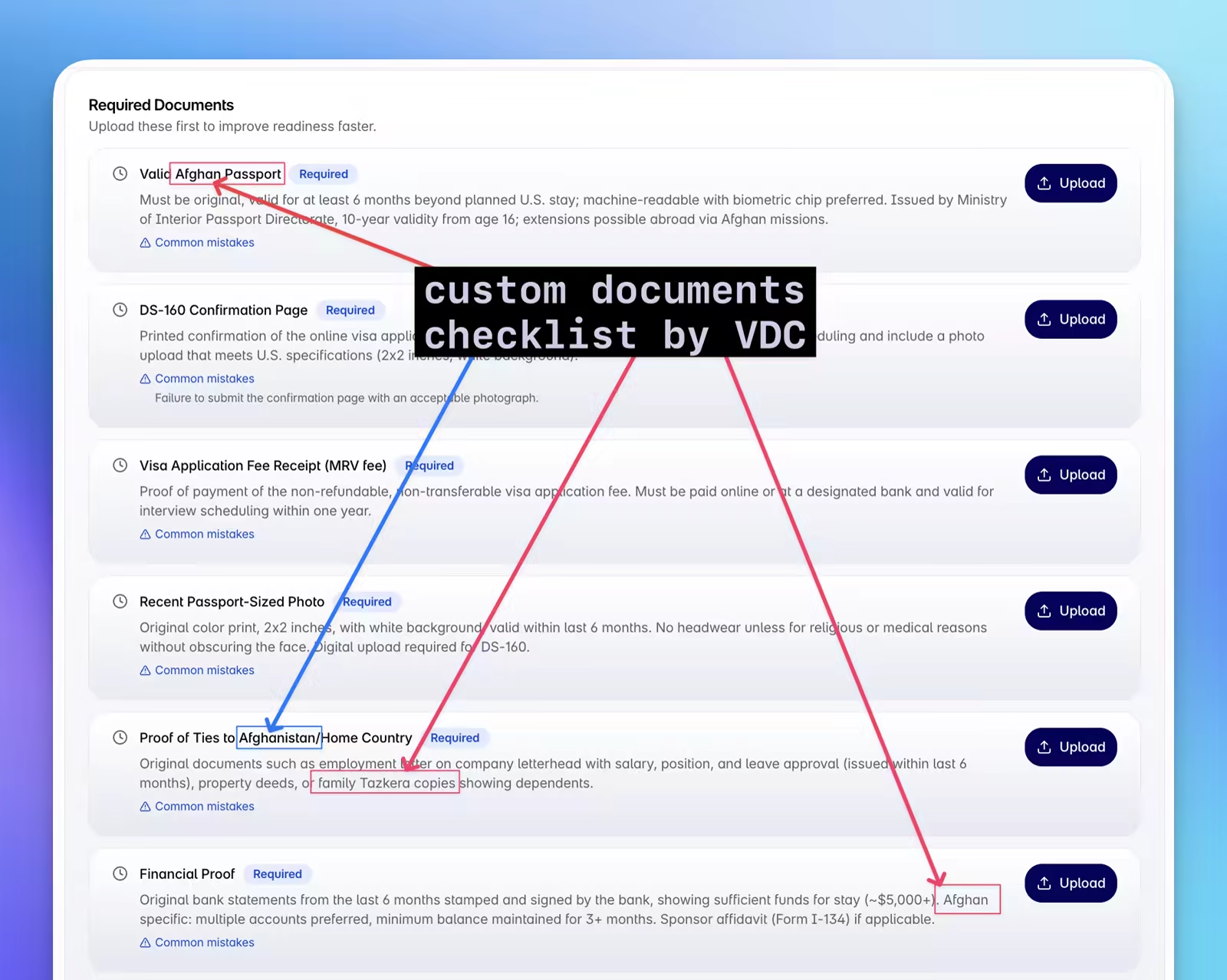
This is also why a document checklist and a rejection-risk review are not the same thing. A checklist asks whether something is present. A risk checker asks whether the full application would still make sense to a skeptical reviewer.
If you are still building the upload pack from scratch, use the route baseline first. Vidicy's How It Works page explains how the checklist, evaluation, and Atlas stages fit together. The avoid visa rejection guide is the better companion once the documents already exist and you are trying to reduce refusal risk before filing.
The 5 official refusal signals to test first
1. Purpose of travel and itinerary logic
Official pages across countries still start with the same question: why is this trip happening, and do the documents prove it?
The current U.S. visitor-visa page says officers may request additional evidence of:
- the purpose of the trip
- the applicant's intent to depart after the trip
- the applicant's ability to pay all costs
The European Commission's Schengen page says applicants must show documents relating to the purpose of the stay, accommodation, financial means, and evidence of the intention to return to the home country after the stay.
That means your itinerary has to line up with the reason you gave. A tourism file with no accommodation plan, a family-visit file with no host context, or a business file with vague dates will all score higher risk than applicants usually expect.
2. Money, source of funds, and cost realism
Financial evidence is not just about the closing balance. It is about whether the money story is believable.
The UK Visitor rules say an applicant must have sufficient funds to cover reasonable visit costs, including return or onward travel. The supporting-documents guide also recommends bank statements that show the origin of the funds held. That is a useful clue for any risk checker: sudden unexplained deposits are not neutral.
Canada's current visitor-visa flow is also clear that the document list changes by travel reason and that you should submit only the documents that actually prove eligibility. In practice, that means bloating the file with random PDFs does not reduce risk if the core bank evidence is still weak.
3. Return-home ties
This is where many visitor cases rise or fall.
The U.S. State Department's visa-denials page explains that a refusal under INA 214(b) means the applicant did not overcome the presumption of immigrant intent. The same official page gives examples of strong ties: your job, your home, and your relationships with family and friends.
Australia's Home Affairs page uses similar logic in plain language. It tells applicants to show they intend to return home and suggests evidence like a current payslip, an employer leave letter, an enrolment certificate, or children's birth certificates.
If your file has almost no return-home evidence, a risk checker should not score it as safe just because the passport and bank statement are present.
4. Completeness and form accuracy
Some refusals happen before the officer even gets to the harder credibility questions.
Canada's official "After you apply" page says IRCC checks whether you have all the documents you need and that if it's incomplete, your application may be refused. The same visitor-visa workflow also highlights travel history in the last 10 years as a useful supporting signal for many visitor cases.
Australia's visitor page says that if your application has all the information and documents the department needs, you will get a faster outcome. That does not mean every complete file is approved. It does mean incomplete files start with avoidable friction.
5. Technical route rules
Technical compliance is where applicants underestimate risk.
The Schengen rules set real timing constraints: you must normally apply at least 15 days before travel and no earlier than 6 months beforehand. The current official page also says the normal processing time is 15 days, but it may be extended to 45 days.
The UK Standard Visitor page requires certified translations for documents that are not in English or Welsh. Australia's visitor page likewise requires English translations and asks for translator details when the translator is outside Australia. These are not cosmetic requirements. A strong file can still get slowed down or weakened if these technical rules are ignored.

Country-by-country warning signs from official pages
The reason a visa rejection risk checker is useful is that each country phrases risk differently, even when the underlying concern is the same.
United Kingdom
The current GOV.UK Standard Visitor application page says:
- the earliest you can apply is 3 months before travel
- the standard fee is GBP 135
- the usual published decision time is 3 weeks
The current supporting-documents guide is even more revealing for risk scoring. It recommends evidence of personal circumstances, employment, and funding, but it also lists weaker evidence types that are less useful in visit applications, including:
- hotel bookings
- flight bookings unless you are transiting
- personal photographs
- travel insurance
That matters because many low-quality visa guides tell applicants to pile on weak attachments. A better risk checker will score the file based on strong evidence, not on sheer document count.
Canada
Canada's current visitor-visa pages give several concrete numbers that help with risk assessment:
- visitor-visa fee starts at CAN$100
- a visitor visa may be valid for up to 10 years
- most visitors can stay for up to 6 months
The more important signals are procedural:
- not all listed documents are required
- the list is not exhaustive
- there is no guarantee the application will be approved even if listed documents are submitted
- if the file is incomplete, it may be refused
That is a useful design rule for any checker. Canada does not reward random over-uploading. It rewards relevant, route-matched evidence.
Schengen
The Schengen short-stay framework is one of the clearest systems to score because the European Commission states the main evidence categories directly:
- purpose of stay
- financial means
- accommodation
- intention to return home
The current adult fee is EUR 90, and the normal processing time is 15 days, extendable to 45 days. If your travel window is already tight, the risk is not only refusal. It is also mistiming.
If you are filing into this route, pair a risk review with the route baseline in the Schengen visa checklist.
United States
The current U.S. non-petition visitor-visa fee is USD 185. The visitor-visa page says the officer may request proof of trip purpose, intent to depart, and ability to pay. It also says a letter of invitation or Affidavit of Support is not needed to apply for a visitor visa and is not one of the decisive factors in whether a visa is issued or denied.
That is a strong reminder that a risk checker should focus more on the applicant's own story and evidence than on decorative invitation templates.
The visa-denials page adds the clearest refusal logic: officers look at the applicant's individual circumstances, travel plans, financial resources, and ties outside the United States. If your U.S. visitor file still depends more on a host promise than on your own documents, your risk score should be high.
Australia
Australia's current visitor guidance is explicit about what a "decision-ready" file looks like. Home Affairs tells applicants to:
- use a clear passport copy
- make sure the spelling matches the passport exactly
- provide all previous or current names
- explain the reason for travel and itinerary
- show reasons to return home
- include recent bank statements
- submit English translations where needed
That is almost a ready-made risk-check rubric. It is less about one magic document and more about whether identity, purpose, funds, and return-home evidence all line up cleanly.
If your route is Australia-specific, use the Australia visa checklist before you submit the final pack.
A simple 10-point self-check before you submit
You do not need a perfect mathematical model to catch obvious refusal risk. A simple 0 to 2 score across five categories is usually enough to tell whether the file still needs work.
| Category | 0 points | 1 point | 2 points |
|---|---|---|---|
| Purpose and itinerary | Purpose is vague or documents conflict | Purpose is clear but lightly documented | Purpose is clear and fully supported |
| Finances | Funds are weak, recent, or unexplained | Funds are adequate but need explanation | Funds are stable, traceable, and proportionate |
| Return-home ties | Almost no tie evidence | Some ties exist but are thin | Employment, family, study, or property ties are strong |
| Completeness and consistency | Missing forms or conflicting details | Complete but still needs one more pass | Complete and internally consistent |
| Technical compliance | Timing, photo, or translation issues remain | Minor technical uncertainty | Route timing and technical rules are fully met |
Use the total like this:
- 0 to 3: high refusal risk, do not submit yet
- 4 to 6: medium risk, rebuild the weak sections first
- 7 to 8: decent file, but still worth a final review
- 9 to 10: strong submission posture, though never a guarantee
This is where the difference between a checklist and a risk checker becomes obvious. A file can earn full points for completeness and still lose points on trip logic, funding quality, or ties to home.
If your file scores below 7, fix the weak category instead of rushing. The next best companion read is How to Catch the Hidden Document Errors That Reject Visa Applications, because many medium-risk files are really consistency problems in disguise.
What AI catches that manual review misses
Manual review is still necessary, but it has one obvious weakness: applicants already know what the documents were supposed to say.
That makes it easy to miss:
- a salary figure in the employment letter that does not match deposits
- a date mismatch between the form and the booking
- a sponsor explanation that is weaker than the bank evidence
- a name variation across old travel records and new documents
An AI-driven visa rejection risk checker is most useful when it compares the documents against each other instead of reading them one at a time. That is the gap between "all files uploaded" and "this case is actually ready."
It also helps with document prioritization. For example:
- the UK guidance says hotel bookings are usually weak evidence
- the U.S. guidance says invitation letters are not decisive
- Canada's guidance says not all listed documents are required
So the better question is not "Can I upload more?" It is "Do the uploads I already have actually reduce risk?"
If you want the route-aware version of that workflow, go from How It Works to Get Rejection-Risk Review. If you have already had one refusal, read If My Visa Is Rejected, Can I Apply Again? before you resubmit the same weak file.
Official video walkthroughs
The UKVI visitor-visa walkthrough below is linked from GOV.UK's official publication page for the UK visitor-visa video. It is useful if you want to re-check the application flow before you submit:
The Australian Department of Home Affairs publishes the overview below on its official YouTube channel. It is older than the current web guidance, but it is still a useful orientation piece for visitor-route applicants:
Canada's official video page is also worth reviewing for document hygiene before you lodge: Save Time: Send a Complete Application.
Official sources
- GOV.UK Standard Visitor application page: https://www.gov.uk/standard-visitor/apply-standard-visitor-visa
- GOV.UK supporting-documents guide: https://www.gov.uk/government/publications/visitor-visa-guide-to-supporting-documents/guide-to-supporting-documents-visiting-the-uk
- GOV.UK Visitor rules: https://www.gov.uk/guidance/immigration-rules/immigration-rules-appendix-v-visitor
- Canada.ca visitor visa overview: https://www.canada.ca/en/immigration-refugees-citizenship/services/visit-canada/visitor-visa.html
- Canada.ca visitor visa about page: https://www.canada.ca/en/immigration-refugees-citizenship/services/visit-canada/about-visitor-visa.html
- Canada.ca visitor visa application page: https://www.canada.ca/en/immigration-refugees-citizenship/services/visit-canada/apply-visitor-visa.html
- Canada.ca visitor visa post-submission page: https://www.canada.ca/en/immigration-refugees-citizenship/services/visit-canada/after-apply-next-steps.html
- Canada.ca official application-completeness video page: https://www.canada.ca/en/immigration-refugees-citizenship/news/video/save-time-send-complete-application.html
- U.S. Department of State visa-fee page: https://travel.state.gov/content/travel/en/us-visas/visa-information-resources/fees/fees-visa-services.html
- U.S. Department of State visitor-visa page: https://travel.state.gov/content/travel/en/us-visas/tourism-visit/visitor.html
- U.S. Department of State visa-denials page: https://travel.state.gov/content/travel/en/us-visas/visa-information-resources/visa-denials.html
- European Commission Schengen visa page: https://home-affairs.ec.europa.eu/policies/schengen/visa-policy/applying-schengen-visa_en
- Australian Department of Home Affairs visitor-visa page: https://immi.homeaffairs.gov.au/check-twice-submit-once/visitor-visa
FAQ
Can a visa rejection risk checker guarantee approval?
No. It can reduce document-level risk, but it cannot control interview performance, discretionary judgments, background issues, or route changes after submission. The honest value is early error detection, not a promise.
What creates the highest rejection risk in visitor cases?
The biggest patterns are weak trip purpose, unstable or unexplained funds, limited return-home evidence, cross-document inconsistencies, and technical non-compliance. Official pages across the UK, U.S., Canada, Schengen, and Australia all keep returning to those same themes.
Is an invitation letter enough to make a risky file safe?
Usually not. The U.S. State Department explicitly says a letter of invitation or Affidavit of Support is not needed for a visitor visa decision. In the UK, sponsor evidence helps, but hotel bookings and other comfort documents are still weaker than strong financial and personal-circumstances evidence.
When should I run the risk check?
Run it once the file is mostly assembled but still editable. Then run it again after every major fix, especially if you changed dates, bank evidence, sponsor proof, or the trip explanation.
What score is good enough to submit?
A score of 7 or higher out of 10 is a sensible threshold for a self-check, but even strong files still need a final human review. If you are below that threshold, the better move is to fix the weak category before paying another fee.
Conclusion
A strong visa rejection risk checker does more than count documents. It tests whether your trip purpose, finances, return-home ties, identity details, and route-specific rules all point in the same direction before you submit.
The official pages are consistent on the core signals: the UK still tests genuine-visitor logic and funds, Canada can refuse incomplete visitor files, Schengen still requires purpose-plus-funds-plus-return evidence, the U.S. still checks purpose and ties, and Australia still pushes applicants toward decision-ready files with exact passport details and supporting proof.
If your score is weak, fix the file before you spend another USD 185, CAN$100, GBP 135, or EUR 90. If the pack is ready and you want a final route-aware review, move from travel visa checker to Get Rejection-Risk Review.