



A sponsor letter for tourist visa applications is a host-side document that explains who is inviting you, where you will stay, what costs the sponsor will cover, and which documents prove that promise. It only works as supporting evidence. According to UKVI, sponsor evidence should show what support is being provided, how, the relationship, and that the sponsor is legally in the UK. Canada says a letter of invitation does not guarantee a visa. Australia says applicants visiting family or friends should include a host letter, and in some cases the Department can require Form 1149. The U.S. State Department is the big exception: for normal B-2 cases, a letter of invitation or Affidavit of Support is not needed and is not one of the factors used to issue or deny the visa.
That difference is exactly why so many search results get this topic wrong. A tourist-visa sponsor letter is not a single global template. The format changes by route, but the same rule holds everywhere: the letter must match the passport, trip dates, funds, accommodation plan, and the applicant’s return-home evidence. If you want the full file checked after the letter is drafted, start with Vidicy’s How It Works page and then run the whole pack through a structured review before you submit.
| Country | What officials call it | What the sponsor letter really does | Current official numbers |
|---|---|---|---|
| UK | Sponsor evidence / invitation letter | Supports travel, maintenance, or accommodation claims in a Standard Visitor file | GBP 135 fee, 6 months max stay, apply 3 months early, usually 3 weeks for a decision |
| Canada | Letter of invitation | Explains who is inviting the visitor, how long they will stay, where they will stay, and how costs will be covered | Visitor visa $100, biometrics $85 per person or $170 per family, visa may be valid up to 10 years, stay usually up to 6 months |
| Australia | Invitation letter / Form 1149 in sponsored cases | Shows the host relationship and, for sponsored-family cases, who is legally undertaking the sponsorship | Sponsor must be 18+, an Australian citizen or permanent resident, and settled in Australia; security bond usually AUD 5,000 to AUD 15,000 if requested |
| United States | Sponsor funding evidence only | May help show who pays, but does not replace the applicant’s own ties abroad | B visitor visa fee $185; invitation letters and Affidavits of Support are not needed for the application decision |
Table of Contents
- What a sponsor letter for tourist visa applications actually does
- Sponsor letter for tourist visa sample
- What the sponsor should attach with the letter
- Country-by-country rules: UK, Canada, Australia, and the U.S.
- Mistakes that make sponsor letters look weak
- Official sources
- FAQ
- Conclusion
What a sponsor letter for tourist visa applications actually does
The fastest way to improve this document is to separate it from the other letters people confuse with it.
| Document | Who writes it | What it proves | When to use it |
|---|---|---|---|
| Sponsor letter for tourist visa | The host or financial supporter | What support the host gives, where the visitor will stay, and why the support is credible | Family visit, friend visit, or host-funded trip |
| Invitation letter | Usually the host or event organiser | Why the trip is happening and where the visitor is expected | Visitor, family, conference, or event routes |
| Cover letter / letter of explanation | The applicant | How the whole file fits together | When the applicant needs to explain itinerary, funds, or a prior refusal |
| Employment letter | The employer | Current work, income, leave, and return-to-work expectation | When work ties help prove return home |
In practice, a sponsor letter for tourist visa files often overlaps with an invitation letter. The real distinction is not the title. It is the job the document is doing.
- If the host is mainly proving relationship and accommodation, it behaves like an invitation letter.
- If the host is mainly proving financial support, it behaves like sponsor evidence.
- If the applicant still needs to explain why the trip makes sense, that belongs in the applicant’s own letter, not the host’s.
That is why a good sponsor letter is factual and limited. It should not promise approval. It should not try to argue the whole case. It should tell the officer:
- who the host is
- who the visitor is
- what the relationship is
- what dates the visit covers
- where the visitor will stay
- what the host will pay for
- which documents prove those claims
If the host is paying but the applicant’s own finances and return ties are weak, fix those separately with the Bank Statement for Visa: What Officers Check guide and the Employment Letter for Visa: Sample + Checklist guide. A host letter should support the file, not carry the whole file by itself.
Sponsor letter for tourist visa sample
There is no one universal government form for every tourist sponsor letter. The safest structure is a short signed letter that mirrors the official evidence rules.
Use this draft as a template and replace every bracketed line with real facts:
[Sponsor full name]
[Full address]
[Phone number]
[Email address]
[Date]

To Whom It May Concern,

I am writing to support the tourist visa application of [visitor full name], passport number [passport number], who is my [relationship].

[Visitor name] plans to visit from [arrival date] to [departure date]. During this visit, [he/she/they] will stay at [full address].

The purpose of the trip is [tourism / family visit / short holiday / graduation / event]. During the visit, we plan to [brief itinerary].

I will provide [accommodation only / accommodation and meals / accommodation and local transport / partial financial support / full financial support]. The estimated amount of support I will provide is [amount and currency].

I am currently [citizen / permanent resident / legal resident] of [country] and I am employed as [job title] at [employer]. Attached are copies of my [passport or residence proof], [financial evidence], and [relationship documents if relevant].

I confirm that the information in this letter is true and that the support described above is genuine.

Sincerely,

[Sponsor name]
[Signature]
How to adapt the sample
- If the host is not paying for flights, say that clearly instead of making the support sound broader than it is.
- If the visitor is staying with you but paying their own daily costs, make the split explicit.
- If several family members are travelling, list each visitor separately.
- If the trip is actually a business visit, use the organiser’s invitation format rather than a family-visit sponsor letter.
- If the route is Canada or the UK, match the letter exactly to the sponsor rules in the official guidance.
If your route is country-specific, use the dedicated Invitation Letter for UK Visa or Invitation Letter for Visitor Visa Canada guide instead of forcing a generic template into the wrong ruleset.
What the sponsor should attach with the letter
The letter matters less than the proof behind it. Across the official pages reviewed for this post, the same evidence categories repeat.
| Attachment | Why it matters | Common failure |
|---|---|---|
| Sponsor passport or residence document | Shows the sponsor is legally in the destination country where that matters | No status proof attached |
| Proof of address | Confirms where the visitor will stay | Old utility bill with no other address evidence |
| Sponsor financial evidence | Supports the claim that the host can actually cover the costs promised | Letter says “I will pay” but no bank evidence follows |
| Relationship evidence | Shows the host and visitor really know each other | Relationship mentioned but never proved |
| Applicant itinerary | Helps the dates in the letter match the rest of the file | Letter says 10 days, itinerary shows 21 |
| Applicant return-home evidence | Shows the visit is temporary | Host letter tries to replace the applicant’s own work or family ties |
For most tourist routes, the safest supporting pack is:
- sponsor ID or residence proof
- recent bank evidence if the sponsor is paying
- relationship proof if it is a family visit
- address proof if the visitor stays with the host
- the applicant’s own passport, itinerary, bank statements, and return-tie documents
That last bullet matters most. A sponsor letter cannot solve a weak applicant story.
If the applicant is relying on work ties to return home, pair the sponsor letter with a current Employment Letter for Visa: Sample + Checklist. If the whole document stack still feels fragile, compare it against the route checklist before submission: UK visa route page, Canada visa route page, and Australia visa route page.
Country-by-country rules: UK, Canada, Australia, and the U.S.
This is where most sponsor-letter articles become inaccurate. The same search term hides different official rules.
UK: sponsor evidence must explain what support is provided and how
UKVI’s updated supporting-documents guide says that if someone else is providing your travel, maintenance or accommodation, you should provide evidence showing:
- what support is being provided
- how it is being provided
- that the sponsor has enough funds to support themselves and their dependants
- the relationship between visitor and sponsor
- that the sponsor is legally in the UK, where relevant
That means a UK sponsor letter should be narrow and document-led. It should explain the support, then point to the proof.
The live Standard Visitor application page adds the timing and cost context:
- the earliest you can apply is 3 months before travel
- the Standard Visitor fee is GBP 135
- the maximum stay is 6 months
- most applicants get a decision in 3 weeks
- each family member needs their own application and pays the fee separately
If your route is specifically a UK Standard Visitor case, the dedicated Sponsor Letter for Visitor Visa UK guide goes deeper on UKVI's five sponsor-evidence checks and the current Home Office caseworker rules on third-party support.
One useful detail most blogs skip is what UKVI says is less useful evidence. The current guide specifically lists:
- bank statements more than 1 year old
- hotel bookings
- flight bookings
- personal photographs
- sponsor utility bills
- sponsor council tax bills
That is a big clue. The sponsor letter has to do real work, not sit on top of weak paperwork.
GOV.UK links this official visitor-visa walkthrough from its own video page:
Canada: the host letter helps, but IRCC says it does not guarantee approval
Canada is more explicit than most countries about what belongs in the letter of invitation. IRCC says the host letter should include:
- the visitor’s complete name
- date of birth
- address and phone number
- relationship to the host
- purpose of the trip
- how long the person plans to stay
- where the person will stay and how they will pay for things
- when the person plans to leave Canada
IRCC also says the host should include:
- their own complete name
- Canadian address and phone number
- job title
- whether they are a Canadian citizen or permanent resident
- proof of status in Canada
- family details if relevant
Most importantly, the page says a letter of invitation does not guarantee that Canada will issue the visa. That limitation belongs in every serious sponsor-letter guide.
Canada’s current visitor-visa pages add precise route facts:
- a visitor visa may be valid up to 10 years
- most visitors can stay up to 6 months
- the visitor visa fee is $100
- biometrics are $85 per person or $170 per family
- children under 14 and applicants over 79 are exempt from biometrics
That is why a Canadian sponsor letter should never be written in isolation. It needs to line up with the passport, intended stay, and biometrics timeline.
Canada.ca also hosts this official “Save Time: Send a Complete Application” video, which is useful because it focuses on delay-causing mistakes rather than just template wording:
Australia: a host letter may be enough, but Form 1149 changes the obligation
Australia’s “Applying for a visitor visa” page says that to support a normal visitor application, you should:
- show you intend to return home
- include a current payslip
- include a letter from your employer granting you leave from work
- include a letter from your family or friends inviting you to visit if you are visiting them
- include documents proving you have enough money, such as recent bank statements
That is already enough to show that Australia treats a host letter as part of the tourist-visa evidence pack.
But Australia has an extra layer many generic sponsor-letter articles ignore: Form 1149.
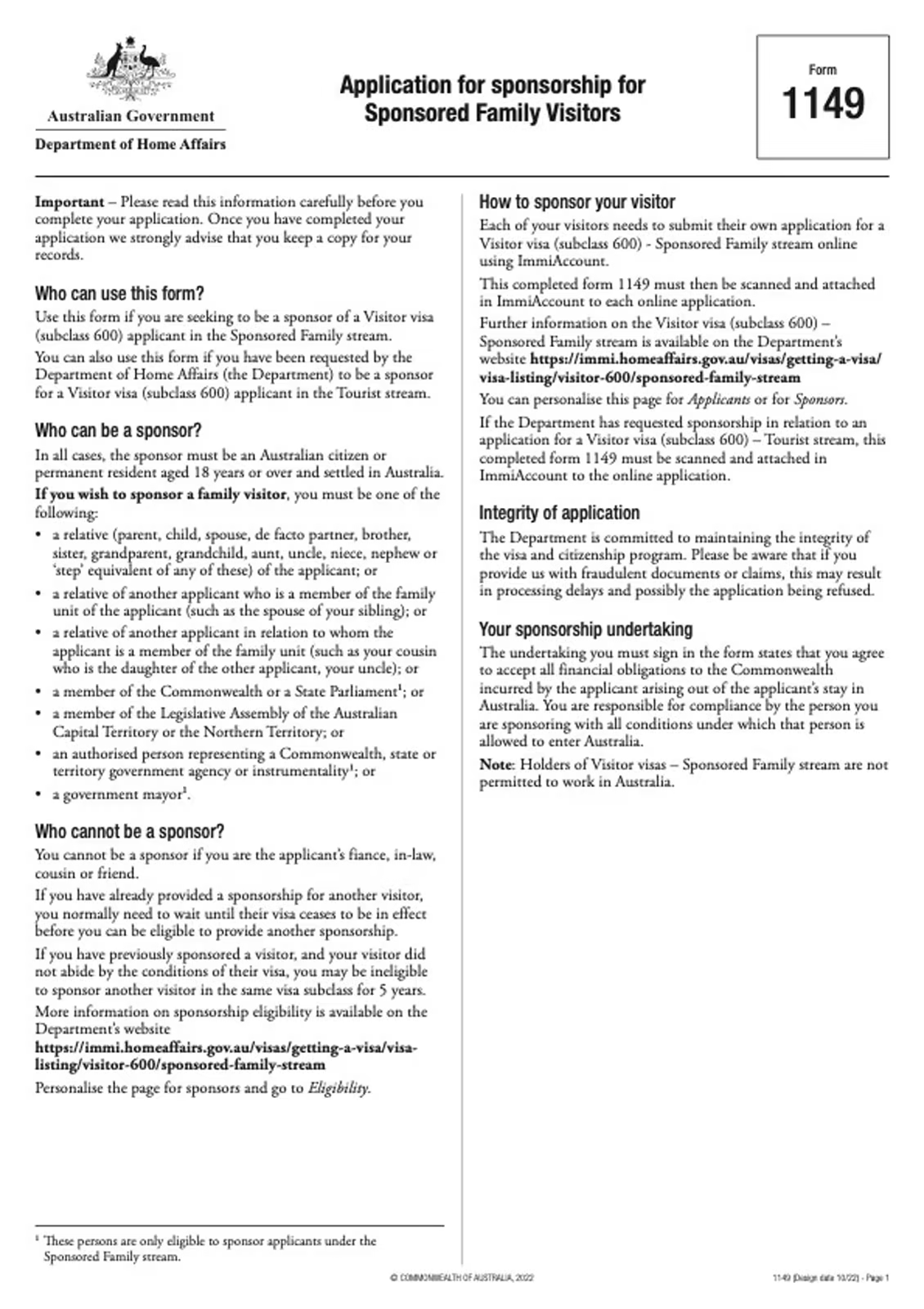
According to the current Department of Home Affairs form:
- it is for Sponsored Family Visitors
- it can also be used when the Department requests sponsorship for a Tourist stream applicant
- the sponsor must be an Australian citizen or permanent resident, 18 or older, and settled in Australia
- the applicant’s fiance, in-law, cousin, or friend cannot be the sponsor under the form’s family-stream rules
- each visitor must submit their own application
- a requested security bond is generally between AUD 5,000 and AUD 15,000 per person
That means the Australian version of a sponsor letter comes in two layers:
- a normal host invitation letter for many tourist files
- a formal sponsorship undertaking when Form 1149 is requested or the visitor is in the Sponsored Family stream
If your route is Australia-specific, use the Australia visitor visa checklist before you draft the host letter so you do not mix the Tourist and Sponsored Family rules together. If the Australian file depends on who can formally sponsor and when Form 1149 actually applies, the dedicated sponsor letter for Australian visa guide goes deeper on sponsor eligibility, bond rules, and the difference between a host letter and a real sponsorship undertaking.
United States: sponsor funding can help, but invitation letters are not a deciding factor
The U.S. State Department takes a very different position from the UK, Canada, and Australia.
On the current B-1/B-2 visitor page, State says:
- evidence of your employment and/or family ties may be enough to show the purpose of the trip and your intent to return
- if you cannot cover all the costs yourself, you may show evidence that another person will cover some or all costs
- but a letter of invitation or Affidavit of Support is not needed to apply for a visitor visa
- and if you still bring one, it is not one of the factors used to issue or deny the visa
The separate Fees for Visa Services page lists the B visitor application fee under non-petition-based nonimmigrant visas at $185.
This is the most important “don’t copy templates blindly” lesson in the whole article. If your destination is the United States, the officer cares more about the applicant’s own ties abroad than about a relative’s promise.
If your case is U.S.-specific, do not treat the sponsor letter as the main document. Start with the US visa document checklist and make sure the applicant’s own passport, DS-160, work ties, and travel story are strong first.
Mistakes that make sponsor letters look weak
Most refusals linked to sponsor letters are not about the title of the document. They are about contradictions around it.
| Mistake | Why it hurts | Better move |
|---|---|---|
| The host promises “full support” without numbers or proof | Officers cannot tell what is actually being funded | Name the support clearly and attach evidence |
| Dates in the letter do not match the itinerary | The letter becomes a contradiction instead of a clarification | Use one exact travel window everywhere |
| The sponsor letter tries to replace applicant ties | A host cannot create the visitor’s return-home story | Add employment, family, or study evidence for the applicant |
| The wrong route is used | A family sponsor letter will not fix a business or marriage-visitor case | Check the visa category first |
| Old or weak evidence is attached | Some officials explicitly down-rank stale or low-value documents | Use recent financial evidence and stronger status proof |
| The letter is too emotional | Officers are checking facts, not persuasion | Keep the tone factual and specific |
One practical rule is worth following across every route: if a sentence in the sponsor letter cannot be backed by a document in the file, change the sentence or add the document.
If you want a second pass on the whole evidence pack, not just the sponsor letter, create an account and run the case through Vidicy before you submit.
Related guides
If you're building the rest of the application pack, these companion guides help:
- Invitation Letter for Tourist Visa Template (2026)
- Sponsor Letter for Visa: Sample + Official Rules
- Documents Required for Tourist Visa (2026 Guide)
Official sources
- UK Standard Visitor application page
- UKVI guide to supporting documents for visiting the UK
- How to apply for a UK visitor visa: official video page
- Canada letter of invitation for visitors
- Canada visitor visa: about the document
- Canada biometrics: who needs to give fingerprints and photo
- Guide 5256: applying for a visitor visa
- Save Time: Send a Complete Application - official Canada video page
- Australia: applying for a visitor visa
- Australia Form 1149 - sponsorship for Sponsored Family Visitors
- U.S. State Department visitor visa page
- U.S. State Department fees for visa services
FAQ
Is a sponsor letter mandatory for a tourist visa?
Not always. Canada and the UK treat it as supporting evidence when another person is covering travel, accommodation, or maintenance. Australia may want a host letter and sometimes Form 1149. The U.S. State Department says invitation letters and Affidavits of Support are not needed for normal visitor-visa decisions.
Can a friend sponsor my tourist visa?
Sometimes, yes, but the answer depends on the route. Canada and the UK may accept support from a friend if the relationship and funding are documented honestly. Australia’s Form 1149 is stricter and says a friend cannot be the sponsor in the Sponsored Family stream. Always check the route-specific rule first.
What is the difference between a sponsor letter and an invitation letter?
In many tourist cases, they overlap. The useful distinction is functional: an invitation letter mainly explains the visit, while a sponsor letter focuses on support, accommodation, and money. One document can do both jobs if it clearly states the relationship, stay details, and the exact support being offered.
Does the sponsor have to pay for the whole trip?
No. A sponsor can provide accommodation only, daily costs only, or partial support. The important thing is that the letter says exactly what is being covered and the rest of the file proves it. Vague claims such as “I will support them” are much weaker than a specific cost split.
What should the applicant still prove even with a sponsor letter?
The applicant still needs to prove identity, trip purpose, and return-home credibility. That usually means passport details, itinerary, personal finances where relevant, and work, study, or family ties outside the destination country. A sponsor letter can support the file, but it rarely replaces the applicant’s own evidence.
Conclusion
The best sponsor letter for tourist visa applications is short, specific, and backed by proof. It should explain who the host is, what support is being given, where the visitor will stay, and how the rest of the file proves that story. Then it should stop.
The key lesson from the official pages is simple: the same keyword hides different rules. The UK wants sponsor evidence, Canada wants a detailed invitation letter, Australia may move from a host letter to Form 1149, and the U.S. does not treat invitation letters as a deciding factor at all.
If you want to make sure the sponsor letter, bank trail, itinerary, and applicant documents all tell the same story, use Vidicy’s workflow and start the review here before you submit.