



A UK student visa checklist starts with two fixed documents: a valid passport and your Confirmation of Acceptance for Studies (CAS). Then you add the documents that match your case: money evidence, English-language proof, ATAS, a TB certificate, parent or guardian consent if you are 16 or 17, and an official sponsor consent letter if a sponsor paid your fees or living costs in the last 12 months. On GOV.UK Student visa pages as of April 16, 2026, the fee is GBP 558, you can apply up to 6 months before your course starts, and outside-the-UK applications usually get a decision in 3 weeks.
That matters because many ranking pages still blur together three different things: university admission documents, Student-route visa documents, and post-approval travel steps. A working UK student visa checklist should do the opposite. It should tell you which documents every Student visa file needs, which ones only apply in specific cases, and which digital steps still matter after approval. If you want the longer document-by-document explanation beside this article, keep Documents Required for Student Visa UK open in the next tab. If you want the broader route view first, start with Vidicy's UK visa checklist.
Key takeaways
- Every Student visa file starts with a passport and a CAS.
- The finance rule usually means course fees for 1 academic year plus GBP 1,529 per month in London or GBP 1,171 outside London, capped at 9 months.
- The money usually has to sit in the account for 28 consecutive days, with evidence dated within 31 days of the application.
- Common conditional documents are English proof, ATAS, TB, under-18 consent, and official sponsor consent.
- Approval is not the end of the checklist: you still need to handle identity verification, your UKVI account, and your eVisa correctly.
| Checklist item | Who needs it | Current official rule | Why applicants miss it |
|---|---|---|---|
| Passport or travel document | Everyone | Mandatory | People upload a cropped bio page or mismatch passports across the form, CAS, and travel plan. |
| CAS | Everyone | Mandatory | Applicants treat the offer letter as enough and forget the visa application runs on the CAS reference. |
| Financial evidence | Most applicants | Course fees plus living costs | The balance looks right on one day, but the 28-day rule is not met. |
| English-language proof | Usually required | CEFR B2 at degree level or above, B1 below degree level | People upload the wrong English document for the course level or sponsor process. |
| ATAS certificate | Only some applicants | Needed for some sensitive subjects at RQF level 7 or above | It gets discovered too late, even though it must be ready before the visa application. |
| TB certificate | Only if residence history triggers it | Needed if all 3 TB conditions apply | Applicants check nationality, but skip the residence-history rule. |
| Parent or guardian consent | Applicants aged 16 or 17 | Mandatory if under 18 | The consent letter is left out because the applicant is treated like an adult elsewhere in the process. |
| Official sponsor consent | Anyone funded in the last 12 months | Conditional | Sponsorship paid the fees, but no written permission is attached to the new application. |
| eVisa setup and travel document link | Everyone after approval | Operationally required | The visa is approved, but the UKVI account or linked passport is wrong before travel. |
Table of Contents
- UK student visa checklist at a glance
- Core documents every Student visa file needs
- Financial evidence and sponsor documents
- English proof, ATAS, TB, and under-18 documents
- Identity checks, photo rules, and eVisa steps
- Common mistakes before you submit
- Official sources
- FAQ
- Conclusion
UK student visa checklist at a glance
If you want the shortest useful UK student visa checklist, use this order:
- Confirm the route fits: you must be 16 or over and have an unconditional offer from a licensed student sponsor.
- Get the CAS: you need the CAS reference before you can apply, and GOV.UK says you must apply within 6 months of receiving it.
- Build the fixed document layer: passport plus CAS.
- Calculate the money rule: first academic year's tuition plus maintenance, using the correct London or outside-London rate.
- Add your conditional documents: English proof, ATAS, TB, under-18 consent, or sponsor consent if they apply.
- Apply online and prove identity: through the path UKVI gives you, either app-based or appointment-based.
- Check the pre-travel timing: for longer courses you can usually arrive up to 1 month early; for courses of 6 months or less, usually up to 1 week early.
- Finish the digital handoff: create your UKVI account, access your eVisa, and link the exact travel document you will use.
That is the main difference between a checklist article and a longer requirements guide. A checklist is the filing order. The related documents guide explains each evidence type in more depth, but this page is built to help you decide what belongs in the folder right now.
Core documents every Student visa file needs
The official Student visa documents page is unusually clear: every normal Student-route file starts with:
- a current passport or other valid travel document
- a CAS from your course provider
The visa application does not run on your university offer letter, your tuition receipt, or your personal explanation note. It runs on the passport you will travel with and the CAS number issued by a licensed sponsor.
According to the live Student visa course page, you must have an unconditional offer from a licensed student sponsor before you get the CAS. GOV.UK also says you must apply for the visa within 6 months of receiving that CAS. That creates one practical rule many applicants miss: if the school updates your course dates, tuition paid, or study location, your checklist must be rebuilt around the updated CAS, not the earlier draft of the story.
Three quick definitions help here:
- CAS means Confirmation of Acceptance for Studies.
- Licensed student sponsor means the university or college can legally sponsor Student-route applicants.
- Student visa is for further or higher education study, not for a short tourism trip with a campus visit attached.
If you are looking for a route-neutral preflight before you sort the evidence, use Vidicy's UK visa checklist. If you want the deeper explanation of how UKVI reads the document stack after the basics are in place, pair this article with How to Prepare Visa Application Documents.
Financial evidence and sponsor documents
For most applicants, this is the part of the UK student visa checklist that causes the delay or refusal risk.
According to the live Student visa money page, you must usually show enough money for:
- your course fees for 1 academic year as shown on the CAS
- your living costs while you are in the UK
The current maintenance figures are:
- GBP 1,529 per month for courses in London
- GBP 1,171 per month for courses outside London
Those living-cost figures are counted for up to 9 months. GOV.UK also says the money must usually be held for 28 consecutive days, and the end of that 28-day period must be within 31 days of the date you apply.
That is why a bank statement can look fine at a glance and still fail the checklist. The officer is not just checking whether the balance exists. They are checking whether:
- the right amount was calculated
- the right location rate was used
- the money stayed there for the full 28-day period
- the evidence is still fresh enough when you apply
If you have already been in the UK with a valid visa for at least 12 months, GOV.UK says you do not need to prove you have this money for the Student visa application. If you are from a country under the differential evidence requirement, UKVI may not ask you to upload the money evidence upfront, but the same page says they can still ask for it before making a decision. The safe version of this checklist is still to prepare the finance pack.
If an official financial sponsor paid your fees or living costs in the last 12 months, GOV.UK says you may also need that sponsor's written consent for the application. That consent document is easy to overlook because it looks administrative. For UKVI, it is part of the route rules.
If finance is the weakest part of your file, keep Vidicy's proof of funds guide next to this checklist while you calculate the numbers and check the holding period.
English proof, ATAS, TB, and under-18 documents
These are the documents that make a Student visa file case-specific rather than generic.
English-language proof
According to the live knowledge of English page, you will usually need to prove your knowledge of English unless an exemption or sponsor-led assessment route applies.
The required level is:
- CEFR B2 for degree-level study or above
- CEFR B1 for study below degree level
That page also says some applicants do not need to prove English because of nationality, a previous qualifying visa application, or the qualification route they are using. The right checklist move is not to upload every English document you have. It is to upload the one that matches the way your sponsor and your route satisfy the rule.
ATAS certificate
According to the live Academic Technology Approval Scheme guidance, some foreign students studying sensitive subjects at RQF level 7 or above need ATAS clearance. If it applies to your course and nationality, the ATAS certificate must be ready before the Student visa application, and the certificate is valid for 6 months for visa-use purposes.
TB certificate
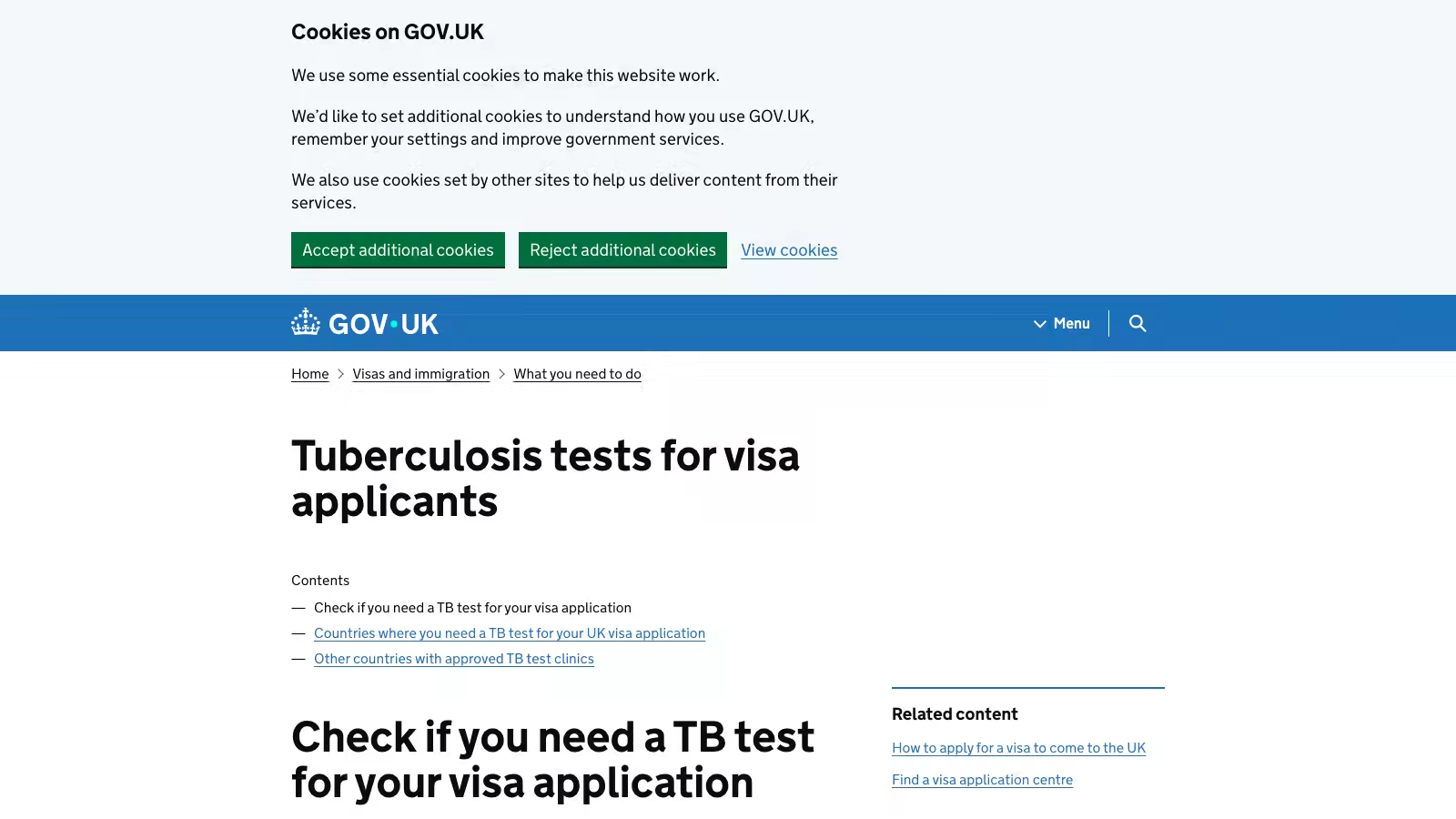
According to the live TB test guidance, you need a TB certificate if all of these are true:
- you are coming to the UK for 6 months or more
- you lived in a listed country for 6 months or more
- you were living there within the last 6 months
If the clinic clears you, the certificate is valid for 6 months from the x-ray date.
Under-18 consent documents
If you are 16 or 17, the Student visa documents page says you need written consent from your parent or guardian for:
- your visa application
- your living and care arrangements in the UK
- your travel to the UK
You also need a document such as a birth certificate that shows the names of your parents or guardians. This is one of the clearest places where applicants confuse being old enough for the route with being treated exactly like an adult for the paperwork. UKVI does not treat those as the same thing.
Identity checks, photo rules, and eVisa steps
The live apply online page says Student visa applicants apply online and then prove their identity through the route UKVI gives them. That usually means one of two paths:
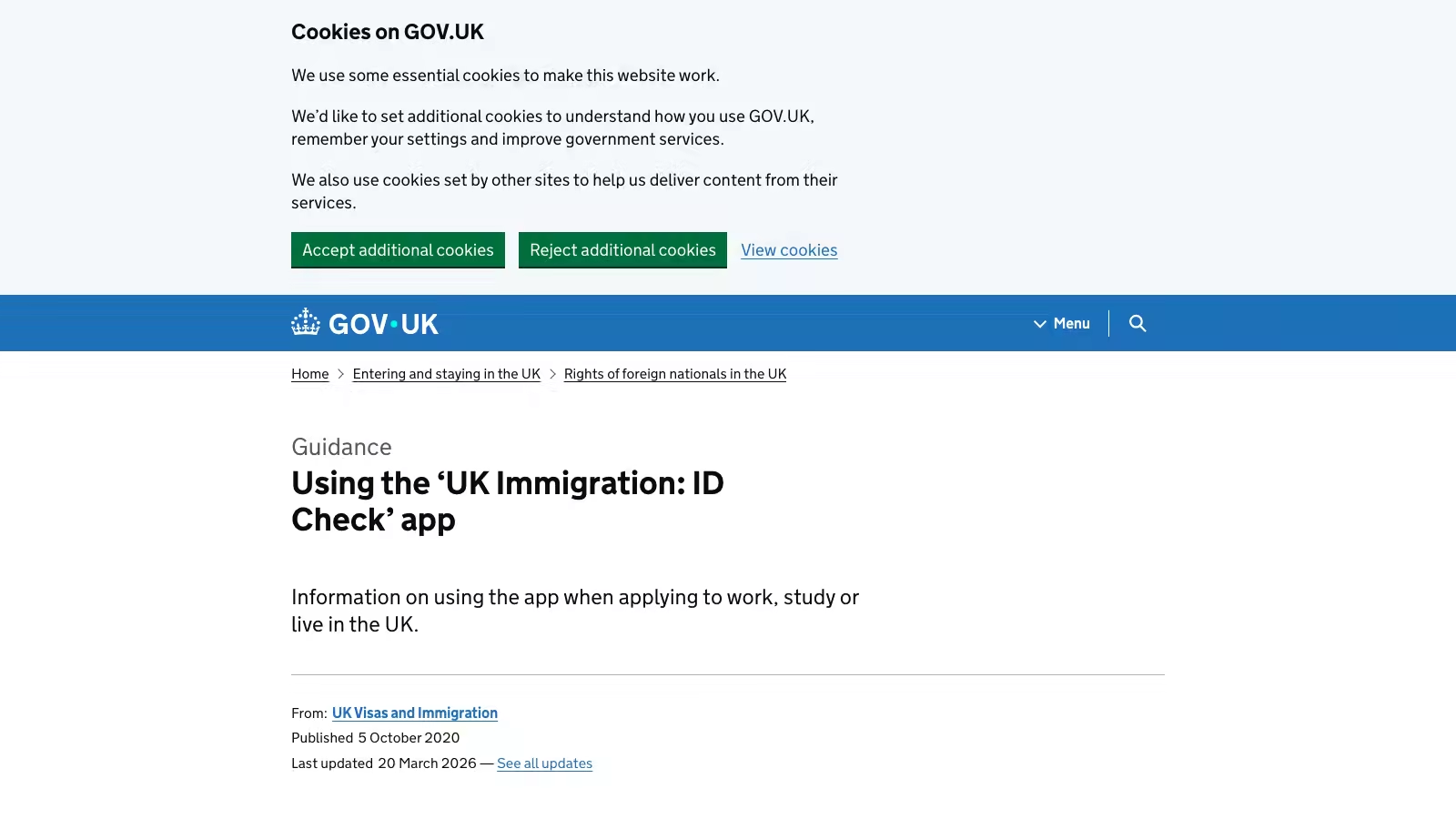
- use the UK Immigration: ID Check app if UKVI tells you that you can
- attend a visa application centre for fingerprints and a photo
The current ID Check app guidance explains that the app checks whether the identity document is genuine and whether it belongs to you. It also says that if the app cannot read the chip in your document, you may need to confirm identity another way and book an appointment instead.
The same guidance also spells out the digital photo rules that usually matter more than applicants expect. For the app photo, you must:
- be in even lighting
- stand against a plain, light-coloured background
- keep your head straight and look directly at the camera
- show your head, shoulders, and upper body
You must not have anything covering your face or eyes, and you should not have shadows or other people in the background.
The Home Office photo walkthrough below is linked from GOV.UK's updated photo-guidance publication. It is useful for the app-photo step because it shows the framing and background rules visually.
After approval, the checklist is still not finished. The live Student visa pages say successful applicants get an eVisa, and GOV.UK's eVisa pages say you need to create a UKVI account and link the travel document you will actually use. That last point matters because a technically approved student can still create airport problems if the passport in the UKVI account does not match the passport used for travel.
The official account-setup video below is linked from the GOV.UK eVisa support pages.
For the travel step after approval, GOV.UK also links this official walkthrough: How to travel with your eVisa.
If you want a structured second pass before you submit, review how Vidicy works and then start your application workspace.
Common mistakes before you submit
Most weak Student-route files do not fail because the applicant forgot the word "checklist." They fail because the checklist was technically present but operationally wrong.
The most common problems are:
- CAS mismatch: course dates, fees, campus details, or sponsor information in the form do not match the CAS.
- Wrong maintenance rate: the file uses the outside-London rate for a London course, or the reverse.
- Broken 28-day rule: the money reaches the right number eventually, but not for the full required period.
- Late ATAS or TB planning: the visa application is ready, but the pre-application certificate is still missing or expired.
- Under-18 consent gap: the applicant is 16 or 17, but the parent or guardian consent document is missing one of the required permissions.
- Differential evidence confusion: the applicant assumes "not uploaded now" means "not needed at all."
- eVisa handoff errors: the visa is approved, but the UKVI account or linked passport is wrong before travel.
That is also why this checklist pairs well with Vidicy's document-preparation guide. The file can be complete on paper and still be weak in the way the evidence lines up.
Related guides
If you're building the rest of the application pack, these companion guides help:
- Documents Required for Student Visa UK: 2026 Checklist
- Documents Required for Student Visa in 2026
- Proof of Funds for UK Student Visa: 2026 Rules
- Employment Letter for UK Visa: Sample + UKVI Checks
Official sources
- GOV.UK Student visa overview
- GOV.UK Student visa course requirements
- GOV.UK Student visa documents you'll need to apply
- GOV.UK Student visa money guidance
- GOV.UK Student visa knowledge of English
- GOV.UK Student visa apply online
- GOV.UK Academic Technology Approval Scheme guidance
- GOV.UK tuberculosis tests for visa applicants
- GOV.UK using the UK Immigration: ID Check app
- GOV.UK eVisa support videos
- GOV.UK how to take a photo for a visa application or permission: video
- GOV.UK how to create, link and access your eVisa with a passport: video
- GOV.UK how to travel with your eVisa: video
FAQ
Is there an official UK student visa checklist PDF?
Not as one universal student-only PDF that covers every profile. The live GOV.UK Student visa pages split the route into course, money, English, documents, and apply-online steps. The safer approach is to use the official pages as the source of truth and then build a case-specific checklist like this one.
Do I need bank statements if I am from a differential-evidence country?
You may not need to upload them upfront, but you should still prepare them. GOV.UK says UKVI can still ask for that evidence before they decide the application. Treat the differential-evidence rule as an upload shortcut, not as permission to skip the money calculations or holding-period checks.
Do I need both a CAS and a university offer letter?
For the visa application itself, the CAS is the decisive document because it is the reference number UKVI uses in the Student-route process. An offer letter may still help you understand your course record, but the visa application cannot replace the CAS with the offer letter.
When does ATAS apply to a UK Student visa?
ATAS does not apply to every student. GOV.UK says it applies to some foreign students studying sensitive subjects, mainly at RQF level 7 or above. If it applies to your course and nationality, you must get the certificate before the visa application, and it is valid for 6 months for that purpose.
When can I travel to the UK after approval?
According to the live GOV.UK Student visa pages, you can usually arrive up to 1 month before your course starts if the course lasts more than 6 months. If the course lasts 6 months or less, you can usually arrive up to 1 week before the start date instead.
How long does a UK Student visa decision take in 2026?
The live GOV.UK apply pages currently say Student visa applications usually get a decision within 3 weeks if you apply from outside the UK and within 8 weeks if you apply from inside the UK. Use those as planning benchmarks, not as a guarantee for booking non-refundable travel too early.
Conclusion
The safest way to use a UK student visa checklist is to think in layers. First lock the passport and CAS. Then calculate the money rule correctly. Then add the conditional documents like English proof, ATAS, TB, or consent letters. Finally, finish the identity and eVisa steps instead of treating approval as the end of the process.
If you want the full explanation layer, read Documents Required for Student Visa UK next. If you want a second set of eyes on the file before you submit, start with how Vidicy works and then move into the workflow through sign up.