


If you are searching for documents needed for Indian visa applications, start with this split: most travelers either need a short e-Visa pack or a regular paper visa pack, and the documents change as soon as your purpose switches from tourism to business, medical, conference, or long-stay travel. According to the Government of India's Indian Visa Online portal, every foreign national entering India needs a valid passport plus either a visa from an Indian Mission/Post or an eVisa in limited categories. The same official portal says the e-Visa route currently covers 14 categories, while the regular-visa portal still routes applicants through an online form, a printed application, and submission through the relevant mission or visa center.
That means the real answer is not "bring your passport and a photo." The safer answer is:
- For most short visits, prepare a valid passport, a compliant digital photo, and the extra route proof tied to your visa type.
- For e-Tourist cases, the core upload is usually the passport bio page, then extra documents only if your trip includes a short course or short voluntary work.
- For e-Business, e-Medical, and e-Conference cases, the file gets stricter fast because invitation letters, hospital letters, and government clearances can become mandatory.
- For regular paper visas, mission-level rules matter because you still need the online application, the printed and signed form, and the supporting documents the Indian mission or its service partner asks for.
If you want the short version before the full breakdown, use this table.
| Visa path | Core documents | Extra documents that change by purpose | Best fit |
|---|---|---|---|
| e-Tourist visa | Passport bio page + digital photo | Short-course letter or voluntary-work letter if applicable | Tourism, family visits, short yoga or short course travel |
| e-Business visa | Passport bio page + digital photo | Business card, and invitation letter if applicable | Meetings, commercial visits, lectures, business travel |
| e-Medical visa | Passport bio page + digital photo | Hospital letter from India with suggested admission date | Medical treatment in India |
| e-Conference visa | Passport bio page + digital photo | Organizer invitation, MEA political clearance, MHA event clearance | Approved conference or seminar travel |
| Regular paper visa | Online form, printed application, passport, photo, supporting documents | Mission-specific proof such as itinerary, status, sponsor or category documents | Routes not covered by e-Visa, longer or more sensitive cases, ineligible applicants |
At a glance
- The official e-Visa portal says your passport must have at least 6 months of validity at the time you apply.
- The official e-Tourist visa options are currently 30 days, 1 year, and 5 years.
- The official portal says maximum stay on the 1-year and 5-year e-Tourist visas cannot exceed 180 days in one calendar year.
- The e-Visa photo upload must be JPEG, 10 KB to 1 MB, square, and front-facing without spectacles.
- The passport bio-page upload for e-Visa must be PDF, 10 KB to 300 KB.
- The regular-visa instruction page says the regular photo upload must be JPEG, 10 KB to 300 KB, with a light or white background.
Key takeaways
Use this guide to verify the route, evidence, and next action before you finalize the file. The Indian visa document set depends on e-Visa versus regular visa, nationality, purpose, photo quality, and passport validity.
Table of Contents
- Documents needed for Indian visa start with e-Visa vs regular visa
- Core documents every Indian visa applicant should prepare
- Extra documents by Indian visa type
- Regular paper visa documents and mission-specific rules
- Photo, file-format, and upload mistakes that trigger rework
- Official sources
- FAQ
- Conclusion
Documents needed for Indian visa start with e-Visa vs regular visa
The first decision is whether your trip fits the e-Visa system or whether you need a regular paper visa.
An e-Visa is the online route managed through the Government of India's dedicated e-Visa portal. A regular paper visa is the mission-based route where you complete the online application, print it, sign it, and submit it with supporting documents through the embassy, high commission, consulate, or its service partner.
According to the official indianvisaonline.gov.in portal:
- all foreign nationals entering India need a valid passport and a visa or eVisa
- the e-Visa route is limited to specific travel purposes
- the current e-Visa page lists 14 categories
- only nationals of Japan, South Korea, and the UAE in limited conditions are shown under India's separate Visa on Arrival note
That matters because the wrong route changes the document list immediately. The same e-Visa page says e-Visa is not available to:
- diplomatic or official passport holders
- laissez-passer or other international travel document holders
- people endorsed on a parent's or spouse's passport
- travelers with a defense, military, security, or police background, serving or retired
The portal also says travelers of Pakistani origin should use the regular-visa route instead of the e-Visa route.
Inference from the official sources: if your case is unusual, sensitive, long-stay, or outside the standard tourism/business/medical/conference buckets, the safest assumption is that you should verify the regular-visa route before collecting documents.
If your broader goal is to stop treating visa prep as one generic file dump, the product lesson is the same one Vidicy already applies on its live routes: a route-specific checklist beats a universal list every time. The UK visa document checklist is the closest live example on the site right now of how that route-by-route logic should work before submission.
Core documents every Indian visa applicant should prepare
No matter which India route you use, the official sources converge on a small set of essentials.
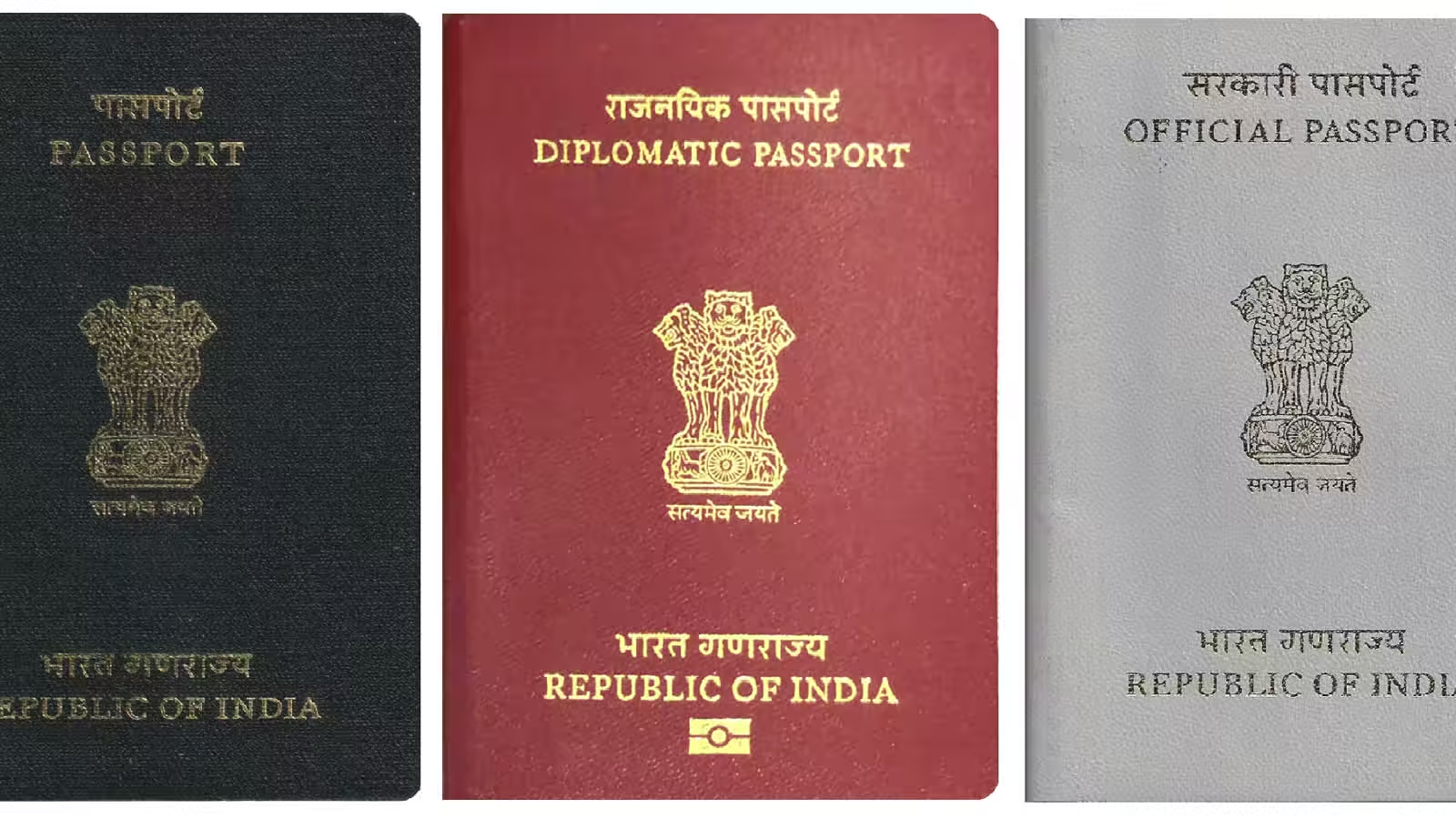
1. A passport that is still valid long enough
According to the e-Visa portal, the applicant's passport should have at least six months of validity at the time of applying for an e-Visa. The Consulate General of India in San Francisco says that for visa issuance, the passport should also have two blank pages.
Those two rules are easy to underestimate. A passport that is technically valid but nearly full can still slow you down if your route needs physical stamping or later registration.
2. A compliant visa photo
The Government of India regular-visa instruction page says the uploaded visa photo must be:
- JPEG
- 10 KB to 300 KB
- full-face, front-view, eyes open
- against a plain light or white background
- without shadows or borders
The e-Visa portal is slightly different on the digital upload side. It says the e-Visa photograph must be:
- JPEG
- 10 KB to 1 MB
- square, with equal height and width
- full-face, front-view, eyes open, and without spectacles
If the photo is the part you are still fixing, use the dedicated photo requirements for Indian visa guide before you submit the rest of the file.
3. Your passport bio page in the format the system expects
For e-Visa applications, the official portal says the passport bio page upload must be:
- 10 KB to 300 KB
- the same passport whose details you enter in the form
For regular paper visas, the HCI London guidance says the online form cannot be edited after submission, which means the passport details, dates, and spellings should be checked before you print anything.
4. Proof that matches the reason for travel
According to the e-Visa portal, international travelers should have a return or onward ticket and sufficient money for the stay. That is only the starting point. Your actual supporting proof changes depending on whether the trip is tourism, business, treatment, study, or conference travel.
This is where the biggest avoidable mistakes happen. Applicants collect files that are individually real but do not tell one consistent story together. If you want the system-level fix for that problem, read how to prepare visa application documents before you upload everything in one rush.
Extra documents by Indian visa type
Once the basics are ready, the official e-Visa portal becomes much more specific.
| Visa type | Official extra proof | What that means in practice |
|---|---|---|
| e-Tourist | Short-course letter or voluntary-work letter, only if applicable | Standard tourist travel is lighter; mixed-purpose travel needs supporting proof |
| e-Business | Business card, and invitation letter if applicable | The business purpose should be documented, not merely described |
| e-Medical | Hospital letter in India with suggested admission date | Treatment-driven travel needs provider documentation early |
| e-Conference | Organizer invitation, MEA political clearance, MHA event clearance | Conference travel is one of the most document-heavy e-Visa routes |
| e-Student | Parent/guardian support letter plus bank guarantee or previous 6 months of bank statements, plus admission letter | Student routes need both admission proof and funding logic |
| e-Transit | Confirmed ticket to India and onward journey, plus destination-country visa or passport if dual-national | Transit cases fail when the onward journey is vague |
e-Tourist visa documents
According to the official portal, the standard e-Tourist upload is the scanned bio page of the passport. Extra documents appear only if the travel purpose moves beyond ordinary sightseeing or family visits.
For example:
- a short local course requires a letter from the institute or organization
- short voluntary work requires a letter from the organization on its letterhead
That is a strong signal that "tourist visa" is not one universal bucket. The moment your trip includes structured activity, the document list changes.
e-Business visa documents
The portal says e-Business applicants should prepare:
- the passport bio page
- a copy of the business card
- an invitation letter from Indian parties if applicable
This is also the point where a sloppy invitation letter can weaken the file. If the host-side document is the confusing part, the broader invitation letter for visa is useful as a structure guide, but the India route still depends on what the official portal asks for.
e-Medical and e-Conference documents
For e-Medical, the official portal requires a hospital letter from India that includes the date or tentative date of suggested admission. For e-Conference, the official list is stricter:
- invitation from the organizer
- political clearance from the Ministry of External Affairs
- event clearance from the Ministry of Home Affairs
That is why generic "documents needed for Indian visa" blog posts often underserve readers. The document list is light for a simple e-Tourist file and much heavier for conference or medical travel.
Regular paper visa documents and mission-specific rules
Regular paper visas are where many applicants lose time because they assume the online form is the whole process. It is not.
According to the High Commission of India in London:
- e-Visa is handled separately and not by the mission
- regular-visa applicants still go through the mission's service partner
- the visa validity begins on the date of issue, not the travel date you prefer
- applicants should not confirm bookings before a visa decision is made
The same HCI London page also says all applicants have to fill the regular/paper visa application form. The separate Indian Visa Online regular-visa portal says that after submitting the form, the applicant must print and sign it and submit it with supporting documents and the passport to the visa center or mission.
The Government of India's Visa Provision page is useful here because it shows how regular categories differ:
- Tourist: up to 5 years, multiple entry, non-extendable in India
- Transit: 15 days, single or double entry, onward ticket required
- Business: up to 5 years, multiple entry, proof of bona fide business purpose required
- Employment: 1 year or contract period, proof of employment required
- Student: course period or 5 years, proof of admission required
That is the clearest regular-visa reminder in the whole workflow: the category itself determines the documents.
When regular paper visa cases get more complicated
The San Francisco consulate guidance adds two practical warnings:
- minors need a notarized parental authorization form, both parents' passport copies, and a marriage certificate
- long-term students, medical travelers, and workers staying more than 180 days may have to register with FRRO/FRO within 14 days of arrival
That is why regular paper visas deserve slower preparation than short e-Tourist filings. You are not just satisfying one upload validator. You are building a route that may involve physical submission, category-specific proof, and post-arrival compliance.
If you want the visual product-side version of that idea, Vidicy's how-it-works page shows the checklist-first workflow this site is trying to push readers toward. If you want to pressure-test the full file before submission, that is where the sign-up flow becomes relevant.
Photo, file-format, and upload mistakes that trigger rework
The official India visa systems are unforgiving about file format.
For e-Visa, the official portal says:
- photo: JPEG, 10 KB to 1 MB
- passport bio page: PDF, 10 KB to 300 KB
- other business or medical documents: PDF, 10 KB to 300 KB
For the regular-visa upload page, the Government of India portal says:
- uploaded supporting documents must be in English
- upload format is PDF
- file size must be 10 KB to 500 KB
- hard copies of the uploaded documents must also be submitted with the printed application
That last point matters more than most third-party guides admit. A regular-visa upload can be technically accepted online and still fail later if the physical packet or supporting papers are incomplete.
Common India visa document mistakes
| Mistake | Why it fails | Safer fix |
|---|---|---|
| Using the wrong route | e-Visa rules do not cover every travel purpose or traveler profile | Decide route first, then collect documents |
| Uploading the wrong passport page | The portal expects the passport bio page and matching passport details | Check the passport number, expiry date, and upload before final submit |
| Assuming one tourist checklist fits business or conference travel | Invitation and clearance rules change the file | Use the route-specific document list from the official portal |
| Treating the photo as a casual selfie upload | KB, format, square crop, and background rules are strict | Fix the photo before the last step |
| Finalizing travel before approval | Missions warn against confirmed bookings before decision | Hold flexible plans until the visa is issued |
If you want a current walkthrough of the official mobile-app flow, the Government of India has promoted the Su-Swagatam app on embassy press releases. This recent third-party walkthrough is useful for orientation only; the rules still come from the official portals, not the video creator.
If your bigger concern is refusal risk rather than one missing file, read why visa applications get rejected and why visa applications get rejected because of document mistakes before you submit.
Official sources
- Indian Visa Online main portal
- Indian e-Visa portal and document requirements
- Indian regular visa application instructions
- Indian visa provision table by category
- High Commission of India, London: general visa information
- High Commission of India, London: tourist visa page
- Embassy of India, Buenos Aires: official Su-Swagatam app press release
FAQ
What documents do I need for an Indian e-Visa?
For most e-Visa cases, the official portal starts with a valid passport bio page and a compliant digital photo. After that, the extra document depends on the visa type. Business cases may need a business card and invitation letter, medical cases need a hospital letter, and conference cases need organizer and clearance documents.
Do Indian tourist visa documents differ from business or medical visa documents?
Yes. According to the official e-Visa portal, e-Tourist cases are usually lighter, while e-Business, e-Medical, and e-Conference routes add specific supporting documents. According to the regular-visa provision page, category also changes validity, extendability, and what proof must be filed with the application.
Do I need a printed application for a regular Indian visa?
Yes. The regular Indian Visa Online portal says applicants must print the completed application form, sign it, and submit it with supporting documents and the passport to the Indian mission or visa center. HCI London also says the regular paper-visa route still goes through the mission's submission partner.
How early can I apply for an India e-Visa?
According to the official e-Visa FAQ, applicants for the 1-year and 5-year e-Tourist visa, e-Business, e-Medical, e-Medical Attendant, and e-Conference routes may apply 120 days in advance, but no later than 4 days before arrival. The 30-day e-Tourist visa can be filed up to 30 days before arrival.
What document details most often cause India visa rework?
The most common issues are route mismatch, passport validity problems, non-compliant photo files, and missing purpose-specific proof such as hospital or conference documents. For regular paper visas, another frequent problem is assuming the online upload is enough even though the mission may still require the printed form and physical supporting packet.
Conclusion
The safest answer to documents needed for Indian visa searches is not one flat checklist. It is a decision tree: choose e-Visa or regular paper visa first, then collect the passport, photo, and purpose-specific documents that match that exact route. According to the official Indian portals, the technical rules are strict, the categories differ, and some travelers should skip the e-Visa route entirely.
If you want fewer avoidable errors before submission, start with the official sources above, fix the photo and file-format issues early, and then use a route-specific workflow instead of a generic checklist. That is the logic behind Vidicy's how-it-works page and the next practical step is to start your application once your document pack is coherent.