


A UK visa photo rejection is often faster than a refusal on funds or ties—because the file fails automated checks before a human reads your story. In plain terms, uk visa photo requirements in 2026 mean your picture must match UK Visas and Immigration (UKVI) digital rules when you apply online, and the correct picture size for uk visa prints (45 mm high × 35 mm wide on standard UK passport-photo strips, with 29–34 mm from crown to chin inside the frame) when a centre asks for prints.
According to GOV.UK’s visa and permission photo guidance, a compliant digital image must be at least 600 pixels wide and 750 pixels tall, between 50 KB and 6 MB, saved as JPG or JPEG, and vertically orientated (not mirrored or flipped). That single sentence is the “source of truth” anchor most applicants miss when they reuse a square U.S. visa crop.
This guide walks through digital uploads, printed booth photos, child rules, glasses, and how UK specs differ from Schengen and U.S. photos—then links you to checklist and workflow tools so the rest of your uk visa file matches the same standard.
Official UK sources (primary): How to take a photo for a visa application or permission (detailed guide), Printed passport photo rules, the Home Office publication Taking a photo for a visa application or permission: video, and How to update your digital photo on your UKVI account: video. The two YouTube embeds below use the exact watch?v= IDs linked from those GOV.UK publication pages (fetched from the live HTML, not guessed).
Comparison: UK vs Schengen vs US visa photos (2026)
| Topic | UK (UKVI digital upload) | UK (printed passport-style) | Schengen (common booth spec) | US (DS-160 style) |
|---|---|---|---|---|
| Print dimensions | N/A (digital stage) | 45 mm high × 35 mm wide (UK booth standard) | 35 mm × 45 mm (common Schengen spec) | 2 in × 2 in (51 mm × 51 mm) |
| Face height on print | N/A | 29–34 mm crown-to-chin (GOV.UK printed rules) | Varies by mission (often strict face framing) | 50–69 % of image height (digital rules differ) |
| Digital shape | Vertical rectangle (≥600×750) | N/A | Varies by upload portal | Square (600–1200 px) |
| Max digital file | 6 MB (UKVI digital) | N/A | Varies | 240 KB (U.S. digital upload) |
| Primary official source | UKVI digital photo guidance | GOV.UK printed photo rules | Mission / VFS instructions | travel.state.gov photos |
Quick read: If you are switching from a U.S. visa photo mindset, treat the UK as a different template: do not assume a square 600×600 export will satisfy UKVI’s minimum height rule.
At a glance
- UKVI digital uploads should be at least 600 px wide and 750 px tall.
- The file must be JPG/JPEG, vertically oriented, and between 50 KB and 6 MB.
- If a centre asks for printed photos, the standard UK booth size is 45 mm × 35 mm.
- Do not reuse a square U.S. visa crop for a UK upload without rechecking the height rule.
Table of Contents
- What counts as a compliant UK visa photo in 2026
- UK digital photo specifications for online applications
- Printed UK passport-style photos for paper submissions
- Common rejections and quick fixes
- How UK rules compare to US and Schengen visa photos
- FAQ
- Conclusion
What counts as a compliant UK visa photo in 2026
According to UKVI’s published checklist, your digital photo must be clear, in colour, unaltered, taken in a well-lit room, and show head, shoulders, and upper body against a plain light-coloured background with clear contrast. You must be facing the camera, with a plain expression and mouth closed, eyes open and visible, no hair across the eyes, no red-eye, and no shadows on the face or behind you—and you must not submit a scan or photo of another photo, a picture of an identity document, or the same image already used in your passport if rules require a fresh capture.
Those bullets mirror the UK government’s wording so you can quote them in a self-check: they are the fastest “pass/fail” gate before you even debate travel history or finances.
If you are building the rest of a visitor file in parallel, bank evidence, employment proof, and sponsor logic all matter too, so use UK Visitor Visa Bank Statement Requirement (2026) as the companion reference so your financial documents receive the same rigor as your portrait.
UK digital photo specifications for online applications
Pixel dimensions and file format
UKVI’s digital standard is explicit: minimum 600 px width and 750 px height, 50 KB–6 MB, JPG/JPEG, vertical orientation, and not mirrored. If you export a wide landscape image or a heavily compressed thumbnail, expect an instant technical reject.
Composition, background, and clothing
The same GOV.UK page requires no other people or objects, a plain light background, and appropriate clothing with shoulders and torso covered (head coverings only for religious or medical reasons). That is stricter in spirit than “any pale wall”—busy textures, door frames, or plants read as objects under the rule text.
Glasses and expression
UKVI tells applicants not to wear glasses unless they have to. If glasses are medically required, they cannot be sunglasses or tinted, and eyes must be visible without frames, glare, reflection, or shadow. Combined with the plain expression rule, most travelers get a faster outcome by removing glasses entirely.
Official help video
The Home Office’s publication Taking a photo for a visa application or permission: video embeds the UKVI tutorial on YouTube. The live GOV.UK page links to https://www.youtube.com/watch?v=woI09Wewjjs — use that if you prefer a text link instead of the player below.
Practical capture workflow (phone-friendly)
- Wipe the lens and disable portrait-mode blur (UKVI wants a sharp, natural image).
- Stand 1.5–2 metres from a plain wall; use daylight plus one diffuse lamp to kill shadows.
- Frame vertical head-and-shoulders; leave modest headroom—avoid a tight chin crop that later fails height checks.
- Export JPEG; verify ≥600×750 in your editor’s metadata panel before upload.
- Do not mirror the selfie; flip tools often create a rejection.
For a route-level view of every document, not only the portrait, open the Documents Required for UK Visitor Visa (2026 Checklist) or the full UK visa checklist and work top to bottom. If you are applying under the study route, pair the photo spec with the full documents required for student visa UK guide before you upload anything. If the money evidence is the part still blocking the study-route file, the dedicated proof of funds for UK Student visa guide breaks down the current maintenance figures, accepted accounts, and timing rules. If you want the full supporting-evidence breakdown behind that checklist, Documents Required for UK Visitor Visa (2026 Checklist) is the best companion read. If your home-ties evidence depends on current work, pair the photo prep with this employment letter for UK visa guide so the employer letter, leave dates, and bank trail stay consistent across the same visitor file.
Printed UK passport-style photos for paper submissions
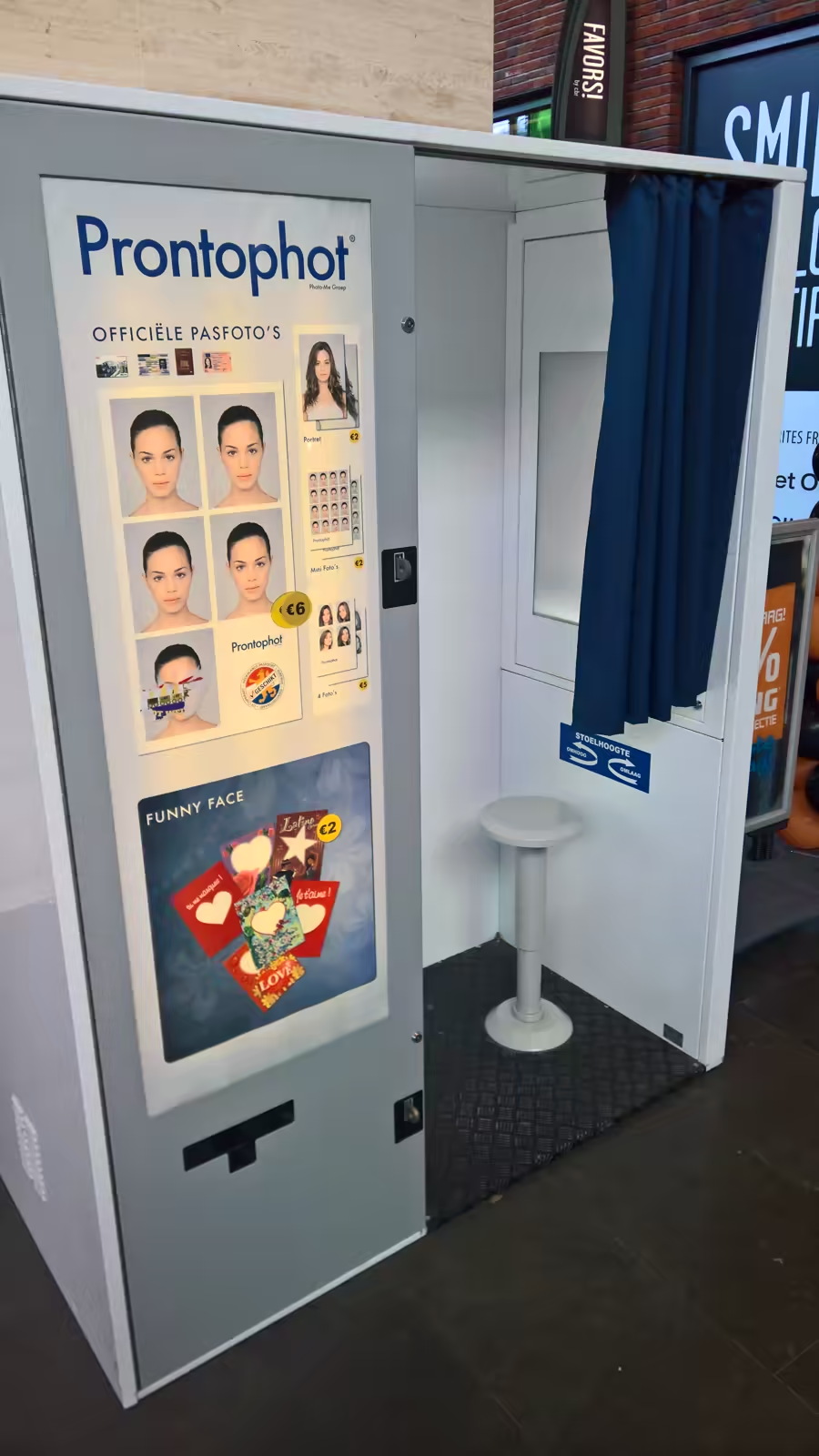
When a paper stage still requires two identical printed photos, GOV.UK’s passport photo rules remain the clearest public baseline: prints must measure 45 mm high × 35 mm wide, with the crown-to-chin image between 29 mm and 34 mm high, on plain white photographic paper with no border, professional standard, no creases, and unaltered. The page also reminds applicants that photos must usually be taken in the last month for a new passport—treat that recency discipline as best practice for visa bundles too.
If you shoot overseas, note the warning that photo booths outside the UK may not output the 45 mm × 35 mm UK standard—measure before you pay for a dozen wrong strips.
When prints still matter
Some service centres or legacy submission paths still ask for physical copies even when the core application is digital. Bring two identical images rather than “close enough” variants.
If you already have a UKVI account and must replace a portrait, follow How to update your digital photo on your UKVI account: video. That publication’s HTML links to https://www.youtube.com/watch?v=ebTAxORO7LM.
Common rejections and quick fixes
| Symptom | Likely cause | Fix |
|---|---|---|
| Upload says “dimensions too small” | Export below 600×750 | Re-crop vertical canvas; verify height first |
| File too large | >6 MB JPEG | Lower quality one step; avoid RAW inserts |
| “Mirrored” rejection | Front camera flip | Disable mirror; re-export original sensor orientation |
| Shadow bars on cheeks | Single ceiling downlight | Add frontal fill light or bounce card |
| Tinted “blue blocker” lenses | Looks like sunglasses | Remove glasses if medically safe |
| Busy dorm room background | Objects behind shoulders | Hang a plain sheet corner-to-corner |
If your issue is bigger than pixels, dates, employer letter, or funds story, pair this section with Why Visa Applications Get Rejected: 7 Document Mistakes so you fix cross-document problems at the same time.
How UK rules compare to US and Schengen visa photos
Schengen missions typically publish 35 mm × 45 mm guidance (see Schengen visa photo requirements (2026): size, rules, examples), while the United States expects a square digital frame and tighter file-size pressure—covered in US visa photo requirements (2026): size, rules, upload. Turkey is a useful third comparison because current Turkish consular guidance centers on a 50 × 60 mm biometric print baseline, with some missions still publishing local print exceptions; see Turkish visa photo requirements: size + rules. The UK sits in the middle: rectangular digital minimums plus UK-print geometry that does not match a 2×2 inch U.S. print.
Stat snapshot (official GOV.UK sources, verified February–March 2026):
- Digital minimum pixels: 600 wide × 750 tall — UKVI visa/permission photo guidance.
- Digital file size band: 50 KB–6 MB — same source.
- Accepted digital types: JPG/JPEG only — same source.
- Printed passport photo height × width: 45 mm × 35 mm — GOV.UK printed photo rules.
- Printed face height (crown to chin): 29–34 mm — same printed-rules page.
Limitations: Embassies, VFS Global, TLScontact, or Sopra Steria workflows may add local capture steps (biometric appointments). Always read the exact instructions in your booking email after you align with UKVI’s baseline.
Related guides
If you're building the rest of the application pack, these companion guides help:
- Visa photo requirements (2026): size, pixels, background
- US visa photo requirements (2026): size, rules, upload
- Documents Required for UK Visitor Visa (2026 Checklist)
- UK Visitor Visa Bank Statement Requirement (2026)
Official sources
- GOV.UK’s visa and permission photo guidance
- Printed passport photo rules
- Taking a photo for a visa application or permission: video
- How to update your digital photo on your UKVI account: video
- travel.state.gov photos
FAQ
What is the official uk visa photo size for digital uploads?
UKVI requires at least 600×750 pixels, 50 KB–6 MB, JPEG, vertical orientation, and no mirroring. Start from those numbers before you worry about booth prints.
Can I reuse my US visa photo file for a UK application?
Usually no. U.S. digital rules emphasize a square frame and a much smaller file-size ceiling than UKVI’s 6 MB cap; a U.S.-cropped square often fails UK minimum height or composition checks. Build a UK-specific vertical export.
Do UK visa photos allow glasses?
UKVI says you should avoid glasses unless you must wear them. If you do, lenses cannot be tinted, and eyes must be fully visible without glare, reflection, or frame obstruction.
What background colour is acceptable?
Digital guidance calls for a plain light-coloured background with clear contrast to your face. Printed passport photos use cream or light grey in GOV.UK’s printed section—pick a plain tone, not a textured wall.
Are children exempt from the “neutral face” rule?
According to UKVI, children under six do not need a plain expression or direct gaze; babies under one do not need eyes open and may lie on a plain sheet with supporting hands hidden. Toys and dummies are not allowed.
How often do GOV.UK photo rules change?
Guidance can update without a major announcement. UKVI’s digital page carried a February 2026 publication stamp in GOV.UK metadata when we last aligned this article—re-check the live page before submission.
Conclusion
Uk visa photo requirements are strict because they gate biometric identity: meet the 600×750 digital floor, stay inside the 50 KB–6 MB window, keep a plain light background, and treat glasses, shadows, and mirroring as high-risk failure modes. For prints, default to 45 mm × 35 mm UK passport geometry unless your centre specifies otherwise.
Once the portrait is locked, zoom out and stress-test the whole file—employment evidence, funds, travel logic—using how Vidicy works and, when you are ready for software-assisted review, create your Vidicy account so the same rigor applies across every document, not only the photo.
If you still need a spec-by-spec pass on the American side before a dual trip, run the US visa photo checker after you finish the UK export so each country’s template stays separate.