


If you’re applying for a German short-stay (Schengen) visa, your application needs a photo that complies with ICAO standards and the German mission’s checklist. In practice, that means a 35 × 45 mm color photo on a white/light grey background, taken in the last 6 months, with your face framed to a biometric standard (not a casual portrait).
The EU’s Schengen visa guidance explicitly requires “a photo in compliance with ICAO standards” when you apply. (Applying for a Schengen visa — European Commission)
Quick spec table (what German missions typically ask for)
| Requirement | What to aim for | Why it matters |
|---|---|---|
| Photo size | 3.5 × 4.5 cm (35 × 45 mm) | Standard biometric format used by German missions for Schengen applications |
| Background | White or light grey, plain, no patterns | Prevents shadows/contrast issues that fail automated checks |
| Recency | Not older than 6 months | Ensures the photo matches your current appearance |
| Face framing | Face should cover ~80% of the image (biometric framing) | The most common “looks fine to me” rejection reason |
| Standard | Must comply with ICAO photograph guidelines | Schengen application rule at EU level |
The above aligns with an example German mission checklist that specifies: 3.5 × 4.5 cm, white/light grey background, face covers at least 80%, and photo not older than 6 months. (German Embassy Jakarta — Schengen Visa (Visitor))
Table of Contents
- What “German visa photo requirements” really means
- German visa photo size (35×45 mm) and framing
- Background, lighting, and editing rules
- Glasses, head coverings, and kids
- The fastest self-check before you submit
- FAQ
- Conclusion
What “German visa photo requirements” really means
The keyword “photo requirements for German visa” is a bit misleading, because Germany applies different rules depending on what you’re applying for:
- Schengen (short stay, up to 90 days in any 180-day period): usually handled with a Schengen application form and Schengen/VIS requirements. The European Commission’s Schengen visa page is the best “top-of-funnel” reference for the overall process and baseline requirements. (Applying for a Schengen visa — European Commission)
- National (long stay, > 90 days): requirements can vary by category (study, work, family reunion) and sometimes the photo specs or intake process can differ.
This article focuses on the most common case: Germany Schengen visa photo requirements, because that’s where the “35×45 mm biometric photo” requirement is most consistently enforced at intake.
If your route is a long-stay university case rather than a short-stay Schengen visit, switch to the German student visa checklist before you package the rest of the file. The photo spec stays important, but the overall checklist changes once Germany treats the case as a national student visa.
If you’re not sure which route you’re applying under, start from the EU overview, then confirm the exact checklist on the German mission or application center handling your jurisdiction. (Applying for a Schengen visa — European Commission) If you need the full short-stay evidence stack around the photo, use the newer documents required for German visa checklist before you book the appointment.
German visa photo size (35×45 mm) and framing
For Germany Schengen applications, many German missions list the required photo size as 3.5 × 4.5 cm (35 × 45 mm). (German Embassy Jakarta — Schengen Visa (Visitor))
The tricky part isn’t the paper size—it’s the biometric framing:
- Your face must be centered, straight-on, and the photo must be taken like a biometric ID photo (not a social profile picture).
- Some German mission checklists summarize the framing as “the face should cover at least 80% of the picture.” (German Embassy Jakarta — Schengen Visa (Visitor))
- At the EU level, the rule is stated as compliance with the ICAO photograph guidelines. (Applying for a Schengen visa — European Commission)
If you want the “source of truth” for how ICAO-style framing is evaluated, use the ICAO guideline PDF that the European Commission links directly from the Schengen visa application page. (ICAO photograph guidelines — European Commission download)

Background, lighting, and editing rules
German mission checklists typically specify a white or light grey background. (German Embassy Jakarta — Schengen Visa (Visitor))
In practice, photos get rejected when they look “almost right” but fail one of these:
- Background isn’t uniform: patterns, visible texture, or objects behind you.
- Shadows: especially behind the head or on one side of the face.
- Over-editing: smoothing, sharpening, or changing the photo in a way that alters facial features.
When in doubt, anchor your decision to the EU requirement: the photo must comply with ICAO guidelines. (Applying for a Schengen visa — European Commission)
A practical “failure mode” table
| What people submit | Why it fails | What to do instead |
|---|---|---|
| Head too small (portrait-style framing) | Doesn’t meet biometric framing; face isn’t large enough | Re-take/crop so the face fills the frame per ICAO guidance |
| White background but visible shadow | Shadow reads as non-uniform background | Add even lighting or move farther from the background |
| “Looks professional” but heavily retouched | Can be treated as altered / not a faithful likeness | Avoid beauty filters and heavy retouching |
| Glasses reflect light | Eyes not clearly visible | Remove glasses or re-light to eliminate reflections |
Glasses, head coverings, and kids
Different German missions may present these rules with different wording, but the underlying principle stays consistent: your face must be clearly visible and the image must remain ICAO-compliant. The EU requirement to follow ICAO standards is the umbrella rule for Schengen applications. (Applying for a Schengen visa — European Commission)
Glasses
If you wear glasses:
- Make sure your eyes are clearly visible (no glare, reflections, or thick frames blocking eyes).
- If you can’t reliably avoid reflections, taking the photo without glasses is usually safer.
Head coverings
If you wear a head covering:
- Ensure full facial visibility (forehead to chin) and avoid shadows on the face.
- If a head covering is required for religious/medical reasons, keep the framing consistent and prioritize face visibility.
Children
For children, acceptance can be more tolerant—but you should still aim for the same core biometric principles (clear face, plain background, correct photo size).
The fastest self-check before you submit
Before you upload or print anything, do this quick check:
- Confirm the route: are you applying for Schengen (short stay) or a national long-stay visa? Start with the EU overview if unsure. (Applying for a Schengen visa — European Commission)
- Verify the mission checklist: use the German mission/application center page for your jurisdiction. Example checklist fields include 35×45 mm, white/light grey background, face ≥80%, and ≤6 months old. (German Embassy Jakarta — Schengen Visa (Visitor))
- Check against ICAO: use the official guideline PDF linked from the EU page. (ICAO photograph guidelines — European Commission download)
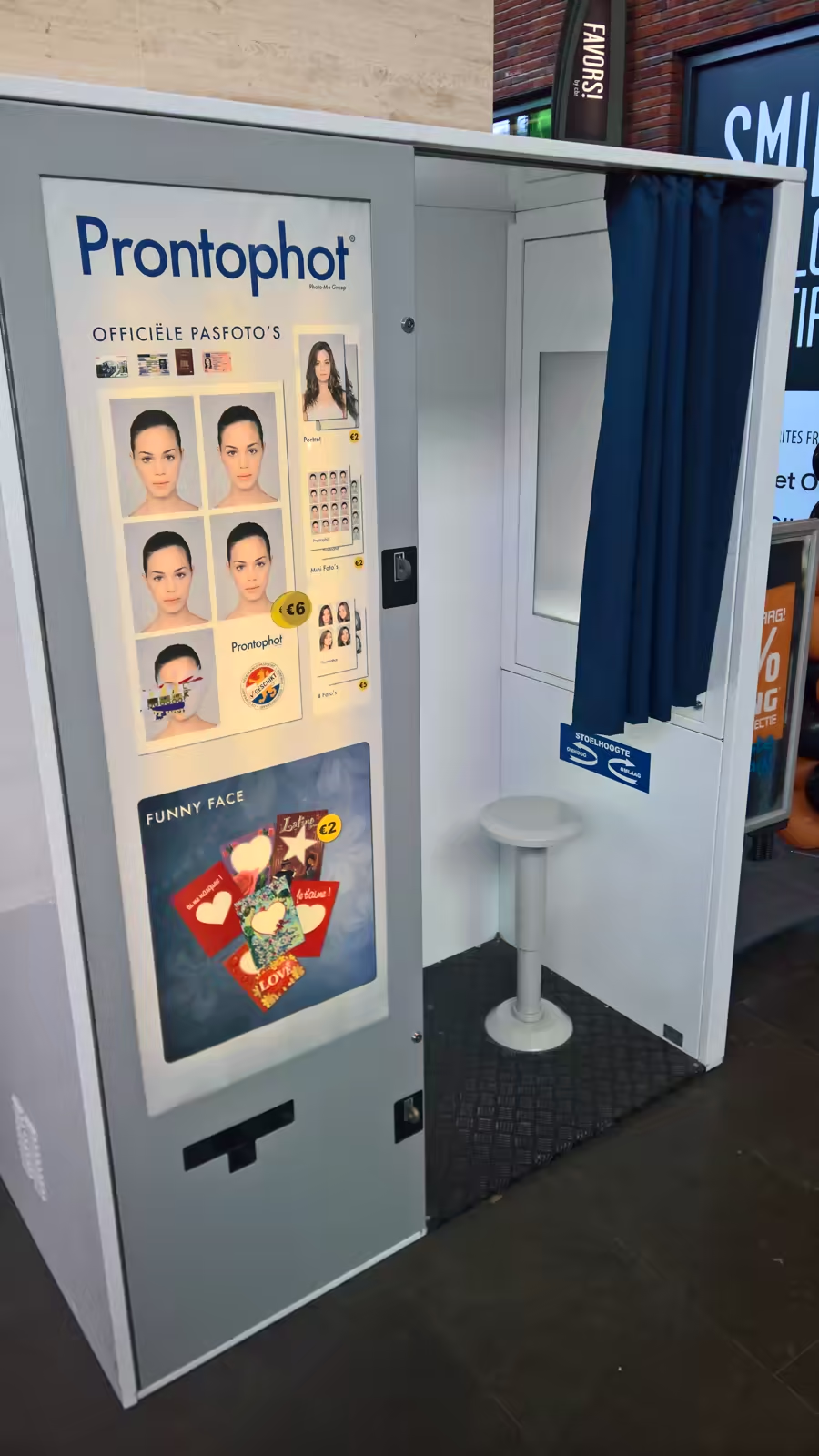
If you’re doing this last-minute, a dedicated photo booth (Fotoautomat) can work—just make sure the booth output still matches the mission checklist and the ICAO framing guidance.
If you want an application-style “sanity check” on your full document pack (photos included), Vidicy’s workflow is built for pre-submission QA across your evidence set, not just a single file. Start with the Schengen Visa Checklist: Documents You Need in 2026, then compare the photo-specific rules in the Schengen Visa Photo Requirements (2026): Size, Rules, Examples. If you want Vidicy to keep everything organized in one place, create a free account and upload your checklist documents before you book your appointment.
The video above is published by TLScontact (a visa application services provider used by multiple governments). Use it for an overview of the flow, then rely on the official sources below for photo specifications and legal requirements.
Related guides
If you're building the rest of the application pack, these companion guides help:
- Schengen Visa Photo Requirements (2026): Size, Rules, Examples
- Visa photo requirements (2026): size, pixels, background
- Schengen Visa Checklist: Documents You Need in 2026
- Documents Required for German Visa: 2026 Checklist
Official sources
- Applying for a Schengen visa — European Commission
- ICAO photograph guidelines (PDF) — via European Commission
- German Embassy Jakarta — Schengen Visa (Visitor) checklist
FAQ
What size photo is required for a German visa?
For many Germany Schengen visa applications, German mission checklists specify 3.5 × 4.5 cm (35 × 45 mm). Always confirm the checklist for your jurisdiction, then align the composition to ICAO guidance. (German Embassy Jakarta — Schengen Visa (Visitor), EU Schengen visa overview)
How recent does the photo need to be?
A common requirement on German mission checklists is that the photo must be not older than 6 months (i.e., recent enough to match your current appearance). (German Embassy Jakarta — Schengen Visa (Visitor))
What background color is acceptable?
Many German mission checklists specify white or light grey backgrounds. In practice, “plain + evenly lit” matters more than the exact shade—avoid shadows, gradients, and textured walls. (German Embassy Jakarta — Schengen Visa (Visitor))
Do Schengen visa photos have to follow ICAO rules?
Yes—at the EU level, the Schengen visa application requirements specify that your photo must be in compliance with ICAO standards, and the European Commission provides a direct link to the ICAO guideline document. (EU Schengen visa overview, ICAO photograph guidelines PDF)
How much does a Schengen visa cost, and how long does processing take?
According to the European Commission’s Schengen visa guidance, the visa fee is €90 for adults and the normal processing time is 15 days, which can be extended up to 45 days in certain cases. (These figures can change, so re-check before you submit.) (Applying for a Schengen visa — European Commission)
Conclusion
To meet German visa photo requirements for a typical Germany Schengen visa application, you’re aiming for a 35×45 mm biometric photo, on a white/light grey background, taken in the last 6 months, and composed to ICAO standards.
Before you submit, use the official checklist for your mission and sanity-check your framing against the EU-linked ICAO guideline.
If you want a last-mile review of your full application evidence (not just the photo), start with the Schengen Visa Checklist: Documents You Need in 2026 and then compare the broader Schengen Visa Photo Requirements (2026): Size, Rules, Examples. You can also reduce overall refusal risk by following Why Visa Applications Get Rejected: 7 Document Mistakes before you upload anything.